



Uncategorized
As Political Lines Blur, Republican Jewish Coalition’s Matt Brooks Warns of a Deeper Shift Facing American Jews

Matt Brooks, CEO of the Republican Jewish Coalition, holds a kippah in support of former US President and Republican presidential candidate Donald Trump as he speaks on Day 2 of the Republican National Convention, at the Fiserv Forum in Milwaukee, Wisconsin, US, July 16, 2024. Photo: REUTERS/Mike Segar
At some point, the question stops being which political party you belong to — and becomes what, exactly, you believe that party stands for.
That was the underlying tension in a recent conversation with Republican Jewish Coalition CEO Matt Brooks, who offered a stark assessment of the changing political landscape for American Jews: the erosion of bipartisan support for Israel, the reemergence of antisemitism across ideological lines, and a growing sense that long-held assumptions about political alignment no longer cleanly apply.
For decades, support for Israel functioned as one of the few durable points of agreement in American public life. It transcended party, survived shifts in leadership, and provided a kind of baseline continuity in an otherwise volatile political system. That consensus, Brooks suggested, has now meaningfully weakened.
“There is only one pro-Israel party today,” he said on The Algemeiner‘s “J100” podcast. “And that’s the Republican Party.”
It is, in his telling, less a triumph than a warning — a sign that what was once shared ground has become contested terrain.
The shift did not happen overnight. Brooks, who has spent nearly four decades at the intersection of Jewish communal life and Republican politics, described a long internal effort to strengthen pro-Israel sentiment within the GOP — one that has, by his account, succeeded.
What concerns him now is not where the Republican Party has landed, but where parts of the Democratic Party have moved.
Yet the more unsettling dynamic, he argued, is not confined to partisan drift. It is structural.
Invoking the “horseshoe theory,” Brooks pointed to a phenomenon that has become increasingly difficult to ignore: the convergence of the political extremes. While the far left and far right often present themselves as opposites, he argued, their rhetoric — particularly when it comes to Jews — can begin to mirror itself in striking ways.
“The language may be different,” Brooks said, “but the themes are familiar.”
On one end, Jews are cast as agents of capitalism, landlords, or power brokers within systems of inequality. On the other, they are portrayed as shadowy manipulators of media, finance, or political institutions. The ideological framing shifts. The underlying instinct does not.
That convergence, he warned, creates a more diffuse and unpredictable threat environment — one in which antisemitism is no longer easily located or dismissed as belonging to a single fringe.
The implications of these changes, Brooks suggested, extend into the political behavior of American Jews more broadly.
For much of the modern era, Jewish voting patterns have been closely tied to identity, history, and inherited political affiliation. But Brooks indicated that those patterns may be undergoing a quiet but significant recalibration — one driven less by ideology than by a more immediate question: security.
“It’s not about who you like,” he said. “It’s about who you trust to keep you safe.”
That framing, he noted, has proven especially resonant in recent election cycles, where data-driven outreach efforts have shown that concerns about personal safety, antisemitism, and the security of Israel can outweigh longstanding partisan loyalties — particularly among undecided voters.
It is, in many ways, a shift from expressive politics to consequential politics — from signaling identity to assessing risk.
And yet, for all the instability he described, Brooks did not frame the moment as one of inevitable decline.
On the contrary, he returned repeatedly to the idea of resilience — not as a slogan, but as a historical pattern.
“We’ve faced adversity before,” he said. “We’re a resilient people.”
That resilience, in his view, is what underwrites his long-term optimism about American Jewry.
Still, optimism, as Brooks articulated it, is not the same as comfort. It is contingent. It requires recognition — of shifting alliances, of emerging threats, and of the limits of assumptions that may no longer hold.
The deeper question raised by his analysis is not simply which party is more aligned with Jewish interests at a given moment. It is whether the framework through which those interests have historically been understood — bipartisan consensus, stable coalitions, predictable boundaries — is itself in the process of being rewritten.
If so, then the challenge facing American Jews is not only political, but conceptual. It is to understand where they stand in a landscape that is less fixed than it once was — and to decide, with greater clarity and less nostalgia, what matters most when the ground begins to shift.
Uncategorized
Interviews with Holocaust survivors reveal the richness of Yiddish
Many people today prize the Yiddish of native speakers who grew up in Eastern Europe before World War II, viewing it as a mark of linguistic authenticity.
As a language of daily life that millions of Jews spoke in a range of regional dialects, Yiddish had, over the centuries, become enriched with many words and idioms that were unique to a specific location.
More than 80 years after the end of the Holocaust, very few of those speakers are still around. As a result, the Yiddish they spoke is deemed precious. Thanks to a new online resource, in which dozens of Holocaust survivors talk about their lives before, during and after the war, anyone can now hear the language of that bygone era.
There are already a number of resources that document the Yiddish of these native speakers. Among the earliest examples are 28 audio recordings made by David Boder, a psychologist who traveled from the United States to Europe in 1946 to interview Holocaust survivors. He asked them about their wartime experiences in nine different languages, including Yiddish.
Another valuable source for hearing native Yiddish speakers is the Language and Cultural Atlas of Ashkenazic Jewry (LCAAJ). In the late 1950s, linguist Uriel Weinreich launched this project, based at Columbia University, to study Yiddish dialects and folklore. Weinreich and his colleagues taped responses from over 600 European-born Yiddish speakers to a detailed survey of their language, with over 3,000 individual questions, as in, for example: “What games did you play as a child?”
One of the largest number of recordings of these Yiddish speakers can be found in the Shoah Foundation’s Visual History Archive (VHA), launched in 1994. Based at the University of Southern California, the VHA holds almost 50,000 video interviews with Holocaust survivors. Among these recordings, which were conducted in 32 different languages, are more than 600 entirely or partially in Yiddish. Until recently, only people who had access to the VHA, mostly through university libraries, were able to listen to this trove of Yiddish speakers as they relate their life histories. Thanks to a new online resource, known as the Corpus of Spoken Yiddish in Europe (CSYE), anyone can now hear these interviews.
The CSYE is the brainchild of Yiddish sociolinguist Isaac Bleaman who first worked with the VHA’s Yiddish interviews for his doctoral dissertation, where he compared the Yiddish spoken in the 2010s by Hasidim and Yiddishists. Through these recordings, Bleaman was able to explore how these two contemporary forms of Yiddish developed.
After joining the faculty at Berkeley, Bleaman sought a way to make the VHA’s Yiddish interviews more accessible to both linguists and students learning the language. Eventually, he received permission from the Shoah Foundation to use some 200 of its Yiddish videos for this purpose, and in 2022 he was awarded a multiyear grant from the National Science Foundation to establish the CSYE.
Creating this online resource entails manually transcribing the interviews, which are rendered both in transliteration and in the Yiddish alphabet. This is a painstaking process that relies on skilled speakers of Yiddish as well as other languages that the survivors may have included in the interviews. The transcripts, when synced with the videos, enable users of the CSYE to search the interviews for specific terms and topics.
A database on the CSYE lists each survivor’s name, city of birth, gender, age and dialect of Yiddish (Central, Northeastern, or Southeastern). The website also features an interactive map, showing the location of each survivor’s hometown, grouped by dialect. A different map shows where the VHA interviews were recorded in the 1990s. Ranging across Europe, the Americas, Australia and Israel, they reflect the scope of the postwar Yiddish-speaking diaspora.
In this Yiddish interview, for example, Holocaust survivor Lazar Milamed talks about his childhood in a Ukrainian village, his experiences under the Nazis and his post-war life in Brooklyn.
The CSYE also offers an interactive page that enables users to generate their own word maps to explore the geographic range of words or patterns of speech.
To demonstrate how the CSYE can be used for linguistic research and for language learning, the website provides instruction on pronunciation, as well as examples of the East European Yiddish dialects (for example, which of the interviewees said nit for the word “not” vs. those who said nisht). To date, 171 interviews, totaling more than 300 hours, have been transcribed. When this process is completed, the CSYE explains on its website, it will provide public access to “the most extensive source of conversational Yiddish ever compiled,” which will “bring the voices and narratives of native Yiddish speakers into the classroom.”
For the Yiddish student, teacher and researcher, or anyone else who loves the language, the CSYE is an extraordinary resource. Listening to survivors recount their life histories is compelling, both for the experiences they recall and for the cherished language in which they speak.
The post Interviews with Holocaust survivors reveal the richness of Yiddish appeared first on The Forward.
Uncategorized
Trump Says US May Strike Iran Again but That Tehran Wants Deal
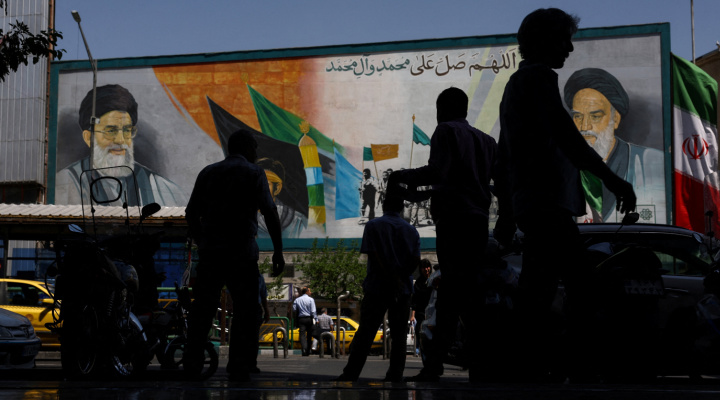
People walk past a mural depicting the late leader of the Islamic Revolution, Ayatollah Ruhollah Khomeini, and the late Iran’s Supreme Leader Ayatollah Ali Khamenei, in Tehran, Iran. Photo: Majid Asgaripour/WANA (West Asia News Agency) via REUTERS
President Donald Trump said on Tuesday that the United States may need to strike Iran again and that he had been an hour away from ordering an attack before postponing it.
Trump made the comments a day after saying he had paused a planned resumption of hostilities following a new proposal by Tehran to end the US-Israeli war.
“I was an hour away from making the decision to go today,” Trump told reporters at the White House on Tuesday.
Iran‘s leaders are begging for a deal, he said, adding that a new US attack would happen in coming days if no agreement was reached.
The United States has been struggling to end the war it began with Israel nearly three months ago. Trump has previously said that a deal with Tehran was close, and similarly threatened heavy strikes on Iran if it did not reach an accord.
The US president is under intense political pressure at home to reach an accord that would reopen the Strait of Hormuz – a key route for global supplies of oil and other commodities. Gas prices remain high and Trump‘s approval rating has plummeted as congressional elections loom in November.
Oil prices settled lower on Tuesday after Vice President JD Vance said Washington and Tehran had made a lot of progress in talks and neither side wanted to see a resumption of the military campaign. “We’re in a pretty good spot here,” he said.
Speaking to reporters at a White House briefing, Vance acknowledged difficulties in negotiating with a fractured Iranian leadership. “It’s not sometimes totally clear what the negotiating position of the team is,” he said, so the US is trying to make its own red lines clear.
He also said one objective of Trump‘s policy is to prevent a nuclear arms race from spreading in the region.
IRAN PROMISES RESPONSE TO ANY NEW ATTACK
In Tehran, Ebrahim Azizi, head of the Iranian parliament’s national security committee, said on X that pausing an attack was due to Trump‘s realization that any move against Iran would mean “facing a decisive military response.”
Iranian state media said Tehran‘s latest peace proposal involves ending hostilities on all fronts including Lebanon, the exit of US forces from areas close to Iran, and reparations for destruction caused by the US-Israeli attacks.
Tehran also sought the lifting of sanctions, release of frozen funds, and an end to the US marine blockade, according to Deputy Foreign Minister Kazem Gharibabadi as cited by IRNA news agency.
The terms as described in the Iranian reports appeared little changed from Iran‘s previous offer, which Trump rejected last week as “garbage.”
BOTH SIDES ‘CHANGING GOALPOSTS,’ SAYS PAKISTANI SOURCE
Reuters could not determine whether military preparations had been made for strikes that would mark a renewal of the war Trump started in late February.
Trump said on Monday that Washington would be satisfied if it could reach an agreement that prevented Tehran from obtaining a nuclear weapon.
A Pakistani source confirmed that Islamabad, which has conveyed messages between the sides since hosting the only round of peace talks last month, had shared the Iranian proposal with Washington.
The sides “keep changing their goalposts,” the Pakistani source said, adding, “We don’t have much time.”
CEASEFIRE MOSTLY HOLDING
The US-Israeli bombing killed thousands of people in Iran before it was suspended in a ceasefire in early April. Israel has killed thousands more and driven hundreds of thousands from their homes in Lebanon, which it invaded in pursuit of the Iran-backed Hezbollah terrorist group.
Iranian strikes on Israel and neighboring Gulf states have killed dozens of people.
The Iran ceasefire has mostly held, although drones have lately been launched from Iraq towards Gulf countries, including Saudi Arabia and Kuwait, apparently by Iran and its allies.
The US seized an Iran-linked oil tanker in the Indian Ocean overnight, the Wall Street Journal reported on Tuesday, citing three US officials. The tanker, known as the Skywave, was sanctioned by the US in March for its role in transporting Iranian oil, the report said.
Trump and Israeli Prime Minister Benjamin Netanyahu said they launched the war to curb Iran‘s support for regional militias, dismantle its nuclear program, destroy its missile capabilities, and create conditions for Iranians to topple their rulers.
But the war has yet to deprive Iran of its stockpile of near-weapons-grade enriched uranium or its ability to threaten neighbors with missiles, drones, and proxy militias.
The Islamic Republic’s clerical leadership, which had faced a mass uprising at the start of the year, withstood the superpower onslaught with no sign of organized opposition.
Uncategorized
Somaliland Says It Will Open an Embassy in Jerusalem, Israel to Reciprocate

Israeli Foreign Minister Gideon Saar meets with Somaliland President Abdirahman Mohamed Abdullahi on Jan. 6, 2026. Photo: Screenshot
Somaliland, a self-declared republic in East Africa, will set up an embassy in Jerusalem soon, its ambassador said on Tuesday, after Israel became the first country to formally recognize it as an independent and sovereign state.
In turn, Israel is expected to set up an embassy in Somaliland‘s capital Hargeisa, Ambassador Mohamed Hagi said in a post on X.
Somaliland, which has claimed independence for decades but remains largely unrecognized, is situated on the southern coast of the Gulf of Aden and bordered by Djibouti to the northwest, Ethiopia to the south and west, and Somalia to the south and east. It has sought to break off from Somalia since 1991 and utilized its own passports, currency, military, and law enforcement.
Unlike most states in its region, Somaliland has relative security, regular elections, and a degree of political stability.
Last month, Israel appointed Michael Lotem as its first ambassador to Somaliland, after the two governments formally established full diplomatic relations.
Lotem, who was serving as a non-resident economic ambassador to Africa at the time of his appointment, will now shift to work as a non-resident ambassador to Somaliland. He previously served as Israel’s ambassador to Kenya, Uganda, Tanzania, Malawi, and Seychelles, a position he concluded in August.
Israel recognized Somaliland as an independent and sovereign state in December, a move Somalia rejected and termed a “deliberate attack” on its sovereignty.
Over the years, Somalia has rallied international actors against any country recognizing Somaliland.
The former British protectorate hopes that recognition by Israel will encourage other nations to follow suit, increasing its diplomatic heft and access to international markets.
Israel‘s Foreign Minister Gideon Saar said on Tuesday that the opening of the embassy in Jerusalem would be another significant step in strengthening relations with Somaliland. Once opened, the Somaliland embassy would be the eighth embassy in Jerusalem, he said.
Most countries maintain their embassies in Israel in Tel Aviv, although the United States moved its embassy to Jerusalem during President Donald Trump’s first administration. Fiji, Papua New Guinea, and a small number of other countries have also established embassies there.
Israel considers all of Jerusalem to be its capital. However, Palestinians seek East Jerusalem, where the holiest sites in Judaism are located, as the capital of a future state.