


Uncategorized
At this interfaith calligraphy class, the lines between Jew and Muslim blur
“So…are you Middle Eastern?”
I had just walked into the American Sephardi Federation office in lower Manhattan, where 20 Muslim and Jewish young people gather twice a month to learn Arabic and Hebrew calligraphy together. I was clearly the newbie, and one of the participants was sussing me out.
“I am,” I replied.
“Fully?” he asked.
I gave my usual spiel, explaining my Iraqi and Iranian background.
“Sick,” he said. “I’m only half.”
It struck me then that neither of us had any idea whether the other was Muslim or Jewish.
As I broke bread with the group, we chatted over an odd but familiar spread of kosher pizza and Gojeh Sabz, golf-ball-sized and very tart plums – a common Middle Eastern fruit many of us grew up eating. Somehow, religion didn’t really come up.
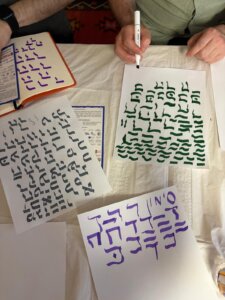
Eventually, felt-tipped multicolored calligraphy pens were passed around, and we began learning to write Hebrew letters — letters I had been perfecting since I embarked on my Hebrew School journey as a fourth grader. I was terrible. My reyshes weren’t swooping as they should, my khafs were somehow uneven and my yuds looked suspiciously like daleds.
Across the table, a young man who had introduced himself to me minutes before as Mohamad from Saudi Arabia had effortlessly filled the page with elegant Hebrew letters. He noticed my frustration. “Don’t worry,” he said. “I’ve done this like a million times. You’ll get it.” 
The person at the helm of this unusual form of interfaith exchange is Ruben Shimonov, a 39-year-old Sephardic polymath. I first discovered Ruben’s work when I saw an exhibit of his calligraphy blending Hebrew, Arabic and Farsi at the Museum of Jewish Heritage. I assumed he was a full-time artist, but soon learned that his main gig is serving as an educator and interfaith organizer. He mentors dozens of Sephardic college students, hosts LGBTQ+ Sephardic Shabbats. Now, he leads Sacred Scripts in NYC, a new six-month-long cohort-based interfaith calligraphy fellowship where Jewish and Muslim community leaders learn the intertwined history and etymology of Hebrew and Arabic.
Shimonov was born in Uzbekistan, a Muslim-majority country. For him, that background makes interfaith work feel like an extension of his upbringing.
“As a Jew from a community whose culture was shaped by Islamic cultures and histories, it is a natural expression of my Jewish identity to be in interfaith spaces,” he told me. “It’s not something I do because it’s cool or sexy or whatever. I just feel at home, because these are my people. This is my own background.”
From a young age, he was drawn to language, inspired in equal measure by the Hebrew letters he learned for his bar mitzvah and the Arabic script that adorned the mosques and architecture of his hometown.
Eventually, he taught himself calligraphy in three languages and came to see it as a powerful tool for the interfaith work he was already doing — organizing gatherings such as iftars in synagogues and seders in mosques through the Muslim Jewish Solidarity Committee. Over the past decade, Shimonov has led more than 100 interfaith calligraphy workshops around the world, highlighting the deep historical and linguistic connections between Hebrew and Arabic.
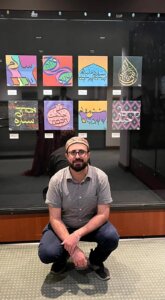
This year, Shimonov launched Sacred Scripts alongside his longtime partners at the Muslim American Leadership Alliance (MALA), drawing fellows from networks he and MALA have built over the years. The program brings together young artists and community leaders — many with Middle Eastern backgrounds — who they feel stand to benefit from sustained engagement. Over the course of six months, fellows study calligraphy and the histories of the languages, while connecting over shared meals and cultural outings. This month, they are attending a concert focused on Jewish and Muslim music from the Maghreb.
After Oct. 7, Shimonov said, he witnessed fractures between many Jewish and Muslim organizations that had been working together on interfaith initiatives. “That sense of betrayal and hurt was very real,” he said. “But if the only times you meet are when things are bad, what do you expect? I think the secret sauce to all this stuff is you’ve got to be in it for the long haul.”
The Sephardic connection
During each session, we practice writing while Shimonov lectures on the connections between the two languages. Shiminov gives each language its due, devoting several sessions to studying each before bringing them together.
Eventually, we learn the same words in Hebrew and Arabic — beit and bayt for home, Shabbat and al-sabt for Saturday — the list goes on. Before tackling day one of learning the Arabic alphabet, we practiced writing the phrase Bismillah ir-Rahman ir-Rahim, which appears at the beginning of every surah in the Quran, into Hebrew. Translated word-for-word, it sounds remarkably similar.
For Shimonov, that overlap is the point. He believes strongly that Sephardic and Mizrahi Jews occupy a unique place in interfaith work because of the seemingly endless cultural similarities they share with Muslims from the Middle East and North Africa.
That sensibility is reflected in the space itself. The fellowship is hosted at the American Sephardi Federation, a Jewish institution that looks more like a place to sip chai and do a close reading of Rumi’s greatest hits. The floors are covered with embroidered rugs, the walls are lined with ouds, a pear-shaped Middle Eastern instrument, and endless shelves are packed with rare books in Hebrew, Arabic and Farsi.

Because of these connections, the days focused on Arabic study are more Jew-y than one might expect. Shimonov takes care to highlight Jewish history in the Middle East, explaining how Iraq — not Europe — was the world’s foremost hub of Jewish life for centuries, where many Jews only spoke Arabic because Hebrew wasn’t widely taught, and presenting pivotal Jewish texts written in Judeo-Arabic.
In Shimonov’s Sephardic approach, the aim is less to “build bridges” — a phrase that has become a catch-all interfaith mantra — than to reveal how much was never separate to begin with.
Ali Saracoglu, a Muslim participant in the fellowship and an artist from Izmir, Turkey, said Sacred Scripts reshaped his understanding of Jewish identity.
When he moved to the United States, his primary exposure had been to Ashkenazi Jewish communities. “When you open the conversation to Sephardi and Mizrahi Jews, you encounter people from Uzbekistan to North Africa to descendants of communities from Spain,” he said. “You start to see a much more global form of Judaism.”
Saracoglu joked that within the group, it was often impossible to tell who was Jewish and who was Muslim unless it came up in conversation.
Nora Monasheri, a 23-year-old Iranian Jew, said that after Oct. 7, she had participated in countless interfaith dialogues at her alma mater, Binghamton University. “I felt like I’d been there, done that on campus,” she said, lamenting that such gatherers were “always very focused on Israel and Palestine, and it felt very forced.”
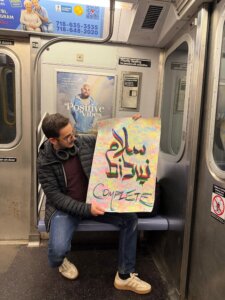
For her, creating calligraphy rather than debating peace agreements from the ’90s is a welcome change.
“I found that some of our most important words in Hebrew are the same in Arabic — faith, charity, blood — So instead of debating each other, we’re discovering this shared history, tradition, and spirituality together.”
For Saracoglu, the program’s artistic aspect is particularly powerful. He first met Shimonov at a one-off interfaith calligraphy workshop two years ago, an experience that stayed with him as an artist. He has been creating ebru, the traditional Turkish art of marbling, since the age of five, and now practices it in his New York City apartment. In a recent series he calls “One Word: Peace,” he layers his marbled designs with calligraphy by both Jewish and Muslim artists — often including Shimonov himself.
During one session, Shimonov read aloud from a Judeo-Arabic translation of the Torah, explaining that many Jews in the Arab world historically translated religious texts into Arabic because many did not understand Hebrew. The word for God was therefore transcribed as the Arabic word, Allah.
I chimed in that my own Jewish parents say “Inshallah” all the time when they simply mean “God willing.” My non-Sephardic friends always found this bizarre, but among this crowd, it barely required explanation.
As he read from the Torah, one Muslim fellow suddenly interrupted.
“It sounds like the Quran!”
The post At this interfaith calligraphy class, the lines between Jew and Muslim blur appeared first on The Forward.
Uncategorized
At a Georgetown College Republicans event, member of Germany’s far-right party tells students the Holocaust is ‘used as a weapon’
Marc Bernhard, a member of Germany’s far-right AfD party, told Georgetown students Monday night at an event hosted by the university’s College Republicans that the Holocaust is “used as a weapon against Germany.”
The Forward obtained recordings of parts of the event, which was billed as Bernhard presenting about “mass migration and the future of the West.”
The event followed the AfD’s historic victory in a German state election last month, with party leaders campaigning on the promise of mass deportations and a rejection of the country’s culture of Holocaust remembrance.
During the Q&A period, an audience member asked Bernhard about the AfD’s “opinion on the Holocaust.”
“Our opinion? It’s a very, very large party,” Bernhard responded.
“Do you think German education overcompensates or you know, like, overapologizes?” the audience member followed up.
Bernhard said that over the last decade, accusations of Nazism had become “inflationary, because everyone who does not have the opinion of the government is a Nazi. So nobody takes this serious anymore, because it’s a joke.”
The “Holocaust is also used as a weapon against Germany,” Bernhard told the crowd of about 40. “Why is Poland telling us we need to pay reparations and things like this?”
He blamed anti-Jewish sentiment on “anti-fascists,” saying left-wing antisemitism was “why a lot of Jews leave Germany or a lot of Jews leave France, because they don’t feel secure anymore, especially in Berlin.”
Bernhard, meanwhile, has faced an antisemitism controversy of his own. Last January, he led a campaign to place tens of thousands of fake deportation plane tickets in voters’ mailboxes. The fake tickets read “ILLEGAL IMMIGRANT” in place of a passenger’s name.
The campaign drew comparisons to Nazi-era propaganda that used mock travel documents to encourage Jews to leave Germany, including one that read “free ticket to Jerusalem … never to return.”
Asked about the parallels by PBS FRONTLINE in November 2025, Bernhard said he was unaware of that history.
“Yeah, well, I’m not familiar with these actions,” Bernhard told FRONTLINE at the time. “To be honest, I don’t know them, nor was I aware of them.”
In a statement provided to the Forward, Georgetown College Republicans stood by its invitation to Bernhard, writing that “The AfD is currently leading national polls, and its growing support deserves serious engagement. Just as Republicans reject the American left’s efforts to dismiss our positions as extreme, we too reject the German Socialist Government’s labelling of AfD as extremist.”
The club added that “allegations of antisemitism are totally baseless.”
This wasn’t the first time Georgetown College Republicans hosted a member of the AfD: In 2025, the club hosted the party’s deputy leader, Markus Frohnmai.
The club also drew controversy in March for an X post from the club’s account saying “Let’s Be Honest: Muslims have no place in American society. Their religion is incompatible with our Christian Nation.” Georgetown Republicans said on Instagram that the post was “inconsistent with the values of our organization” and “promptly deleted.”
At Georgetown, Bernhard also engaged in anti-Muslim rhetoric: “We have this problem with people who are not with our culture or with our tradition,” Bernhard said. “Always, where you see problems it’s with Muslims. We don’t have problems with Ukrainians. We don’t have problems with Polish.”
Bernhard’s remarks drew frequent interruptions. The Georgetown Voice, the campus student-run magazine, reported that members of The Georgetown Heckler, Georgetown’s satirical publication, staged a coordinated ringtone prank, with 15 people each setting their ringtones to “funny noises” that went off as Bernhard spoke.
The Jewish Caucus of the College Democrats of America and Georgetown College Democrats also issued a joint statement condemning the College Republican’s decision to host Bernhard.
“We want Georgetown to put the safety of Jewish students above a platform for a foreign politician whose ideology is steeped in antisemitism and Holocaust revisionism,” Leo Auerbach, a senior at Georgetown and vice chair of the Jewish Caucus of College Democrats, told the Forward. “I think that antisemitism has to be called out, no matter who it comes from, whether it’s politically convenient or not.”
The post At a Georgetown College Republicans event, member of Germany’s far-right party tells students the Holocaust is ‘used as a weapon’ appeared first on The Forward.
Uncategorized
In Israel’s elections, where are the women?

On Oct. 27, Israelis will go to the polls at one of the most consequential moments in the country’s history. After years of war, trauma and political division, the next Knesset and government will face decisions that will shape Israel’s future for years to come.
But one question deserves significant attention: Where are the women?
Israel has long celebrated its history of women’s leadership. Golda Meir became one of the world’s first women prime ministers. Generations of Israeli women have built institutions, led social movements and fought to advance equality and democracy.
Yet despite this history, women have never achieved equal representation in Israel’s highest political institutions. Their representation has declined in key positions, and when Israel formed its war cabinet following Oct. 7, 2023, no women were included in its core membership. Women have also remained significantly underrepresented in high-level diplomatic and totally absent in peace negotiations.
For example, the senior Israeli delegation to the hostage deal negotiations in Doha in January 2025 consisted of four men, with no women among its publicly identified members. Similarly, men dominated the leadership of diplomatic negotiations concerning arrangements in Lebanon and coordination meetings regarding Iran’s nuclear program.
The numbers tell an important story.
According to a March 2026 analysis by the Israel Democracy Institute, only 31 of Israel’s 120 Knesset members were women—approximately 26 percent, below the global average of 27.5 percent. Israel’s international ranking for women’s parliamentary representation has fallen sharply, from 61st in 2022 to 92nd out of 181 countries in April 2026.
Women held just five of 24 cabinet positions, fewer than 21 percent, a substantial decline from the previous government, when women occupied approximately one-third of ministerial positions.
For more than 17 years, no woman has held any of Israel’s four most senior political positions: prime minister, foreign minister, defense minister or finance minister.
The disparity extends beyond elected office. A Knesset research report found that women accounted for 64 percent of Israel’s civil servants in 2024, yet held only 9 percent of the highest-ranking positions.
These figures are particularly troubling because, throughout Israel’s recent crises, women have demonstrated their indispensable leadership.
Since the Oct. 7 Hamas attacks on Israel, women have mobilized emergency responses, supported displaced families and kept civil society organizations functioning under extraordinary circumstances. Many have done so while confronting fear, grief and uncertainty in their own families.
Women who lead nonprofit organizations, advocacy movements and social-change initiatives develop expertise directly relevant to government. They understand how policies affect people, how institutions function, how to mobilize resources and how to bring communities together around shared challenges.
These are precisely the skills needed in public leadership.
But at the very moment Israel has depended on women’s leadership, women have had too little influence over the decisions shaping its future.
Israel’s electoral system places considerable importance on the composition of political party lists. Voters choose parties, and the placement of candidates on those lists affects who ultimately enters the Knesset. Some parties have adopted gender-balanced lists, while others have included far fewer women in positions with realistic prospects of election.
Efforts are emerging to change that. Seventeen women make up a majority of the slate for Beyachad (Together) — the merger of Naftali Bennett’s previously unnamed faction with Yair Lapid’s Yesh Atid. Meanwhile, even though ultra-Orthodox parties do not allow women to be their candidates to the Knesset, a new party called Haredi Public has included two women on their slate.
Two women whose candidacies have been particularly meaningful to me are Moran Zer Katzenstein and Moria Rodal Silfen, whose leadership I have had the privilege of witnessing firsthand through The Collective, Elluminate’s leadership advancement program. Through a Jewish and feminist lens, we invest in, train, connect and elevate women leaders advancing social change. Both women have demonstrated extraordinary courage and leadership in confronting some of Israel’s most pressing challenges.
Katzenstein, founder of Bonot Alternativa, a nonpartisan women’s organization advocating for women’s rights and

democracy, is running with The Democrats, led by Yair Golan. Her organization gained international recognition in 2023 when women dressed in the iconic red robes and white bonnets of The Handmaid’s Tale staged silent protests against Israel’s judicial reforms, becoming a powerful symbol of the pro-democracy movement.
Silfen, CEO of the Task Force on Human Trafficking and Prostitution (TFHT), was running with Benny Gantz’s Blue and White party until his decision Monday to withdraw from the race. For more than a decade, Silfen has led efforts to combat human trafficking and sexual exploitation in Israel, advancing legislative reforms and protections for vulnerable women.
Both women have been pursuing different political paths, but their candidacies illustrate a shared truth: Israel has an extraordinary reservoir of experienced women leaders ready to bring their expertise from civil society into national decision-making.

Their candidacies demonstrate what becomes possible when women move from influencing public policy through civil society to seeking a direct role in making it. But the issue goes beyond numbers on a ballot.
Representation matters because who participates in decision-making influences which experiences are heard, which questions are asked, which problems receive attention and which solutions are considered.
Consider the challenges Israel faces: rebuilding communities devastated by war, responding to trauma, strengthening democratic institutions, addressing economic pressures, supporting families and restoring trust across a deeply divided society.
Women bring essential expertise to every one of these challenges—as professionals, public servants, community leaders, researchers, entrepreneurs, advocates and members of families and communities affected by the war.
The goal is not simply to increase the number of women in office, but to ensure that Israel’s institutions benefit from the full range of leadership and expertise available in its society. What they need are opportunities, investment, visibility and access to the institutions where decisions are made. For this reason, we should continue to invest in women-led civil society organizations and the relationships that help them succeed.
These organizations are not peripheral to Israel’s future. They are developing solutions to pressing social challenges, supporting vulnerable populations, strengthening communities and creating opportunities for public participation. When women leaders connect across issues and sectors, they exchange expertise.
Whatever its political composition, Israel’s next government will confront enormous challenges. Meeting them will require the knowledge, experience and leadership of the entire population.
Golda Meir’s legacy should not simply be something Israel celebrates. It should remind us that women’s leadership belongs at the center of national decision-making.
The women who have sustained the state throughout years of crisis have demonstrated their capacity to lead. They should not have to prove it again.
The post In Israel’s elections, where are the women? appeared first on The Forward.
Uncategorized
Vance declines to endorse Netanyahu, a day after Trump backs prime minister
(JTA) — Vice President JD Vance has refused to endorse Prime Minister Benjamin Netanyahu, just a day after President Donald Trump announced his support for the incumbent Israeli leader.
“I’m not anti-endorsing. I’m not pro-endorsing,” Vance told journalist Mark Halperin in a Monday interview. “I’m not getting involved in the Israeli elections.”
“I endorse American candidates,” the vice president added, noting that he is focused on the U.S. midterms.
Trump declared his support for Netanyahu, who is running for reelection, in a Sunday Truth Social post in which he deemed the Israeli leader “a Great Warrior Prime Minister” and a vital partner in removing the Iranian threat. Recent polls show Netanyahu closely trailing former IDF chief-of-staff Gadi Eisenkot in the election, which will take place on Oct. 27.
Liberal Middle East policy advocates, including J Street, have blasted Trump’s decision to back Netanyahu, arguing that he’s acting against the interests of U.S. taxpayers.
While Vance declined to endorse the Israeli prime minister, he has previously involved himself in international elections. In April Vance joined Trump in backing then Prime Minister Viktor Orbán in Hungary, although that support did not end in victory.
Last year, the vice president also met with the leader of the far-right Alternative for German political party, AfD, in Munich but he did not issue an official endorsement for that candidate.
This article originally appeared on JTA.org.
The post Vance declines to endorse Netanyahu, a day after Trump backs prime minister appeared first on The Forward.
