


Uncategorized
Can Manischewitz make matzo ball soup hot again?
Last weekend, I was walking through Lower Manhattan, when I strolled past something confusing. Several women in matching baby blue leggings and puffer coats were dancing to pop music in a small park outside the Soho Apple store, surrounded by ice blocks with something — it was hard to tell what — frozen inside them. As I got closer, I realized that they were handing out some kind of greens-boosted energy drink. The set-up was a made-for-Instagram PR stunt.
The whole point of the event seemed to be to cultivate a cool Manhattanite sheen for the brand. People were taking cans of the beverage, because why not — it was free! No one, however, was hanging out and dancing with the paid promoters, who were dancing conspicuously alone. The drink, which was gross, piled up in nearby municipal trashcans. The whole thing left a sour taste in my mouth, and not just from the fake sweetener in the beverage. Do these stunts sell energy drinks? Do they sell anything at all?
These questions were front of mind when I showed up at an art exhibit at a gallery on the Lower East Side. The art show was called SOUP, and it was hosted by Manischewitz to mark the launch of, yes, a line of jarred soups.
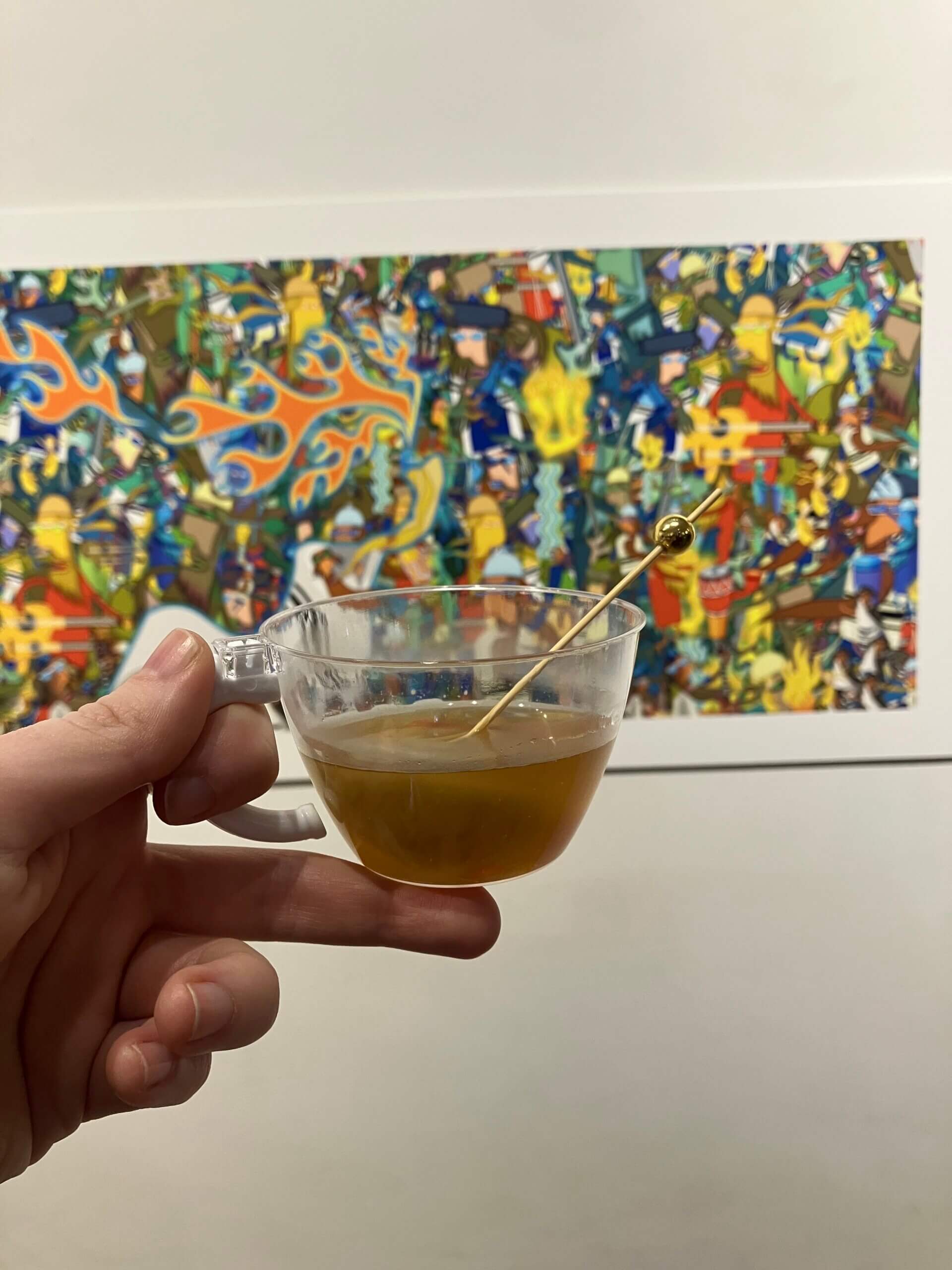
When I walked in, there was a solid crowd mingling in the gallery. Photos from Manischewitz’s newest ad campaign from Ohad Romano — a delightfully campy set of family photos featuring, of course, jars of soup — hung on one wall, opposite the soup-free work of two other Jewish artists, psychedelic scenes by Dan Weinstein and colorful objects from Rosemarie Gleiser.
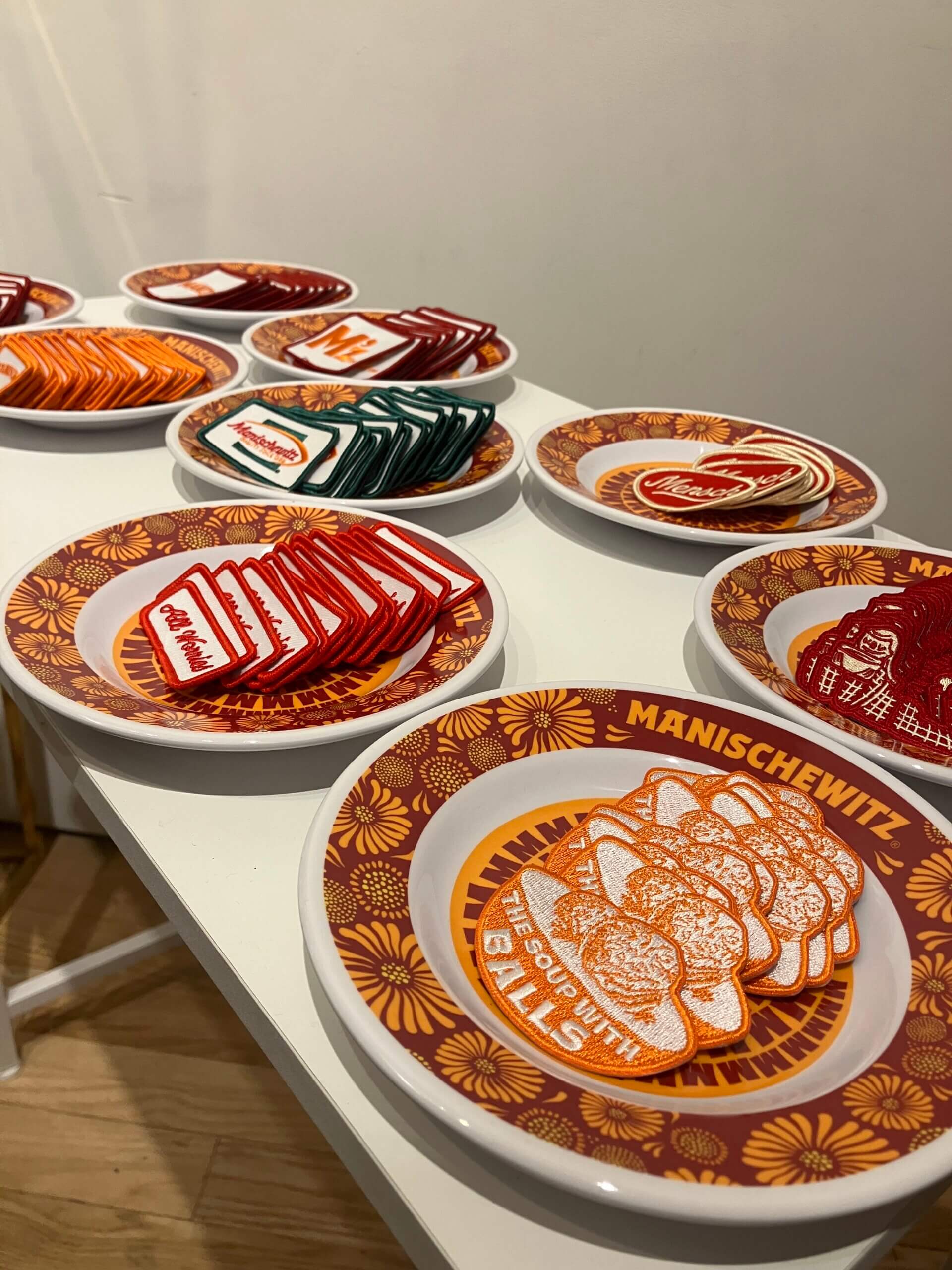
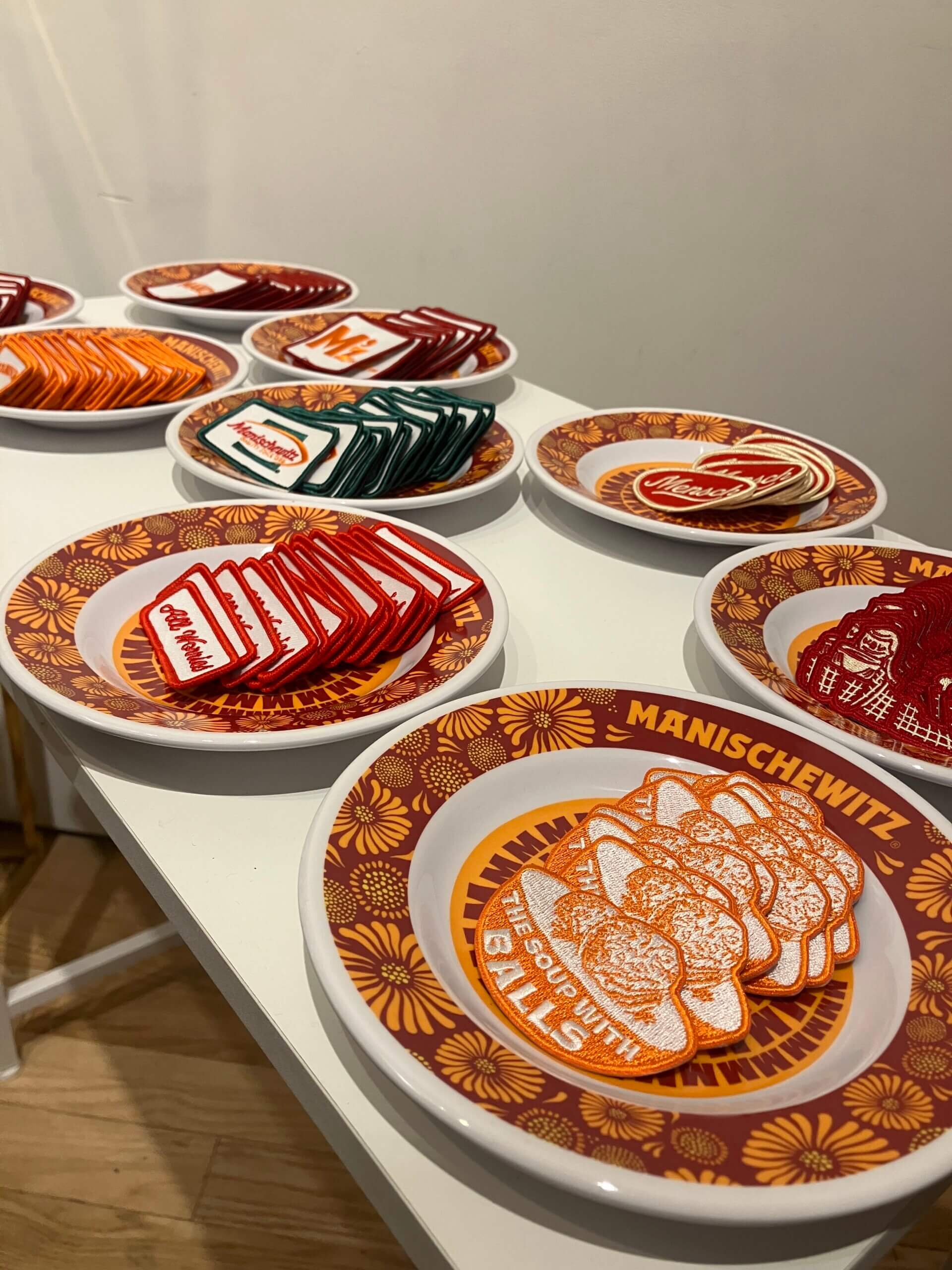
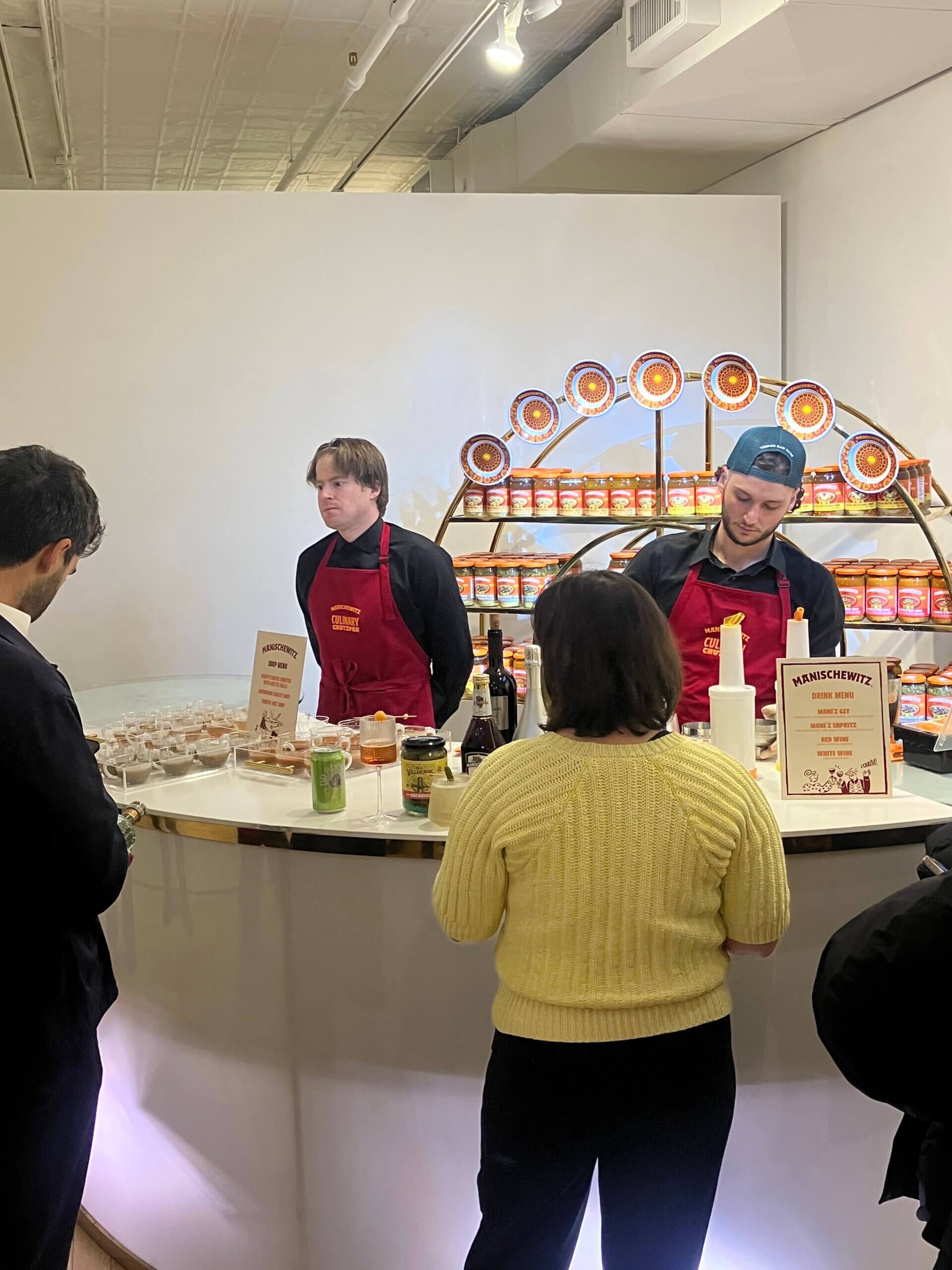
Orange-aproned waiters passed around teacups full of soup and a bartender made gin and tonics featuring Cel-Ray and spritzes with Manischewitz wine. (The wine is owned by a different company than the food products, so was unrelated to the event.) There was a line in the back room to get Manischewitz-themed patches sewn onto Manischewitz-branded hats. A baby on a woman’s hip giggled. A man in a sharp suit, cravat and kippah laughed with a group of friends as they all sipped chicken soup with matzo ball floaters.
But what did any of it have to do with actually selling soup?
Talia Sabag, a marketing manager at Manischewitz, told me that the art show was part of the rebrand that the company has been rolling out over the past few years. Their boxes of matzo went from a bookish off-white to a bright orange, with scribbled illustrations of little figures carrying bowls of soup across the box that look like they should have walked out of the Jewish Almanac. The company told The New York Times, in 2024, that the rebranding effort was to refresh the brand, but also to target a new base of “culturally curious” consumers. In short, they wanted to sell kosher products to everyone, not just Jews.
Nearly everyone at the art show’s opening, however, seemed to be Jewish. More relevantly, the show was only planned to be up for six days.
While I sipped my teacup of soup, I asked Sabag what the show was meant to achieve for the brand. At first, she stuck to the message, arguing that the show was exactly what it said it was: an art show about soup.
“We want to celebrate the interwoven ways cuisine plays a role in communicating Jewish culture to ourselves and to the world,” she said with a bright smile, all symbolized by “the warmth of soup!”
Eventually, though, we got down to it: “A lot of studies do show that Gen Z does buy products based on that coolness factor,” Sabag told me. (She mentioned Nutter Butter as an example; the cookie started posting surreal, apocalyptic memes and saw their sales spike as a result.) In the words of the Gen Z buyers the brand is trying to attract, the art show is aura farming.
But is it possible to make Manischewitz cool? The brand is so iconic, so central to American Judaism, that it almost feels like asking whether it’s possible to make Judaism itself cool. Whether or not Judaism needs help in that arena is an open question, but plenty of people and brands have been trying to boost its coolness factor, whether it’s handbag designer Susan Alexandra’s glitzy launch party for her line of Judaica or the transgressive Bushwick burlesque show, Sinner’s Shabbat.
“We want to open up the conversation to the younger generations of course,” Sabag said. “But we’re not neglecting our core audience: our bubbes.” That means balancing nostalgia and hipness.
It’s almost impossible to purposefully construct coolness; by its nature, it resists trying. Usually, trying to be cool can only backfire, like the event with the energy drink dancers.
But I have to admit: The art show was kind of cool. It nailed its aesthetic, embracing the absurdity and surrealism of a moment in which a historic, grandmotherly brand like Manischewitz would be running an aura farming event, tonally a perfect fit for an irony-pilled era. Yet it also took itself seriously in the right ways; it was, ultimately, an actual art show with Jewish artists’ work in a neighborhood with deep Jewish roots, serving historic Jewish food. It felt genuine and rooted even as it was irreverent. Every detail was thoughtful. The drinks were actually good. The soup was exactly the same as ever.
The truth is, Manischewitz’s rebrand is cool because Manischewitz has always been cool. So has Judaism.
The post Can Manischewitz make matzo ball soup hot again? appeared first on The Forward.
Uncategorized
Trump Says Gas Prices May Remain High Through November Midterm Election

U.S. President Donald Trump takes questions from reporters while Vice President JD Vance and Secretary of State Marco Rubio look on, as they attend a meeting with oil industry executives, at the White House in Washington, D.C., U.S., January 9, 2026. REUTERS/Kevin Lamarque
US President Donald Trump said on Sunday that the price of oil and gasoline may remain high through November’s midterm elections, a rare acknowledgement of the potential political fallout from his decision to attack Iran six weeks ago.
“It could be, or the same, or maybe a little bit higher, but it should be around the same,” Trump, who is in Miami for the weekend, told Fox News’ “Sunday Morning Futures With Maria Bartiromo” when asked whether the cost of oil and gas would be lower by the fall.
The average price for regular gas at US service stations has exceeded $4 per gallon for most of April, according to data from GasBuddy. Trump’s comments on Sunday came after weeks of asserting that the spike in prices is a short-term phenomenon, though his top advisers are cognizant of the war’s economic impacts, officials have said.
Earlier on Sunday, Trump announced on social media that the US Navy would blockade the Strait of Hormuz and intercept any ship that paid a crossing fee to Iran, after marathon talks between the US and Iran in Pakistan over the weekend did not yield a peace deal.
“No one who pays an illegal toll will have safe passage on the high seas,” he wrote on Truth Social.
Any US blockade is likely to add more uncertainty to the eventual resolution of the conflict, which is currently subject to a tenuous two-week ceasefire. The new tactic is in response to Iran’s own closure of the strait’s critical shipping lanes, which has caused global oil prices to skyrocket about 50%.
UNPOPULAR WAR HITS TRUMP’S APPROVAL
The war began on February 28, when the US launched a joint bombing campaign with Israel against Iran. The scope quickly expanded as Iran and its allies attacked nearby countries, while Israel targeted Hezbollah with massive strikes in Lebanon.
The war has buffeted global financial markets and caused thousands of civilian deaths, mostly in Iran and Lebanon.
Trump’s political standing at home has suffered, with polls showing the war is unpopular among most Americans, who are frustrated by rising gasoline prices.
The president’s approval rating has hit the lowest levels of his second term in office, raising concern among Republicans that his party is poised to lose control of Congress in the midterm elections. A Democratic majority in either chamber could launch investigations into the Trump administration while blocking much of his legislative agenda.
US Senator Mark Warner of Virginia, the ranking Democrat on the Senate Intelligence Committee, questioned the strategy behind Trump’s planned blockade.
“I don’t understand how blockading the strait is going to somehow push the Iranians into opening it,” he told CNN’s “State of the Union” on Sunday.
In a separate appearance on CBS’s “Face the Nation,” Warner said the blockade would not undermine Iranian control of the waterway.
“The Iranians have hundreds of speedboats where they can still mine the strait or put bombs against tankers in closing the strait,” he said. “How is that going to ever bring down gas prices?”
Although Trump has repeatedly said that the war would be over soon, Republican US Senator Ron Johnson of Wisconsin told ABC News’ “This Week” on Sunday that achieving US aims in Iran “could take a long time.”
“It’s going to be a long-term project,” said Johnson, who was not asked about Trump’s proposed blockade. “I never thought this would be easy.”
Uncategorized
Israel’s Ben-Gvir Visits Flashpoint Al-Aqsa Mosque Compound

Israeli politician Itamar Ben-Gvir walks inside the Knesset, in Jerusalem, Oct. 13, 2025. Photo: Chip Somodevilla/Pool via REUTERS
Israel’s far-right police minister Itamar Ben-Gvir visited the flashpoint Al-Aqsa Mosque compound in Jerusalem on Sunday, saying he was seeking greater access for Jewish worshipers and drawing condemnation from Jordan and the Palestinians.
The compound in Jerusalem’s walled Old City is one of the most sensitive sites in the Middle East. Known to Jews as Temple Mount, it is the most sacred site in Judaism and is Islam’s third-holiest site.
Under a delicate, decades-old arrangement with Muslim authorities, it is administered by a Jordanian religious foundation and Jews can visit but may not pray there.
Suggestions that Israel would alter the rules have sparked outrage among Muslims and ignited violence in the past.
“Today, I feel like the owner here,” National Security Minister Ben-Gvir said in a video filmed at the site and distributed by his office. “There is still more to do, more to improve. I keep pushing the Prime Minister (Benjamin Netanyahu) to do more and more — we must keep rising higher and higher.”
A statement from the Jordanian foreign ministry said it considered Ben-Gvir’s visit to be a violation of the status quo agreement at the site and “a desecration of its sanctity, a condemnable escalation and an unacceptable provocation.”
The office of Palestinian president, Mahmoud Abbas, said such actions could further destabilize the region.
Ben-Gvir’s spokesman said the minister was seeking greater access and prayer permits for Jewish visitors. He also said that Ben-Gvir had prayed at the site.
There was no immediate comment from Netanyahu’s office. Previous such visits and statements by Ben-Gvir have prompted Netanyahu announcements saying that there is no change in Israel’s policy of keeping the status quo.
Muslim, Christian and Jewish sites, including Al-Aqsa had been largely closed to the public during the Iran war. There was no immediate sign of unrest on Sunday after Ben-Gvir’s visit.
Uncategorized
Netanyahu Visits Troops Fighting Hezbollah in Southern Lebanon

Israeli Prime Minister Benjamin Netanyahu speaks during a press conference at the Prime Minister’s office in Jerusalem, Aug. 10, 2025. Photo: ABIR SULTAN/Pool via REUTERS
i24 News – Israeli Prime Minister Benjamin Netanyahu visited Israeli forces operating in southern Lebanon on Sunday as military operations against Hezbollah-linked targets continue.
Netanyahu toured forward positions alongside Defense Minister Yisrael Katz, Eyal Zamir, and Northern Command Commander Rafi Milo, meeting troops and receiving operational briefings from commanders on the ground.
Speaking to soldiers, Netanyahu praised their performance and said operations in the Lebanese security zone were ongoing.
“The war continues, including within the security zone in Lebanon,” he said, adding that Israeli forces were working to prevent infiltration attempts and neutralize threats such as anti-tank fire and missiles.
He described the northern campaign as part of a broader regional struggle involving Iran and its allies, saying Israel’s adversaries were now “fighting for their survival” following sustained Israeli military pressure.