


Uncategorized
Conservative students grill Vance on support for Israel at Turning Point USA event
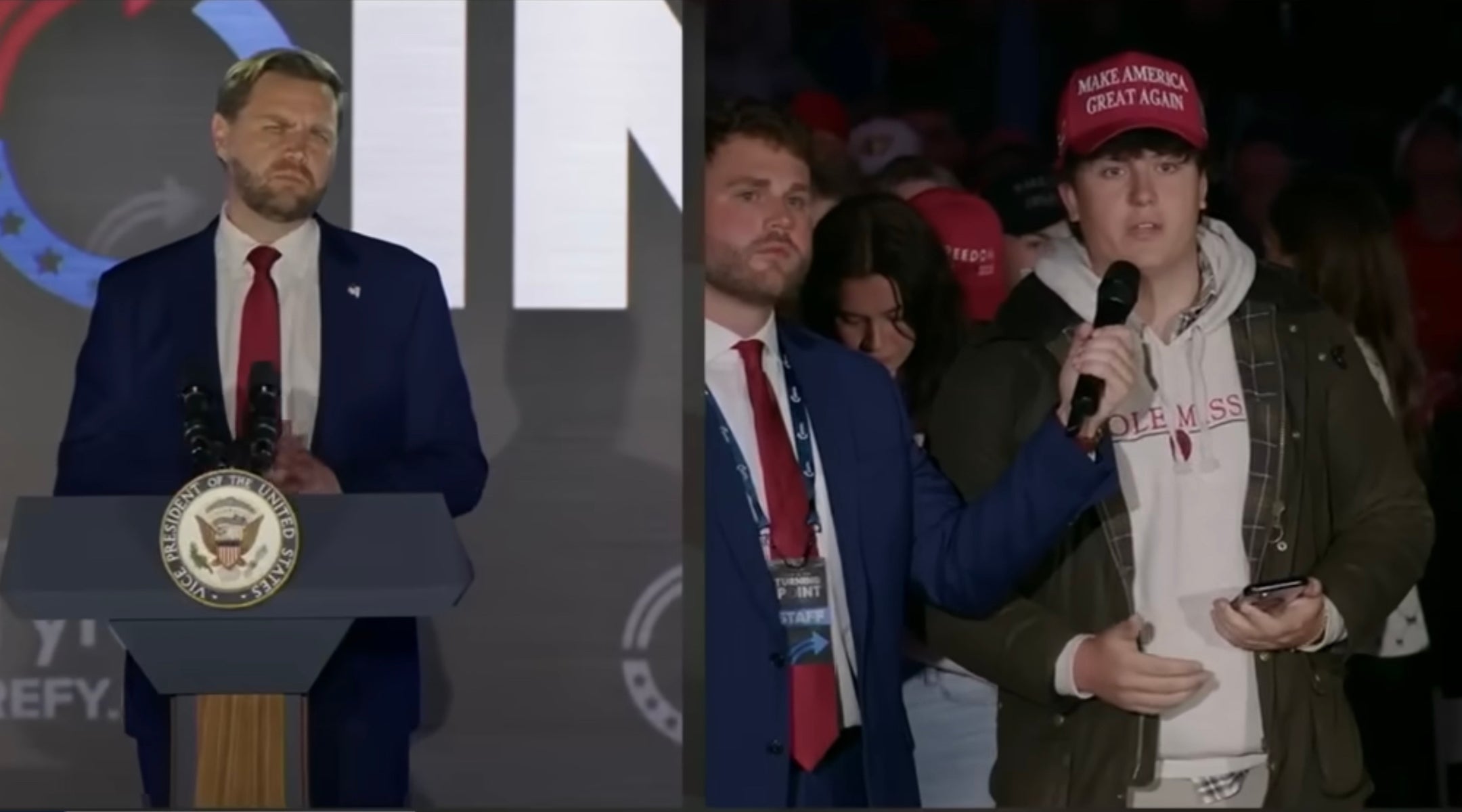
(JTA) — Vice President JD Vance fielded skeptical questions about American support for Israel, including one conspiratorial remark about Judaism, from conservative college students while headlining Wednesday’s stop on the right-wing group Turning Point USA’s nationwide tour.
The event, at the University of Mississippi, was a further sign of shifting priorities among young conservatives when it comes to support for Israel, a long-held GOP tenet that has seen sharp erosion since Oct. 7 and the Gaza war.
Following the talk, Vance — who recently declined to condemn a group chat of Young Republican leaders joking about Hitler and gas chambers — received criticism from Jewish conservatives for failing to take another opportunity to condemn antisemitism.
Charlie Kirk, the murdered conservative activist and TPUSA founder whose legacy on Israel has been sharply debated since his death, was invoked by both Vance and his questioners.
“I’m a Christian, and I’m just confused why there’s this notion that we might owe Israel something, or that they’re our greatest ally, or that we have to support this multi-hundred-billion dollar foreign aid package to Israel, to cover this, to quote Charlie Kirk, ‘ethnic cleansing in Gaza,’” one student wearing a MAGA hat asked the vice president.
That student went on to assert, of Judaism, “Not only does their religion not agree with ours, but also openly supports the prosecution of ours.” The student did not elaborate, though young right-wing Christians have taken Israel to task for recent videos of Jewish Israeli extremists spitting on Christians in the country.
His was the second critical Israel-related question of the night. An earlier questioner had asked Vance, “Do you think it’s a conflict of interest for Miriam Adelson, an Israeli donor, to give millions of dollars to his campaign, and then Trump have pro-Israeli policies?” (Adelson, a major pro-Israel GOP donor, is Israeli-American.)
The questions mirrored a growing anti-Israel flank within the MAGA movement, as polls reflect a growing antipathy for the Jewish state among young Republicans. The movement is fueled by figures including Rep. Marjorie Taylor Greene and Tucker Carlson, the former Fox News host who maintains an influential presence on YouTube and X. Carlson in particular spoke at Kirk’s funeral, and has platformed open antisemites — most recently including Nick Fuentes — while also headlining other stops on the current TPUSA college tour and maintaining close ties with Trump and Vance.
At Ole Miss, Vance responded to both Israel questions in an America-first framing — and suggested that his own support for Israel was not unequivocal.
“He pursues the interests of Americans first,” Vance said about his boss to the student who had asked about Christian allyship with Israel. “That doesn’t mean that you’re not going to have alliances, that you’re not going to work with other countries from time to time.”
Vance continued, ”Israel, sometimes they have similar interests to the United States, and we’re going to work with them in that case. Sometimes, they don’t have similar interests to the United States.”
In praising the recent ceasefire and hostage return deal brokered by Trump, Vance said the president succeeded by “actually being willing to apply leverage to the state of Israel” — something many left-wing activists had pressured former President Joe Biden to do, largely unsuccessfully.
That “leverage,” Vance said, proved that Trump was acting in America’s interests, not Israel’s. He then hinted at a conspiracy theory of his own. “So when people say that Israel is somehow manipulating or controlling the president of the United States, they’re not manipulating or controlling this president of the United States,” he said.
He then attempted to address the student’s comments about the divide between Jews and Christians.
“Jews disagreeing with Christians on certain religious ideas, yeah, absolutely. It’s one of the realities, is that Jews don’t believe that Jesus Christ is the Messiah. Obviously Christians do believe that,” he said. “My attitude is, let’s have those conversations. Let’s have those disagreements when we have them.”
Vance named protecting the Church of the Holy Sepulchre in Jerusalem, a holy Christian site, as an area “I really, really care about” and wanted to work with Israel on. Vance, a convert to Catholicism, attended mass at the church during his state visit to Israel last week. The church is primarily tended to by Palestinian Christians, and has been the site of contested real-estate disputes as far-right Israeli settlers have sought to secure control of historical Christian sites in Jerusalem.
To the student who asked about Adelson, the vice president denied that Trump was influenced by her Israel views — even as he acknowledged that Israel appeared to be her primary cause as a top Republican donor.
“She is very clear about the fact, she doesn’t hide the fact, that she really loves Israel, and that is part of what motivates her political giving. That is a reality. At the same time, the president of the United States is America first, through and through,” Vance said, adding that he, too, had “a very good relationship” with Adelson. The widow of casino magnate Sheldon Adelson was present at Trump’s Knesset address announcing the Gaza ceasefire, and received several shout-outs from the president.
Vance also said that Trump’s anti-war critics, some from his own party, hadn’t given him enough credit for the ceasefire.
“I remember when people said that the president of the United States was going to get us into a multi-hundred-thousand troop, regime-change war for Israel,” the vice president said. “I wonder if they stepped back and said, ‘You know what, we were wrong about that.’”
Vance’s performance has attracted ire from Jewish conservatives who increasingly have been warning of rising, unchecked antisemitism on the right.
“Tonight the vice president had an opportunity to denounce antisemitism amid its historic surge,” Jewish conservative activist Sloan Rachmuth wrote on X. “He could’ve set an example for the young people who are steering in that direction. JD Vance chose not to.” Conservative writer Jonah Goldberg wrote that Vance was “a profile in cowardice.”
“At a Turning Point USA event this week, a young man said something that should have been met with instant moral outrage,” the pro-Israel commentator Daniel Mael wrote on his Substack. “Instead, the Vice President of the United States treated it as a legitimate question.”
Mael took issue with several of Vance’s phrasings, including his remark about Trump not being “controlled by Israel.”
“The meaning was obvious. It implied that past presidents—Biden, Obama, and George W. Bush—were controlled by Israel,” he wrote. “With one careless phrase, the Vice President of the United States echoed one of the most poisonous lies in history: that Jews secretly control governments and act against others for their own gain.”
Vance’s failures to respond to claims that Israel was committing “ethnic cleansing” and to the remark about Judaism targeting Christians were also troubling, Mael wrote. “The claim that Judaism attacks Christianity is not ignorance; it is the sewage of the alt-right media machine…. If conservatives do not confront this now, the movement will rot from within. The world’s oldest hatred has returned, speaking the language of patriotism and pretending to defend faith. ”
At the conclusion of his Q&A, Vance —- who also raised eyebrows by stating he hoped his Hindu wife, Usha, would convert to Christianity — thanked the Israel critics in the audience for strengthening the conservative movement.
“We don’t need, in our political movement, people who agree with us on every single issue. We got a couple of questions about Israel,” he said. “What we need is people of good faith who love the United States of America and are willing to work hard to save it.”
The post Conservative students grill Vance on support for Israel at Turning Point USA event appeared first on The Forward.
Uncategorized
The Case for Zionism: Jews Must Always Act to Defend Themselves

People stand next to flags on the day the bodies of deceased Israeli hostages, Oded Lifschitz, Shiri Bibas, and her two children Kfir and Ariel Bibas, who were kidnapped during the deadly Oct. 7, 2023, attack by Hamas, are handed over under the terms of a ceasefire between Hamas and Israel, in Tel Aviv, Israel, Feb. 20, 2025. Photo: REUTERS/Ammar Awad
As Israel marks tonight the beginning of Holocaust Remembrance Day, I found myself returning to a question that is not abstract, not historical, but immediate: what did we learn — and what have we done with that lesson?
I started writing this column after listening to Matti Friedman’s interview by Haviv Rettig Gur about his compelling new book “Out of the Sky” — the story of a small group of young Jewish men and women, most in their twenties and thirties, who parachuted into Nazi-occupied Europe on missions that fused intelligence work with a near-impossible hope: to reach Jews already marked for annihilation.
What stays with you isn’t only their courage. It’s the indictment embedded in the setting. By then, the leading powers of the world knew what was being done to the Jews — not vaguely, not abstractly, but in sufficient detail to understand the scale and intent. And yet the Nazi annihilation machine continued to operate at full capacity. Priorities were elsewhere. Calculations were made. The Jews were not high enough on the list.
In the interview, Friedman describes Zionism as “a call to the heroic impulse of the Jewish people.” That beautifully captures the spirit of those who volunteered. But it does not fully capture the conditions that made such a call necessary. That necessity was forged over centuries in which Jews learned — repeatedly, across continents — that when they did not act on their own behalf, no one else reliably would.
By the time Zionism emerged as a political movement in the late 19th and early 20th centuries, this was not a new realization. It was the product of accumulated experience.
In Europe, Jews were expelled from England in 1290 and from Spain in 1492 — decisions made by sophisticated societies that had benefited from Jewish presence until it became politically or socially convenient to discard them. Across the continent, Jews were confined to ghettos, barred from numerous professions, subjected to forced conversions, and periodically massacred when rulers or mobs required a scapegoat. In Eastern Europe, pogroms were not aberrations; they were recurring events, often tolerated, sometimes encouraged, and routinely administered by authorities.
In the Middle East and North Africa, the legal framework differed, but the condition often did not. Jews lived under dhimmi status — protected, but explicitly inferior. That protection was conditional and revocable. Jewish communities in Fez, Granada, and elsewhere experienced massacres from the 7th through the 19th centuries. In the 20th century, that fragility fused with Nazi ideology and erupted in events like the 1941 Farhud in Baghdad — a pogrom in a modern Arab capital, not medieval Europe, where Jews were murdered in plain view.
The 19th century is often invoked as a European turning point for civilization — a narrative of emancipation and integration. But when it comes to the Jews, that narrative collapses under scrutiny. The Dreyfus Affair did not occur in a backward state. It unfolded in France, a republic that literally defined itself by liberty and equality. Yet the public degradation of a Jewish officer, falsely accused and convicted, revealed how quickly those ideals could be suspended when the subject was a Jew and the society was looking for a scapegoat.
In 19th century Eastern Europe, antisemitic violence intensified rather than receded.
The Holocaust is often framed as a rupture, a singular descent into madness disconnected from what came before. But that framing is wrong. The Holocaust represents continuity taken to its most efficient extreme: the same logic of exclusion, dehumanization, and disposability, now executed with industrial precision — and when the entire world refused to act.
This is the environment in which Friedman’s protagonists took action into their own hands. Figures like Hannah Senesh, 23, and Enzo Sereni, 39, parachuted into occupied Europe under British auspices. They were not naïve. They understood the constraints. They were explicitly made to understand by the British that saving Jews was not the mission’s priority.
They went anyway.
That choice — risking everything to reach other Jews marked for death, in a world that had already decided not to make that even a secondary priority — captures the essence of Zionism more clearly than any political manifesto. It is the refusal to accept passivity in the face of annihilation.
And even after the war ended, the lesson did not soften.
Roughly 250,000 Jewish Holocaust survivors remained in Displaced Persons camps across Europe for years. Not weeks — years. Stateless. Unwanted. Warehoused in the shadow of a continent that had just attempted to erase them. The world had seen the camps. It had documented the atrocities. It had declared “never again.”
And still, Jews were in DP camps. For years.
That changed only with the establishment of Israel — a state that, from its inception, absorbed those survivors and provided what no one else had: a place where Jewish life was not contingent on the tolerance of others.
This is the record behind Zionism.
The post-Zionist claim — that Jews were better off without sovereignty, that Israel somehow makes Jews less safe — requires the erasure of everything that came before. It requires ignoring expulsions, pogroms, legal subjugation, and ultimately industrialized extermination. It requires treating the Holocaust as a complete anomaly instead of a culmination. It requires believing that a world that refused to absorb Jewish refugees before, during, and after that catastrophe would somehow behave differently in the absence of a Jewish state.
Strip away the rhetoric, and the “post-Zionist” expectation is unmistakable. Jews are being asked — again — to place their survival in the hands of others.
History has already tested that proposition.
If Jews do not secure their own survival, no one else will do it for them.
And when they finally did — when a sovereign Jewish state took in 250,000 survivors who had nowhere else to go, when it replaced statelessness with citizenship and dependence with agency — that was not merely refuge.
It was justice.
Justice that had been denied for centuries — finally asserted.
Micha Danzig is an attorney, former IDF soldier, and former NYPD officer. He writes widely on Israel, Zionism, antisemitism, and Jewish history. He serves on the board of Herut North America.
Uncategorized
Iran Has Been America’s Enemy for 47 Years, Yet Critics Claim It’s Israel’s War

Illustrative: Members of the United Nations Security Council vote against a resolution by Russia and China to delay by six months the reimposition of sanctions on Iran during the 80th UN General Assembly in New York City, US, Sept. 26, 2025. Photo: REUTERS/Eduardo Munoz
In light of President Trump’s decision to attack Iran, enemies on the right, left, and in mainstream media, accuse him of breaking his promise to put “America first” — with the slanderous footnote that the US started the Iran war solely at Israel’s behest.
In fact, the Iran war is very much an “America first” war — launched to neutralize one of the longest-standing, most dangerous threats to the US, its allies, and the Western world.
Notable critics on the right have slammed Trump’s attack on Iran, including former head of the US National Counterterrorism Center, Joe Kent, who said Iran, “posed no imminent threat to our nation, and it is clear that we started this war due to pressure from Israel and its powerful American lobby.”
Hard-leftists have similarly condemned the President for attacking Iran on Israel’s behalf. Rep. Rashida Tlaib (D-MI), for example, accused Trump of “acting on the violent fantasies of the American political elite and the Israeli apartheid government.”
Legacy media, which take every opportunity to bash Trump or the Jewish State, have also accused the President of reneging on his “America first” promise and launching a war for Israel’s sake. An article in The New York Times, for instance, asserted that Israeli Prime Minister Benjamin Netanyahu was “determined to keep the American president on the path to war.”
Against all evidence, Israel’s enemies have managed to convince many that the Iran war is Israel’s war, not America’s.
This “blame Israel” movement corresponds with another major spike in antisemitism. In just the first week of the conflict, global antisemitism surged 34%, rekindling the age-old practice of blaming the world’s tiny (0.2%) Jewish population for its gargantuan troubles.
For decades, Iran has attacked Americans and US interests, all the way back to the 1979 Islamic Revolution. Notable attacks include the 1983 Beirut Marine Barracks bombing, which killed 241 American forces, and the 1996 Khobar Towers bombing in Saudi Arabia, which killed 19 US airmen and wounded about 500 more.
Iran was also responsible for the death of scores of US soldiers in the Iraq war, through its aid to terrorist groups there, and construction of IEDs and similar devices.
Iran has also consistently lied about its nuclear program, claiming it was peaceful, but steadily enriching uranium to approach weapons-grade levels. No one in the world disputes that Iran is trying to achieve nuclear weapons — the only debate was whether it was worth military action to prevent it.
Iran wanted these weapons so that it could blackmail America and our Middle Eastern allies, and not have to worry about an American military response.
It’s no wonder that before his death, Ayatollah Khamenei repeatedly declared, “Death to America is not just a slogan — it is our policy.” Thus, it’s no surprise that over the last 47 years, all nine successive US administrations, including Trump’s, have made Iran a foreign-policy centerpiece.
After decades of diplomacy and appeasement, one president said “no.” The administrations of Obama, Biden, and Trump (twice) attempted painstaking diplomacy to convince Iran to abandon its nuclear weapons program — to no avail. In fact, diplomacy only strengthened Iran and its terrorist network. The 2015 nuclear deal, for example, gave Iran billions of dollars in sanctions relief, which the mullahs used to expand their nuclear and ballistic missile programs, and fund terrorist proxies.
In short, after 47 years of lies, diplomatic failures, terrorism, and the threats of an Islamist regime sworn to America’s destruction, Iran’s determination to obtain nuclear weapons left the US no choice but military force.
Nonetheless, the lie that the Iran war is being fought because of Jewish conniving — primarily for Israel’s sake — continues to spread. The result will be more antisemitism, more violent attacks on Jews, and more generational anti-Jewish hatred.
Our best weapon to fight this is to keep explaining the real reasons for the Iran war — and the very real threat that Iran poses to America, the region, and the entire free world.
Jason Shvili is a Contributing Editor at Facts and Logic About the Middle East (FLAME), which publishes educational messages to correct lies and misperceptions about Israel and its relationship to the United States.
Uncategorized
He committed murder today. Or maybe yesterday. He doesn’t know.
In the spring of 1940, two French Algerians, the brothers Raoul and Edgar Bensoussan, got into a rumble with two Arabs on a beach near the city of Oran. The reason is unclear, but not the result: One of the Arabs, Kaddour Betouil, pulled out a knife and stabbed Raoul in the arm and mouth. The latter, bloodied and retreating to his beach cottage, returned to the crime scene armed with a pistol. A second fight occurred between the two men, ending not with a pistol shot but instead with the arrival of French gendarmes.
It happens that the Bensoussan brothers were Algerian Jews whose family were beneficiaries of the Crémieux Law, which in 1870 extended French citizenship to the Jewish community that had lived for centuries in Algeria. That same law, however, did not extend to the several million Arabs and Berbers, who, like Kaddour Betouil, were condemned to remain subjects, not citizens, under the French republic.
If this story sounds familiar, it is not at all absurd. This same strip of beach, the historian Alice Kaplan reports, is still known to locals as la plage de L’Étranger, or The Stranger’s beach. The story of this altercation, bien évidemment, made its way back to a friend of Bensoussan brothers, Albert Camus.
In both the novel and in François Ozon’s new film adaptation, this scene, though it arrives midway through the story, is in fact the climax. On a beach in Algiers, there is a confrontation between a Frenchman, named Meursault, and an Arab, left unnamed. The latter, reclining on the sand, holds a knife, while Meursault, standing above him, holds a pistol. This time, though, as waves crash and the sun blinds, the pistol does go off. There is a single shot, a pause, then four more shots.
“It was like knocking,” Meursault observes, “four quick times on the door of unhappiness.”
Ozon has Meursault, played by the actor Benjamin Voisin, speak these words in a voice-over once he fires the shots. He repeats this use of the voice-over, reciting the final lines of the novel as the film approaches its conclusion. As for the rest of the screenplay, also written by Ozon, it bears an unwavering fidelity to the lean yet lyrical cadence of Camus’ own language, famously described by the literary theorist Roland Barthes as the “zero degree” of writing, one that strove to be utterly transparent.
Yet there are also dramatic departures from the novel, not to mention the even more faithful adaptation by Luchino Visconti in 1967, which starred Marcello Mastroianni as Meursault. In part, the Visconti version was more faithful because it was filmed in color. How could it be otherwise for a novel in which the startling colors of the sea, sand and sky play such a crucial role? Yet Ozon chose to film in black and white, perhaps reflecting Hollywood film noirs, and the crime novels by the likes of James M. Cain and Raymond Chandler, that knocked the socks off Camus and fellow existentialists like Jean-Paul Sartre. While the images captured by cinematographer Manu Dacosse often vibrate with sensuality, they nevertheless smack of skilled artifice and not Meursault’s reality.
Moreover, Ozon refashions the role of Marie Cardona, the woman who falls for Meursault. In the novel, she is little more than a prop — a woman as attracted to Meursault’s physical beauty as she is alienated by his emotional blankness. Here, Marie, played by the young stage actor Rebecca Marder, assumes a central role. Marder is mesmerizing, but that is precisely the problem; it risks turning an iconic account of the absurd into a love story. And, to paraphrase Tina Turner, love’s got nothing to do with this story.
Ozon introduces other wrinkles — for example, the thrum of homoeroticism that accompanies the scene with Meursault and the Arab — but they pale in comparison to his most dramatic departure from the novel. In effect, Ozon names not just the Arab, but also his sister. The latter works as a prostitute and is beaten by her pimp, Raymond Sintès, who also befriends Meursault. It is this unromantic triangle that leads to their confrontation on the beach — and, of course, to the reader’s confrontation with the perennial question: Why did Camus leave them nameless?
Rather than try to answer this question, the Algerian writer Kamel Daoud decided to give the Arab not just a name, Musa, but a history. In Daoud’s stunning novel Meursault, Contre-enquête, or The Meursault Investigation, Musa’s brother, Harun, cannot forgive the injustice that Meursault won undying fame while Musa was condemned to nameless obscurity. “Good God, how can you kill someone and then even take his own death away from him? My brother was the one who got shot, not him! There’s something I find stunning, and it’s that nobody…ever tried to find out the victim’s name.”
In a couple of simple and scintillating scenes of his own invention — one with Musa’s sister Djemila visiting his gravestone, the other an encounter between Djemila and Marie — Ozon repairs this omission by giving names and voices to those who had been nameless and speechless. No less importantly, he has given us a film that reminds us of the elusiveness of meaning and strangeness of life in a world as absurd today as it was in Camus’ day.
The post He committed murder today. Or maybe yesterday. He doesn’t know. appeared first on The Forward.