



Uncategorized
‘Creates More Enemies’: Iran’s War Spreads to Turkey as Analysts Warn Regional Assault Is Strategic Mistake

Debris of a NATO air defense system that intercepted a missile launched from Iran is seen in Dortyol, in southern Hatay province, Turkey, March 4, 2026, in this screengrab from video. Photo: Ihlas News Agency (IHA) via REUTERS
Turkey became the latest unexpected target in the widening war in the Middle East on Wednesday after it intercepted an Iranian missile, as Iran’s retaliation for joint US-Israeli strikes spreads across the region.
Tehran appears to be betting that hitting countries beyond Israel will ignite regional pressure on Washington to stop its military operation, but Arab and Israeli diplomats say the strategy is backfiring, with the Islamic Republic “creating more enemies.”
Turkey said NATO air defenses destroyed a ballistic missile fired from Iran that was detected over Iraq and Syria and heading toward Turkish airspace. Turkey, a majority Sunni country and a NATO member, shares a roughly 310-mile border with Iran. Two days earlier, Turkish President Recep Tayyip Erdoğan called for “an end to the bloodbath,” describing the war, launched by joint US-Israeli strikes on Saturday, as “illegal.”
Since the strikes that killed Iranian Supreme Leader Ayatollah Ali Khamenei and other senior officials, the regime in Tehran has expanded its retaliatory missile and drone fire to hit a swath of American allies including Qatar, Bahrain, Jordan, Kuwait, Saudi Arabia, and the United Arab Emirates.
Iran’s interim national security chief, Ali Larijani, said on Sunday that Iran was “not seeking to attack” regional states and was acting only in self-defense against American bases. But in the days since, Iranian strikes have hit civilian infrastructure including power facilities and hotels across the Gulf.
New figures released Wednesday by Israel’s Institute for National Security Studies (INSS) show Iran has concentrated far more firepower on Gulf neighbors than on Israel in the war’s opening days. Over the first four days, INSS said Iran launched about 200 missiles and about 100 drones at Israel across 123 attack waves. Over the same period, it targeted the Gulf states with about 500 missiles and about 2,000 drones — 2.5 times more missiles and 20 times more drones than it fired at Israel.
According to Michael Eisenstadt, a military analyst and former US Army officer at the Washington Institute for Near East Policy, the attacks reflect Iran’s strategy of applying graduated pressure by “catalyzing opposition to the war” in the United States and other countries. Tehran hopes disruptions to oil infrastructure and higher energy prices will create pressure for a ceasefire.
But nearly every expert called Iran’s Gulf assault a blunder, saying the strikes have caused widespread anger in the Arab world. Six GCC states and Jordan condemned Iran’s attacks as “indiscriminate and reckless” and reaffirmed each country’s right to self-defense.
Jeremy Issacharoff, a former Israeli ambassador and arms expert, said the Iranian strategy was counterproductive, turning quasi-allies into adversaries.
“Attacking countries like Qatar that were pretty much positively inclined towards them was a huge mistake,” he told The Algemeiner. “They’ve created more enemies.”
Issacharoff said that Tehran’s leaders frame the conflict through hostility toward Zionism and the existence of a Jewish state in what they see as part of the Islamic world, adding that their driving strategic goal is hegemony. “In the end, they were looking to be much more in control of the region, and of the Arab world as a whole,” he said.
But the region was already moving in the opposite direction of what Iran wants, he said. Years of Iranian-backed missile attacks on Israel by proxy groups like Hezbollah in Lebanon had already pushed several countries to develop what he described as a regional defense mechanism, with Arab states cooperating with Israel and the US under the radar.
“It’s discreet, but it’s happening,” Issacharoff said, adding that the latest attacks could prompt the emerging coalition to expand cooperation even further, beyond the military arena into a broader framework for regional stability.
Former US Central Command (CENTCOM) communications director Joe Buccino took it a step further, telling Fox News that Iran’s move was a “stunning strategic miscalculation” that could “set the Gulf states on [a] path toward normalization with Israel.”
Abbas Dahouk, a retired US Army colonel who served as a senior military adviser for Middle Eastern Affairs at the US State Department, echoed Issacharoff’s view that years of quiet cooperation had already strengthened a regional coalition against Iran, but he tied the acceleration to a specific turning point: Israel’s inclusion in CENTCOM in 2021, which he said was a “transformative” inflection point that forced regional militaries that once avoided overt ties to “quietly mature counter-Iran plans over years of joint exercises and coordination.”
That groundwork is now showing up in the scale of coordination, Dahouk told The Jerusalem Post in comments published Tuesday, with “hundreds of aircraft” able to operate at once, refuel, strike concealed targets, and counter Iran’s drone and missile networks. He added that Iran’s retaliation has left Gulf states little room to stay on the sidelines.
“The region must view the Iranian regime as a common threat alongside the United States and Israel,” he said. “At this moment, they have little alternative.”
Former US General Jack Keane also told Fox that the Islamic Republic’s strategy had “backfired.”
“The Gulf states are responding, they’re adequately defending themselves … they’re frustrated with the Iranians,” Keane said, adding that several GCC states were preparing for combat.
Emirati analyst Mohammad Al Ali wrote in Gulf News that Iran’s only success in this war so far was in “uniting the region and much of the world against them, constructing a vast wall of isolation between [the] regime and the international community.”
“If Iran’s leaders have succeeded in any respect during this war, it is only in uniting the region and much of the world against them, constructing a vast wall of isolation between their regime and the international community,” he wrote.
Beyond the Arab world, Iran’s strikes have triggered outrage in Europe and led France, Greece, and Britan to deploy defensive military assets to the Mediterranean.
“Iran’s strategy is to sow chaos and set the region on fire,” European Union foreign policy chief Kaja Kallas told reporters on Wednesday, lambasting the Iranian regime for indiscriminately attacking its neighbors.
Polish Foreign Minister Radosław Sikorski expressed similar sentiments when asked about the Iranian ballistic missile headed into Turkish airspace.
Iran is broadening the war to countries that did not attack it … there is a well-known saying it’s worse than a crime, it’s a mistake,” he said.
Uncategorized
Iran Hits Ships and UAE Oil Port in Show of Force After Trump Orders Navy to Open Strait
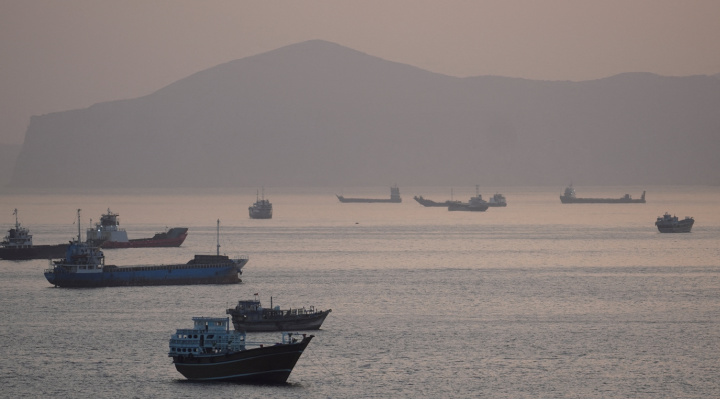
Ships and boats in the Strait of Hormuz, Musandam, Oman, May 1, 2026. Photo: REUTERS/Stringer TPX IMAGES OF THE DAY
Iran hit several ships in the Strait of Hormuz on Monday and set a UAE oil port ablaze, following President Donald Trump‘s announcement that he will use the US Navy to free up shipping.
The Iranian attacks marked the war’s biggest escalation since a ceasefire was declared four weeks ago.
Trump‘s new mission “Project Freedom,” which he announced on social media overnight to release ships stuck in the strait, was the first apparent attempt to make use of naval power to unblock the world’s most important energy shipping route.
But at least in the initial hours on Monday, the effort brought no surge of merchant shipping through the strait while provoking a show of force from Iran, which had long threatened to respond to any escalation with new attacks on its neighbors.
The US military said two US merchant ships had made it through the strait, without saying when. Iran denied any such crossings had taken place.
The commander of US forces in the region said his fleet had destroyed six small Iranian boats, which Iran also denied. Admiral Brad Cooper said he “strongly advised” Iranian forces to keep clear of US military assets carrying out the mission.
Iranian authorities, for their part, released a map of what they said was an expanded sea area now under their control, which went far beyond the strait to include swathes of international waters, including long stretches of the United Arab Emirates’ coastline on either side of the strait.
South Korea reported one of its merchant ships had been hit by an explosion and fire inside the strait. The British maritime security agency UKMTO reported two ships had been hit off the coast of the UAE, and the Emirati oil company ADNOC said one of its empty oil tankers was hit by Iranian drones while trying to cross.
“Iran has taken some shots at unrelated Nations with respect to the Ship Movement, PROJECT FREEDOM, including a South Korean Cargo Ship. Perhaps it’s time for South Korea to come and join the mission!” Trump posted on social media on Monday.
After reported drone and missile attacks inside the UAE throughout the day, including one that caused a fire at an important oil port, the UAE said Iranian attacks marked a serious escalation and it reserved the right to respond.
STRAIT STILL BLOCKED
Trump has struggled to find a solution to the disruption of international energy supplies caused by Iran‘s blockade of the strait, which carried a fifth of global oil and liquefied natural gas before the war.
In the more than two months since Trump launched an air war against Iran alongside Israel, Tehran has largely blocked the strait to ships apart from its own. Since last month, the United States has imposed its own blockade of ships leaving and entering Iranian ports, further crippling Iran’s already ailing economy.
The warring sides issued contradictory statements on Monday about the initial impact of the new US mission, and Reuters could not independently verify the full situation there.
But there was no immediate sign that large numbers of merchant ships were making new attempts to cross, and major shipping companies said they were likely to wait for an agreed end to hostilities before trying to sail through.
REVOLUTIONARY GUARDS SAY NO TRANSITS TOOK PLACE
In a post on X, US Central Command said some of its Navy guided-missile destroyers were inside the Gulf supporting the operation, and that two US-flagged merchant vessels had crossed the strait “and are safely headed on their journey.”
It did not identify either the warships or the merchant vessels or say when any of those crossings had taken place.
Iran‘s Revolutionary Guards said no commercial vessels had crossed the strait in the past few hours, and that US claims to the contrary were false.
Earlier, Iran said it had fired on a US warship approaching the strait, forcing it to turn around. An initial Iranian report had said a US warship was struck, but Washington denied this and Iranian officials later described the fire as warning shots.
South Korea’s Foreign Ministry said there was a fire and an explosion onboard the Namu, a merchant ship operated by South Korean shipper HMM. Yonhap news agency reported that the government was checking intelligence indicating the vessel may have been attacked.
The UAE, meanwhile, reported a fire at an oil installation in its port of Fujairah following an Iranian drone attack. Fujairah lies beyond the strait, making it one of the few export routes for Middle East oil that does not require passing through it.
SHIPPING INDUSTRY AWAITS CLARITY ON SAFETY
Oil prices jumped more than 5% in volatile trade as news of the increased Iranian attacks emerged.
In his social media post announcing the new mission, Trump gave few details of what action the US Navy would take to get ships through the strait.
“We have told these Countries that we will guide their Ships safely out of these restricted Waterways, so that they can freely and ably get on with their business,” Trump wrote.
In response, Iran‘s unified command told commercial ships and oil tankers:
“We have repeatedly said the security of the Strait of Hormuz is in our hands and that the safe passage of vessels needs to be coordinated with the armed forces … We warn that any foreign armed forces, especially the aggressive US Army, will be attacked if they intend to approach and enter the Strait of Hormuz.”
The United States and Israel suspended their bombing campaign against Iran four weeks ago, and US and Iranian officials held one round of face-to-face talks. But attempts to set up further meetings have failed.
Iranian state media said on Sunday that Washington had conveyed its response to a 14-point Iranian proposal via Pakistan, and that Tehran was now reviewing it. Neither side gave details of any US response.
The Iranian proposal would postpone discussion of Iran‘s nuclear program until after an agreement to end the war and resolve the standoff over shipping. Trump said over the weekend he was still studying it but would probably reject it.
Uncategorized
Australia Begins Hearings Into Bondi Beach Attack and Rising Antisemitism

Rabbi Levi Wolff lights a menorah at Bondi Pavilion to honor the victims of a shooting during a Jewish holiday celebration at Bondi Beach, in Sydney, Australia, Dec. 15, 2025. Photo: REUTERS/Hollie Adams
Australia began public hearings on Monday in an inquiry into the Bondi Beach mass shooting in December, with Jewish Australians giving evidence of their experience of rising domestic antisemitism.
The attack on a Jewish Hanukkah celebration killed 15, fueling calls for tougher gun controls and more action to tackle hatred toward Jews, following a spate of antisemitic incidents.
The first block of public hearings will investigate the nature and prevalence of antisemitism, said Virginia Bell, the retired judge leading the wide-ranging national inquiry known as a Royal Commission.
“The sharp spike in antisemitism that we’ve witnessed in Australia has been mirrored in other Western countries and seems clearly linked to events in the Middle East,” Bell said.
“It’s important that people understand how quickly those events can prompt ugly displays of hostility toward Jewish Australians simply because they’re Jews.”
‘WE DON’T FEEL SAFE HERE’
Witnesses from the Jewish community told the inquiry they felt increasingly unsafe amid rising hostility since the October 2023 start of the war in Gaza.
“What is happening in Australia today is not a faint echo of a distant past,” said Peter Halasz, an 86-year-old Holocaust survivor who fled to Australia from Hungary.
“For those of us who lived through the 1930s and 1940s, it is something we recognize, and that recognition is frightening and cause for alarm.”
Sheina Gutnick, who lost her father Reuven Morrison in the Bondi attack, said antisemitism had damaged her family’s sense of safety and freedom of movement.
“As a mother, I’m constantly weighing up the risk of exposing my children to environments where they may be witness, or subject, to antisemitism,” she told the panel.
She recounted an incident in which a stranger at a shopping center called her an “effing terrorist” for wearing a Star of David necklace.
Another witness said her family was relocating to Israel because of safety concerns.
“We never expected synagogues to be burned down,” said the woman, who used the pseudonym “AAM.” “We never expected Jews to be hunted on Bondi Beach.
“My family and I no longer want to live in Australia. We don’t feel safe here. We don’t feel welcome.”
JEWISH SCHOOL LOOKS ‘MORE LIKE A PRISON’
Stefanie Schwartz, the president of Sydney Jewish primary school Mount Sinai College, spoke of holding drills to prepare young students to deal with terrorist attacks, and requiring an “extreme” security presence on campus.
“You walk past our school, and it looks a lot more like a prison than a primary school.”
Antisemitism has “run riot,” with Jewish Australians being held responsible for the actions of the Israeli government, said Benjamin Elton, the chief minister of the Great Synagogue in Sydney.
The inquiry released an interim report of 14 recommendations last Thursday, urging greater security for Jewish public events and further counterterrorism and gun reforms.
A second block of hearings later in May will focus on the circumstances leading up to the Bondi Beach attack and issues raised in the interim report.
The commission is due to deliver its final report on Dec. 14, exactly a year after the attack.
Uncategorized
A new musical wonders: What happened to solidarity with English Jews?
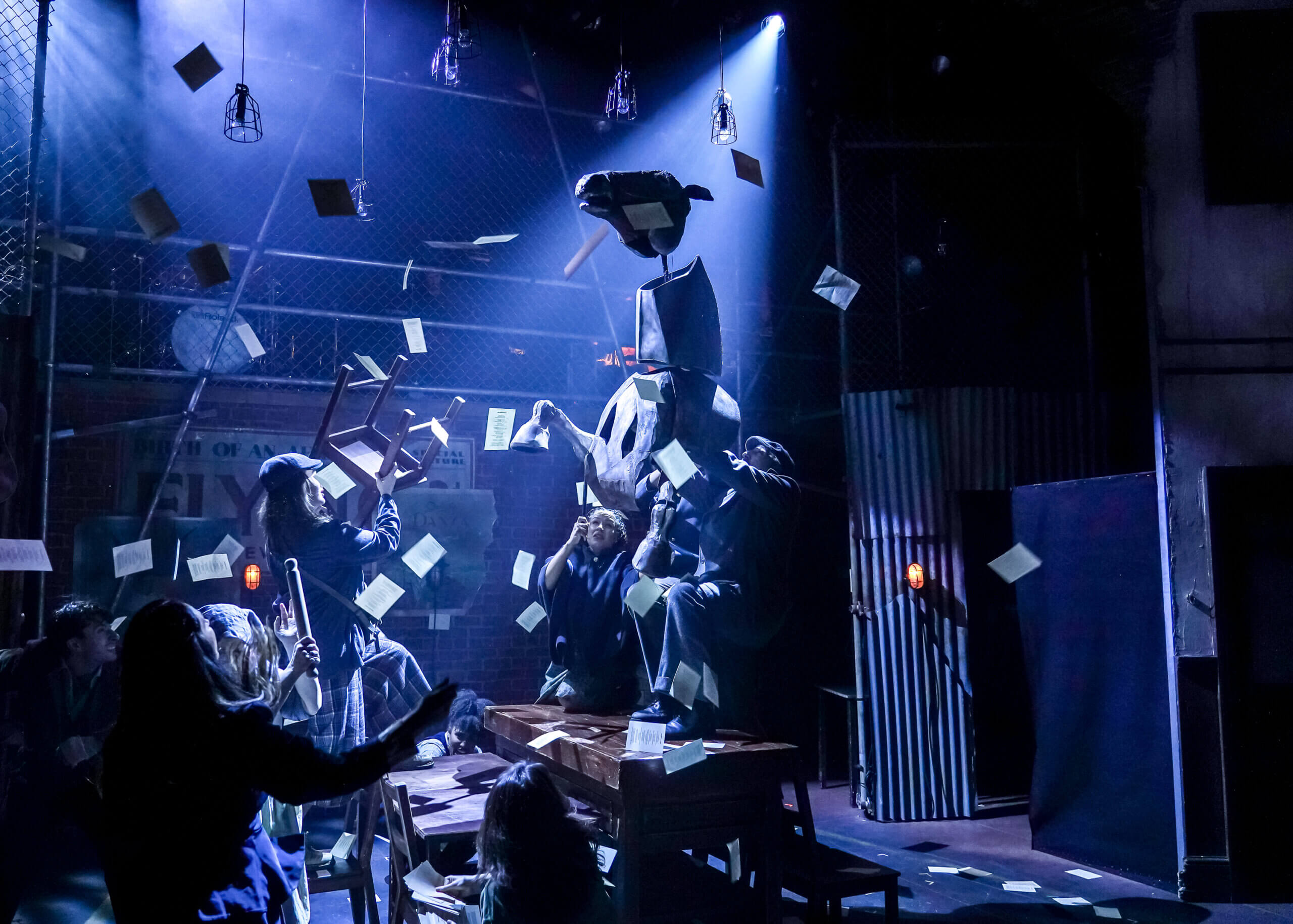
The Battle of Cable Street, a 1936 street scuffle off an obscure stretch of road in London’s East End, holds a totemic importance to the Jews of England, and, given how few they are in number, a correspondingly small significance in the larger British imagination.
The musical Cable Street, dramatizing that showdown between Jewish and Irish East Enders against Oswald Mosley’s fascist blackshirts, arrives Off-Broadway from London amid a spate of headlines about the safety of English Jews and a subsequent minimization of their fears. Only now, the political alignment of those defending or hectoring Jews has recalibrated from the days the play examines.
In his rhetoric and tactics, the anti-Islam “activist” Tommy Robinson, who antagonizes Muslim neighborhoods and marched through Central London in his “Unite the Kingdom” rallies, would appear to be the heir apparent to a Mosley, with the exception that he presents himself as a friend of the Jews. (Most Jews in the U.K. won’t have him; the Israeli far-right welcomed him to the Jewish state last October.)
On the left, the multicultural coalition has found a cause in Palestinian rights, which they march for like clockwork. Jews, who in the U.K. make up about .5% of the population but a whole 29% of recorded religious hate crimes, don’t count in their social justice calculus, comedian David Baddiel has argued. Evidence is mounting in that direction.
Police have surrendered to community leaders pushing to cancel an Israeli soccer club match, fabricating evidence with A.I. post facto to make it seem like the Israel fans will be the violent faction. A Panorama documentary from last month makes an earnest case for Jewish anxiety, but aired only after the BBC was made to review their standards over stories on Gaza following the network running a documentary that failed to disclose its narrator was the son of a Hamas minister. (This to my mind is nowhere near as egregious as the channel’s reluctance some years before to back down from blaming Orthodox children for their own abuse by mistranslating a word of Hebrew into an anti-Arab slur.)
Jews being gunned down outside shuls on Yom Kippur or stabbed in the streets – as they were just last week, two days before I saw this musical — don’t mobilize the masses. They do get the odd pundit condemning the violence, only to then to whatabout with the humanitarian disaster in Gaza or blame Jewish institutions’ efforts to conflate Jews and Israel, as if only when uncoupled will their targeting be truly horrendous.
British Jews are so much a rounding error they could hardly sway a council election. That fact scarcely moves the needle on the old libels of governmental control, as Labour responds to violence with crack downs on pro-Palestinian protests.
The development of Cable Street goes back years before the current bloodletting, yet it has hit on a rhyme in history.
The story provides a framing device of a present-day walking tour before jumping back in time to follow three youths and their families: Irish immigrant Mairead (Lizzy-Rose Essin-Kelly), who dreams of a writer’s life during her day job rolling bagels; Sammy Scheinberg (a dynamic Isaac Gryn), who wants to be a boxer against the wishes of his shmata business father; and Ron (Barney Wilkinson) a recent Lancashire transplant, underemployed, with hair the color of threshed wheat, ripe for recruitment by a band of populist nativists.
The show finds hope in an unlikely coalition of Irish dockworkers, Jews and Communists rallying to stop a police-escorted British Union of Fascists (BUF) march through London’s Jewish Quarter. The parable is so near to today’s headlines that it can make one’s head spin, and, in the particular case of a Jew, scan for allies. Better luck in New York, with the Brits Off Broadway festival, than across the pond, where this may be taken as a more general parable, with Jews as allegorical victims standing in for other marginalized groups. To read into the story the excesses of today’s protests, and what the authorities allow under the pretext of free speech, would surely be sacrilege, depending on which marchers it’s applied to and where your loyalties lie.
The music by Tim Gilvin has shades of what I’ll call Hebraic Hamilton (“Dream of making the dough, making the bread, baking the challah,” Sammy spits bars over a backbeat). There’s an Irish jig and a ballad that sounds like Coldplay, and “Only Words,” an elegiac plea from a Jewish father to his hothead son. (Jez Unwin plays the Scheinberg patriarch, a modern-day descendant and the leader of the Stepney BUF.) A ragtime number of chattering broadsheets sellers feeds us intermittent exposition.
The introduction of the BUF imagines them as a ‘90s boy band, making fun before they prove their menace. It works better downtown, when the Nazis in another British import, Operation Mincemeat, do their K-Pop number, as that show is an all-out farce.
Better by far is the play’s treatment of Jewish scenes, scripted by book writer Alex Kanefsky with deft direction by Adam Lenson. We hear a hamotzi, see a synagogue (with an implied women’s balcony) and hear a refrain of Sholem Aleichem and Sim Shalom integrated into musically layered sequences.
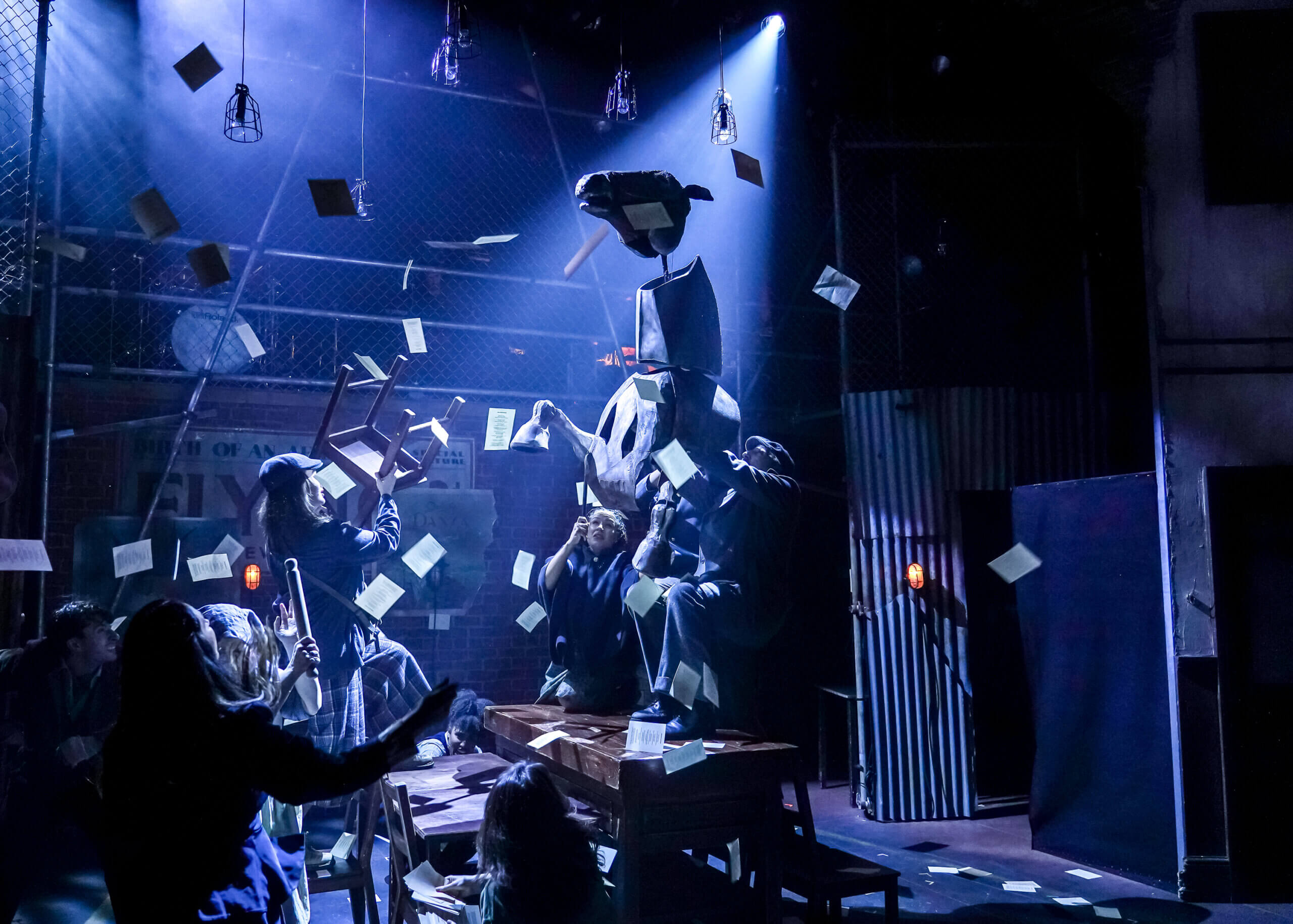
The indefatigable cast of 13 plays countless characters, switching allegiances from Mosleyites to Jews at the donning of an armband. This can lead to odd stage imagery, as when musician-actor Max Alexander-Taylor is togged up like a blackshirt while riffing on an electric guitar. (The rest of the band is on a top level, shielded in by the corrugated metal and chainlink of Yoav Segal’s set design.)
But there are moments of sublime stage work, après Les Miz, as the story’s action rises and the street mounts a defense with slogans borrowed from Spanish Republicans. The play, in its chilling wisdom, doesn’t stop at this high point. It allows room for what followed: The BUF’s membership only grew after the battle. Regrouping, they retaliated with a pogrom against the Jews. This time, no one showed up to defend them.
The cringey lyric of the battle song — “we’re not like the others, we won’t let you demonize our sisters and brothers” — is replaced with a more sober conclusion from Sammy’s sister in the wreckage of the attack.
After noting how “the rich blame the poor, the poor blame the rich and everybody hates the Jews,” Rosa Scheinberg (Romona Lewis-Malley) laments that “when the common enemy’s defeated, old wounds flare up, and old mistakes get repeated.” Solidarity was but a brief and shining moment.
As a concession to hope, the show doesn’t end there, but it very well might.
The musical Cable Street plays at 59E59 in New York through May 24. Tickets and more information can be found here.
The post A new musical wonders: What happened to solidarity with English Jews? appeared first on The Forward.