


Uncategorized
For kosher families in need, a new community fridge offers food — and anonymity
When SNAP payments froze during the government shutdown earlier this month, Rabbi Hody Nemes worried about a particularly vulnerable group: kosher families, who already pay 20-50% higher prices for groceries and have fewer food pantries available to them.
Across Chicago, “community fridges” have long offered a lifeline to food insecure families — outdoor refrigerators stocked by volunteers, where anyone can take what they need, no questions asked. But for kosher households, those fridges were effectively off-limits.
Solu, an Orthodox Jewish social services nonprofit, decided to fix that. Last month, it opened the area’s first kosher community fridge in a parking lot in Skokie, a Chicago suburb with a large Orthodox population. With the blessing of the Goldberg-Polin family, Solu named it “Hersh’s Community Fridge” — a tribute to Hersh Goldberg-Polin, the slain Gaza hostage whose parents once attended Ida Crown Jewish Academy in Skokie.
At Hersh’s Fridge, the food is divided into three sections: refrigerated groceries bearing a reliable hechsher, or kosher certification; food cooked in kosher homes; and a pantry with kosher-certified shelf-stable goods. Volunteers monitor the fridge for compliance with kosher food standards — not an uncomplicated task for a fridge where anyone can drop off food at any hour of the day. A club of around 100 students at Ida Crown in “Hersh’s Fridge Club” have pitched in, ensuring that each homemade item includes a label attesting, on the honors system, that it was prepared in accordance with Orthodox halacha.
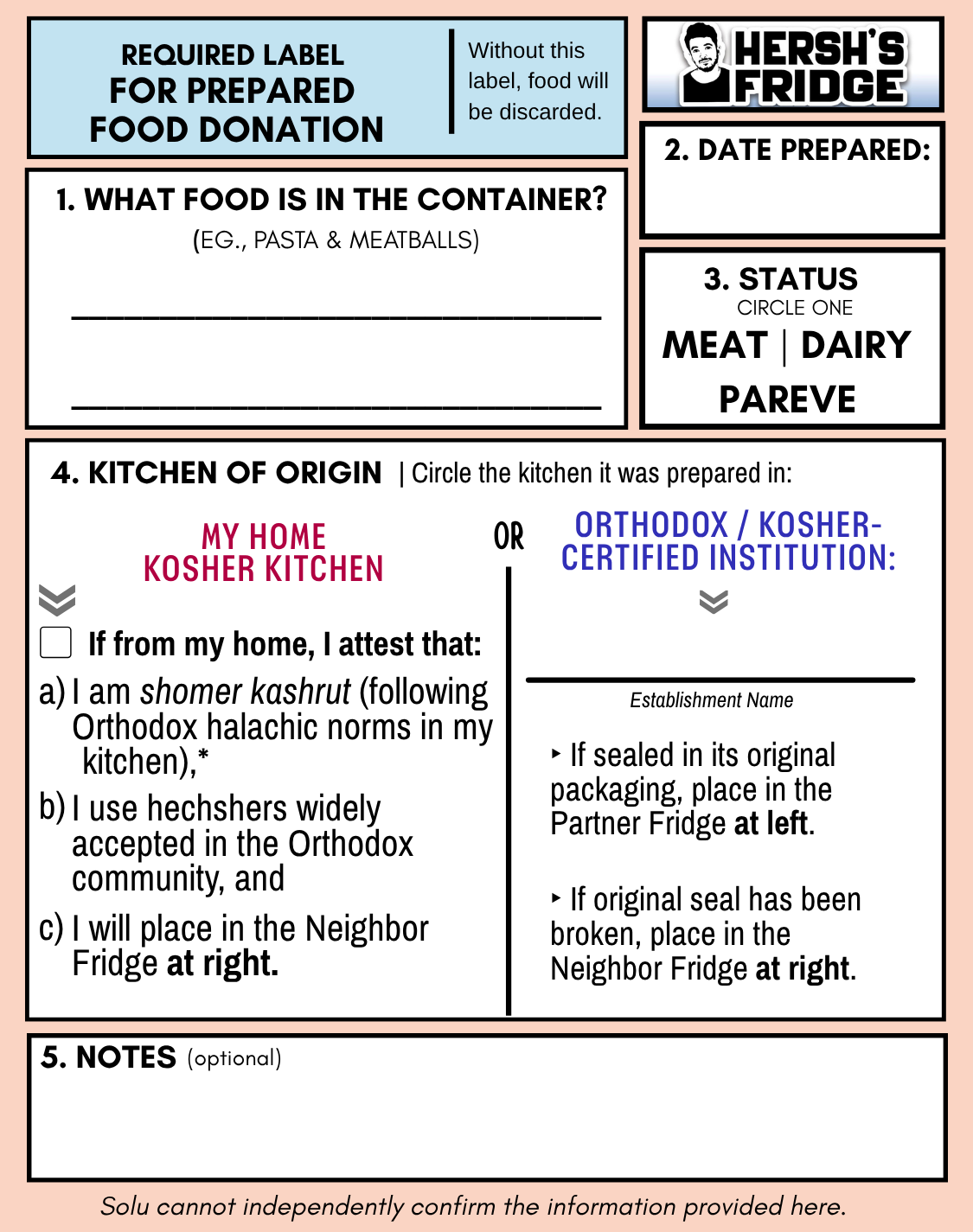
“We have to set a standard so that people can feel confident taking food, and that they won’t open the fridge and discover, like, a box of bacon and Popeyes,” Nemes said.
Demand surpassed expectations, spiking significantly as soon as SNAP benefits paused, said Nemes. Volunteers struggled to keep the fridge stocked fast enough.
That revealed to organizers that there was more need in their community than initially thought.
“Even in our shul community at Skokie Valley, someone approached and said, ‘When is the fridge starting?’ And our assumption was they wanted to get involved. And they were like, ‘No, I need to know, because I need to be able to take,’” Nemes said.
Kosher food is available at pantries like The Ark in Northbrook, about a half-hour away, but the fridge provides two advantages traditional food banks don’t: 24/7 access and anonymity.
Judaism considers anonymous giving the highest form of charity, Nemes noted — a principle Hersh’s Fridge fulfills. Just as important, he added, is anonymous receiving, which allows people to maintain their dignity.
That anonymity matters, said Ilana Horwitz, an assistant professor of Jewish Studies and sociology at Tulane University who researches Jewish poverty. Shame and stigma, she said, are among the biggest barriers preventing financially vulnerable Jews from seeking help.
Her research uncovered many such cases, including a Modern Orthodox woman with an advanced degree who appeared financially secure but was quietly overwhelmed by medical bills. Rather than go to the local food bank — where the volunteers were often her fellow congregants — she drove 20 miles to one where she wouldn’t be recognized.
“There is a particular kind of stigma because of this narrative we have in the Jewish community of like, Oh, Jews have been very upwardly mobile. Jews are really successful,” Horwitz said. “Anybody who sort of falls outside of that scope feels like they did something wrong.”
Leah Rubin, a Solu board member, said she experienced her own wake-up call at her day job as a psychotherapist. She routinely offers snacks like chips or candy to the children who come into her office. But one day, a child spotted a can of tuna in her pantry and asked for that instead — explaining she hadn’t eaten all day.
Rubin later learned the family relied on a kosher food bank that offered pickup only a few times a month and felt uncomfortable asking for additional help.
“It became really clear that within the Jewish community in particular, there is a need for an anonymous, easy, grab-and-go” service that enabled people “to feed themselves and their families in a dignified way,” Rubin said.
Nemes emphasized that the fridge doesn’t just serve Jewish families. He said it’s been especially moving to see neighbors of different faiths take food from a fridge named for Hersh, who was involved in interfaith efforts, using soccer to connect Israeli and Palestinian children. Still, he cautioned, the community shouldn’t assume Jewish families don’t also need help.
“We live in a suburban community where a lot of people have said, ‘Is there really need here?’” Nemes said. “We’re seeing that it is needed, based on the response.”
Disclosure: Nemes contributed to the Forward from 2013 to 2015, as a staff reporter for some of that time.
The post For kosher families in need, a new community fridge offers food — and anonymity appeared first on The Forward.
Uncategorized
Iran’s Guards Will View Military Vessels Approaching Strait as Ceasefire Breach

FILE PHOTO: A map showing the Strait of Hormuz is seen in this illustration taken March 23, 2026. REUTERS/Dado Ruvic/Illustration/File Photo
Iran’s Revolutionary Guards said on Sunday that any military vessels attempting to approach the Strait of Hormuz will be considered a violation of the two-week US ceasefire and be dealt with harshly and decisively.
The strait is under the control and “smart management” of Iran’s Navy, the Guards said in a statement reported by Iranian state media, adding it is “open for the safe passage of non-military vessels in accordance with specific regulations.”
Uncategorized
Iran Rejected US Demand to Stop Funding Proxies, and Halt Uranium Enrichment During Talks

FILE PHOTO: The atomic symbol and the Iranian flag are seen in this illustration, July 21, 2022. REUTERS/Dado Ruvic/Illustration/File Photo
i24 News – Iran has rejected core US demands in recent negotiations, including an end to uranium enrichment, the dismantling of major nuclear facilities, and a halt to support for regional terrorist groups, according to a senior US official speaking to Reuters.
The official also said that Tehran refused to end backing for Hamas, Hezbollah, and the Houthis, as well as calls to fully open the strategically vital Strait of Hormuz, underscoring deep divisions that continue to stall diplomacy.
The failed talks come as assessments from officials and experts suggest that Iran’s nuclear program has remained largely resilient despite five weeks of intense US and Israeli strikes.
According to reporting from The Wall Street Journal, that while the campaign did cause significant damage to research facilities and parts of Iran’s enrichment infrastructure, the strikes appear to have stopped short of eliminating Iran’s most sensitive capabilities.
Iran likely retains operational centrifuges and access to a heavily fortified underground enrichment site, preserving the technical foundation of its program.
A critical concern for Western officials is Iran’s continued possession of an estimated 1,000 pounds of near-weapons-grade uranium. The International Atomic Energy Agency has reported that roughly half of this stockpile is stored in reinforced containers within tunnels beneath the Isfahan nuclear complex.
Uncategorized
Trump Vows to Blockade Strait of Hormuz After Iran Peace Talks Fail to Yield Agreement

Pakistan’s Prime Minister Shehbaz Sharif meets with Iranian Parliament Speaker Mohammad Bagher Ghalibaf, as delegations from the United States and Iran are expected to hold peace talks, in Islamabad, Pakistan, April 11, 2026. Office of the Iranian Parliament Speaker/WANA (West Asia News Agency)/Handout via REUTERS
President Donald Trump said on Sunday the US Navy would start blockading the Strait of Hormuz, raising the stakes after marathon talks with Iran failed to reach a deal to end the war, jeopardizing a fragile two-week ceasefire.
Trump also said in a post on Truth Social that the US would take action against every vessel in international waters that had paid a toll to Iran, and begin destroying mines that he said the Iranians had dropped in the strait, a choke point for about 20% of global energy supplies that Iran has blocked.
Iran’s Revolutionary Guards responded with a statement warning that military vessels approaching the strait will be considered a ceasefire breach and dealt with harshly and decisively, underlining the risk of a dangerous escalation.
“Effective immediately, the United States Navy, the Finest in the World, will begin the process of BLOCKADING any and all Ships trying to enter, or leave, the Strait of Hormuz,” Trump said in his Truth Social post.
“I have also instructed our Navy to seek and interdict every vessel in International Waters that has paid a toll to Iran. No one who pays an illegal toll will have safe passage on the high seas,” Trump added.
“Any Iranian who fires at us, or at peaceful vessels, will be BLOWN TO HELL!” he added.
Six weeks of fighting has killed thousands, roiled the global economy and sent oil prices soaring as Iran prevented traffic through the strait.
MORE NEGOTIATIONS?
In an interview with Fox News after his post about the strait, Trump said that he believed Iran would continue to negotiate and called the weekend discussions “very friendly.”
“I do believe they’re going to come to the table on this, because nobody can be so stupid as to say, ‘We want nuclear weapons,’ and they have no cards,” Trump told Fox News from his golf course near Miami, Florida.
Trump also said that NATO allies, whom he has criticized for failing to back the war he launched along with Israel on February 28, wanted to help with the operation in the strait.
There was no immediate comment from Washington’s allies.
The weekend talks in Islamabad, which followed the announcement of a ceasefire last Tuesday, were the first direct US-Iranian meeting in more than a decade and the highest-level discussions since the 1979 Islamic Revolution.
“The bad news is that we have not reached an agreement, and I think that’s bad news for Iran much more than it’s bad news for the United States of America,” said Vice President JD Vance, who headed the US delegation.
A US official said Iran had rejected Washington’s call for an end to all uranium enrichment, the dismantling of all major enrichment facilities and the transfer of highly enriched uranium. The two sides also failed to reach agreement on the US demand that Iran cease funding for Hamas, Hezbollah and the Houthis as well as fully open the strait, the official added.
Iran’s Parliamentary Speaker Mohammad Baqer Qalibaf, who led his country’s delegation along with Foreign Minister Abbas Araqchi, blamed the US for not winning Tehran’s trust, despite his team offering “forward-looking initiatives.”
Iran’s President Masoud Pezeshkian, who discussed the talks in a call with Russian President Vladimir Putin, said Tehran wanted “a balanced and fair agreement.”
“If the United States returns to the framework of international law, reaching an agreement is not far off,” he told Putin, Iranian state media reported.
ISRAEL CONTINUES BOMBING LEBANON
Iran’s semi-official Tasnim news agency said “excessive” US demands had hindered reaching a deal. Other Iranian media said there was agreement on a number of issues, but the strait and Iran’s nuclear program were the main sticking points.
Despite the stalemate, three supertankers fully laden with oil passed through the Strait of Hormuz on Saturday, shipping data showed, in what appeared to be the first vessels to exit the Gulf since the ceasefire deal.
Israel has continued bombing Tehran-backed Hezbollah terrorists in Lebanon, insisting – along with Washington – that that conflict was not part of the Iran-US ceasefire. Iran says the fighting in Lebanon must stop.
The Israeli military said it struck Hezbollah rocket launchers overnight into Sunday and black smoke could be seen rising in the southern suburbs of the Lebanese capital Beirut.
And in Israeli villages near the border, air raid sirens sounded, warning of incoming rocket fire from Lebanon.