


Uncategorized
From Buenos Aires to Warsaw, ‘The Bride’ comes home
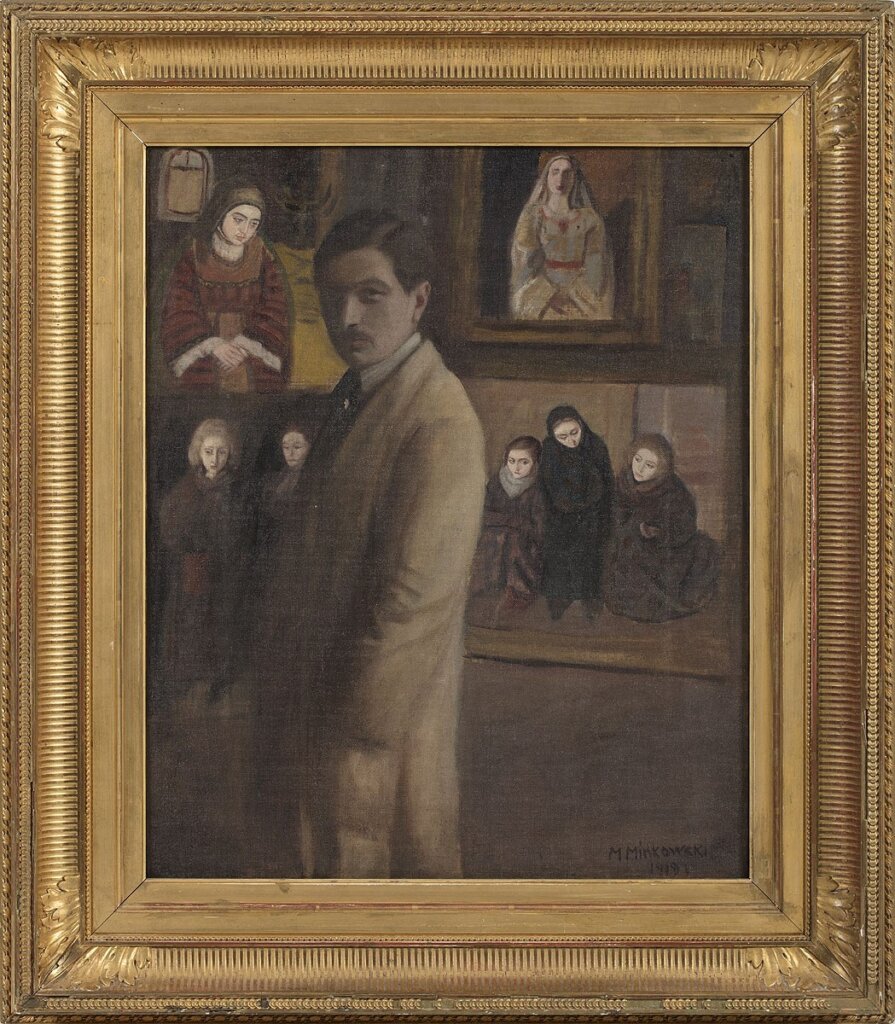
For almost 100 years, “The Bride,” a magnificent painting by Polish Jewish artist Maurycy Minkowski (1881–1930), has been in exile.
In 1930, Minkowski traveled to Buenos Aires for an exhibition of more than 200 of his works. And then tragedy struck. As a child, he had lost his hearing due to an accident. While walking on the street shortly before the exhibit’s opening, he was struck by an oncoming vehicle whose approach he couldn’t hear. The paintings, which were exhibited posthumously, stayed in Argentina and were dispersed.
Since then, Fundación IWO — the Buenos Aires branch of the YIVO Institute for Jewish Research in Vilna — managed to acquire more than 80 of Minkowski’s paintings, some at auction and many through a coordinated effort during the 1940s to rescue 60 works that had been pawned or were on consignment with dealers trying to sell them.
IWO’s Minkowski collection, the largest in the world, was almost lost during the 1994 bombing of the AMIA building (the Buenos Aires Jewish community center), where IWO’s holdings were kept. A volunteer rescue team led by IWO’s academic director Ester Szwarc saved the paintings from the rubble. “The Bride” was among them.
POLIN Museum of the History of Polish Jews in Warsaw had long expressed strong interest in including this painting in its core exhibition. Already in 2007, Renata Piątkowska, Chief Curator of Collections, had proposed “The Bride” for the museum’s exhibit on the Jewish wedding and its transformations in the 19th century.
On Nov. 7, 2025, almost 20 years later, that dream came true. The painting arrived at POLIN Museum to great fanfare, as a landmark gift from IWO made possible by funding from philanthropist and POLIN Museum Council member, Ronald S. Lauder.
Maurycy Minkowski was born into a well-to-do Warsaw family. He attended a school for the deaf, which encouraged his artistic talent. Minkowski graduated from the Kraków Academy of Fine Arts with a gold medal in 1905 and returned to Warsaw. He was shaken by the bloody pogroms and devastation of the Jewish community that he witnessed there and elsewhere that year. This experience prompted him to shift his focus from landscapes and portraits to the trauma of Jews fleeing violence. Those powerful paintings capture the desperation of masses of Jews on the run with nowhere to go. He is best known for these works, although he was never fully appreciated in his lifetime, neither in Poland, nor in Argentina.
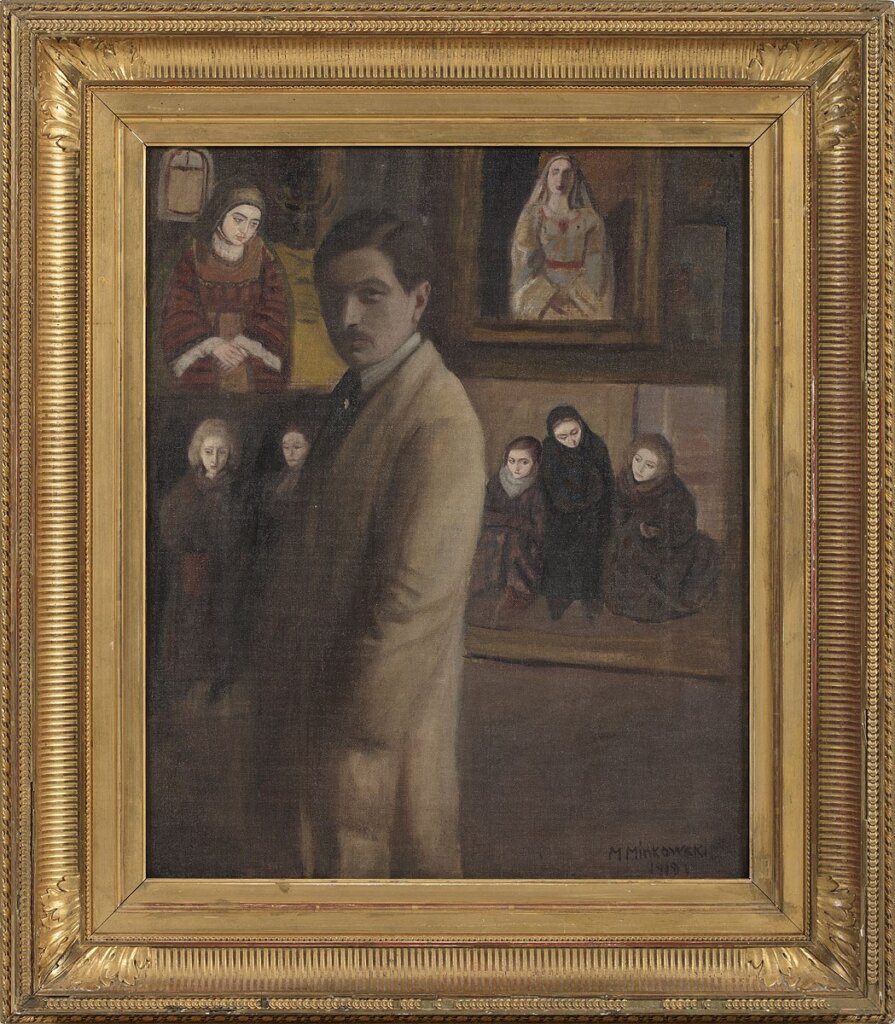
Minkowski moved to Paris in 1908 and in the years that followed turned to scenes of Jewish daily life, essentially in the shtetl. It was around 1920 that he painted “The Bride,” one of several of his works on this theme. The bride’s attire and that of the married women surrounding her recall the clothing of Jewish women more than a century earlier.
The married women are dressed in keeping with tsnies, modesty. Their short hair is covered with an elaborately embroidered bonnet, shimmering with metallic thread. There is also the hint of a shterntikhl, a bejeweled panel along the front of the head covering; a brusttukh, a decorative panel on their chest, and a helzl, a ruff, around their neck.
The bride’s hair has not yet been shorn and is not yet covered. All the women are holding a prayerbook — it was customary to give the bride a beautifully bound prayerbook as a wedding gift. Set in an exquisite wooden frame hand carved by Minkowski himself, the painting captures the solemnity of this moment, as the bride contemplates her future after the wedding. The lives of Jewish women — not only their dress and weddings — would be transformed beyond recognition in the decades that followed.
“This remarkable painting is a true testament to Maurycy Minkowski’s artistic talent and his deep connection to Jewish culture,” said Zygmunt Stępiński, Director of POLIN Museum, when the painting arrived. The work will be the centerpiece of a reimagined presentation in 2027 on the evolution of the Jewish wedding during the nineteenth century.
The post From Buenos Aires to Warsaw, ‘The Bride’ comes home appeared first on The Forward.
Uncategorized
Trump Says Gas Prices May Remain High Through November Midterm Election

U.S. President Donald Trump takes questions from reporters while Vice President JD Vance and Secretary of State Marco Rubio look on, as they attend a meeting with oil industry executives, at the White House in Washington, D.C., U.S., January 9, 2026. REUTERS/Kevin Lamarque
US President Donald Trump said on Sunday that the price of oil and gasoline may remain high through November’s midterm elections, a rare acknowledgement of the potential political fallout from his decision to attack Iran six weeks ago.
“It could be, or the same, or maybe a little bit higher, but it should be around the same,” Trump, who is in Miami for the weekend, told Fox News’ “Sunday Morning Futures With Maria Bartiromo” when asked whether the cost of oil and gas would be lower by the fall.
The average price for regular gas at US service stations has exceeded $4 per gallon for most of April, according to data from GasBuddy. Trump’s comments on Sunday came after weeks of asserting that the spike in prices is a short-term phenomenon, though his top advisers are cognizant of the war’s economic impacts, officials have said.
Earlier on Sunday, Trump announced on social media that the US Navy would blockade the Strait of Hormuz and intercept any ship that paid a crossing fee to Iran, after marathon talks between the US and Iran in Pakistan over the weekend did not yield a peace deal.
“No one who pays an illegal toll will have safe passage on the high seas,” he wrote on Truth Social.
Any US blockade is likely to add more uncertainty to the eventual resolution of the conflict, which is currently subject to a tenuous two-week ceasefire. The new tactic is in response to Iran’s own closure of the strait’s critical shipping lanes, which has caused global oil prices to skyrocket about 50%.
UNPOPULAR WAR HITS TRUMP’S APPROVAL
The war began on February 28, when the US launched a joint bombing campaign with Israel against Iran. The scope quickly expanded as Iran and its allies attacked nearby countries, while Israel targeted Hezbollah with massive strikes in Lebanon.
The war has buffeted global financial markets and caused thousands of civilian deaths, mostly in Iran and Lebanon.
Trump’s political standing at home has suffered, with polls showing the war is unpopular among most Americans, who are frustrated by rising gasoline prices.
The president’s approval rating has hit the lowest levels of his second term in office, raising concern among Republicans that his party is poised to lose control of Congress in the midterm elections. A Democratic majority in either chamber could launch investigations into the Trump administration while blocking much of his legislative agenda.
US Senator Mark Warner of Virginia, the ranking Democrat on the Senate Intelligence Committee, questioned the strategy behind Trump’s planned blockade.
“I don’t understand how blockading the strait is going to somehow push the Iranians into opening it,” he told CNN’s “State of the Union” on Sunday.
In a separate appearance on CBS’s “Face the Nation,” Warner said the blockade would not undermine Iranian control of the waterway.
“The Iranians have hundreds of speedboats where they can still mine the strait or put bombs against tankers in closing the strait,” he said. “How is that going to ever bring down gas prices?”
Although Trump has repeatedly said that the war would be over soon, Republican US Senator Ron Johnson of Wisconsin told ABC News’ “This Week” on Sunday that achieving US aims in Iran “could take a long time.”
“It’s going to be a long-term project,” said Johnson, who was not asked about Trump’s proposed blockade. “I never thought this would be easy.”
Uncategorized
Israel’s Ben-Gvir Visits Flashpoint Al-Aqsa Mosque Compound

Israeli politician Itamar Ben-Gvir walks inside the Knesset, in Jerusalem, Oct. 13, 2025. Photo: Chip Somodevilla/Pool via REUTERS
Israel’s far-right police minister Itamar Ben-Gvir visited the flashpoint Al-Aqsa Mosque compound in Jerusalem on Sunday, saying he was seeking greater access for Jewish worshipers and drawing condemnation from Jordan and the Palestinians.
The compound in Jerusalem’s walled Old City is one of the most sensitive sites in the Middle East. Known to Jews as Temple Mount, it is the most sacred site in Judaism and is Islam’s third-holiest site.
Under a delicate, decades-old arrangement with Muslim authorities, it is administered by a Jordanian religious foundation and Jews can visit but may not pray there.
Suggestions that Israel would alter the rules have sparked outrage among Muslims and ignited violence in the past.
“Today, I feel like the owner here,” National Security Minister Ben-Gvir said in a video filmed at the site and distributed by his office. “There is still more to do, more to improve. I keep pushing the Prime Minister (Benjamin Netanyahu) to do more and more — we must keep rising higher and higher.”
A statement from the Jordanian foreign ministry said it considered Ben-Gvir’s visit to be a violation of the status quo agreement at the site and “a desecration of its sanctity, a condemnable escalation and an unacceptable provocation.”
The office of Palestinian president, Mahmoud Abbas, said such actions could further destabilize the region.
Ben-Gvir’s spokesman said the minister was seeking greater access and prayer permits for Jewish visitors. He also said that Ben-Gvir had prayed at the site.
There was no immediate comment from Netanyahu’s office. Previous such visits and statements by Ben-Gvir have prompted Netanyahu announcements saying that there is no change in Israel’s policy of keeping the status quo.
Muslim, Christian and Jewish sites, including Al-Aqsa had been largely closed to the public during the Iran war. There was no immediate sign of unrest on Sunday after Ben-Gvir’s visit.
Uncategorized
Netanyahu Visits Troops Fighting Hezbollah in Southern Lebanon

Israeli Prime Minister Benjamin Netanyahu speaks during a press conference at the Prime Minister’s office in Jerusalem, Aug. 10, 2025. Photo: ABIR SULTAN/Pool via REUTERS
i24 News – Israeli Prime Minister Benjamin Netanyahu visited Israeli forces operating in southern Lebanon on Sunday as military operations against Hezbollah-linked targets continue.
Netanyahu toured forward positions alongside Defense Minister Yisrael Katz, Eyal Zamir, and Northern Command Commander Rafi Milo, meeting troops and receiving operational briefings from commanders on the ground.
Speaking to soldiers, Netanyahu praised their performance and said operations in the Lebanese security zone were ongoing.
“The war continues, including within the security zone in Lebanon,” he said, adding that Israeli forces were working to prevent infiltration attempts and neutralize threats such as anti-tank fire and missiles.
He described the northern campaign as part of a broader regional struggle involving Iran and its allies, saying Israel’s adversaries were now “fighting for their survival” following sustained Israeli military pressure.