


Uncategorized
Gaza protest slogans amounted to ‘racial slurs’ toward Jews, Trump administration alleges in new Harvard lawsuit
In the Trump administration’s year-long battle with Harvard University threatening federal funding over alleged antisemitism, its precise concerns have emerged in fuzzy and piecemeal fashion — in comments from White House officials, administrative agency findings and letters to the university as a pressure campaign and negotiations dragged on.
That changed Friday with a lawsuit filed by the Department of Justice under Title VI of the Civil Rights Act of 1964, which levels specific allegations of how the government contends Harvard violated the rights of Jewish and Israeli students.
The government claims in its federal court complaint that these students had been “harassed, physically assaulted, stalked, and spat upon,” and relies heavily on the report produced by Harvard’s own antisemitism task force, which found many Jewish students had experienced painful social isolation but stopped short of alleging that the university itself had engaged in antisemitism.
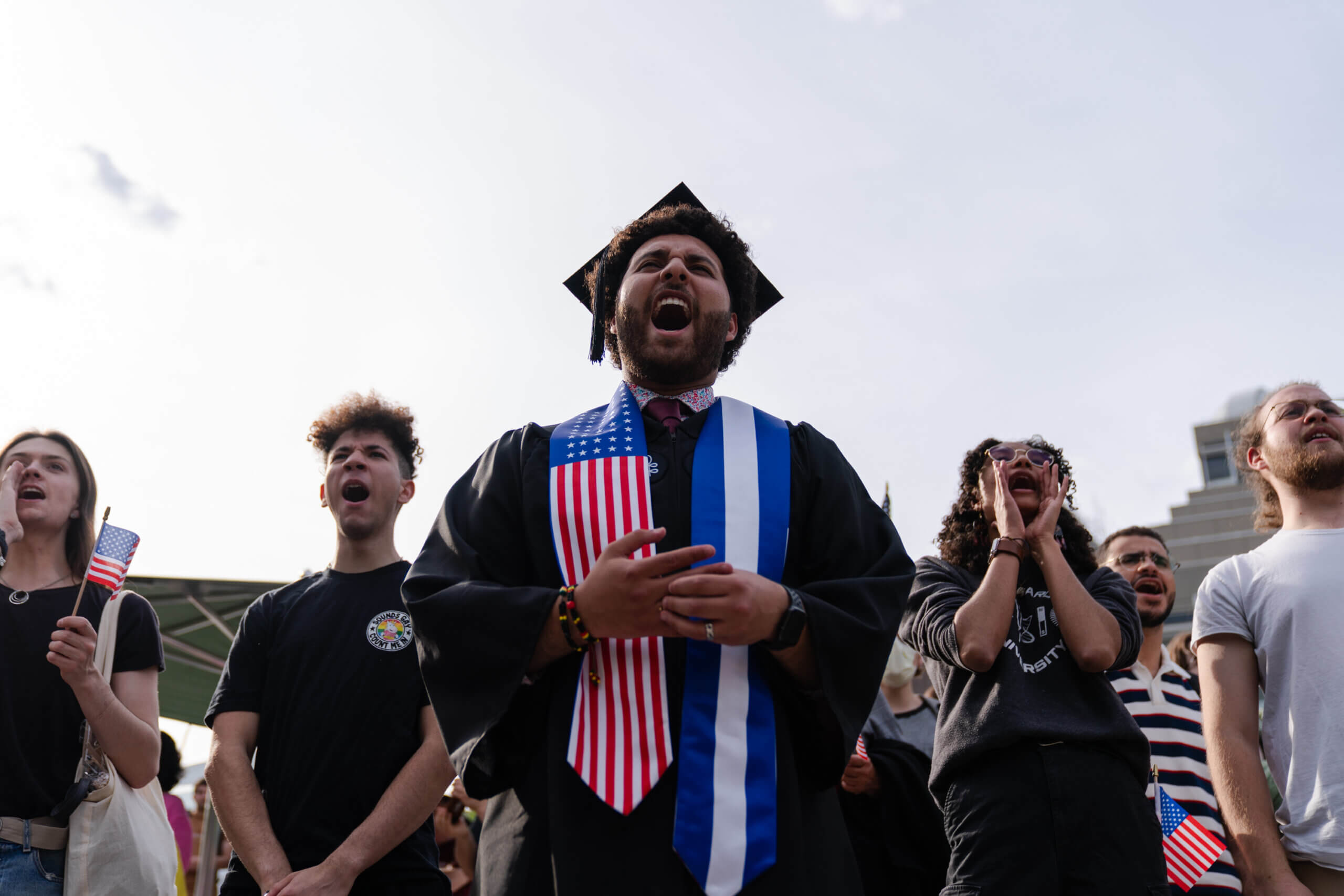
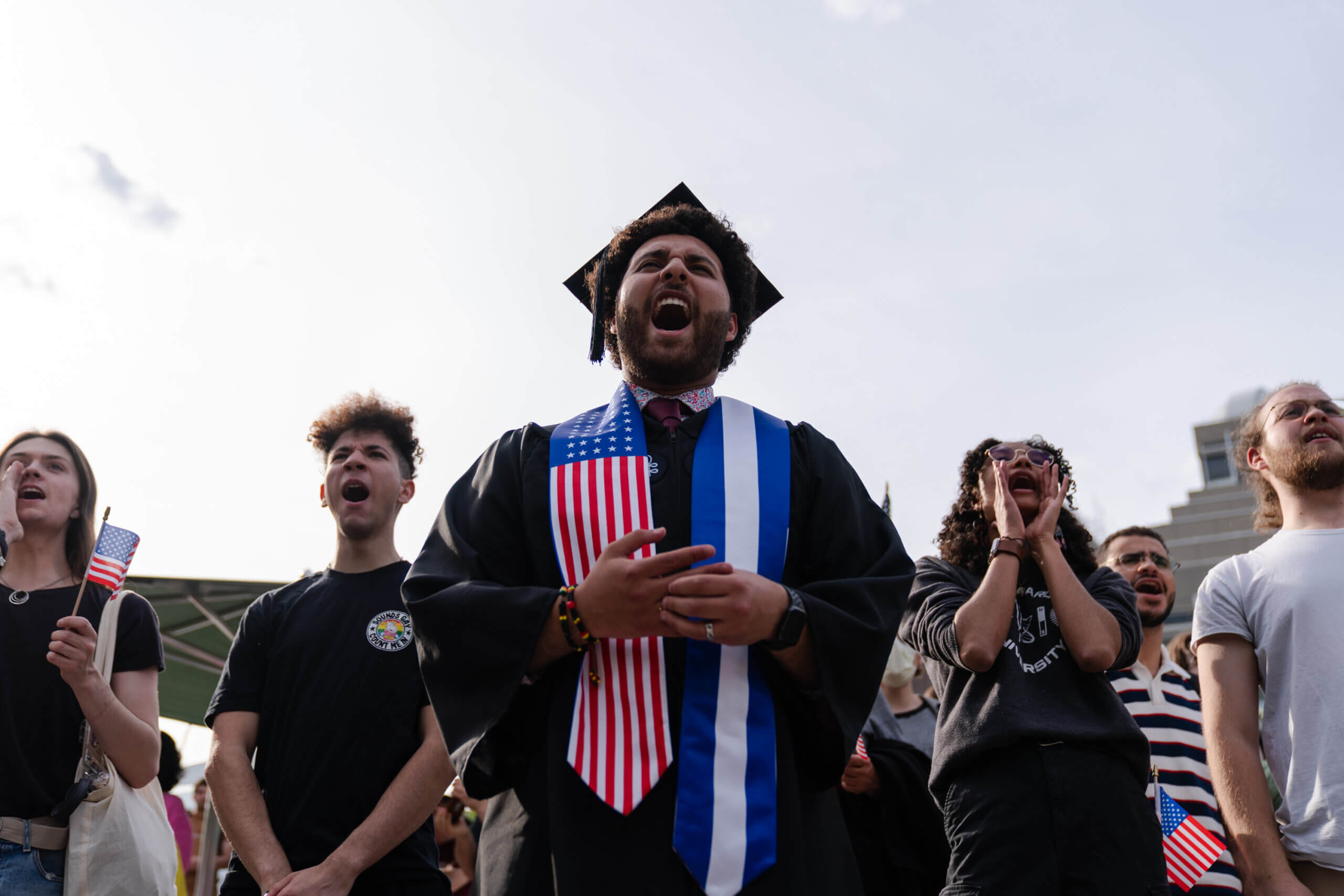
The lawsuit goes further, though, presenting its specific allegations alongside strident arguments popular with political opponents of the campus demonstrations that swept Harvard and other higher education institutions across the country after Oct. 7.
Harvard was not only too lenient toward protesters who violated school rules, but the protests themselves sought to intimidate and threaten violence toward Jewish students — the lawsuit claims — through the use of particular language.
Offensive terms
In laying out their case that students’ civil rights have been violated, lawyers for the federal government detailed offenses that Harvard allegedly permitted or allowed against Jewish students, and cited testimony from students who told the antisemitism task force that they had been assaulted and were afraid to display wear Jewish symbols on campus.
The complaint also provides examples of Harvard responding to claims of bias and discrimination lodged by other minority groups, that it says were not taken when community members raised concerns around antisemitism.
While stating that “peaceful protests that annoy Jewish and Israeli students” are not the target, the DOJ goes on to detail demonstrations that it asserts crossed a line, using slogans such as “from the river to the sea, Palestine will be free,” “globalize the intifada,” and “there is only one solution, intifada revolution.”
The DOJ stated: “to a Jewish or Israeli ear, these chants are racial slurs.”
After summarizing the Hamas attack against Israel — including a graphic allegation that Hamas terrorists cut open a pregnant woman’s womb and stabbed her fetus — the lawsuit said that the violence was “representative of what is meant by ‘intifada.’”
And the complaint also stated: “‘Intifada’ was the name given to a pair of wars waged by Palestinian groups against Israeli civilians” and that the only “reasonable” way to interpret the terms used by protesters was “as calls to kill Jews, rather than metaphors expressing political opposition to Israel.”
Prevailing on this point won’t necessarily be easy.
“Intifada,” in the context of the Israeli-Palestinian conflict, refers to two periods of political unrest that combined widespread protests against Israeli military rule in the West Bank and Gaza with violent attacks on Israeli civilians. Palestinian militants killed around 1,000 Israelis during the second Intifada, which took place between 2000 and 2005, while Israeli soldiers killed an estimated 3,000 Palestinians.
“Globalize the intifada” has become an especially controversial slogan because it invokes this history of violence for many Jews.
But proponents of the slogans, including some Jews in the campus protest movement, have embraced them as an expression of solidarity with Palestinian resistance to Israeli occupation.
The lawsuit similarly states that “from the river to the sea” is similarly not a political slogan but a call to expel the Jewish population of Israel.
Potential precedent
Legal precedent on the slogans don’t work in Trump’s favor.
In October, a panel of the First Circuit Court of Appeals — which oversees the Massachusetts district court in which the government filed its lawsuit against Harvard — rejected
the argument by student plaintiffs and StandWithUs that protesters at MIT were engaged in antisemitic behavior when they used similar slogans.
“Plaintiffs say that we should construe chants of ‘from the river to the sea, Palestine will be free’ and ‘intifada revolution’ as calls to wipe out the Jewish people as such,” the judges wrote in their ruling. “But neither slogan says as much on its face, nor do plaintiffs allege facts suggesting that either chant was commonly so constructed by the protesters.”
Ken Marcus, who ran the Education Department’s civil rights division during the first Trump administration, acknowledged that ruling could create a “controlling precedent” compelling the judge assigned to the Department of Justice’s case against Harvard to reject claims that the slogans were de facto antisemitic.
But he said other judges in the district had rejected attempts by Harvard to dismiss on free speech grounds other lawsuits that claimed that the school tolerated an antisemitic environment for Jewish students.
And some courts elsewhere in the country have reached the conclusions the Trump administration seeks. A federal judge in Washington, D.C. ruled in August that stealing an Israeli flag could be a hate crime because “targeting the Star of David is as racially motivated as the highly offensive racial slur, ‘‘n—.’” And the judge overseeing a lawsuit against the University of California, Los Angeles, that was ultimately settled ruled that anti-Zionist demonstrations required Jewish students to “denounce their faith,” declaring this “unimaginable and so abhorrent to our constitutional guarantee of religious freedom.”
Marcus, who now runs the Brandeis Center for Human Rights Under Law, said he supported the government lawsuit and was not worried that an unfavorable ruling — in which a judge rejects the notion that the campus protests were inherently antisemitic — would make it more difficult to bring similar cases against other universities.
“Even if the Justice Department loses its case, other universities aren’t going to want to be dragged through this sort of process,” Marcus said. “It will be expensive, it will be time-consuming — it’s just not the sort of thing that other institutions would want to risk.”
Latest salvo
The lawsuit is only the latest chapter in a campaign against Harvard that began almost a year ago when three federal agencies threatened to suspend $9 billion in funding to the venerable Cambridge institution unless it made a wide range of changes ostensibly intended to address antisemitism, including changes to academic departments and campus protest policies.
When the government made good on its threat to cut funds, Harvard sued and won a series of legal victories starting in June. Those, culminated in the fall, when a federal judge in Boston ruled that the funding freeze was illegal and that the White House had used “antisemitism as a smokescreen for a targeted, ideologically-motivated assault on this country’s premier universities.”
The government is appealing that ruling. But where the initial funding freeze relied on an untested legal theory in which the government claimed it was allowed to suspend grants for violations of civil rights law without following the standard procedure, Friday’s lawsuit follows the more conventional path and asks for judicial approval to revoke federal funding for Harvard and clawback three years worth of grants.
“In theory this process is what they should have been doing all along,” said Katy Joseph, who served as an Education Department official during the Biden administration. “But I think the conflict between the federal government and Harvard has gone far beyond vindicating the rights of Jewish and Israeli students — it’s more about proving a point than ensuring all students can learn.”
The post Gaza protest slogans amounted to ‘racial slurs’ toward Jews, Trump administration alleges in new Harvard lawsuit appeared first on The Forward.
Uncategorized
Atlanta movie exec who complained of ‘nasty Jews’ is running for Congress
Ryan Millsap, a prominent film and real estate executive in Atlanta who made antisemitic and racist comments in private text messages, is now running for a congressional seat in rural Georgia.
ProPublica and the Atlanta Journal-Constitution reported two years ago that Millsap had sent the offensive texts to a girlfriend.
“Just had a meeting with one of the most nasty Jews I’ve ever encountered,” Millsap wrote in a 2019 text message viewed by the Forward. John Da Grosa Smith, Millsap’s former attorney, filed the text messages in Fulton County Superior Court in Georgia in 2024.
The news outlets also reported that Smith said in court documents that Millsap had allegedly made derogatory comments about Jews while they worked together, including referring to his Jewish colleagues as “the Jew crew” and calling one of them “a greedy Israelite.”
ProPublica and the AJC reported that during arbitration with Smith, Millsap said the comments Smith had described represented “locker room talk.”
Millsap apologized for the offensive text messages in a 2024 statement to the news outlets, saying “comments which I never intended to share publicly have come to light, and people I care about and who put their trust in me have been hurt.”
He also spoke directly at the time to the racist and antisemitic remarks.
“I want to extend my sincere apologies to my dear friends, colleagues and associates in both the black and Jewish communities for any and all pain my words have caused,” his statement continued. “My sincere hope is that the bonds and friendships that we have forged speak far louder than some flippant, careless remarks.”
Millsap is running in the Republican primary for the open seat in Georgia’s 10th Congressional District, which stretches from the far outskirts of Atlanta to the South Carolina border and includes the college town of Athens. The district is outside of the major Jewish population centers in Georgia and had fewer than 7,000 Jewish adults, according to the American Jewish Population Project.
The election is on May 19 and Millsap is running against a popular state lawmaker Houston Gaines in what is expected to be a competitive race.
Gaines called Millsap’s reported text messages “disqualifying.”
“Antisemitism has no place in this country, and as a Christian, I’ll always stand firmly against it,” Gaines said in a statement to the Forward.
Millsap did not respond to a request for comment about the text messages or whether he has conducted any outreach to the local Jewish community as part of his campaign.
In an interview last month with the Washington Reporter, Millsap said that negative interactions with local protesters had pushed him into politics. Millsap’s studio controlled land adjacent to the construction site for Cop City, a planned police training ground near Atlanta, and both sites were targeted by activists.
“They tried to ruin my reputation,” Millsap said in the interview. “Leftist journalists at ProPublica were enlisted to write hit pieces on me, call me a racist, antisemite, anything they could do to hurt my life and put me in a bad political position, because obviously DeKalb County is mostly black Democrats.”
Millsap’s Blackhall Group, whose studio produced movies including “Venom,” “Blockers,” and “Loki,” purchased the property in a county forest near the future Cop City site in 2021. Millsap said activists violently attacked construction workers on his property, burned a pickup truck and left threatening messages in 2022.
He has referred to the demonstrators as “antifa” and made his dispute with them a cornerstone of his campaign.
Antisemitism does not seem to be a major issue in the congressional race, in which Millsap and Gaines have focused on immigration and election security. The seat is considered a safe Republican district and the winner of the GOP primary is expected to win the general election.
According to the text messages filed in court and reviewed by the Forward, Millsap and his then-girlfriend, Christy Hockmeyer, complained about Jews and Black people on several occasions. “F—king Black people,” Millsap wrote in one message reported by ProPublica and AJC after Hockmeyer complained about a Black driver whose car she hit.
Hockmeyer also apologized for her role in the text message conversations with Millsap. “Those comments do not reflect who I am and I disavow racism and antisemitism as a whole,” she wrote in a statement to ProPublica and the AJC.
The ProPublica and AJC article noted that Millsap had built close ties with the Black and Jewish communities in Atlanta after relocating to the city from California and seeking to become active in its robust film industry. He had also been applauded for embracing workplace diversity.
His apology received a mixed response from those he had worked with in Atlanta.
Smith, Millsap’s former attorney, filed the text messages in a lawsuit after the two became embroiled in a heated legal dispute. An arbitrator found that Smith had violated his contract with Millsap when the two were working together and ordered him to pay $3.7 million for breach of contract and breach of fiduciary duty.
Millsap said in his 2024 apology that Smith had “violated the most basic and fundamental principle of attorney client privilege and released private text messages between myself and a former romantic partner.”
The post Atlanta movie exec who complained of ‘nasty Jews’ is running for Congress appeared first on The Forward.
Uncategorized
A new book explores the vibrancy of pre-war Warsaw
The Last Woman of Warsaw
Judy Batalion
Dutton, 336 pages, $30
Don’t be misled by the title of this debut novel by Judy Batalion, nor by her previous book, The Light of Days, about the role of Polish-Jewish women in the anti-Nazi resistance.
Though the specter of the Holocaust looms over The Last Woman of Warsaw, the novel is not really Holocaust fiction. It does not portray a final female survivor of that embattled city. Its subject is instead the odd-couple friendship of two young Jewish women embroiled in the artistic and political ferment of pre-World War II Warsaw.
For Batalion, recreating the atmosphere and quotidian life of this cosmopolitan city, which once elicited comparisons to Paris, was a major aim. “In our contemporary minds, historical Warsaw conjures images of gray and death,” she writes in a lengthy author’s note. But that shouldn’t negate its more vibrant past. “Long before Vegas,” Batalion writes, “Warsaw was the capital of neons, its night skyline dotted with glittering cocktail glasses and chefs carrying platters of roasts. Much of this artistic production was Jewish.”
Even this brief excerpt shows that Batalion isn’t much of a prose stylist. But awkward locutions and diction mistakes aside — including the repeated use of “cache” when she means “cachet” — Batalion generally succeeds in immersing readers in Warsaw’s lively urban bustle and heated street politics. Here, skating on the edge of catastrophe, Polish Jews of varying ideologies and backgrounds face off against antisemitic persecution and violence.
Batalion’s handling of the historical backdrop is defter than her fledgling fictional technique. The narrative of The Last Woman of Warsaw is a plodding and repetitive affair that ultimately turns on an improbable coincidence.
The plot involves the sudden disappearance of a photography professor with communist ties and the halting efforts of the novel’s two protagonists to find and free her. The pair, whose initial antagonism mellows into friendship, are Fanny Zelshinsky, an upper-middle-class Warsaw University student, and Zosia Dror, who hails from a religious shtetl family. Her adopted surname references the Labor Zionist group that now claims her loyalty. Despite their differences, the two women have in common a desire to shake off the past and forge new lives. They also share an attraction to a single man, Abram, who can’t seem to decide between them.
When the story begins, Fanny is engaged to the perfectly nice, highly suitable Simon Brodasz, whom she’s known since her teenage years. Her mother is pushing the match. But Fanny is not in love and dreads the loss of freedom marriage entails. Her true passion is photography – in particular, fashion photography, to which she brings an idiosyncratic, modernist flair.
Zosia’s passion is political activism, and she aspires to a more prominent leadership role in Dror. Like Fanny, she is at odds with her mother, who is urging her to return to the shtetl for the festivities preceding her sister’s wedding.
What brings these women together is the arrest of the famous photographer Wanda Petrovsky, to whom both are connected. Wanda is one of Fanny’s professors, and Fanny needs her help to enter a potentially career-making exhibition. Wanda also happens to be a political activist, a leader of Zosia’s Zionist group, and Zosia hopes she’ll provide her with a visa for Palestine.
As Batalion’s narrative alternates between their perspectives, the antisemitic fervor in Warsaw mounts. Polish right-wing groups have started terrorizing Jews. Police invade clubs where Jewish comedians are mocking antisemitism. At Warsaw University, where Jewish students already have been subject to admissions quotas, the humiliation of being consigned to a “Jew bench” in class comes as a humiliating shock to Fanny.
Zosia, by contrast, has seen far worse. She and her family were victims of one of the murderous pogroms that periodically roiled the Polish countryside. She has been traumatized by the burning of her home, her father’s injuries and the refusal of her neighbors to offer refuge from the catastrophe.
In late 1930s Warsaw, Polish Jews are fighting back – with protests, hunger strikes and more. But what will any of this accomplish? Will Wanda attain her freedom, with or without the help of her protegees? Will Zosia and Fanny successfully defy their families and find meaningful lives? Which woman will Abram ultimately choose? And will any of this matter as both Poland and Polish Jewry hover on the brink of destruction?
Batalion answers these questions in an epilogue describing the fate of both women and of Fanny’s photographs, which eventually take a political turn, and in her author’s note. In the note, she reveals that all four of her own grandparents “spent their young adulthoods in interwar Warsaw.” That heritage helps account for her own passion: “to memorialize Warsaw’s golden age of creativity and the Jewish art and culture that, along with six million lives, was also decimated in the Holocaust.” A worthy endeavor, however clumsily executed.
The post A new book explores the vibrancy of pre-war Warsaw appeared first on The Forward.
Uncategorized
Mahmoud Khalil’s anti-Zionist case to Jews shows the case for skepticism
Mahmoud Khalil wants to reassure the Jewish community. In an extensive new interview with the Forward, the pro-Palestinian protest leader recognized “a Jewish connection” to Israel, and promised that a free Palestine would include safety and security for Jewish residents.
And yet I read the interview and felt a sense of alarm.
Not because Khalil seems insincere. I believe he means much of what he says. But rather because his attempts to instill confidence fall short in ways that illuminate exactly why so many Jews remain afraid and skeptical of the anti-Zionist movement.
Serious causes for serious concerns
Khalil describes himself as a pragmatist. In his activism, however, he envisions a utopia.
He is adamant that a two-state solution preserving a Jewish majority in Israel is a nonstarter. He argues, instead, for a democratic country — or multiple countries — across Israel, the West Bank and Gaza, with equal rights for all and the right of return for Palestinian refugees.
“I know it might sound like a very ideal utopia,” he told the Forward‘s Arno Rosenfeld, “but this is what we should aspire for.”
Khalil is concerned that Jewish fear is an obstacle to Palestinian liberation, and suggests that this fear is misplaced. “People think that we want to drive all Jews to the sea,” he said. “We don’t believe that.”
But history has long shown that Jewish safety without Jewish autonomy often proves conditional. In the ideal that Khalil advances, Israel would lose the self-determination that leads so many Jews to view it as a safe haven. My late grandfather, who was deported to a Siberian gulag by the Soviets from Lithuania — where about 90% of his fellow Jews were murdered by the Nazis — put it simply: Israel was a place where he felt his fate was in his own hands.
Nor is apprehension of anti-Zionism misplaced. Report after report has cataloged persistent harassment of Jews, threats of violence against Zionists, and invocations of antisemitic tropes within anti-Zionist movements. Yes, there are moderates, many of whom are driven by a commitment to a better future for Palestinians. But there are also extremists, and scenes on campuses and city streets around the world have shown that their tactics often prevail.
Adding to Jews’ sense of alarm are decades of violence within Israel — including the Second Intifada and Hamas’ Oct. 7, 2023 attack — and globally, including recent violence against American Jewish institutions. Jews are not scared because we misunderstand the aims of the anti-Zionist movement. We are scared for good reason.
Political abstractions
A genuine effort at reassurance would engage with that truth. Instead, Khalil dances around it, suggesting that the thing we’re worried about doesn’t actually exist. He says, for example, that the pro-Palestinian campus movement did a good job of keeping antisemitism at bay. It did not.
Even when it comes to the well-established facts of Hamas’ Oct. 7 massacre, he demurs: “I wouldn’t rule out that Hamas targeted civilians,” he said, “but I wouldn’t confirm it either.”
When referencing the excesses of pro-Palestinian campus protests, Khalil retreated into vague language. “There were maybe some bad actors,” he said. His denunciations of antisemitism remained safely generic: “some anti-Zionist actions may touch on antisemitism that we absolutely oppose.”
Who, exactly, is “we” here?
Political movements are not abstractions. They consist of real people doing real things. When excesses are common enough, they become characteristic. This is something I’ve long argued about the Israeli right as well. We cannot dismiss settler violence or anti-Palestinian abuses as fringe when they keep escalating and enjoy support from those in power.
It’s easy to say you oppose antisemitism or suffering by Palestinians, or that a utopian future is possible if we all look past our fear. It’s much harder to look within your political coalition and call out the specific negative acts your allies have committed — or acknowledge their very real consequences.
Denial and Oct. 7
Circle back to Khalil’s alarming equivocation about Oct. 7.
He frames the killings as civilians being “caught up” in violence, not targeted by it. Notice the evasive grammar: Khalil says “there were crimes committed” and Hamas has “a responsibility,” rather than “Hamas committed crimes.”
Khalil does explicitly say that he thinks Hamas is “not up to the Palestinian aspiration for liberation” and that he “doesn’t believe in political Islam.” But for someone so attuned to the language of liberation and justice, he is remarkably comfortable with passive voice when it comes to Hamas carrying out horrific murders on Oct. 7.
As I’ve previously written, the evidentiary record is overwhelming. Amnesty International and Human Rights Watch, organizations critical of Israel, independently concluded that Hamas deliberately and systematically targeted civilians. In one intercepted call, a Hamas terrorist bragged to his parents, “Look how many I killed with my own hands! Your son killed Jews!”
Neutrality on established facts is no different than denialism. If you are trying to reassure Jews but can’t acknowledge that Hamas killed Jews as such, any reassurance you have to offer will ring hollow.
A practical peace
Khalil says he is opposed to any violence against civilians but cannot dictate what Palestinians who experience Israeli human rights abuses should do. He says he understands why Palestinians turn to resistance, even violence, in the face of oppression.
But if you say you understand why decades of oppression push Palestinians toward resistance, then you should also understand why decades of terrorism push Israelis toward aggressive security measures, including ones that harm Palestinian civilians. If every act is merely a justified reaction to a prior act, we will end up in a world in which it’s too easy to argue that all violence is legitimate, rather than none of it.
The deep culture of mutual suspicion that this painful history has bred may be the biggest obstacle to Khalil’s utopian vision.
I share Khalil’s aspirations for peace. But Israelis, even most liberals, leftists and the millions who have protested the right-wing government, say they won’t accept a one-state solution. One 2025 poll by The Institute for National Security Studies, an independent think tank affiliated with Tel Aviv University, found that only 4% of all Israelis, and 1% of Israeli Jews, prefer a one-state solution with equal rights. Palestinians, too, are skeptical of a single state with equal rights.
At the same time, many Israelis oppose a two-state solution. So do many Palestinians. The people who live in the region hold complicated and often contradictory ideas of the path forward, and Khalil does not necessarily speak on their behalf.
Any anti-Zionist looking to reassure Jews needs to, at minimum, acknowledge that Hamas killed civilians deliberately, because they were Jews; condemn specific instances of antisemitism rather than just the concept in the abstract; and ask why Jews are scared right now, rather than telling us we shouldn’t be.
Yet Khalil’s reticence to be honest about his own movement’s flaws is a mirror of our own. Supporters of Israel have long been reluctant to name the failures of the Israeli right and to reckon with how settlements and the occupation harm Palestinians.
Khalil recounts being born in the Palestinian refugee camp Khan Eshieh in Syria, and raised on stories of his grandparents’ expulsion from a village near Tiberias. He was shot by an Israeli soldier when he was just 16. His effort to nevertheless engage with Israeli perspectives, like by reading Ari Shavit, is admirable. Jews should similarly listen to Palestinian perspectives and sit with Palestinian stories, including Khalil’s and those of Palestinians living today in the West Bank and Gaza.
The only way for any of us to build a durable political movement is to be exactingly honest about the ways in which we have, so far, failed, and to ask others with open ears: Why are you so scared?
The post Mahmoud Khalil’s anti-Zionist case to Jews shows the case for skepticism appeared first on The Forward.