



Uncategorized
Hamas Exploits Gaza Ceasefire to Rebuild Military Power, Tighten Civilian Control

Hamas fighters on Feb. 22, 2025. Photo: Majdi Fathi via Reuters Connect
As tensions in the Middle East escalate and global attention focuses on the war with Iran and fragile talks over Lebanon, Hamas is quietly exploiting the ceasefire in Gaza to tighten its grip on civilian life while rebuilding its military strength behind the scenes.
Even as Hamas operatives seem to keep a lower profile on Gaza’s streets, the Palestinian terrorist group’s hold of roughly half the enclave remains readily apparent through checkpoints, tight control over goods, and the takeover of civilian institutions, including hospitals, Israel’s Channel 12 reported.
According to new Israeli military intelligence assessments, Hamas is exploiting the cover of the ceasefire to rapidly rebuild its operational capabilities, restore its command structure, and tighten its grip across strategic sectors of the war-torn enclave.
Israeli officials estimate that Hamas’s military wing, the al-Qassam Brigades, is rebuilding its forces, with its ranks now totaling roughly 27,000 members.
The terrorist group has also reportedly maintained monthly salary payments to some 49,000 officials who oversee the administration of daily life in Gaza.
Across the enclave, Hamas continues to oversee ministries responsible for the economy, education, health, and welfare, along with 13 municipalities, maintaining a largely behind-the-scenes system of governance.
Under the ceasefire, the Israeli military currently controls 53 percent of Gaza, while Hamas remains entrenched in the nearly half of Gazan territory it still controls, where the vast majority of the population lives.
Beyond its efforts to rebuild military capabilities, Hamas is tightening its hold over civilian life, extending its reach through local authorities, revenue collection, and control of aid and goods, including taxation, attempts to dominate aid distribution, regulation of commerce, and the imposition of commercial fees.
With the apparent goal of operating under the radar, Hamas has reportedly embedded itself within civilian institutions, including hospitals and charitable organizations, where it collects money from patients and exerts de facto control over management and resources.
There have also been reports of Hamas intensifying its crackdown and social control across the enclave, amid allegations of widespread abuse, coercion for food, sexual exploitation, rising child marriages, and an increase in child pregnancies.
According to the United Nations Population Fund (UNFPA), while pre-war numbers of child brides fell to 11 percent in 2022, a decrease from 26 percent in 2009, marriage records from 2025 showed that at least 400 girls between 14 and 16 had become wives.
Even as Hamas’s military presence appears less visible on the ground, the organization continues consolidating power behind the scenes through civilian institutions, the economy, and the health system — quietly rebuilding its influence across Gaza’s daily life infrastructure.
Israeli officials have warned that Hamas’s ongoing rebuilding efforts are allowing the group to retain control and steadily sustain its influence despite over two years of military conflict.
Last month, the Meir Amit Intelligence and Terrorism Information Center (ITIC) — an Israel-based research institute — released a report explaining how the US-Israeli war against the Islamic regime in Iran has disrupted the second phase of the ceasefire agreement in Gaza, which requires Hamas to disarm in order for Israeli troops to withdraw.
The report warns that such delays are giving Hamas a window of opportunity to rearm and further tighten its control over Gaza, complicating fragile efforts to move forward with the next stage of the truce.
ITIC’s assessment shows Hamas has moved to reassert control over parts of the war-torn enclave and consolidate its weakened position by targeting Palestinians it labels as “lawbreakers and collaborators with Israel.”
With its security control tightening, Hamas’s brutal crackdown has escalated, sparking widespread clashes and violence as the group seeks to seize weapons and eliminate any opposition.
According to ITIC’s report, Hamas is also rebuilding its military capabilities by smuggling arms from Egypt and producing weapons independently, while simultaneously consolidating civilian control through expanded police presence, regulation of markets, and the distribution of financial aid to residents in areas it governs.
On Sunday, the New York Times reported that two Hamas officials said the Palestinian terrorist group planned to surrender thousands of automatic rifles and small weapons which belonged to Gaza police and other internal security organizations. However, this would not entail full disarmament, which according to the US-backed peace plan is a key prerequisite for beginning major reconstruction of Gaza and for Israel to further withdraw its force.
According to several reports, Hamas recently rejected the Board of Peace’s eight-month phased plan for the terrorist group to disarm. US President Donald Trump proposed the Board of Peace in September to oversee his plan to end the Israel-Hamas war in Gaza, subsequently saying it would address other conflicts.
Earlier this month, Hamas demanded that Israeli forces exit Gaza first before giving up weapons.
Uncategorized
Germany Flags Surge in Antisemitic Slogans, Extremist Symbols, Hate Speech Under Banner of ‘Palestine Solidarity’

Pro-Palestinian demonstrators during a protest against Israel to mark the 77th anniversary of the “Nakba” or catastrophe, in Berlin, Germany, May 15, 2025. Photo: REUTERS/Axel Schmidt
German authorities are stepping up scrutiny of antisemitic slogans, extremist symbols, and online hate speech amid a deteriorating climate of hostility toward Jews and Israelis that officials warn is hardening into a deepening national crisis.
On Tuesday, Germany’s domestic intelligence agency, the Federal Office for the Protection of the Constitution (BfV), released new guidance aimed at raising awareness of antisemitism and extremist forms of so-called “Palestine solidarity,” with a particular focus on developments in Berlin.
According to the agency’s newly published report, a growing network of extremist activists has emerged within segments of the pro-Palestinian movement in the German capital, where anti-Israel demonstrations increasingly feature antisemitic slogans, hateful imagery, and incitements to violence.
German officials said these new resources are intended primarily for teachers, educators, and the general public, as part of broader efforts to strengthen democratic resilience and sharpen awareness of more subtle forms of antisemitism.
In a document entitled “Hidden Messages – Antisemitic Codes and Ciphers,” the agency defines antisemitism as “rejecting, hostile or violent attitudes towards Jews or towards people who are perceived as Jewish.”
Among the report’s key findings is that within secular pro-Palestinian extremism, criticism of Israel’s policies and actions is increasingly being generalized onto Jews as a whole, with anger over the Israeli-Palestinian conflict frequently mutating into antisemitic narratives.
The agency also points to a growing use of antisemitic slogans and imagery, noting recurring symbols among extremist pro-Palestinian activists, including the red inverted triangle — used to signal support for Hamas — and the watermelon motif when used to depict the outline of Israel.
It also points to the slogan “From the river to the sea, Palestine will be free,” which is widely interpreted as a call for the elimination of the State of Israel.
German officials warned that these dynamics are increasingly serving as “bridge narratives,” drawing together otherwise disparate extremist circles, including the far right, far left, and Islamist movements.
The report further notes that since the Hamas-led invasion of and massacre across southern Israel on Oct. 7, 2023, segments of Germany’s radical left have drawn closer to what they describe as the “Palestinian liberation struggle.”
Islamist and left-wing extremists are increasingly merging anti-imperialist ideology with entrenched antisemitic narratives in their propaganda around the Israel–Hamas war, including claims of a “genocide in Gaza,” depictions of the Jewish state as a “colonial power,” and labels such as “child murderer.”
Such antisemitic narratives have become a central mobilizing force since the Oct. 7 atrocities, shaping public discourse and being used to justify acts of violence and intimidation.
After more than two years of escalation, German officials warn that the threat to Jewish life has risen dramatically, with antisemitic hate speech surging as extremist actors deliberately exploit the war in Gaza for propaganda.
Uncategorized
Anti-Israel Rep. Thomas Massie Trails in Race as New Kentucky Ad Targets Jewish Donor With Rainbow Star of David

US Rep. Thomas Massie (R-KY) leaves a meeting of the House Republican Conference in the US Capitol on Wednesday, June 4, 2025. Photo: Tom Williams/CQ Roll Call/Sipa USA via Reuters Connect
A new poll is signaling growing trouble for US Rep. Thomas Massie in Kentucky’s Republican primary, with Trump-endorsed challenger Ed Gallrein now leading the incumbent congressman 53 percent to 45 percent among likely GOP voters in the state’s 4th Congressional District.
The poll comes as Massie faces intensifying backlash over an advertisement released by a pro-Massie super PAC targeting billionaire Republican donor Paul Singer, a prominent Jewish supporter of pro-Israel causes who has backed efforts to defeat the incumbent.
The ad characterizes Singer as a “pro-trans billionaire” and features a rainbow-colored Star of David behind his image while attacking Gallrein’s allies.
NEW: Take a look at this #KY04 ad called “LGBTQ Mafia” from a PAC affiliated w/ Jan. 6 rioter Derrick Evans.
It depicts Jewish donor Paul Singer with an unexplained rainbow Star of David.
More on this insane, now record-breaking $25 million primary: https://t.co/iT3YN8wYEz pic.twitter.com/0YIRYmaJwL
— Andrew Solender (@AndrewSolender) May 11, 2026
Critics condemned the imagery as antisemitic, arguing it invoked longstanding tropes about Jewish financial influence and used Jewish symbolism in a way designed to inflame cultural resentment. Many social media users accused the ad of crossing a red line at a time when antisemitic incidents in the United States remain elevated following Hamas’s Oct. 7, 2023, massacre across southern Israel.
The Kentucky ad was paid for by Hold the Line PAC — a group backing Massie that is “focused on Religious Liberty, 2A, and Restoring Election Integrity,” according to its website — not Massie’s official campaign.
The race has drawn national attention, with more than $25 million spent on ads, the most ever in a House primary election, according to AdImpact.
Outside groups have poured millions of dollars into the campaign, Because Kentucky’s 4th District is overwhelmingly Republican, the GOP primary is widely expected to determine who will ultimately hold the seat. According to data sourced from the Federal Election Commission (FEC), Massie has only garnered roughly $70,000 from in-state donors, compared to over $1.1 million from out-of-state, a whopping 94 percent of his total donations.
The latest survey showing Massie trailing was conducted on May 12 by Quantus Insights. It marks one of the clearest signs yet that US President Donald Trump’s endorsement may be reshaping the race in Gallrein’s favor. The Kentucky primary has rapidly evolved into one of the most closely watched Republican intraparty battles of the 2026 election cycle, drawing national attention over divisions surrounding Israel, antisemitism, and ideological loyalty within the GOP.
Massie, a libertarian-leaning Republican known for frequently breaking with party leadership, has a long track-record of voting against sending aid to all foreign countries, including Israel. Although he has received substantial criticism over his voting record, Massie has argued that his positions do not reflect an animus against the Jewish state but are reflective of his staunch fiscal conservatism. He has also condemned Israel’s military operations in Gaza and Lebanon, arguing that the Jewish state has targeted civilian infrastructure and should not receive assistance from the US.
Critics contend his voting record and anti-Israel rhetoric have increasingly isolated him from the Republican mainstream, particularly on issues involving Israel and national security. Skeptics also claim that Massie’s criticisms of Israel are devoid of nuance, oftentimes omitting Hamas’s tendency to use human shields, repurpose civilian infrastructure for military purposes, and intercept trucks intended to distribute food.
The race has become a major test of Trump’s continued influence over Republican primaries. Trump has repeatedly criticized Massie in recent months before formally endorsing Gallrein, framing the contest as a battle between party unity and ideological obstructionism.
“We got to get rid of this loser. This guy is bad,” Trump said at a March rally in Hebron, Kentucky. “He’s disloyal to the Republican Party. He’s disloyal to the people of Kentucky, and most importantly, he is disloyal to the United States of America. And he’s got to be voted out of office as soon as possible.”
Gallrein, a retired Navy SEAL officer, has sought to position himself as a firmly pro-Israel conservative aligned with Trump’s “America First” coalition. His campaign has emphasized strong US-Israel relations, expanded security cooperation, and staunch support for the Jewish state following Hamas’s Oct. 7 attack.
Political analysts say the outcome could reverberate far beyond Kentucky, shaping how Republican lawmakers navigate issues surrounding Israel, antisemitism, and loyalty to Trump heading into the 2026 midterm elections.
Uncategorized
Jewish Teens in France Tell US Ambassador About Enduring Antisemitism in Schools
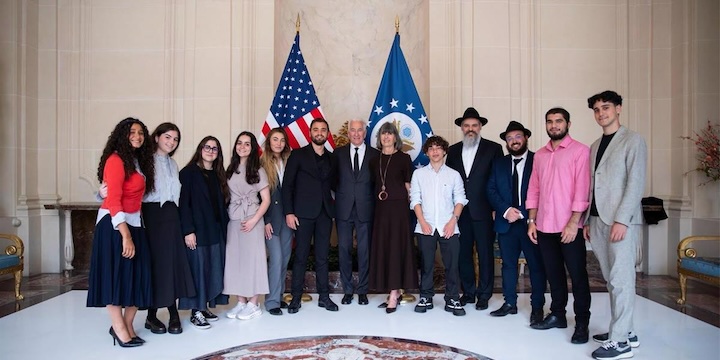
Members of French Cteen chapters meet with United States Ambassador to France Charles Kushner and his wife Seryl on Monday, May 4, 2026. They discussed their experiences with antisemitism and what keeps them motivated. Photo: US Embassy in France
Nine members of the Chabad youth group CTeen France met last week with US Ambassador to France Charles Kushner to discuss their experiences of antisemitism in the years since Hamas’s Oct. 7, 2023, attack on Israel, a massacre which left nearly 1,200 people dead and led to a surge in hate crimes targeting Jews around the world.
Following an invitation, the youth aged 14-18 visited the ambassador’s official residence at rue du Faubourg Saint-Honoré in Paris for a two-hour discussion also attended by Kushner’s wife Seryl. Rabbi Mendy Mottal, CTeen’s director, and his wife Chaya also participated.
One member of the group, 18-year-old Younes, declined when offered a letter from the embassy to explain his absence from school. He explained that he did not want anyone at his school to discover he was Jewish, that only his best friend knew the secret of his true identity.
Another student, Salomé, described living 90 minutes south of Paris in Orléans and not knowing any other Jews in her region until the launch of a CTeen group. “All week at school I’m just waiting for the moment when I can see my Jewish friends,” she told the ambassador.
“These are teens who walk into their public school every morning knowing they may be the only Jew in their classroom,” said Rabbi Mendy Kotlarsky, chairman of CTeen International.
Discussing the meeting on X, Kushner wrote, “I love seeing motivated young leaders! CTeen is developing youth across France and focusing, like me, on countering antisemitism by combatting all forms of hatred in our communities.”
The teenagers received a tour of the ambassador’s residence and enjoyed Kosher refreshments before receiving two gifts: a kippah custom-made for the embassy and an embassy medal.
“These are teens regularly experiencing antisemitism on the front line,” Mottal said. “The ambassador was very moved by them and how they spoke. Frankly, so was I.” He described how Kushner “wanted to know what actually happens in the hallways, what they feel when they walk into a classroom knowing they might be the only Jews in the room.”
Kushner stated during the meeting that he intended the gathering to be the start of his collaborations with the CTeen group and that combating antisemitism in France had become a top priority.
“The fact that the ambassador sits with them, listens to their stories, and acknowledges the weight they carry on their shoulders — that means something profound to these young people,” Kotlarsky said.
The students’ fears align with survey responses from Jews in France and Europe. A 2026 Jewish Agency report found 78 percent of French Jews expressed feelings of fear in their country while 43 percent of European Jews surveyed said they experienced antisemitism in the last year either themselves or through a member of their family.
Last year authorities in France documented 1,320 antisemitic incidents recorded nationwide, a fall of 16 percent from the previous year’s high of 1,570. While Jews make up less than one percent of the French population — totaling 500,000 to amount to Europe’s highest Jewish population — they account for 53 percent of hate crime victims. French officials warned that the numbers were certainly undercounts of the actual number of incidents.
Last month, lawmaker Caroline Yadan put forward legislation to expand penalties for antisemitic speech. Dubbed the “Yadan law,” the proposed measure would ban “implicit” justifications of terrorism, advocacy for obliterating any state recognized by France, and comparing Israel to Nazi Germany. The bill’s supporters chose to withdraw the plan on April 16 after determining they were unlikely to succeed.
The centrist party Ensemble pour la République (EPR) blamed the leftist La France Insoumise (LFI) party for allegedly obstructing the bill’s progression.
In March, Dov Maimon, a senior fellow at the Jewish People Policy Institute, described the ideological dynamics in local French politics today and the threat they posed against the Jewish people.
“On one side, Jean-Luc Mélenchon’s far-left party, La France Insoumise (LFI), which didn’t hold a single seat on any municipal council, has now entered hundreds of councils and captured real cities for the first time,” Maimon wrote. “On the other side, the far right took approximately 40% of the vote and clinched dozens of mayoral races.”
Maimon warned that “the center seems to have collapsed. According to current polls, Mélenchon has a real chance of reaching that final round as the standard-bearer of the left. His political movement has weaponized hostility toward Israel, and his ties to Islamist networks are well-documented.”
In March, French authorities arrested two brothers alleged to have planned an antisemitic terror attack. Investigators found a semi-automatic firearm, a bottle of acid, and an ISIS flag during a traffic stop.
Kushner is the grandson of Holocaust survivors. His son Jared is US President Donald Trump’s son-in-law and serves as the Special Envoy for Peace where he has acted as a key foreign policy negotiator during the ongoing conflict with the Islamic regime in Iran.