



Uncategorized
‘Hands Off Iran’: Chicago Teachers Union Sponsors Anti-US, Anti-Israel Protest

“Hands Off Lebanon & Iran” Protest, March 8, 2026, Chicago, Illinois. Photo: Screenshot
Teachers employed by the Chicago Public Schools system, which serves over 300,000 students, participated last weekend in a protest against the US-Israeli war in Iran, apparently siding with the Iranian regime and its Lebanese terrorist proxy Hezbollah in the ongoing conflict.
The “Hands Off Iran & Lebanon” protest, held in Chicago on March 7, received a generous sponsorship from the Chicago Teachers Union (CTU), along with several socialist and Islamist groups. At least one of the organizers, the Palestinian Youth Movement, is known to hold ties to the Popular Front for the Liberation of Palestine, an internationally designated terrorist group that has been involved in armed hijackings of airplanes, suicide bombings, shootings, and assassinations. For decades, the group has attacked Israeli and other Western targets.
“Hey Siri, play: Boom, Boom Tel Aviv,” said one of the signs held up by a protester on Saturday, referencing the song “Boom, Boom, Tel Aviv.” The song, which calls for the killing of Jews and Israelis, includes lyrics such as “Iranian missiles have your entire sky lit” and “How does it feel to have bombs dropping on your civilians?”
Another sign read, “Hands off Iran, Lebanon, and Palestine. Stop the US Israeli war machine.”
At one point, a CTU member addressed the throng of protesters wearing a keffiyeh — a symbol of Palestinian jihad popularized by the late terrorist and Palestinian leader Yasser Arafat.
“The Chicago Teachers Union has made it very clear it wants to put ‘political education’ above actual education. CTU’s priority is radical activism, and it is willing to sacrifice its teachers, its students, and their families to the cause,” Mika Hackner, director of research at the North American Values Institute (NAVI), told The Algemeiner on Friday.
K-12 students have seen a surge in antisemitic incidents in their schools, but teachers have experienced extreme anti-Zionism and bigotry as well, according to preliminary results of a survey conducted by the research arm of the StandWithUs advocacy group shared in January.
The data shows that Jewish K-12 teachers in the US face widespread antisemitic discrimination, harassment, and bullying in both public and non-Jewish private schools. Approved by the leading US scientific ethics committee, the survey found that 61.6 percent of the 584-person sample have been both targets and witnesses of antisemitic conduct in a professional setting. Meanwhile, nearly half suffered antisemitism perpetrated by their teachers unions, purportedly their advocates and representatives in collective bargaining.
School districts, obligated to comply with civil rights laws which proscribe discrimination, fail at prevention, according to the data. Of the 65 percent of respondents who said they are required to take anti-bias trainings, only 10 percent said those trainings address antisemitism.
Other research has argued that public sector education unions turned K-12 classrooms into theaters of anti-Zionist agitation, thereby alienating Jewish teachers and students. According to a report by the Defense of Freedom Institute, several major teachers unions escalated their anti-Zionist and anti-Jewish activity following the Hamas-led Oct. 7, 2023, massacre across southern Israel — a series of actions which included attempting to sever ties with the Anti-Defamation League (ADL), staging protests in which teachers led chants of “Death to Israel,” and teaching students that Israel constitutes an “settler-colonial” state which perpetrates ethnic cleansing against Palestinians.
In New York City, report author Paul Zimmerman writes, the United Federation of Teachers (UFT) has advanced from fostering popular support for anti-Zionism among students to seeking cover from government by placing one or more of its fellow travelers in high office. The UFT endorsed the New York City mayoral candidacy of Zohran Mamdani in July, calling the avowed socialist and Hamas sympathizer a potential “partner.”
“The historical record shows that, whatever their shortcomings, previous generations of teacher-union leaders stood up to antisemitism in K-12 schools on behalf of their Jewish members and promoted strong US support for Israel in the face of existential attacks on that country,” the report states. “Now, antisemitic activists grossly dishonor that legacy by weaponizing teacher unions to spread antisemitism, intimidate Jewish teachers, and recast the classroom as a battlefield against the West.”
Zimmerman outlines three concepts for reforming union conduct, reserving a significant role for the US Congress, which holds the power to investigate the union bosses and subpoena them before its relevant committees. He also calls on teachers to register their opposition by withholding compulsory union dues which ply union leadership with both resources and legitimacy.
The problem of educators promoting anti-Zionism is present in higher education too. Following the announcement of US-Israeli strikes on Iran late last month, anti-Zionist faculty on college campuses cajoled students to support Islamism, jihad, and terrorism by recruiting them to participate in demonstrations for Iran, a regime which is responsible for killing American soldiers through proxy groups across the Middle East.
The Algemeiner reviewed over a dozen examples of faculty, specifically the Faculty for Justice in Palestine organization, proclaiming solidarity with Iran’s Islamist, authoritarian regime and lambasting the US and Israel for their joint operation.
“These u.s.-backed attacks are designed to spark a regional war, sacrificing the people of Iran, Palestine, Lebanon, Syria, Yemen, and beyond to further amerikkkan and zionist domination [sic],” said a post liked by the University of California Ethnic Studies Council, a body of professors who proposed an ethnic studies high school requirement for UC admissions. Critics have noted that the proposal pushed anti-Zionism in the classroom.
“Every drop of their blood spilled ignites our rage, our grief, and our duty,” the post continued. “We must continue to organize in solidarity with the Palestinian people, until the end of zionism [sic] and the liberation of Palestine.”
In Bronxville, New York, Sarah Lawrence College’s Faculty for Justice in Palestine (FJP) chapter posted a volley of messages which called for “de-platforming Zionists” and ending military operations in Iran. The group also shared false claims that the US opened fire on Pakistani civilians.
Just miles away, the Saint John’s University FJP group shared agitprop alleging that the US intentionally targeted an Iranian school with an airstrike and has “always … sacrificed” children. The group also called for sabotaging the war effort by refusing to file taxes or to file by paper to delay the government’s receiving revenue. Meanwhile, the post suggested that agents in the government are prepared to participate in the conspiracy.
“The absolute bare minimum those of us in the imperial core should be doing is NOT FUNDING THIS SH—T,” said the post. “For example even just filing your taxes via paper slows down the IRS and makes it easier for other tax resisters to make an impact with their actions as well.”
Bowdoin College, New York University, Bryn Mawr College, and Haverford College all have Faculty for Justice in Palestine groups sharing similar social media content.
Follow Dion J. Pierre @DionJPierre.
Uncategorized
1912 Yiddish operetta tackles class conflict and women’s rights
One of the smash hits of New York’s thriving Yiddish theater scene in the early 20th century grappled with socio-political issues that still resonate 100-plus years later. It’s coming back for a very limited run and you don’t have to speak Yiddish to enjoy it.
The production — a concert of songs from the 1912 Yiddish operetta Khantshe in Amerike — will be performed twice this month, first at Bard College in Annandale-on-Hudson, New York and then at the YIVO Institute for Jewish Research in Manhattan.
The protagonist, Khantshe, is a young working-class woman who dresses as a man, working as a chauffeur for a nouveau-riche immigrant family. Khantshe flirts with and romances the women she works for — mother and daughter alike. The operetta grapples with class conflict, women’s rights, gender fluidity and cars.
The performances, made possible by material reconstructed from archival documents, will feature students from Bard accompanied by piano. There will be no dialogue; instead the singers will deliver brief plot summaries in English before each song. A translation of the lyrics will be included in a booklet for the audience, who will also be able to follow along watching English supertitles.
The operetta first opened on Dec. 31, 1912 at Sarah Adler’s Novelty Theatre in Williamsburg, Brooklyn and was a runaway hit. It was mounted in Warsaw just six months after the New York premiere.
“This is one of the shows that were in dialogue with all of the political and social issues that people were talking about,” said Alex Weiser, director of public programs at YIVO and a member of the trio that reconstructed the performance materials. “They were made because the masses needed the cultural material in their language that spoke to the specificity of their milieu.”
Khantshe in Amerike was also a turning point in the career of both its composer, Joseph Rumshinsky, and its star, Bessie Thomashefsky. The previous year she had left her renowned husband Boris Thomashefsky, the titan of the Yiddish stage, known as a compulsive philanderer.
At the height of their influence, the Thomashefskys owned theaters in and out of New York, published their own magazine, The Yiddish Stage and wrote columns in the popular Yiddish newspapers of the day. When Boris Thomashefsky died in 1939, some 30,000 people lined the streets of the Lower East Side for his funeral.
“This show was a star vehicle for Bessie when she first left Boris,” notes Weiser. “They were a power couple and this was a really important turning point in her career. She left him, she went out on her own and there was a big question: ‘Is this it for her?’”
The angry, wily, rebellious and militantly feminist character that Bessie Thomashefsky portrayed became the prototype for a series of heroines she played going forward. They were tough, brassy, usually working-class fighters, endowed with chutzpah.
Bessie Thomashefsky also produced the operetta.
The musical was a watershed moment for Rumshinsky, as well. He went on to dominate the American Yiddish musical for the rest of the decade. It marked the first time that “American rhythm” had been incorporated in Yiddish music, a euphemism for acknowledging the influence of African-American music on the genre.
“Nothing had ever happened like that in Yiddish theater before,” said Ronald Robboy, who was part of the team that reconstructed the performance material. “Yiddish theater then quickly started incorporating elements of Tin Pan Alley. It also became interestingly more self-consciously Jewish, as smarter and better educated composers learned how to manipulate Jewish modal material, the scales that came from liturgical music and klezmer music. So the music was at once more American and at the same time more skillfully Jewish in its self-identity.”
Robboy’s connection to the material is a lengthy one. For five years he served as researcher for the Thomashefsky Project, an homage to the legacy of Boris and Bessie Thomashefsky instigated by their grandson, the late conductor Michael Tilson Thomas. The culmination of the project occurred in April 2005 with the premiere of The Thomashefskys: Music and Memories of a Life in the Yiddish Theater at Carnegie Hall. A recording of a subsequent performance in Miami Beach aired on the PBS series Great Performances in 2012.
Robboy worked with Weiser and Max Friedman, a law student in Memphis, to turn a number of archival documents into the printed matter needed to do the Khantshe performance. In 2023 the team reconstructed Rumshinsky’s Shir-hashirim operetta.
The documents for Khantshe came from YIVO and the American Jewish Historical Society, among other sources. They included a copy of the libretto that had been published as a bootleg in Warsaw.
Friedman got obsessed with Yiddish while studying for a master’s degree in music composition at Brandeis. For his master’s thesis he set to music sound recordings of Yiddish poets H. Leivick, Yankev Glatshteyn, Kadia Molodovsky, and Rokhl H. Korn reading their own work.
The last musical number in Khantshe in Amerike has the protagonist singing about herself. Soon the song Khantshe was played whenever Bessie Thomashefsky walked into restaurants and social gatherings. Tilson Thomas often played it as she made her triumphant entrance into the family living room.
Khantshe in Amerike will be performed on Thursday, May 14, in the Bitó Conservatory Building at Bard College from 7 – 8:30 p.m.
It will also be performed at YIVO on Monday May 18, at 7 p.m., as part of Carnegie Hall’s United in Sound: America at 250 festival. Admission is $15, $10 for YIVO members and students. Registration is required for the free livestream on Zoom.
The post 1912 Yiddish operetta tackles class conflict and women’s rights appeared first on The Forward.
Uncategorized
They texted about Torah and mitzvahs. Feds say they were insider trading
The suspects texted one another as though they had everyone fooled.
“How’s the rabbi?” one asked in a message. “Is he still scheduled for surgery?”
“We are still waiting for the doctor to check if it’s still needed,” came the response.
But there was no surgery, authorities say, and there was no rabbi. Instead, prosecutors allege, the men were referring to Amazon’s impending acquisition of the vacuum company iRobot, hoping to trade on what was then still a closely guarded secret. According to a pair of federal indictments unsealed last week, the deal was one of dozens leaked to a criminal network that used Jewish code words to plan their investments.
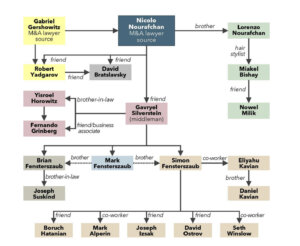
At the center of the alleged insider trading scheme was Nicolo Nourafchan, 43, a corporate lawyer who prosecutors say used his access to company files to collect and share deal information with a sprawling network of middlemen and investors. Capitalizing on the lawyer’s knowledge of in-progress mergers and acquisitions, the crew allegedly racked up tens of millions of dollars in illicit proceeds over the course of a decade.
The indictments are rife with Jewish code words that the defendants used in the alleged plot. “Torahs” and “mitzvahs” were stock tips, and a merger was a “flight to Israel.” A “chavrusa” — Aramaic for study partner — meant another lawyer or investor, and a company was a “shul.”
And to share the ticker symbol of a company soon to be acquired, one alleged co-conspirator spelled out its initials using Jewish names.
Nourafchan and the other lawyers received kickbacks when the deals hit, according to prosecutors.
Nineteen of the case’s 30 defendants have been arrested in Los Angeles, New York and Florida and have appeared in federal court. (Two located in Russia and Israel are considered fugitives, according to the Department of Justice.)
Of those, 16 defendants are each charged with two counts of conspiracy to commit securities fraud, two counts of securities fraud and one count of money laundering conspiracy. The conspiracy charges carry a combined sentence of up to 30 years in prison, while the fraud charges carry a sentence of up to 45 years and money laundering up to 20 years. Fines could exceed $5 million per defendant.
Those charged in the first indictment include Nourafchan, who prosecutors say drew extensively on a network of family and friends to build the scheme, and David Bratslavsky, the former director of the U.S. Israel Business Council, a group that brings together business leaders from those two countries.
An additional five alleged co-conspirators, including Nicolo’s brother Lorenzo Nourafchan, face two counts of conspiracy to commit securities fraud, two counts of securities fraud and one count of money laundering conspiracy.
Reuters has reported that Avi Sutton, a former Israeli Supreme Court law clerk, is among the unindicted co-conspirators involved in the alleged scheme. (Sutton could not be reached for comment.)
The prosecutions have caused an earthquake in the world of M&A law, with the Wall Street Journal calling it “one of the most brazen insider-trading schemes in years.” Nicolo Nourafchan had worked at top M&A law firms and leaked information on corporate giants that included Amazon, Johnson & Johnson and Burger King.
“Everyone charged today is accused of scoring significant profits from expected market moves and making out like bandits,” Ted Docks, special agent in charge of the FBI’s Boston division, said May 6 after the charges were announced. “That’s not merely gaming the system — it’s a federal crime.”
If proven guilty, the Nourafchan brothers, who have not yet entered a plea, could face decades in prison. Lawyers for each did not respond to a request for comment.
No attorneys are on record for other defendants and no pleas have been entered yet in the case. The Forward could not reach them for comment.
Ask the ‘rabbi’
To most who knew them, Nicolo and Lorenzo Nourafchan were LA brothers who had made good. They had graduated from top schools — Nicolo from Yale Law School, Lorenzo from Yeshiva University — and gone on to careers in corporate law and finance.
Nicolo bounced around between major law firms including Sidley Austin, Latham & Watkins and Goodwin Procter. At each stop, authorities said, he used internal document management systems to access information about deals that were in progress. He recruited Robert Yadgarov and Gabriel Gershowitz, respectively his former roommate and classmate, to gather tips from their firms, prosecutors allege.
The three would allegedly then pass on the tips to middle-men, who would share the knowledge with investors. (Yadgarov is among the 16 charged in the first indictment. Gershowitz has pleaded guilty and is cooperating with authorities, who have recommended a sentence of two years in prison.)
Eager for the next tip, the investors often badgered the middlemen in code, authorities say.
“Gavy, we are all just waiting for you to tell us when the next flight to Israel is,” one investor named Simon Fensterszaub asked alleged middleman Gavryel Silverstein. “It’s coming soon,” Silverstein replied. (Silverstein is also charged in the first indictment.)
In June 2022, court documents say, Fensterszaub, who had invested in a company expected to be acquired, asked Silverstein for an update on the deal: “Any chance you can find out how the rabbi is feeling?” Fensterszaub wrote.
“Unfortunately nothing,” Silverstein replied.
Then Fensterszaub dropped the code entirely: “Should I tell ppl to pull out?” he said.
Ultimately, he didn’t — and the brothers netted about $179,000 from their iRobot trades.
In another instance, one of the investors, unable to remember the name of the company being purchased, asked a co-conspirator to remind him. The company’s name was Momentive — ticker symbol MNTV.
According to authorities, the person replied:
“Menachem
Nachman
Tuvya
Vladmir”
Silverstein and Simon Fensterszaub, who do not have lawyers currently assigned in court documents, could not be reached for comment.
Family affairs
The Nourafchans are not the only brothers named in the indictments, which in total run more than 120 pages. Text messages from Brian and Mark Fensterszaub, of Hollywood, Florida — Simon’s brothers — show the two using code to discuss Nourafchan with Silverstein, who is their brother-in-law.
The first indictment shows the brothers as regularly agitated about the status of deals. “We need that damn rebbe already,” Mark Fensterszaub allegedly told Silverstein in 2022 as the two discussed money issues.
Soon after, Silverstein came through, court documents say. With Amazon on the verge of acquiring iRobot, he used Hebrew letters to allude to iRobot’s stock symbol in a text, allegedly tipping the brothers to the opportunity.
The traders in Nourafchan’s network made a total of $1.7 million trading on the Amazon/iRobot deal, according to court documents.
After Nourafchan lost his job at Goodwin Procter in September 2023, the Fensterszaubs appeared worried that the tips might stop coming.
“Let’s say he’s not davening or doing any Torahs, mitzvahs,” Brian Fensterszaub told Silverstein that October. “Let’s say he said ‘I don’t have anything, f”ck you, give me my money.’ We’d still be like alright, torah and mitzvahs. We gotta do what we gotta do.” (The three Fensterszaub brothers are charged in the first indictment.)
Nicolo Nourafchan reassured Silverstein that December that more info would be on the way soon. “I’m working on getting a job,” he said, according to court documents. “So baruch hashem we’ll have more.”
Silverstein’s brother-in-law Yisroel Horowitz is also charged in the scheme, as is Brian Fensterszaub’s brother-in-law Joseph Suskind; Eliyahu and Daniel Kavian, another sibling duo, were allegedly connected to the plot through Simon Fensterszaub.
It was the relationship between the Nourafchan brothers, however, that may have led the decade-long scheme to unravel.
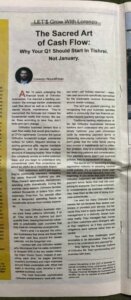
Lorenzo Nourafchan, 38, ran a business he started called Northstar Financial Consulting Group, and on LinkedIn had accrued several thousand followers. He also wrote a money column for the Los Angeles Jewish Home, an Orthodox print weekly, in which he wrote about the challenges and opportunities of being an Orthodox business owner. (The LA Jewish Home did not respond to an inquiry.)
Lorenzo was looser with the information, court documents show, recruiting his hair stylist to the scheme, who then involved nearly a dozen of his friends and relatives. Lorenzo instructed the stylist, Miakel Bishay, not to do the trading himself so the trail would not lead back to him, authorities say, but Bishay did anyway. Bishay’s friend, Nowel Milik, netted more than $700,000 in the iRobot deal, according to one of the indictments. (Bishay and Milik are both charged in the second indictment.)
Soon, the jig was up. In March 2024, a federal agent posing as a representative from FINRA, a regulatory organization that monitors trading activity, called Brian Fensterszaub asking for more information about the iRobot trade. The call alarmed Fensterszaub, who immediately called Silverstein to let him know.
“Listen, God forbid that I don’t think anything should come of it,” Fensterszaub told Silverstein, “but God forbid if something did, you don’t need it pointing back to you and you having to deal with it.”
A legal filing from Tuesday by lawyers for the Nourafchan brothers asked the court to grant Lorenzo permission to use the proceeds from the sale of his business to pay for Nicolo’s legal representation. Judge Leo T. Sorokin granted the request.
The post They texted about Torah and mitzvahs. Feds say they were insider trading appeared first on The Forward.
Uncategorized
Trump announced a national Shabbat — and a giant celebration of Christianity the very next day
To celebrate the 250th birthday of the United States, President Trump has announced several religious ceremonies. This weekend is Shabbat 250, in honor of Jewish Heritage month, beginning Friday night and carrying into Saturday.
“We celebrate the contributions that Jewish Americans have made to our way of life, we honor their role in shaping the story of our Nation, and we remember that religious devotion, learning, and service to others are enduring pillars of a thriving culture,” the announcement says.
But that recognition of Judaism is followed the very next day by Rededicate 250, a celebration “about the history and the foundations of our nation, which was built on Christian values,” as Paula White-Cain, Trump’s senior faith advisor, said in a webinar earlier this month for the National Faith Advisory Board, adding that attendees shouldn’t worry the event might include “praying to all these different Gods.”
In that same webinar, Brittany Baldwin, an executive of the America 250 taskforce planning the event, reassured viewers that the event would focus on Christianity and not give much space to other religions to ensure it has “the right focus for our community of believers.”
“The vast majority of the speakers are Christian,” Baldwin said. “If you do see another religion represented, it would probably be in a modest way, talking about religious freedom.”
All this is certainly mixed messaging as far as the place of Jews in the nation’s celebrations is concerned.
Rededicate 250 will feature dozens of Christian speakers including pastors; figures such as Dr. Larry Arnn, the founder of Hillsdale College, a private, conservative Christian school; members of the Trump administration including Pete Hegseth, who has openly voiced support for Christian nationalism; Jonathan Roumie, who plays Jesus on the hit Christian show The Chosen; and a selection of Christian musical performers. Rabbi Meir Soleveichik is the sole non-Christian slated to participate.
Rededicate 250 and Shabbat 250 are both headed by the larger task force organizing the 250th birthday celebration, led by the public-private partnership organization founded for this purpose, Freedom 250, the funders of which include Exxon Mobile, Palantir, and Wall Builders, an advocacy group “integrating the elements of Biblical faith and morality throughout all aspects of American life and culture.” Its page highlights religion as a central piece of the nation’s birthday, advertising initiatives like “America Prays,” a site where Americans can post prayers and commit to praying 10 minutes every week for the country from May 7 until July 4 this year.
The back-to-back Shabbat and Rededicate events are taking place shortly after the Trump administration released its report on anti-Christian bias, the work of a task force on the topic Trump founded shortly after taking office for his second term. For nearly 600 pages, the report inveighs against what it frames as oppression of Christians in the U.S., with examples including American embassies flying rainbow pride flags, President Biden’s declaration of a Trans Day of Visibility and limitations placed on church services during the COVID-19 pandemic.
Though the report mentions the importance of freedom of religion to all Americans — and notes that Christians make up 62% of the U.S. population — the papers, much like the Rededicate 250 event, heavily emphasize Christianity’s particular importance in the U.S.’s founding. No one disputes this — the founders were Christian. But the document takes it a step farther, interpreting Christianity’s centrality in American history to imply that the religion should play an essential role in the government.
“Christianity was embedded into both American government and society, to its great credit and benefit,” the report says, “even as its laws strive to protect religious pluralism.” After outlining Christianity’s historical influence, the document concludes that it is just as central to the U.S. today. “The Christian faith has been an indispensable feature of American governance and society,” it says, “from the earliest colonies to present.”
The report, as its title implies, focuses exclusively on Christianity. But even then, it excludes certain beliefs. It offers a definition of the religion, stating that “most” Christians oppose LGBTQ marriage and abortion, quoting liberally from the Bible to support this point, though many churches differ in their interpretations of the verses or actively reject the stated beliefs on LGBTQ marriage or abortion.
“This belongs to a package, a story, about who ‘we’ are, when they talk about ‘we the people,’ or ‘in God we trust.’ When they use that word ‘we’ — who are the ‘we?” said Robert W. Tuttle, a professor of religion and law at George Washington University’s law school, of the report. “Whose voices are silenced in this? We know whose voices are being lifted up. But whose voices are silenced?”
The task force report, the America Prays page and the page for Rededicate 250 largely avoid mentioning Jesus by name, and Freedom 250’s site even has a brief “Jewish blessing for the government” from 1789. All ostensibly leave space for non-Christian religious observance and prayer. But looking at the contents and speaker lists, Christianity is the only religion that is given more than passing attention. Judaism is the only minority religion mentioned at all.
Instead, all of the events frame the nation’s founding, and its birthday, as a gift from God — a God implied to be Christian. On the Rededicate 250 site, three “pillars” are outlined for programming at the nine-hour event on Sunday. One is “a reflection on God’s providence throughout 250 years, honoring the faith that inspired America’s founders and has carried us forward in every generation since.” The next is personal testimonies, and the final is the titular rededication, asking for God to grant the U.S. another 250 years.
The rhetoric “suggests such an image of the state being the recipient of this divine blessing, this divine empowerment,” said Tuttle. “And it’s troubling because when the state claims that it has authority from God, it loses what is crucial about our specific political arrangement, which is the idea that we the people create the government. The government is not a creation of god. ‘We the people,’ — this is a secular compact.”
Why, then, among numerous events all dedicated to Christianity, have a national Shabbat? Many Christians see Jews as part of a unified “Judeo-Christian” society and system of values, one that often downplays the differences in beliefs, practices and culture between Jews and Christians. And Shabbat is becoming increasingly popular among Christians; Charlie Kirk’s book on the topic encouraged his fellow Christians to observe a specifically Jewish Shabbat on Saturday instead of the Christian Sunday Sabbath — all while downplaying and even stripping away the Jewish beliefs from the practice.
Shabbat 250 too encourages Americans of “all backgrounds” to observe Shabbat this weekend, one that Trump said should center “gratitude for our great Nation.” In this schema, Shabbat, too, can fit in with the celebrations’ Christian focus.
“How do we knit together a religiously pluralistic polity into a society? They’ve offered one way to do it — we’re going to center this one. If you don’t wish to join it, we’ll tolerate you,” Tuttle said, in summary. “It’s the story of who belongs and who doesn’t belong.”
The post Trump announced a national Shabbat — and a giant celebration of Christianity the very next day appeared first on The Forward.