



Uncategorized
Hezbollah Plotting to Attack Israel From Syria, Report Says, as Fears Grow of Wider Middle East War

Smoke billows after an Israeli strike on Beirut’s southern suburbs, following an escalation between Hezbollah and Israel amid the US-Israeli conflict with Iran, Lebanon, March 2, 2026. Photo: REUTERS/Mohamed Azakir
Hezbollah is reportedly seeking to launch attacks against the Jewish state from Syrian territory in support of Iran while continuing operations along the Lebanese border, fueling fears the Middle East war is escalating and expanding across multiple fronts.
According to Israeli broadcaster Kan News, which cited Arab intelligence sources, the Syrian government has instructed its military forces to prevent any terrorist cells operating in Syria from launching attacks against Israel, amid Iran’s broader regional confrontation with Israel and the United States.
As Hezbollah vowed to support Iran in its broader confrontation with Israeli and American forces by targeting the Jewish state, Damascus has reportedly strengthened security controls in southern Syria, setting up checkpoints in an effort to prevent any cross-border attacks or terrorist operations from taking shape.
Although Iran and its terrorist proxies were expelled from Syria after the fall of long-time Syrian President Bashar al-Assad in December 2024, the new Syrian government under President Ahmed al‑Sharaa has continued to focus on dismantling the infrastructure that Hezbollah and other Iranian proxies built on the Syrian side of the border.
According to media reports, Damascus is also preparing to potentially target the positions of Hezbollah along the border in the Bekaa Valley, a region in eastern Lebanon near the Syrian border, in an effort to weaken the group’s operational infrastructure.
However, Syrian leadership has said it has no plans to conduct military operations against any neighboring country, reiterating that its military deployments are aimed strictly at securing borders and maintaining internal stability.
“But Syria is prepared to deal with any security threat to itself or its partners,” a security official told the Times of Israel.
As the war continues to escalate across the region, Syria has further strengthened its border with Lebanon by deploying thousands of troops, including infantry units, armored vehicles, and short-range rocket launchers, in an effort to curb arms and drug smuggling while preventing infiltration by Hezbollah or other terrorist groups.
After Hezbollah fired multiple rockets into Israeli territory in support of Iran earlier this week, the Jewish state launched a wave of airstrikes across southern and central Lebanon, striking sites linked to the group’s military infrastructure.
On Monday, the Israeli military said it killed the commander of Palestinian Islamic Jihad in Lebanon, calling the operation a major blow to the Iran-backed terrorist group’s capabilities.
Israeli Defense Minister Israel Katz announced that he had authorized the military to advance and take control of additional positions in Lebanon, where Israeli troops have held several hilltops since a war with Hezbollah in 2024.
With dozens of people killed in retaliatory Israeli strikes, Hezbollah’s move to enter the conflict has sharpened long-standing divisions in Lebanon over its status as an armed group – the only Lebanese faction to keep its weapons after the 1975-90 civil war.
The Lebanese government has even taken the unprecedented step of banning the military activities of Hezbollah. The pro-Hezbollah newspaper Al-Akhbar condemned the decision as a “capitulation to dictates,” warning that it could potentially spark the outbreak of civil war.
Uncategorized
US Legal Group Says Georgetown University Acting as Foreign Agent of Qatar, Calls on Trump Admin to Investigate

Anti-Israel demonstration on the campus of Georgetown University in Washington, DC in September 2024. Photo: Bryan Olin Dozier via Reuters Connect
A leading Jewish advocacy organization on Thursday implored the US Justice Department to investigate Georgetown University following a bombshell report which exposed a secret contract with Qatar, arguing the school is acting as a foreign agent of the Qatari monarchy.
The Washington Free Beacon first reported this week that, based on documents provided by the US House Education Committee, Georgetown in 2024 inked a $630,000 deal with Qatar which guaranteed the monarchy’s support of an initiative to promote awareness of “Islamophobia.” However, critics noted that the terms of the deal required the university to surrender intellectual and logistical control of events held to promote the program to the Qatari foreign ministry, which enjoyed the right to dictate “themes and speakers.”
The partnership resulted in Georgetown inviting to campus a series of problematic Islamists tied to the Qatari government, including extreme anti-Zionists and an unindicted co-conspirator in the 1993 bombing of the World Trade Center. The last of the money was paid out in January, according to sections of the agreement shared by the Free Beacon, but on Thursday, the Louis D. Brandeis Center for Human Rights Under Law insisted that the matter is not over and called on the federal government to determine whether Georgetown University broke the law by failing to register itself as a foreign agent.
“Qatar has spent untold amounts of money embedding itself in American higher education, and what this contract reveals is exactly how that influence works in practice: a foreign government quietly shaping what gets said and who gets to say it at events held in our nation’s capital,” Brandeis Center chairman and founder Kenneth Marcus said in a statement. “Our foreign agent laws are designed to address situations just like this, and we must ensure accountability in order to protect the interests of students.”
Arguing that the school’s arrangement with Qatar “clearly violates the Foreign Agents Registration Act,” the Brandies Center argued in its letter that the US federal government must “look into this matter and ensure that the American public be fully informed of Georgetown’s role not as a neutral presenter of information but the creature of the Qatar government promoting its point of view”
Georgetown University has not responded to requests for comment on the allegation.
The Brandies Center’s letter to Acting US Attorney General Todd Blanche came less than four months after the Middle East Forum, an American think tank, released a report describing how Qatar has allegedly exploited and manipulated Georgetown since 2005 by hooking the school on money that buys influence, promotes Islamism, and degrades the curricula of one of the most recognized names in American higher education.
“The unchecked funds provided by Qatar demonstrate how foreign countries can shape scholarship, faculty recruitment, and teaching in our universities to reflect their preferences,” the report explained. “At Georgetown, courses and research show growing ideological drift toward post-colonial scholarship, anti-Western critiques, and anti-Israel advocacy, with some faculty engaged in political activism related to the Israeli-Palestinian conflict or anti-Western interventionism.”
Georgetown is hardly the only school to receive Qatari money. Indeed, Qatar is the single largest foreign source of funding to American colleges and universities, according to a recently launched public database from the US Department of Education that reveals the scope of overseas influence in US higher education. Meanwhile, the federal dashboard shows Qatar has provided $6.6 billion in gifts and contracts to US universities, more than any other foreign government or entity. Of the schools that received Qatari money, Cornell University topped the list with $2.3 billion, followed by Carnegie Mellon University ($1 billion), Texas A&M University ($992.8 million), and Georgetown ($971.1 million), according to the figures listed at the time of the database’s initial publication.
The US opened diplomatic relations with Qatar in 1971 after it achieved independence from Great Britain, and the two states continue to enjoy what the US State Department describes as a “strategic partnership” for fostering economic growth, counterterrorism, cultural exchange, and defense and security cooperation.
However, Qatar has generously financed Hamas for years, and it has hosted the Palestinian terrorist group’s political bureau in Doha since 2012. Yet, the US designated Qatar a major non-NATO ally in 2022, and in December, President Donald Trump established, via executive order, a security commitment to defend the country if it is attacked by an aggressor.
In return for inclusion in the US international system, Qatar has invested vast sums of money in the American economy, forging along the way relationships which boost its ability to influence an array of interest groups which shape popular opinion and government policy.
Last May, the Middle East Forum released a separate report exposing the extent of Qatar’s far-reaching financial ties to American institutions. The findings showed that Qatar has attempted to expand its soft power in the US by spending $33.4 billion on business and real estate projects, over $6 billion on universities, and $72 million on American lobbyists since 2012.
The soft power campaign has focused heavily on higher education, according to a November 2025 report by the Institute for the Study of Global Antisemitism and Policy (ISGAP), which found that Qatar funneled roughly $20 billion into American schools and universities over the past five decades. ISGAP argued the money facilitates a conspiracy to embed groups linked to the Muslim Brotherhood in American academia, civil society, and government agencies. It amounts, ISGAP argued, to a “civilization jihad” strategy which hides in plain sight for being an initiative housed in the government of a US ally.
Georgetown University is a valuable case study in just how much Qatar gets for its money, ISGAP said in another report which alleged that the monarchy translates its oil wealth into Georgetown courses which “minimize the threat of Islamist extremism” and promote anti-Zionism.
“The Qatari regime targets Georgetown due to its unrivaled access to current and future leaders. Over two decades, that investment has paid off — embedding Muslim Brotherhood scholars and narratives deep within the American academic and political culture,” Dr. Charles Asher Small, executive director of ISGAP, said last June. “This masterful use of soft power is not only about Georgetown. It is how authoritarian regimes are buying access, narrative control, and ideological legitimacy — and too many universities are willing sellers.”
Qatar’s reach has even extended into the DEI (diversity, equity, and inclusion) office of Carnegie Mellon University, according to a recent lawsuit which says that a DEI official there obstructed an investigation into an incident of antisemitic discrimination because her salary is partly funded by the country. A judge has since ordered Carnegie Mellon to turn over any documents “reflecting the full economic benefit received from its Qatari relationship.”
What the case reveals about foreign influence in the US is disturbing, Jewish advocacy groups have said.
“Foreign governments with appalling human rights records are funding the very offices meant to protect students’ civil rights,” Ziporah Reich, director of The Lawfare Project, said in February. “This should alarm every parent, every student, and every policymaker in this country. The court recognized that foreign government funding is not peripheral but potentially central to understanding how civil rights laws are applied on campus.”
Follow Dion J. Pierre @DionJPierre.
Uncategorized
Antisemitism Exploding on the Far-Right: The Conspiracy Doesn’t Need an Event Anymore

Dan Bilzerian arrives at the Fashion Nova x Cardi B Collection Launch Party held at the Hollywood Palladium on May 8, 2019, in Hollywood, Los Angeles, California, United States. Photo: Xavier Collin/Image Press Agency/NurPhoto via Reuters Connect
In April 2026, Dan Bilzerian — a social media personality with 29.6 million Instagram followers — filed to run for the US Congress against incumbent Randy Fine (R-FL). Within 10 days, he had been interviewed across right-wing, left anti-imperialist, manosphere, and tabloid outlets, calling his Jewish opponent a “fat Jew” and naming “Jewish supremacy” as the greatest threat to America.
My team at NYU’s Center for the Study of Antisemitism collected and coded 3,000 YouTube comments under six of these video appearances. Across the six videos, 41 percent of comments were antisemitic. The lowest single video came in at 23.6 percent. Under TMZ, where the hosts pushed back on Bilzerian on camera, the figure reached 52 percent — the highest of the six.
These are not numbers consistent with the way online antisemitism has usually been studied — including in my own previous work.
Most digital antisemitism research, including the studies my team has run after the Capital Jewish Museum shooting, the Charlie Kirk assassination, the Bondi Beach attack, the Temple Israel Synagogue attack, and the White House Correspondents’ Dinner shooting, treats the discourse as event-driven. Something happens; comment sections respond. The highest antisemitism rate I have ever documented in those event studies sits in the 12 to 20 percent range.
Sadly, even Bilzerian’s quietest video outran the worst spike I have ever seen after a major attack. There is no event driving these numbers. There is just a candidate.
Online antisemitism is still being produced on the left, by Islamist actors, and by foreign malign-influence operations. None of that has gone away — and on the left in particular, the post-October-7 surge has not receded.
What has changed is that a second front has opened among right-wing influencers with mass audiences, and it is moving fast. Bilzerian comes from there. So did Candace Owens before him. So did Tucker Carlson.
Antisemitism and adjacent conspiracy narratives are now being normalized by these figures at an unprecedented pace, inside the broader Republican coalition, using platform infrastructures and institutional vehicles existing monitoring rarely even looks at.
Jewish institutions calibrated mainly to track the left or external state actors are now watching one front while a second one widens.
The pattern holds across audiences that have nothing else in common. Owen Shroyer is a former Infowars right-populist. George Galloway is a heterodox left anti-imperialist who was expelled from Labour in 2003 over his Iraq War statements. Sneako is a manosphere influencer and Muslim convert. Jimmy Dore is a left-populist commentator.
The antisemitism saturation is steady under all of them, because what is producing it is not the host or the audience but the speaker each is platforming. Under Galloway, a typical comment ran: “It is the Zionists in control of all our western governments that have promoted the illegal immigration issues we have all been experiencing for the past decade.” Under Sneako, where the title named “Jewish supremacy” directly, the wordplay register surfaced — “very Cohencidental,” “Cohencidence” — alongside lines like “anyone who shits on Jews is a legend.”
Under Jimmy Dore, where antisemitism reached 42 percent, the historical-authority register dominated: a Hitler quotation got 71 likes, with a reply reading, “Yes we owe that man AH a big apology.”
Bilzerian’s candidacy is more than a single bad actor. It is a convergence: manosphere reach built up over a decade — poker, weapons, wealth display — converted into a pre-loaded political audience; anti-establishment positioning that reads as left or right depending on the listener but is coherent only as anti-Jewish-power (anti-Trump, anti-AIPAC, anti-Iraq War, pro-Palestinian); eliminationist content visible across the comment sections, including Hadrian endorsements, death wishes referencing the Nova massacre directed at named Jewish commenters, and the line “FINISH THE JOB THIS TIME”; and a Republican primary as the institutional vehicle that cleared the FEC filing process without friction.
The TMZ result shows what happens when this baseline meets resistance. Hosts Harvey Levin and Charles Latibeaudiere did exactly what mainstream-media accountability journalism is supposed to do. They named “fat Jew” as antisemitic on camera. They challenged Bilzerian’s redirection toward Palestinians as the “real Semites.” They refused his pivot from his own rhetoric to attacks on Fine’s record. By the standards of on-camera adversarial framing, this was a textbook intervention. The replies came in at 52 percent antisemitic.
The mechanism is the finding. The audience did not register the host pushback as journalistic accountability. It registered the pushback as further evidence of the conspiracy Bilzerian was naming. TMZ co-founder Harvey Levin’s documented appearance in the Epstein files — a real fact in the public record — became the activation trigger. One commenter, with 30 likes: “the owner of TMZ is in the Epstein files and plays the victim. These people support actual genocide. They are using words as a shield.” Another, with 73 likes: “He would win with ease but I don’t think the tiny hats would ever allow him to run.” A Goebbels quotation circulated through six different stations of one mega-thread, accumulating endorsements at each stop — “based,” “my daddy.” Latibeaudiere, the Black co-host, was recoded as a racial subordinate to a Jewish boss: “his boss and co-partner is a Jue,” “he figures it’s better to be in the house than in the fields.” A single counter-comment in the entire 500-comment sample, detailed and factually correct, arrived sixteen days late and received zero likes.
The dominant strategy that Jewish institutions, journalists, and platforms have for handling antisemitic public figures is on-camera adversarial framing: bring them on, push back, make them defend the indefensible. The assumption is that the audience will absorb the pushback as suppression. The TMZ case shows this assumption breaking. When the audience has already been primed — by years of speaker supply on other platforms — to read the host as part of the system being challenged, adversarial framing does not suppress the saturation. It feeds it.
Antisemitism in this material is not one hate register among several. It is the organizing logic for the others. Anti-Black framings, misogyny, anti-Muslim and anti-trans rhetoric all appear under the videos — but not as parallel categories. They appear under the conspiracy frame, organized by formulations like “the media is run by Jews and pushes X.” Monitoring systems that track hate categories separately measure each layer in isolation and miss the architecture connecting them.
Two things follow.
For Jewish institutions: a Congressional candidate with 29.6 million followers and a steady four-in-10 antisemitism saturation in his comment sections is not a fringe figure. The fact that he can be interviewed on TMZ and the replies come out at 52 percent is not a journalism problem. It is a structural condition. Strategies that depend on the host’s standing to push back will fail when the audience has already coded the host as compromised. And the threat is now coming from a direction the field has been slow to map: the Republican coalition, mass-audience right-wing creators, and the convergence of manosphere reach with anti-establishment populism.
For those tracking online antisemitism: the methodology to see this exists. The bottleneck is not detection. It is the analytical assumption that antisemitism is something that happens around events. When the speaker is the event, the existing framework cannot register what is in front of it.
The FEC filing was processed without friction. The primary ballot will list a candidate calling a sitting Jewish Congressman a “fat Jew” on national television. Both of those institutional doors opened on schedule. The architecture passing through them did not announce itself as extremism, because by the time it arrived it was wearing the credential of a federal Congressional campaign.
Matthias J. Becker, PhD, is AddressHate Research Scholar at NYU’s Center for the Study of Antisemitism. He is the founder and lead of Decoding Antisemitism — now its successor project, Decoding Hate — Research Advisor to AddressHate, and Editor-in-Chief of Digital Hate Review.
Uncategorized
Iranian Rapper Releases Persian Remix of Israeli Song, Calls for Revenge Against Regime
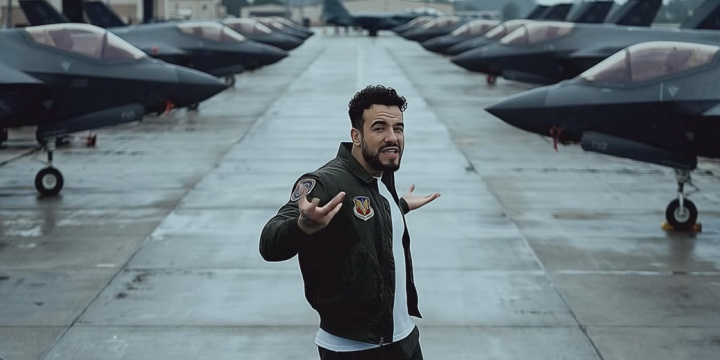
British-Iranian rapper 021Kid in the music video for his Persian remix of the song “Harbu Darbu” (feat. Stilla & Ness). Photo: Screenshot
British-Iranian rapper 021Kid has released a Persian remix of the song “Harbu Darbu” by Israeli rap duo Ness & Stilla, and in the lyrics, he calls for the death of the Iranian regime forces responsible for the killing and oppression of their own people.
The rapper, whose real name is Tony Mohraz, sings in both Farsi and English in “Harbu Darbu,” which was originally released by Ness and Stilla in 2023 in response to the deadly Hamas-led terrorist attack in southern Israel on Oct. 7.
In the Persian remix, 021Kid calls for the destruction of Iran’s Islamic Revolutionary Guard Corps (IRGC), an Iranian military force and internationally designated terrorist group, as well as the Basij parliamentary force that operates underneath it. The regime uses the Basij to violently suppress protests and crush political opposition across the country.
The rapper, who was born in Tehran but now lives in the United Kingdom, also sings about Iranian leaders and senior military figures who have been killed in US and Israel strikes. He mentions by name Supreme Leader Ali Khamenei, Islamic Revolutionary Guard Corps-Qods Force Commander Qasem Soleimani, former Iranian Air Force Commander Aziz Nasirzadeh, and Brig. Gen. Amir Ali Hajizadeh, the commander of the IRGC Aerospace Force.
021Ki further targets the People’s Mojahedin Organization of Iran (MEK), an Iranian opposition group that has been persecuted by the regime and seeks its overthrow but was a US-designated terrorist group from 1997 to 2012.
“We don’t want mullah, neither MEK. Smoke ’em on site, show no mercy,” 021Kid raps in English. He then sings in Farsi, “I’m standing with Iran till the end … We get our country back, just watch.”
The song includes some Hebrew phrases as well. “My Persian Jews, Irani Chai and that’s why Am Israeli Chai,” 021Kid raps in the song. “I pull up Tel Aviv, Ma Nishma? [How are you?].”
The music video also features clips from Ness and Stilla’s music video for the Hebrew version of “Harbu Darbu.”
021Kid explained the intention behind his new song in an Instagram post.
“After what happened in Golders Green, London a few days ago where a Jewish man was stabbed — it’s a reminder that hate doesn’t just live online, it shows up in real life,” he wrote, referring to the antisemitic stabbing attack in which two Jewish men were injured in late April.
“Since January, the people of Israel & the jewish [sic] community have shown strength, resilience, and unity and solidarity standing next to us Iranians. As Persians and sons of Cyrus the Great we see it we respect it,” 021Kid further wrote on social media. “In times like this, real allies don’t stay silent. We stand together against hate, against violence, and for something bigger than politics — humanity, strength, and loyalty … From Persians to Israelis — we stand with you, to the very end AM IRANI CHAI & AM ISRAEL CHAI.”
In the original “Harbu Darbu,” released after the Oct. 7 attack in 2023, Ness & Stilla call for revenge against Hamas and Hezbollah, and threaten celebrities who voiced support for the terrorist groups or condemned Israel. The rappers name Hezbollah leader Hassan Nasrallah and top Hamas officials Mohammed Deif and Ismail Haniyeh, saying “every dog’s day will come.” All three have since been killed by Israel.
In 2024, Ness & Stilla claimed that were denied visas to enter the United States because of the song. The track also received backlash from pro-Palestinian activists who called for it to be removed from YouTube, claiming that it violated the platform’s harassment policies, but YouTube ultimately decided to let the song remain on its website.
Watch the music video for 021Kid’s “Harbu Darbu [Persian Remix]” featuring Ness & Stilla below.