


Uncategorized
How a Russian samovar connects me to the old country — and my black market dealing great-great-grandmother
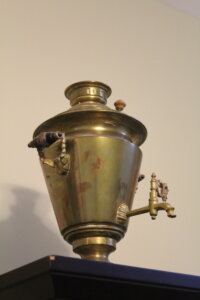
For as long as I can remember, the golden samovar — a Russian teapot of sorts — has rested somewhere high in our home. In our first house, it sat imposingly on a shelf above the staircase. In our current home, it tops the boudoir in our guestroom. When I was growing up, I didn’t actually know what it was and, until a few years ago, I didn’t think to ask.
Spurred by some unknown impulse — possibly a quarter-life crisis or my mom and dad entering their 60s — I decided to interview my parents on the origin of every object and piece of furniture displayed in our home, gathering information that would otherwise die with them. Some of my questions yielded three-word answers (“It’s a lamp”); others evoked longer stories, like that of my black market-dealing great-great-grandmother.
Rivka Silberberg brought the samovar with her when she and her family — including my great-grandfather — immigrated to the United States from the Pale of Settlement sometime before World War I. According to my grandfather, while Rivka’s neighbors were fleeing religious persecution, she was evading authorities after a neighbor ratted her out for illegally selling items — some say tea, others tobacco — without the proper taxation. My mom thinks it was probably a combination of antisemitism and legal peril that motivated Rivka to leave.
Samovars were an important part of Russian social life in the late 19th and early 20th centuries. Jenna Weissman Joselit, a professor of Judaic studies and history at George Washington University and former Forward columnist, wrote, “The samovar loomed large in Jewish immigrant culture” and “a hefty proportion of Russian Jewish immigrants … lugged the heavy and bulky contraption to the New World.”
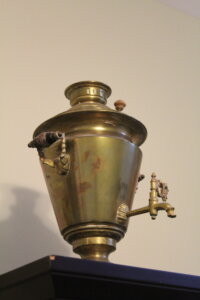
They acted both as a comforting, familiar sight and as something that could be pawned when money was tight, Joselit wrote. Clearly, my great-great-grandmother valued her samovar enough to drag it across the Atlantic.
Learning about the items in my house has given me a new appreciation for the objects that were always just a part of my background. Since the samovar is one of the only pieces of my family’s old world life we still have, it’s imbued with a certain sacredness. This samovar is not simply a vessel for brewing tea; It is a symbol of my ancestors’ forced migration, a testament to their ability to make the hard choices necessary for survival.
I am the only grandchild on my mother’s side. My grandfather was also an only child, meaning I am the only great-grandchild of his parents. I alone carry this history. Like the samovar, I am a physical testament to my family’s survival.
It’s a lot of weight to have on your shoulders — or on your shelf.
Being an only child is what made me feel such an urgent responsibility to capture my parents’ stories; if I didn’t save them, no one else would.
But objects are impermanent. They tarnish (as our samovar has). They shatter. They get lost.
As these sacred objects become more enchanted, we also become more vulnerable to their loss. Any damage to them would feel like a devastating blow.
Since my grandmother passed away in 2020, I have been the owner of her wedding band. I can count on my hands the number of times I’ve worn it, primarily on occasions when I want to feel like she’s near, whether on Rosh Hashanah or my college graduation. Otherwise, I keep it in my jewelry box where it can stay safe.
My mom takes a much more relaxed approach. One Passover, a friend set down one of our dessert plates with too much force, and it cracked. My mom, in an effort to reassure the friend, said probably the last thing one wants to hear after breaking someone else’s belongings: “It was my grandmother’s.”
After the friend panicked for a moment, my mom realized how the words had sounded.
“No, no, no,” she said. “I mean that it’s so old.”
Old things break. It’s part of their natural course of existence. For my mom, this was just an inevitable fact of life. Even without the dessert plate, she has memories of her grandmother to hold onto.
It’s taken me longer to accept the impermanence of objects. Only recently has the loss of a cheap earring not felt like the end of the world.
Luckily, because of its size and shape, the samovar would be a hard thing to misplace. In the future, if it needs to be moved, I’ll make sure I do so with care. But if for some reason something should happen to it, I am comforted to know that the story of Rivka and her smuggling ways lives on within me.
The post How a Russian samovar connects me to the old country — and my black market dealing great-great-grandmother appeared first on The Forward.
Uncategorized
Trump Says Gas Prices May Remain High Through November Midterm Election

U.S. President Donald Trump takes questions from reporters while Vice President JD Vance and Secretary of State Marco Rubio look on, as they attend a meeting with oil industry executives, at the White House in Washington, D.C., U.S., January 9, 2026. REUTERS/Kevin Lamarque
US President Donald Trump said on Sunday that the price of oil and gasoline may remain high through November’s midterm elections, a rare acknowledgement of the potential political fallout from his decision to attack Iran six weeks ago.
“It could be, or the same, or maybe a little bit higher, but it should be around the same,” Trump, who is in Miami for the weekend, told Fox News’ “Sunday Morning Futures With Maria Bartiromo” when asked whether the cost of oil and gas would be lower by the fall.
The average price for regular gas at US service stations has exceeded $4 per gallon for most of April, according to data from GasBuddy. Trump’s comments on Sunday came after weeks of asserting that the spike in prices is a short-term phenomenon, though his top advisers are cognizant of the war’s economic impacts, officials have said.
Earlier on Sunday, Trump announced on social media that the US Navy would blockade the Strait of Hormuz and intercept any ship that paid a crossing fee to Iran, after marathon talks between the US and Iran in Pakistan over the weekend did not yield a peace deal.
“No one who pays an illegal toll will have safe passage on the high seas,” he wrote on Truth Social.
Any US blockade is likely to add more uncertainty to the eventual resolution of the conflict, which is currently subject to a tenuous two-week ceasefire. The new tactic is in response to Iran’s own closure of the strait’s critical shipping lanes, which has caused global oil prices to skyrocket about 50%.
UNPOPULAR WAR HITS TRUMP’S APPROVAL
The war began on February 28, when the US launched a joint bombing campaign with Israel against Iran. The scope quickly expanded as Iran and its allies attacked nearby countries, while Israel targeted Hezbollah with massive strikes in Lebanon.
The war has buffeted global financial markets and caused thousands of civilian deaths, mostly in Iran and Lebanon.
Trump’s political standing at home has suffered, with polls showing the war is unpopular among most Americans, who are frustrated by rising gasoline prices.
The president’s approval rating has hit the lowest levels of his second term in office, raising concern among Republicans that his party is poised to lose control of Congress in the midterm elections. A Democratic majority in either chamber could launch investigations into the Trump administration while blocking much of his legislative agenda.
US Senator Mark Warner of Virginia, the ranking Democrat on the Senate Intelligence Committee, questioned the strategy behind Trump’s planned blockade.
“I don’t understand how blockading the strait is going to somehow push the Iranians into opening it,” he told CNN’s “State of the Union” on Sunday.
In a separate appearance on CBS’s “Face the Nation,” Warner said the blockade would not undermine Iranian control of the waterway.
“The Iranians have hundreds of speedboats where they can still mine the strait or put bombs against tankers in closing the strait,” he said. “How is that going to ever bring down gas prices?”
Although Trump has repeatedly said that the war would be over soon, Republican US Senator Ron Johnson of Wisconsin told ABC News’ “This Week” on Sunday that achieving US aims in Iran “could take a long time.”
“It’s going to be a long-term project,” said Johnson, who was not asked about Trump’s proposed blockade. “I never thought this would be easy.”
Uncategorized
Israel’s Ben-Gvir Visits Flashpoint Al-Aqsa Mosque Compound

Israeli politician Itamar Ben-Gvir walks inside the Knesset, in Jerusalem, Oct. 13, 2025. Photo: Chip Somodevilla/Pool via REUTERS
Israel’s far-right police minister Itamar Ben-Gvir visited the flashpoint Al-Aqsa Mosque compound in Jerusalem on Sunday, saying he was seeking greater access for Jewish worshipers and drawing condemnation from Jordan and the Palestinians.
The compound in Jerusalem’s walled Old City is one of the most sensitive sites in the Middle East. Known to Jews as Temple Mount, it is the most sacred site in Judaism and is Islam’s third-holiest site.
Under a delicate, decades-old arrangement with Muslim authorities, it is administered by a Jordanian religious foundation and Jews can visit but may not pray there.
Suggestions that Israel would alter the rules have sparked outrage among Muslims and ignited violence in the past.
“Today, I feel like the owner here,” National Security Minister Ben-Gvir said in a video filmed at the site and distributed by his office. “There is still more to do, more to improve. I keep pushing the Prime Minister (Benjamin Netanyahu) to do more and more — we must keep rising higher and higher.”
A statement from the Jordanian foreign ministry said it considered Ben-Gvir’s visit to be a violation of the status quo agreement at the site and “a desecration of its sanctity, a condemnable escalation and an unacceptable provocation.”
The office of Palestinian president, Mahmoud Abbas, said such actions could further destabilize the region.
Ben-Gvir’s spokesman said the minister was seeking greater access and prayer permits for Jewish visitors. He also said that Ben-Gvir had prayed at the site.
There was no immediate comment from Netanyahu’s office. Previous such visits and statements by Ben-Gvir have prompted Netanyahu announcements saying that there is no change in Israel’s policy of keeping the status quo.
Muslim, Christian and Jewish sites, including Al-Aqsa had been largely closed to the public during the Iran war. There was no immediate sign of unrest on Sunday after Ben-Gvir’s visit.
Uncategorized
Netanyahu Visits Troops Fighting Hezbollah in Southern Lebanon

Israeli Prime Minister Benjamin Netanyahu speaks during a press conference at the Prime Minister’s office in Jerusalem, Aug. 10, 2025. Photo: ABIR SULTAN/Pool via REUTERS
i24 News – Israeli Prime Minister Benjamin Netanyahu visited Israeli forces operating in southern Lebanon on Sunday as military operations against Hezbollah-linked targets continue.
Netanyahu toured forward positions alongside Defense Minister Yisrael Katz, Eyal Zamir, and Northern Command Commander Rafi Milo, meeting troops and receiving operational briefings from commanders on the ground.
Speaking to soldiers, Netanyahu praised their performance and said operations in the Lebanese security zone were ongoing.
“The war continues, including within the security zone in Lebanon,” he said, adding that Israeli forces were working to prevent infiltration attempts and neutralize threats such as anti-tank fire and missiles.
He described the northern campaign as part of a broader regional struggle involving Iran and its allies, saying Israel’s adversaries were now “fighting for their survival” following sustained Israeli military pressure.