



Uncategorized
How South Africa Embraced Iran — and Isolated Its Own People

South African President Cyril Ramaphosa in Chatsworth, South Africa, May 18, 2024. Photo: REUTERS/Rogan Ward
It’s sometimes tough to be a proud South African. Not because of the place or her people, but because the African National Congress (ANC), the political party that leads our current “government of national unity” and which was once the party of Nelson Mandela, has become an abject embarrassment — and destroyed the ideals it was founded on.
On the domestic front, they have led the country into ruin, as massive levels of governmental incompetence and corruption have led to literally crumbling infrastructure, ruinous public institutions, massive wealth inequality, and one of the highest violent crime rates in the world.
And yet, however disgraceful the ANC has been in local matters, they’re even worse in foreign policy, where the government has aligned itself with the absolute worst, most despotic regimes on the planet. But more than cozying up to Putin’s Russia and Xi’s China, it’s the ANC’s close relationship with the Islamic Republic of Iran (and its proxies) that is the darkest stain on its increasingly tarnished reputation.
The ANC and the Islamic Republic: Brothers in Arms
The ANC and the Islamic Republic have over the years built a relationship that is almost romantic in its intensity and faithfulness. Never has the ANC had a bad word to say about the regime, and never has the regime failed to correspond in kind. Though, of course, the ANC’s loyalty is not entirely freely given reports that it clearly enjoys some financial support from the Islamic Republic.
Either way, whether out of misplaced loyalty to their “fellow revolutionaries” or mercenary self-interest, the ANC has stood by the Islamic Republic through thick and thin; through its nuclear ambitions, its persecution of religious minorities, and its mass murder of tens of thousands of innocent protesters.
The South African government was one of the few around the world to mourn the death of Ali Khamenei — and even as it has effectively cut diplomatic ties with Israel, even refusing the offer of Israeli NGOs to help solve the country’s water problems and to help fix our decrepit national health services, it proudly hosts all sorts of senior Iranian regime officials and maintains ever close ties to the Iranian embassy here.
Unsurprisingly, the ANC’s years-long relationship with the Islamic Republic intensified almost exponentially in the immediate aftermath of October 7, 2023. South Africa and the ANC immediately shifted the focus from the Israeli victims, to Palestinians who it said were experiencing “genocide,” “war crimes,” and “apartheid” before Israel’s defensive war even started.
Aside from taking Israel to international court, the ANC supported all of the attacks taken by Iran and its proxies against Israel. And then came the current war between Iran and the combined forces of the United States and Israel, and things took a bit of a turn once again.
Of Moral Bankruptcy and Terrible Alliances
To those of us paying attention, it’s been all but impossible to miss how different the ANC’s role has been in this war. The Islamic Republic clearly hasn’t used the ANC to constantly legitimize its cause or to propagate its propaganda in the way it did during the Gaza war. It doesn’t need to.
The ANC has already played its role perfectly in turning Israel into the ultimate aggressor on the world stage, and with President Trump’s historically low popularity both at home and abroad, the Islamic Republic may have already won what may be the most crucial battle for its survival: the war over public opinion.
And yet, even as the ANC tries to walk a fine line in not alienating Washington completely and has tried to present itself as a neutral party in the war — even offering to mediate talks between the Islamic Republic and the US — its allegiances remain as clear as ever.
Though it’s hardly the first liberal-democratic government to chafe with the Trump administration, the ANC-captured Department of International Relations and Cooperation (DIRCO) has seemingly done everything in its power to antagonize Trump. Don’t get me wrong, Trump being Trump, a lot of this is his fault, especially with his insistence on there being a “white genocide” happening in South Africa and being decidedly undiplomatic in his thoughts on the ANC. But he’s also right about certain things. There really is no “white genocide” — as President Ramaphosa pointed out correctly, it’s not a question of race but of a high crime rate that targets everyone equally (this is somehow good news?) — but Trump is hardly imagining the ANC’s incompetence or its troubling tight relationships with the enemies of the free world.
The simple, inescapable truth is that the ANC is far more tolerant of tyrants and Islamist theocracies than it is of its fellow liberal-democracies.
Regardless of what you think of the current war in Iran, the ANC’s behavior towards the Islamic Republic since it massacred its own citizens by the tens of thousands over just a couple of days, has been nothing less than disgraceful.
It has also created an environment in South Africa where institutions fall directly in line with its terrible foreign policy. The University of Pretoria, for example, has stoked all kinds of controversy for its decision to “platform” the Islamic Republic’s ambassador to South Africa, while the University of Cape Town has decided to bestow an honorary doctorate on Imtiaz Sooliman, the “philanthropist” and founder of Gift of the Givers, known for his antisemitic statements — and especially his concerning ties to various radical Islamist groups.
A Million Wrongs Make a Right?
There is, however, a silver lining or two in all of this. The ANC is such an unmitigated train wreck at this point that it might be good that it is currently standing so fully on the wrong side of history. It has shown itself to be so wildly incompetent, corrupt, and morally twisted that it would almost be worse if it stood with America and Israel in all of this.
More hopefully, South Africa itself may benefit most from the ANC’s dreadful alliances, ironically. Ten years ago, the thought of the ANC losing power in the country was all but unthinkable — but given what’s happened over the past decade, that might be changing.
What is truly miraculous about all this, though, is that despite everything, South Africa genuinely remains a great place to be a Jew. Yes, there is still some antisemitism and like all Diaspora communities we still need armed security at our shuls, schools, and communal events, but despite the ANC’s best efforts to ingratiate itself to our very worst enemies, there is far less antisemitism here than in most countries and, at least within broadly Jewish and/or cosmopolitan areas, seldom any real need to hide our Jewishness.
And it is of the greatest of all possible ironies that we largely have the ANC to thank for this. At least the version of it that was around in 1994 — that crafted such an inclusive constitution and did its very best to engender a society where bigotry of any sort is entirely unacceptable. Except, of course, to sing “Kill the Boer.”
Uncategorized
Lebanon’s Internal Splits Over Talks With Israel Trip Up Saudi Mediation Efforts

An Israeli military vehicle drives past destroyed buildings in Lebanon, as seen from the Israeli side of the Israel-Lebanon border, April 30, 2026. Photo: REUTERS/Shir Torem
A growing rift between top Lebanese officials has thrown a wrench into Saudi efforts to help Lebanon’s leaders forge a united position over historic negotiations with Israel, Lebanese sources and foreign officials told Reuters on Thursday.
Saudi Arabia, which sponsored the 1990 agreement that ended Lebanon’s 15-year civil war, has deepened its engagement in recent days with Lebanon, where a shaky US-brokered ceasefire has failed to fully halt the nearly two-month war between Israel and Iran-backed terrorist group Hezbollah.
Ties between Riyadh and Beirut had been strained for years due to Hezbollah’s power over Lebanese politics and security, but the Sunni kingdom sees an opening after the group was severely weakened by war with Israel in 2024.
The US intended for the April 16 truce between Israel and Lebanon to allow for direct talks on a peace deal, potentially shaking up Lebanon’s internal dynamics and its role in the region. But Lebanese leaders remain at odds over the negotiation format and ultimate goal.
Lebanon’s President Joseph Aoun has defended face-to-face talks with Israel in Washington, and has said the ceasefire should be transformed into “permanent agreements.” Although he has stopped short of explicitly calling for a peace deal, two sources familiar with Aoun’s position told Reuters he had privately expressed his readiness to normalize ties with Israel to stop the war.
Speaker of Parliament Nabih Berri, a Hezbollah ally, is opposed to direct talks, reflecting the Shi’ite terrorist group‘s position. Berri believes Lebanon should seek a non-aggression pact with Israel but not a full peace deal, two Lebanese sources familiar with his position told Reuters.
PLANS DERAILED
Last week, Saudi envoy to Lebanon Prince Yazid bin Farhan visited Beirut to encourage Aoun, Berri, and Lebanese Prime Minister Nawaf Salam to set out a single position on the talks and to signal their unity through a tripartite meeting, according to two senior Lebanese political sources who met with bin Farhan and a Western official briefed on the talks.
But plans to hold such a meeting this week were derailed by rising tensions, all three sources said, after Berri publicly accused Aoun of making statements about negotiations that were “inaccurate, to say the least.”
There was no immediate response to requests for comment from Aoun’s office or from the Saudi government media office. Aoun met Salam on Thursday, the presidency said in a statement, without mentioning Berri.
The splits between Aoun and Berri, who hold their positions according to a power-sharing system that divides Lebanon’s top posts by religion, reflect broader divisions within Lebanese society over the negotiations with Israel.
Some Lebanese see direct talks and a swift peace deal as the only way to end a long history of Israeli invasions into Lebanon.
But Hezbollah and much of its broader Shi’ite Muslim constituency, who have borne the brunt of Israel‘s attacks, are firmly opposed to face-to-face talks and to normalizing ties. Some people protesting against talks earlier this month called for the government to be toppled.
Saudi Arabia’s intervention with Lebanese leaders was driven by the risk of such instability – as well as its concern that Lebanon was moving towards peace with Israel too swiftly, according to a Gulf source with knowledge of the matter, the two senior Lebanese political sources and the Western official.
Bin Farhan sought and received reassurances that Hezbollah would not seek to topple the Lebanese government, and cautioned Lebanese leaders last week that Beirut’s progress towards peace with Israel should not outpace Saudi Arabia’s, the four sources said.
Riyadh’s longstanding position has been that it will only sign up to the Abraham Accords normalizing ties with Israel if there is agreement on a roadmap to Palestinian statehood.
SAUDI KEEN FOR ‘DETENTE’ BETWEEN LEBANON AND ISRAEL
US President Donald Trump, keen to expand the accords, said this month he would invite Aoun and Israeli Prime Minister Benjamin Netanyahu to the White House for talks.
Bin Farhan advised Lebanese authorities against Aoun meeting Netanyahu soon, the two senior Lebanese political sources said.
However, Saudi Arabia does want Lebanon to work towards a “detente” with Israel that would halt instability, the Gulf source and one of the Lebanese sources said.
Israeli strikes have killed more than 2,500 people in Lebanon and displaced more than 1.2 million since the latest round of fighting between Israel and Hezbollah began on March 2, according to Lebanese authorities. Israel says the vast majority of those killed have been Hezbollah terrorists, who started the conflict by firing drones and rockets at the Jewish state.
The April 16 truce, which facilitated separate negotiations over the Iran war, stopped strikes on Beirut and its southern suburbs but not on other parts of Lebanon.
Uncategorized
Initial Australian Inquiry Into Bondi Beach Shooting Calls for Counterterrorism Reforms

People stand near flowers laid as a tribute at Bondi Beach to honor the victims of a mass shooting that targeted a Hanukkah celebration at Bondi Beach on Sunday, in Sydney, Australia, Dec. 16, 2025. Photo: REUTERS/Flavio Brancaleone
An interim report into last year’s Bondi Beach mass shooting on Thursday advised increased security around Jewish public events and further gun reforms among 14 initial recommendations, but found Australia’s legal and regulatory frameworks did not hinder security agencies in preventing or responding to the attack.
Prime Minister Anthony Albanese said his government would adopt all the initial recommendations made by the Royal Commission, the nation’s most powerful inquiry, into the Dec. 14 shooting at a Jewish Hanukkah celebration at Sydney’s Bondi Beach, which left 15 dead.
While the report did not propose urgent changes, it outlined recommendations to strengthen Australia’s counter–terrorism capabilities, Albanese told reporters.
“This is as the government envisaged – that the first task of the Royal Commission, the priority, was to look at the security elements of these issues,” he said.
Five of the recommendations remain classified due to sensitive national security concerns, Albanese added.
The attack at Bondi Beach stunned Australia, a country known for its strict gun laws, and prompted widespread calls for enhanced measures against antisemitism and tighter firearm controls. Authorities have said the alleged perpetrators, a father and son duo, were inspired by the Islamic State terrorist group. It was the deadliest mass gun attack in the country in three decades.
The Royal Commission was established in January following mounting pressure from Jewish advocacy groups and victims’ families, who criticized Albanese’s initial hesitation in launching the inquiry.
The 154-page interim report recommends a comprehensive review of the country’s joint counter–terrorism teams, with findings to be submitted to police commissioners and the director-general of security within three months.
It also calls for expanded security protocols during Jewish High Holy Days of Rosh Hashanah and Yom Kippur, to include other high-profile Jewish festivals and events.
Additional measures include updating the counter–terrorism handbook promptly and involving senior government officials in counter–terrorism exercises, and accelerating efforts to implement a proposed national gun buyback plan.
“The review has revealed aspects in which counter–terrorism capability at federal and state levels could be improved,” the report noted.
Public hearings by the commission are scheduled to start next week, with a final report due by the end of the year.
Uncategorized
Vessel Carrying Grain Ukraine Says Stolen by Russia Will Not Unload in Israel, Kyiv Says
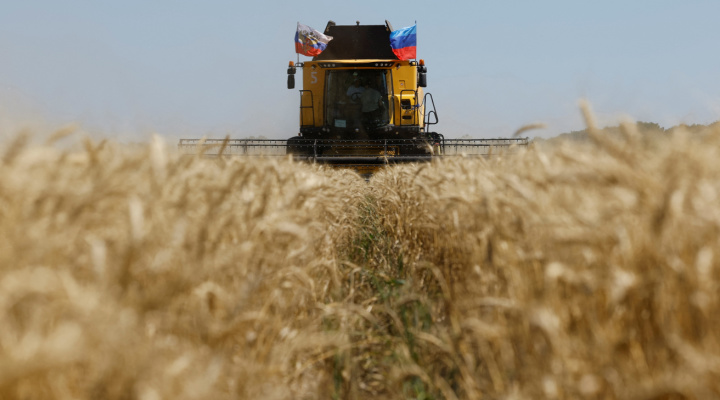
A farmer operates a combine during the start of the wheat harvesting campaign in a field near the town of Starobilsk (Starobelsk) in the Luhansk Region, a Russian-controlled area of Ukraine, July 9, 2025. Photo: REUTERS/Alexander Ermochenko
A vessel carrying grain that Ukraine says was stolen from areas occupied by Russia will not unload in Israel, Ukraine said on Thursday, after Kyiv requested Israel to seize the cargo.
Ukraine‘s prosecutor general, Ruslan Kravchenko, said on the Telegram app that the vessel, Panormitis, left Israel‘s territorial waters and departed into neutral waters following “a range of procedural measures taken by Ukraine.”
“On the basis of the materials provided by the Ukrainian side within the framework of international legal cooperation, the competent Israeli authorities have begun to process the request,” he said.
Israel‘s foreign ministry said, however, that Ukraine‘s request for legal assistance, submitted late on Tuesday, “contained significant factual gaps and did not include any supporting evidence.”
In the meantime, the ministry said, it was informed that the vessel that was supposed to enter the port next week decided to depart from Israel‘s territorial waters.
The Panama-flagged vessel‘s manager was not immediately available for comment.
SIGNAL TO OTHER VESSELS
Ukrainian Foreign Minister Andrii Sybiha, writing on X earlier on Thursday, said the vessel would not be unloading in Israel, describing it as a “welcome development” which “demonstrates that Ukraine‘s legal and diplomatic actions have been effective.”
Sybiha added that Ukraine will continue to track the vessel and warn against any operations with it.
“This is also a clear signal to all other vessels, captains, operators, insurers, and governments: do not buy stolen Ukrainian grain. Do not become part of this crime,” Sybiha said.
The Jerusalem Post and other outlets earlier on Thursday cited a statement from Israel‘s Grain Importers Association saying that the company importing the grain had been forced to turn away the vessel.
Zenziper, the company named in the reports as the importer, did not immediately respond to an emailed request for comment.
Kyiv considers all grain produced in the four regions that Russia claimed as its own since invading Ukraine in 2022 as well as Crimea, annexed by Russia in 2014, to be stolen and has protested over its export by Russia to other countries.
Moscow has not commented on the legal status of grain harvested in regions that remain internationally recognized as Ukrainian.
Ukraine and Israel traded diplomatic barbs this week as Kyiv condemned what it said were purchases of grain produced in Ukrainian territory currently occupied by Russia, while Israel said Kyiv had not produced evidence for its allegations.