


Uncategorized
How The New York Times Used Selective West Bank Data to Shape a False Moral Verdict

The New York Times building in New York City. Photo: Wikimedia Commons
The New York Times’ recent interactive project on the West Bank avoids incendiary terminology. It does not accuse Israel of ethnic cleansing outright. Yet the impression it leaves readers with is unmistakable: a story of systematic dispossession, driven by Israeli settlers and tolerated by the state.
That conclusion is not argued directly. It is constructed indirectly, through selective facts, emotional imagery, and critical omissions.
The article portrays a daily reality of Palestinian villagers under siege by armed settlers, shielded by Israeli soldiers, and backed by state institutions. The tone is stark and accusatory. But the apparent coherence of this narrative depends on three elements that are completely biased.
1/
The New York Times doesn’t use the phrase “ethnic cleansing” in its West Bank project.It doesn’t have to.
Selective imagery, distorted data & erased Palestinian terrorism lead to one conclusion: Israel is driving Palestinians off their land.
That claim is false.
pic.twitter.com/a4boarQwVq
— HonestReporting (@HonestReporting) December 22, 2025

Casualty Statistics
The first is the use of casualty statistics. The Times relies extensively on data from the United Nations Office for the Coordination of Humanitarian Affairs (UNOCHA) to demonstrate a dramatic rise in settler violence.
What readers are not told is how those numbers are assembled. UNOCHA does not consistently distinguish between civilians and terrorists killed while carrying out attacks. Palestinians who die while attempting stabbings, shootings, or vehicular assaults, are frequently recorded simply as casualties.
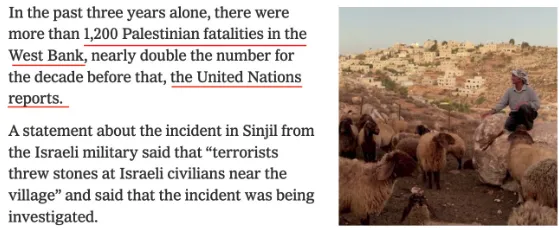
This methodology matters. It collapses perpetrators and victims into the same category and inflates the appearance of civilian harm. When such figures are presented without explanation, they create a misleading picture of violence divorced from context. The New York Times adopts these numbers uncritically, allowing a flawed dataset to underpin its central claim.
Ignoring Palestinian Terrorism
Second, the article ignores Palestinian terrorism. Over the past year, according to Israel Security Agency data, thousands of attacks have targeted Israelis in the West Bank, ranging from shootings and stabbings to Molotov cocktails and explosive devices. Many were intercepted before civilians were harmed. This sustained campaign is essential to understanding Israeli military operations and security measures. Yet it appears only faintly, if at all, in the article.
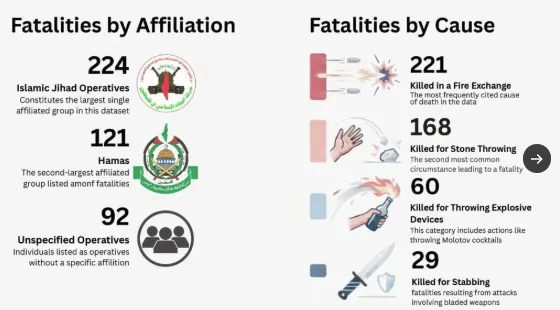
HonestReporting visualization based on B’Tselem data of Palestinians killed by Israeli forces from October 7, 2023, to October 31, 2025.
The absence extends further. Palestinians killed during Israeli counterterror operations are frequently affiliated with armed groups such as Hamas or Islamic Jihad, particularly in hotspots like Jenin and Nablus. These affiliations are rarely acknowledged. Readers are left with an image of indiscriminate force rather than targeted security activity.
Visual Storytelling
The third biased element in the article is the visual storytelling, which reinforces the narrative.
Images of demolished homes and emptied landscapes suggest deliberate displacement. But the legal framework governing much of the territory is barely explained.
Many demolitions occur in Area C, which, under internationally recognized agreements, falls under Israeli civil and security authority. Construction there requires permits. Unauthorized structures, whether Palestinian or Israeli, are subject to enforcement. By omitting this context, regulation is reframed as expulsion.
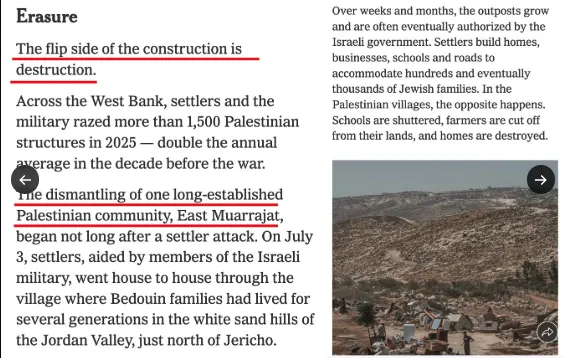
The article also implies that Israeli institutions tolerate or even enable extremist settler violence. This claim overlooks documented realities.
Israeli political and military leaders have repeatedly condemned such acts, warning that they undermine security and divert resources. Extremist settlers have been arrested, prosecuted, and in some cases have violently clashed with Israeli soldiers themselves. Internal accountability exists, but it is erased from the story.
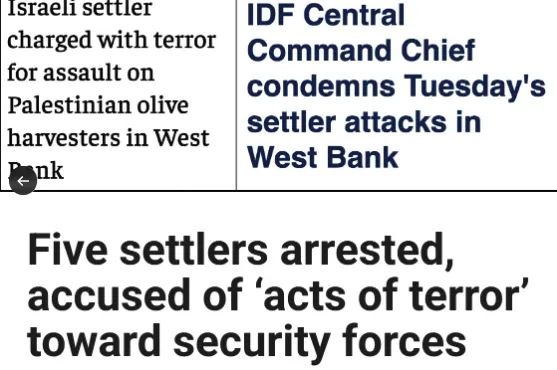
Criticism of Israeli policy is legitimate and necessary. But journalism carries an obligation to present complexity honestly. When context is stripped away, when flawed data is treated as fact, and when terrorism is sidelined, reporting stops informing and starts directing. The New York Times’ project offers readers a powerful story, but not a complete one. And when narrative takes precedence over evidence, the public is misled.
HonestReporting is a Jerusalem-based media watchdog with a focus on antisemitism and anti-Israel bias — where a version of this article first appeared.
Uncategorized
Israel’s Ben-Gvir Visits Flashpoint Al-Aqsa Mosque Compound

Israeli politician Itamar Ben-Gvir walks inside the Knesset, in Jerusalem, Oct. 13, 2025. Photo: Chip Somodevilla/Pool via REUTERS
Israel’s far-right police minister Itamar Ben-Gvir visited the flashpoint Al-Aqsa Mosque compound in Jerusalem on Sunday, saying he was seeking greater access for Jewish worshipers and drawing condemnation from Jordan and the Palestinians.
The compound in Jerusalem’s walled Old City is one of the most sensitive sites in the Middle East. Known to Jews as Temple Mount, it is the most sacred site in Judaism and is Islam’s third-holiest site.
Under a delicate, decades-old arrangement with Muslim authorities, it is administered by a Jordanian religious foundation and Jews can visit but may not pray there.
Suggestions that Israel would alter the rules have sparked outrage among Muslims and ignited violence in the past.
“Today, I feel like the owner here,” National Security Minister Ben-Gvir said in a video filmed at the site and distributed by his office. “There is still more to do, more to improve. I keep pushing the Prime Minister (Benjamin Netanyahu) to do more and more — we must keep rising higher and higher.”
A statement from the Jordanian foreign ministry said it considered Ben-Gvir’s visit to be a violation of the status quo agreement at the site and “a desecration of its sanctity, a condemnable escalation and an unacceptable provocation.”
The office of Palestinian president, Mahmoud Abbas, said such actions could further destabilize the region.
Ben-Gvir’s spokesman said the minister was seeking greater access and prayer permits for Jewish visitors. He also said that Ben-Gvir had prayed at the site.
There was no immediate comment from Netanyahu’s office. Previous such visits and statements by Ben-Gvir have prompted Netanyahu announcements saying that there is no change in Israel’s policy of keeping the status quo.
Muslim, Christian and Jewish sites, including Al-Aqsa had been largely closed to the public during the Iran war. There was no immediate sign of unrest on Sunday after Ben-Gvir’s visit.
Uncategorized
Netanyahu Visits Troops Fighting Hezbollah in Southern Lebanon

Israeli Prime Minister Benjamin Netanyahu speaks during a press conference at the Prime Minister’s office in Jerusalem, Aug. 10, 2025. Photo: ABIR SULTAN/Pool via REUTERS
i24 News – Israeli Prime Minister Benjamin Netanyahu visited Israeli forces operating in southern Lebanon on Sunday as military operations against Hezbollah-linked targets continue.
Netanyahu toured forward positions alongside Defense Minister Yisrael Katz, Eyal Zamir, and Northern Command Commander Rafi Milo, meeting troops and receiving operational briefings from commanders on the ground.
Speaking to soldiers, Netanyahu praised their performance and said operations in the Lebanese security zone were ongoing.
“The war continues, including within the security zone in Lebanon,” he said, adding that Israeli forces were working to prevent infiltration attempts and neutralize threats such as anti-tank fire and missiles.
He described the northern campaign as part of a broader regional struggle involving Iran and its allies, saying Israel’s adversaries were now “fighting for their survival” following sustained Israeli military pressure.
Uncategorized
Saudi Arabia Restores Full Capacity on East-West Oil Pipeline to 7 Million BPD After Attacks

FILE PHOTO: General view of Khurais NGL recovery plant in the eastern province of Saudi Arabia, June 28, 2021. Picture taken June 28, 2021. REUTERS/Mohammed Benmansour./File Photo
Saudi Arabia has restored full oil pumping capacity through the East-West pipeline to about seven million barrels per day, it said on Sunday, days after providing an assessment of damage on its energy sector from attacks during the Iran conflict.
The ministry said energy facilities and the pipeline affected by attacks during the conflict have recovered and restored operational capacity.
Saudi did not specify who launched the attacks, but the kingdom has intercepted many Iranian missiles and drones in recent weeks.
The strikes also disrupted operations at key oil, gas, refining, petrochemical and electricity sites in Riyadh, the Eastern Province and Yanbu Industrial City.
OUTPUT RECOVERY TO HELP SUPPLY CONTINUITY
Saudi said on Thursday the attacks had cut its oil production capacity by around 600,000 barrels per day and throughput on its East-West Pipeline by about 700,000 bpd.
The East-West Pipeline has been Saudi Arabia’s only crude export route amid the closure of the Strait of Hormuz. Reuters reported on Wednesday that Iran attacked the pipeline just hours after the ceasefire was agreed.
The ministry said it recovered affected volumes from the Manifa oilfield, where output had previously been reduced by around 300,000 bpd.
Work was ongoing to restore full output at the Khurais facility, after strikes on it reduced Saudi capacity by a further 300,000 bpd, the ministry said.
It said the quick recovery would enhance the “reliability and continuity of supplies to local and global markets.”