



Uncategorized
If It Can’t Build Nuclear Weapons, Iran Will Likely Ramp Up Its Chemical and Biological Weapons Capacities

A general view of Tehran Iran, April 16, 2026. REUTERS/Thaier Al-Sudani Foreign media in Iran operate under guidelines set by the Ministry of Culture and Islamic Guidance, which regulates press activity and permissions
Alongside Iran’s persistent progress towards nuclear weapons, which was recently stemmed by Israel and the US, the Islamic regime possesses arsenals of other weapons of mass destruction, specifically chemical and biological weapons (CBW).
Now that its nuclear strategy has been largely derailed, the Iranian regime is likely to continue to pursue and to considerably upgrade its ballistic capabilities, particularly in terms of CBW warheads. Ballistic CBW warheads (possibly including radiological weapons as well) will thus constitute Iran’s primary strategic offensive alignment.
Iran has doggedly pursued the development and manufacture of CBW arsenals while being an ostensibly “obedient” state party to the global CBW conventions. Iran’s already operational CBW programs and first-generation weaponry inventories were expounded comprehensively in 2005, in a 52-page article in the International Journal of Intelligence and Counter-Intelligence. The regime’s subsequent progress in the CBW field is examined below.
While some of its CBW facilities were somewhat incapacitated during the 2025-26 Israel-US attacks on Iran, the regime is liable — particularly now that it is likely to be deprived of its goal of achieving nuclear weapons — to take steps to significantly augment its CBW capacities.
First, we should note several assaults that took place during the 2025-26 conflict that apparently undermined some of Iran’s CBW-related assets (among other things). Nuclear and ballistic infrastructures across Iran were the attackers’ top-priority military-associated targets, but within six specific facilities, CBW-related assets were at times deliberately and directly damaged in parallel.
These facilities were: Malek-Ashtar University of Technology (MUT), Imam Hussein University (IHU), Shahid Beheshti University (SBU), Iran University of Science and Technology (IUST), the Tofigh Daru Research and Engineering Company (ToDa), and the Shahid Meisami Research Center (SMRC).
Following the Russians
Two classes of toxic substances comprise the second-generation core of Iranian chemical warfare agents. They basically follow Russian courses, as detailed below.
Pharmaceutical-based agents (PBAs): This category of dose-dependent toxicants is used routinely for anesthetic procedures. Its use as a CBW broke out at the 2002 terrorism incident at a Moscow theater, where Russian security forces employed these substances against the perpetrators at the scene. Iran followed the same line. Ever since 2005, the regime has worked on designing incapacitating agents – mainly fentanyl and medetomidine plus their derivatives – to be used for dispersal via grenades, mortars, drones and bullets. Iran may also intend them to be employed by its regional proxy forces.
The IRGC is the central entity developing PBAs. Key contributors to this effort include IHU, MUT, and the SMRC. The IRGC has conducted open-air field tests involving incapacitant-filled hand grenades and cartridges (such as the 38mm MK 2) as dispersing mechanisms. The tests optimized various aerosolization techniques of those agents.
The potential deployment of these agents via drone is a significant concern. Deployment can take place via existing multi-rotor drones like the Arbaeen bomber, which can carry chemically converted grenades, cartridges and rounds. While no definitive evidence exists confirming extensive operational use of these agents in combat, it is notable that during the 2022 Mahsa Amini protests, in which female protesters, including schoolchildren, were key participants in the demonstrations, victims reported “feelings of anesthesia” inconsistent with standard tear gas as well as unexplained severe delayed impacts.
This group of substances is considerably more potent than ordinary incapacitants. Verified images confirm that MK 2 cartridges (manufactured by Shahid Sattari Industries in Iran) that matched those in hacked PBA development documents were used against Iranian civilians during the crackdowns. Anesthetic-derived tactical munitions were procured, with supporting production linked to the Chemical Industries and Development of Materials Group (affiliated with the Iranian Defense Industries Organization), in specialized, concealed production tunnels beneath Tehran’s District 22.
Furthermore, during the January 2026 protests, aerosolized fentanyl derivatives and medetomidine were employed, probably by means of weaponized grenades and canisters, mortars and projectiles, military-style vehicles equipped with dispersal systems, and drones. The resulting impacts included sudden collapse and immediate loss of consciousness, neurological impairment and mental disorientation, temporary muscle paralysis or acute inability to move, as well as delayed fatality.
As expected, the Iranian regime flatly denied having employed CW in these ways, just as it did about its conduct during the 2022 protests.
Novichok nerve agents: While the potency of the above-mentioned anesthetic agents is controversial due to their being critically dose-dependent, Novichok nerve agents are unequivocally the most toxic synthetic molecules ever created by man. They were initially developed by the Russians. Apart from the USSR (and NATO, in terms of protection), only Iran was (overtly, at least) working on Novichok agents, ostensibly on a scientific level alone. Yet the timing, uniqueness, focus, and meticulousness of Iran’s engagement with these agents are quite striking. According to a scientific paper published in 2016 by Iranian researchers, five Novichok agents – likely including at least some of the four weaponized by Russia – were synthesized at the Iranian Defense Chemical Research Laboratory (the above-referenced complex near Karaj). The syntheses were reportedly performed on a micro-scale to minimize exposure.
Iranian researchers succeeded in synthesizing and obtaining detailed mass spectral data on a series of unusual top nerve agents, and those data were added to the Central Analytical Database of the Organization for the Prohibition of Chemical Weapons. The Iranian researchers explained their study as follows: “For unambiguous identification of Chemical Weapons Convention-related chemicals in environmental samples, the availability of mass spectra, interpretation skills and rapid microsynthesis of suspected chemicals are essential requirements. For the first time… spectra of a series of Novichok agents related to CWC were collected and investigated with the aim of enriching the Organization for the Prohibition of Chemical Weapons Central Analytical Database, which may be used in OPCW verification activities, on/off site analysis, and toxic chemical destruction monitoring.” Through this graceful means, the Iranians pursued both legitimacy and access to the domain of Novichok-based CW.
Biological warfare agents
While the first-generation of Iranian biological warfare agents includes traditional bacterial pathogens and toxins (see below), the second generation includes virulent viruses and sophisticated toxins, as follows.
Highly lethal snake venoms. Alongside synthetic toxic molecules (such as Novichok), one of the most poisonous natural substances in the world is the venom produced by the Caspian cobra. Like the class of PBAs dealt with by the Iranians in terms of dispersibility (as described), this venom was upgraded at Iran’s Razi Vaccine and Serum Research Institute in Karaj. This was done in several ways: by isolating lethal, low molecular weight portions of crude Caspian cobra venom by gel filtration chromatography; by encapsulating that venom into copolymer-shaped poly-microspheres in the size range of 1-10 μm as a biotoxin carrier; and through the advanced encapsulation into nanoparticles of a polysaccharide with an estimated diameter of 120-150 nanometers as a carrier.
These dual-use technologies are applicable to both pharmaceuticals and weapons design. Notably, while the Razi Institute is a fairly autonomous civilian entity, it is linked to both the Iranian Ministry of Health and the Ministry of Agriculture and is indirectly involved with the Iranian CBW weapons program and alignment. Crude Caspian cobra venom is centrifuged, frozen in a -80 °C deep freezer, and lyophilized at the Razi Institute.
Ostensibly, this product is used solely to attain an anti-venom horse serum. However, it is entirely plausible that an unknown portion of it is turned into a biological warfare agent alongside others developed in conjunction.
Highly virulent viruses. Deadly viruses that cause smallpox, influenza or hemorrhagic fevers might comprise components of Iran’s second generation of biological warfare agents.
Smallpox: Infections of the smallpox virus were last recorded in Iran in 1972. The reference strain, IRN72_tbrz, is held at the CDC in the US. It is not known whether additional virus isolates were obtained from Iranian patients and kept in Iran. What is known is that in recent years, the analogous virus – the one that causes monkeypox – has been reviewed at Tarbiat Modares University in Tehran, an institution known for its relationship with the IRGC. In parallel, further viruses that constitute the causative agents of notorious hemorrhagic fevers like Ebola, Marburg, Rift Valley, Crimean-Congo, Chikungunia and dengue, were meticulously investigated at both Tarbiat Modares University and Islamic Azad University. The latter maintains close ties to the IRGC, particularly in terms of military research collaboration. It is not known whether the Ebola and Marburg viruses, which are exotic to Iran, have been obtained by it, but this is likely.
In 2007, a notable interface formed between Iran and Indonesia with regard to the highly pathogenic H5N1 avian influenza virus, which emerged indigenously in Indonesia. While the global average mortality rate for H5N1 was about 60% (in humans), the rate in Indonesia was as high as 85% during 2005-07. A confrontation with WHO arose when Indonesia refused to share local virus samples with the organization. Iran took advantage and established a joint project with Indonesia to produce an H5N1 vaccine in Iran. The Iranian regime took possession of Indonesia’s extremely virulent strains in the process.
Finally, though it appears not to have been attacked in 2025-26, mention should be made of the Baqiyatallah University of Medical Sciences and its associated Institute of Research for Military Medicine (co-located in Vanak, Tehran), which are affiliated with and operated by the IRGC. These are premier Iranian institutions, leading R&D in cardinal areas like neuroscience, genetics, and biotechnology. As for CBW, while these institutions publicly focus on defense against such weapons, they are also oriented towards offensive aspects, covering a range of typical chemical and bio-agents like the pathogens of plague, anthrax, tularemia, brucellosis, typhoid, cholera, botulism, staph-B enterotoxemia and certain fungal toxicoses. They also deal with traditional chemical warfare agents, including mustard, sarin, VX, soman, phosgene and cyanides.
By 2005, Iran already possessed sizable self-made stockpiles of operational CBW, composed of such traditional chem-bio warfare agents (plus ricin, aflatoxin and T-2 toxin). These agents were weaponized with various delivery systems, including aerial bombs, spraying tanks, unmanned aircraft, and unitary missile warheads. These constitute Iran’s first-generation CBW. The systems concerned have been gradually upgraded ever since in terms of quality of the agents in the payloads, spreading mechanisms, and range.
Moreover, during the 2026 war, Iran demonstrated its mastery of the effective delivery of conventional cluster (bomblet) warheads, particularly warheads of ballistic missiles. In all probability, Iran tried over the past decade to weaponize cluster warheads with chemical and biological weapons, which would be a meaningful force multiplier.
If self-production of ballistic missiles is continuously blocked or halted in Iran, the regime may either convert residual stocks of conventional warheads into CB warheads or purchase ballistic missiles with empty warheads from China, Russia or North Korea for the purpose of chemically and biologically supplementing them. At least one of the three allies is likely to consent to such a supply request.
In addition to CB warheads, we must consider the possibility of Iranian radiological warheads, which is not negligible. As long as it is deprived of the ability to obtain nuclear weapons, Iran will maximize its efforts to achieve sub-nuclear weapons of mass destruction, notwithstanding its position as a state party to the conventions banning such weapons.
The Iranian regime’s prolonged and filthy maneuvering in these arenas will undoubtedly persist. The damage inflicted upon the six attacked facilities was considerable and important, certainly, but will not severely hamper Iran’s renewed efforts to procure further upgrades to its CBW armaments.
Dr. Dany Shoham is a former senior analyst in IDF military intelligence and the Ministry of Defense. He specializes in chemical and biological warfare in the Middle East and worldwide. A version of this article was originally published by The BESA Center.
Uncategorized
Israel, Hezbollah War Persists Despite Truce Extension
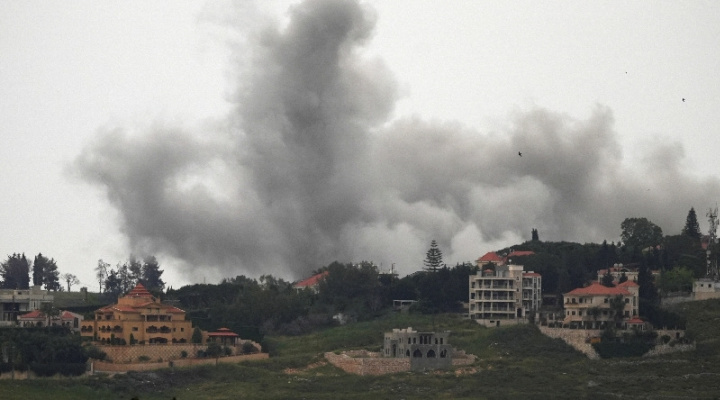
Smoke rises following an Israeli strike in Choukine, Lebanon, May 18, 2026. Photo: REUTERS/Stringer
Israel carried out airstrikes in southern Lebanon on Monday, Lebanese security sources and the state news agency said, while Hezbollah announced new attacks on Israeli forces, continuing the war in Lebanon despite the extension of a US-backed truce.
Since the war began on March 2, more than 3,000 people have been killed in Lebanon, the country’s health ministry reported in its latest casualty toll on Monday. Most of those killed have been Hezbollah terrorists, according to Israeli officials.
Reignited by the US-Israeli conflict with Iran, hostilities between Iran-backed Hezbollah and Israel have rumbled on since US President Donald Trump first announced a ceasefire on April 16, with fighting mostly contained to southern Lebanon.
A 45-day ceasefire extension, announced after a third round of US-hosted talks between Lebanon and Israel on Friday, began at midnight, a Lebanese official said.
The US-led mediation has emerged in parallel to diplomacy aimed at ending the US-Iran conflict. Iran has said ending Israel‘s war in Lebanon is one of its demands for a deal over the wider conflict. Hezbollah, which opened fire at Israel on March 2, objects to Beirut taking part in the talks.
AIRSTRIKES, EXPLOSIVE DRONE
Overnight, an Israeli strike near the eastern Lebanese city of Baalbeck killed a commander of the Palestinian Islamic Jihad terrorist group, a Hezbollah ally, along with his daughter, security sources in Lebanon said.
The Israeli military said it had killed the commander, Wael Mahmoud Abd al-Halim, in a strike, after taking steps to “mitigate the risk of harm to civilians.” It made no mention of Halim’s daughter.
Hezbollah said it launched an explosive drone at an Iron Dome air defense position in the Galilee area of northern Israel and carried out other attacks on Israeli forces in Lebanon.
Israel‘s military said some “launches” aimed at Israeli soldiers in southern Lebanon, as well as an explosive drone, had crossed into Israeli territory.
Lebanon’s National News Agency reported Israeli airstrikes on more than half a dozen locations in south Lebanon.
The Israeli military said it could not comment on the reported airstrikes without the coordinates of each one and didn’t immediately respond to a request for comment on the attack claimed by Hezbollah on the Iron Dome position.
The Israeli military said earlier on Monday it had struck more than 30 Hezbollah sites in southern Lebanon in the previous 24 hours and warned residents of three villages in the south to leave their homes, saying it intended to act against Hezbollah.
DEATH TOLL RISES
Israeli forces have occupied a self-declared security zone in the south, where they have been razing villages, saying they aim to shield northern Israel from attacks by Hezbollah fighters embedded in civilian areas.
Lebanon’s health ministry reported that the death toll in Lebanon had risen to 3,020 people, among them 619 women, children, and health-care workers.
Its toll doesn’t say how many combatants are among the dead. Various reports have put the figure at thousands of Hezbollah fighters.
However, sources familiar with Hezbollah‘s casualty numbers have said many Hezbollah fighters who have been killed in the war are not included in the health ministry death toll.
Reuters reported on May 4 that several thousand Hezbollah fighters had been killed in the war, citing casualty estimates from within the group. The Hezbollah media office said at the time the figure of several thousand fighters killed was false.
Israeli authorities say 18 soldiers have been killed by Hezbollah attacks or while operating in south Lebanon since March 2, in addition to a contractor working for an engineering company on behalf of Israel‘s defense ministry. Hezbollah attacks have killed two civilians in northern Israel.
Uncategorized
Recognizing Shabbat Is Not Establishing a Religion

Shabbat candles. Photo: Olaf.herfurth via Wikimedia Commons.
The backlash to President Trump’s “Shabbat 250” proclamation reveals something deeper than disagreement over a single president or a single ceremonial gesture. It reveals how uneasy a slice of American Jewish leadership has become with the public acknowledgment of a tradition that helped shape America’s moral vocabulary.
The timing matters. Since October 7th, antisemitism has surged on a scale unfamiliar to most American Jews living today – across college campuses, in major cities, on social media, in synagogue parking lots that now require armed guards and entrances fitted with metal detectors. Against that backdrop, a sitting president has used a White House proclamation to honor a core Jewish practice, to invoke George Washington’s 1790 letter to the Hebrew Congregation in Newport, and to name Haym Salomon – the Jewish immigrant financier who helped fund the Revolution – as a model of Jewish American patriotism. One might have expected the organized Jewish community to receive that gesture with something closer to unanimity. Instead, the response has split.
As eJewishPhilanthropy recently reported, the divide ran along predictable lines. Orthodox and politically conservative organizations – Chabad communities, Agudath Israel, the Orthodox Union, the Rabbinical Council of America, Young Jewish Conservatives – embraced the proclamation immediately. Progressive institutions and the Jewish Council for Public Affairs raised church-state concerns. The fault line itself is worth noticing. It tracks, with unsettling precision, which segments of American Jewry still feel confident about Jewish practice in public and which have grown uneasy when Jewish tradition appears outside the synagogue.
The critics’ anxieties are not frivolous. Jewish history is full of governments that used religion coercively and turned on the minorities they once flattered. American Jews were right to be cautious about religious majoritarianism in the past, and a cautious American Jewish political tradition has long taken that lesson seriously. But caution becomes distortion when even symbolic recognition of Jewish practice is treated as a constitutional threat.
The most serious version of the objection comes from Amy Spitalnick, CEO of the Jewish Council for Public Affairs, who warned in the eJP piece that when church-state lines blur, “one day you’re in and the next day you could be out.” The worry deserves a real answer, not dismissal. But Spitalnick herself drew the right distinction in the same interview. A government celebration of Jewish identity and practice, she said, “is very different than trying to utilize the government to advance a specific approach to religion.”
A proclamation honoring rest, gratitude, and the Jewish American contribution to the national story falls squarely on the first side of her line. It establishes no theology. It privileges no denomination. It requires nothing of anyone. It is ceremonial recognition: the same category as presidential Hanukkah candle-lightings, Ramadan iftars, Easter messages, and Thanksgiving statements that have rolled out of the executive branch for generations. The American constitutional order does not require a public square emptied of faith; it requires a public square open to all of them. A president who honors Shabbat one season and hosts an iftar the next is not establishing a religion. He is doing what American presidents have done since Washington: recognizing that the country contains many traditions and that none of them needs to be hidden to be American.
A different objection comes from Rabbi Amichai Lau-Lavie of Lab/Shul, who wrote that we should observe Shabbat “not because a leader commanded it, but because our humanity demands it.” That is a theological worry, not a constitutional one, and it deserves a theological answer. Trump has commanded nothing. All he has done is acknowledge that Shabbat exists, that millions of Americans keep it, that the country is better for the practice.
One can hold separate concerns about this president’s habit of telling Jews how to be Jewish. Those are concerns about a man. They are not an argument against the proclamation. The principle would be right whether the proclamation came from this president or any other, and an American Jewish community that could only accept public recognition from presidents it liked would not be defending the Constitution. It would be practicing politics.
The deeper problem with the church-state framing is that it gets American Jewish history almost exactly backward. American Jews did not flourish because the public square was scrubbed of faith. They flourished because the public square was open to faith – to all faiths -and because the founding promise of religious liberty was extended to a people who had never before been treated as full citizens anywhere in Christendom. Washington’s letter to Touro Synagogue, which the proclamation invokes, did not promise the Newport congregation that religion would be banished from American life. It promised them that the new republic would “give to bigotry no sanction, to persecution no assistance” and that the children of the stock of Abraham would sit safely under their own vine and fig tree. That is not the language of secularism. It is the language of religious confidence extended to Jews as Jews.
The Jews who arrived in America did not ask for invisibility. They asked for equality, and America’s founding promise made that claim possible in a way nearly no other country had. Haym Salomon – born in Poland, jailed by the British, dead in poverty at forty-four after pouring his fortune into the Continental cause – did not finance a revolution so that his descendants could ask the public square to please not mention Jews. The American Jewish bargain has always been the opposite: be visible, be present, be unembarrassed about being Jewish in public, and the country will be the better for it. The First Amendment was designed to prevent a national church. It was never designed to scrub religion from American public life. Covenant, human dignity, moral obligation, liberty under law, the sanctity of conscience; none of it appeared from nowhere. Recognizing that inheritance is not theocracy. It is historical literacy.
It is worth saying plainly what Shabbat is, because much of the anxious commentary proceeds as though the underlying practice were a minor ritual rather than one of the central institutions of Western civilization. Shabbat is the weekly insistence that human beings are not merely productive units. It is the structural refusal to let work, commerce, and noise consume the whole of life. It builds in, by law and by habit, a day for family, for study, for rest, for gratitude and for the things that markets cannot price and bureaucracies cannot manage. The Jewish tradition holds that Shabbat sustained the Jewish people through exile, dispersion, and persecution: more than the Jews kept Shabbat, Shabbat kept the Jews.
That a weekly cessation might be good for an entire country – and not merely for Jews – is not a controversial proposition. It is one of the most quietly radical contributions the Jewish people have made to human civilization. A country drowning in screens, in noise, in the demand to be always available, might reasonably want to pause and acknowledge the institution that taught the West how to stop.
The split inside the American Jewish community over “Shabbat 250” is, in the end, a split about confidence. The progressive instinct to guard the church-state line is the right instinct, applied to the wrong case; the Jews who worry about state-favored religion are reading from the correct historical script, only on the wrong stage. The Orthodox and conservative Jews who embraced the proclamation did so because they still feel ownership over Shabbat; because the practice is theirs, lived, and they are glad to see it honored. Some progressive leaders responded with discomfort because seeing Shabbat publicly honored by political authority now feels unfamiliar, uncomfortable, perhaps even weaponizable. That asymmetry says something painful about where parts of American Jewish life now stand in relation to their own tradition.
Recognizing Shabbat is not the establishment of religion. It is the recognition of a gift; a gift this country received from the Jewish people, and a gift it is finally, in its 250th year, pausing long enough to say thank you for. At a moment when Jews on American campuses are being told they do not belong, and Jews in major cities are being assaulted for being visibly Jewish, the proclamation says something the Jewish community badly needs to hear from the highest office in the land: you are not foreign here. You built this. The country is grateful.
The answer to that gesture is not worry. It is the lighting of candles.
Samuel J. Abrams is a professor of politics at Sarah Lawrence College and a senior fellow at the American Enterprise Institute.
Uncategorized
Stacey Bosworth selected as the Forward’s next Vice President of Development
Forward Publisher and CEO Rachel Fishman Feddersen announced today that Stacey Bosworth has been selected as the Forward’s next Vice President of Development, beginning June 1, 2026.
Bosworth comes to the Forward from documentarian Ken Burns’ Better Angels Society, where she served as Chief Development Officer, leading donor strategy and philanthropic initiatives. Prior to that, she was the Director of Development and Co-Chief Advancement Officer at the Sundance Institute. At both Sundance and Better Angels, she worked with major donors and foundations such as the Emerson Collective, the Ford Foundation, the Doris Duke Foundation and others to secure funding for stories that needed to be told.
Bosworth also served as Vice President of Advancement at MacDowell Artists Residency, where she launched a journalism fellowship fund, was the president of Aaron Consulting, supporting various nonprofit organizations in fundraising strategy, and founding executive director of the Joyful Heart Foundation.
Bosworth began her career at the Workers Circle, then located in the Forward building on 33rd Street in Manhattan. She is also on the board of The Old Stone House in Brooklyn, where she lives.
The post Stacey Bosworth selected as the Forward’s next Vice President of Development appeared first on The Forward.