



Uncategorized
Israel Competes in World Cheerleading Championships for First Time Ever

Israeli national flags flutter near office towers at a business park also housing high tech companies, at Ofer Park in Petah Tikva, Israel, Aug. 27, 2020. Photo: REUTERS/Ronen Zvulun
Israel is competing for the first time ever in the 2026 ICU World Cheerleading Championships.
The competition begins on Wednesday, which is also Israel’s Independence Day.
The ISCU, the official cheerleading organization in Israel that is supported by EL AL Airlines, made the announcement and posted footage on Instagram of the athletes and their final rehearsal before flying to the US for the competition, which will take place until Friday in Orlando, Florida. Ludmila Yasinskaya-Demari is the president of the Israel Cheer Union.
“Today, on Israel’s Independence Day, the Israeli cheerleading team has the honor of competing on the world stage,” the ISCU wrote in an Instagram post. “It’s a very moving and meaningful moment for us to represent Israel on such an important day — with pride, strength, and love for our country. Thank you to EL AL for supporting us in this way. There’s something symbolic and special about flying and competing with Israel’s national airline. From Israel to the world — the Israeli team is ready.”
The championship is being held at the ESPN Wide World of Sports complex at Disney World, and is organized by the International Cheer Union, the official world governing body for cheerleading. Israel is a member of the European Cheer Union and the International Cheer Union. It will compete in the POM category and in two doubles pairs competitions.
Team USA is after its ninth, consecutive co-ed premier world title at the World Cheerleading Championships. The US has won gold since 2021 and also won the competition from 2016 through 2019. The competition was not held in 2020 due to the COVID-19 pandemic.
In 2015, the US came in second place behind Team Chinese Taipei. The US is also the defending champion in the All Girl Premier category.
Uncategorized
Hamas Blocks Rafah Reconstruction, Halting Gaza Rebuilding Effort Amid Ceasefire Stalemate

The damaged Al-Shifa Hospital during the war in Gaza City, March 31, 2026. Photo: REUTERS/Dawoud Abu Alkas
Hamas members have reportedly blocked international efforts to begin reconstruction work in Rafah, a city in southern Gaza, in what appears to be the Palestinian terrorist group’s latest attempt to undermine a US-backed peace plan, as it continues to reject disarmament and stall progress on the ceasefire agreement with Israel.
According to a report by the Israeli broadcaster Kan News, armed Hamas operatives threatened contractors who were set to enter an area under Israeli control in Rafah in coordination with Israeli and American forces to begin reconstruction work funded by the United Arab Emirates (UAE).
The team was forced to abandon the operation and turn back after Hamas members appeared on site and blocked access, derailing what was expected to be a key reconstruction project.
As the Palestinian terrorist group continues to refuse disarmament and negotiations have yet to yield any results, the UAE has reportedly tightened conditions for its continued funding of a new reconstruction project in Gaza.
Abu Dhabi has informed Israel that the reconstruction initiative — still in its planning stages — cannot proceed in any form unless the Hamas threat is neutralized.
The UAE has also conditioned progress on the project on Israel providing assurances that reconstruction infrastructure would not be damaged if fighting resumes.
For months now, the US-led Board of Peace has been conducting parallel negotiations with Israel and Hamas, attempting to tie the large-scale reconstruction of the war-torn enclave to the complete dismantling of the terrorist group’s weapons arsenal.
However, Hamas has consistently refused to relinquish its weapons, insisting that Israel must first fully comply with phase one of the ceasefire — including expanded humanitarian aid deliveries, full reopening of the Rafah crossing, and withdrawal of Israeli forces to the agreed Yellow Line — before any disarmament process can proceed.
For its part, Israel has warned that the Islamist group must fully disarm for the second phase of the ceasefire to move forward, pointing to tens of thousands of rifles and an active network of underground tunnels still under the terrorist group’s control.
In a joint operation by the Israel Defense Forces (IDF) and Israel’s domestic intelligence agency, the Shin Bet, a Palestinian Islamic Jihad weapons production site in the northern Gaza Strip was destroyed this past weekend.
According to an IDF spokesperson, the site had also recently been used by Hamas to manufacture explosive devices and store weapons “intended to harm IDF troops operating in the yellow line area and Israeli civilians.”
Israeli forces additionally destroyed two underground tunnel routes, where they found several living quarters and weapons, and recovered dozens of rockets and explosive devices.
In the midst of stalled negotiations, Israel has expanded its control over the Gaza Strip, with the IDF now holding 64 percent of the territory, reportedly with the knowledge and approval of the Board of Peace, Israel Hayom reported.
The new boundary line, dubbed the Orange Line, replaces the more limited Yellow Line and expands Israel’s security zones by 34 kilometers (13 miles), covering roughly 11 percent of the war-torn enclave.
Israeli officials have vowed not to withdraw any troops from Gaza unless Hamas surrenders its weapons, warning that reconstruction efforts will also be blocked, effectively stalling the ceasefire agreement.
In its latest counterproposal, the terrorist group said that any transfer of its weapons would only be possible as part of a wider process leading to the establishment of a Palestinian state.
Should negotiations collapse entirely, Israeli officials are now weighing contingency plans for a renewed military campaign, pushing the army to prepare for a potential return to combat and initiate a wide-ranging reassessment of its ground maneuver strategy and operational approach.
According to multiple media reports, Hamas has been quietly exploiting the pause in fighting to tighten its control over civilian life while simultaneously rebuilding its military capabilities behind the scenes.
The Palestinian terrorist group has been gradually reestablishing its civilian governance structures across the war-torn enclave, through checkpoints, strict regulation of goods, and control over key public institutions, including hospitals.
Hamas has also been reactivating internal security mechanisms to enforce day-to-day order, while conducting extensive intelligence operations aimed at identifying alleged collaborators with Israel and suppressing any opposition.
Even after more than two years of war, the group is also rebuilding its military capabilities, including recruiting new operatives, conducting field and command-level training, restoring intelligence and surveillance networks, and reconstructing underground tunnel systems and weapons stockpiles.
Uncategorized
Gen Z New Hampshire Congressional Candidate Refuses to Acknowledge Israel’s ‘Right to Exist’
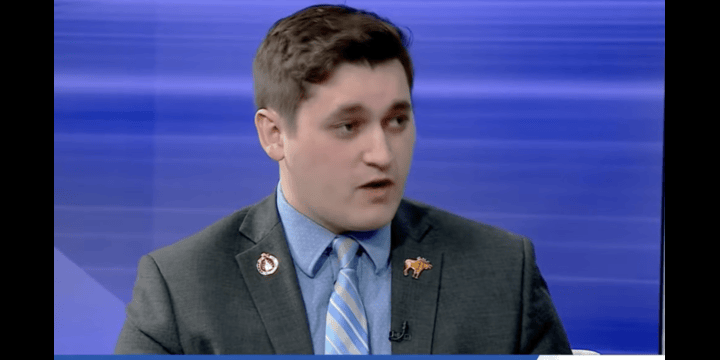
New Hampshire state Rep. Heath Howard, a Democrat who is running for US Congress in the 2026 election, speaks during televised interview. Photo: Screenshot
A Democratic state lawmaker in New Hampshire now running for US Congress is facing mounting criticism after comments in which he refused to affirm the legitimacy of Israel as a Jewish state, reigniting a broader political debate over antisemitism and the boundaries of criticism of Israel.
During a new interview on WMUR’s “Close-Up,” congressional candidate Heath Howard rejected the idea that Israel possesses a unique “right to exist” as a Jewish nation. Howard also drew an equivalence between Israel, the closest US ally in the Middle East, and the Palestinian Islamist group Hamas, a US-designated terrorist organization.
“While there are a number of condemnable actions that they’ve taken, like any sort of government, I don’t think that Hamas has a right to exist. I don’t think Israel has a right to exist. I think that people have a right to exist,” Howard said.
Howard then appeared to defend the prospect of Hamas’s continued rule over Gaza as a form of Palestinian autonomy, saying, “We need to respect the will of the Palestinian people, and we need to make sure that they have access to democracy. We need to make sure that we allow the people to have self-determination.”
Heath has criticized the US relationship with Israel, saying that it has “furthered a lot of conflict in the Middle East,” and called for imposing enhanced restrictions on military assistance to Jerusalem.
He has also hand-waved suggestions that Hamas could be a danger to Jewish people and called for the transformation of Israel into a “secular state.”
Skeptics claim the comments crossed a line from criticism of Israeli government policy into opposition to Israel’s existence as a homeland for the Jewish people, a distinction many Jewish organizations say is central in determining when anti-Israel rhetoric becomes antisemitic.
Benjamin Sharoni, consul general of Israel to New England, rebuked Howard’s commentary.
“To suggest that Israel has no right to exist is not a nuanced policy position. It is a denial of history, reality, international law, and the very principle that grants legitimacy to every nation on earth,” Sharoni told NHJournal.com.
“Israel is a sovereign state, a member of the United Nations, and the national home of the Jewish people,” he continued. “Invoking universal rights while calling for the dismantling of a recognized state is not humanitarianism. Those who are genuinely committed to the rights of people must begin by acknowledging the right of nations to exist and defend their citizens.”
Howard’s policy platform contains a number of unorthodox suggestions, such as implementing a complete arms, trade, and intelligence embargo on Israel, forging closer ties with China, and the removal of the US blockade on Cuba.
“It is essential that we immediately cease our involvement in these endless imperial wars and adopt non-interventionism as a general policy. Moreover, we must immediately end all military aid and weapons sales to both Israel and Saudi Arabia and impose a complete arms, technological, and cultural embargo on Israel,” Howard’s campaign website reads.
“We must also work to restore and improve our relationship with China and work with them, not against them, to make technological, political, and societal progress — and above all, we must honor our commitments to the Universal Declaration of Human Rights and the Charter of the United Nations,” his website continues.
The controversy comes at a particularly sensitive moment in American politics, as tensions surrounding Israel and the war in Gaza continue to divide parts of the Democratic Party following Hamas’s Oct. 7, 2023, attack on Israel. The massacre, which killed roughly 1,200 people and saw hundreds taken hostage, prompted widespread expressions of solidarity with Israel across much of the US political establishment. Since then, however, divisions have emerged between mainstream Democrats and a growing activist wing increasingly critical of Zionism and American support for Israel.
Supporters of Israel argue that denying Jews the right to self-determination to maintain a nation-state is discriminatory, especially given the existence of dozens of countries organized around national, ethnic, or religious identities. They also note that Israel serves as a refuge for Jews facing centuries of persecution.
Critics argue that Howard’s comments may fuel concerns among some Democratic strategists that rhetoric perceived as hostile to Israel could alienate moderate voters and Jewish Americans, particularly in swing districts. Several prominent Democrats nationally have faced similar scrutiny in recent months over statements questioning Israel’s legitimacy or character as a Jewish state.
The dispute reflects a broader ideological battle playing out inside the Democratic Party, where debates over Zionism, antisemitism, and Middle East policy have increasingly become litmus tests in some progressive circles.
Howard, a 25-year-old left-wing candidate, may be reflective of a newer generation of Americans which are broadly skeptical of the US-Israel relationship. Recent polling suggests that overwhelming majorities of younger Americans disapprove of the Jewish state.
Uncategorized
Mamdani supersizes NYC hate crimes office, as tensions simmer over synagogue protests
New York City Mayor Zohran Mamdani announced a nearly ninefold increase in New York City’s budget for preventing hate crimes as part of his budget proposal announced Tuesday, fulfilling a campaign promise that was central to his outreach to Jewish voters amid concerns about his stance against Israel.
The Jewish community overwhelmingly did not support his election, and his proposal comes amid rising tensions stoked by anti-Israel protests — most recently on Monday night, when dozens descended on a heavily Jewish Brooklyn neighborhood where a synagogue hosted a real estate sale that included West Bank properties.
Mamdani’s $26 million for the Office for the Prevention of Hate Crimes would significantly expand an agency created in 2019 to combat rising antisemitism and other forms of hate, which currently has a $3 million annual budget
The office is tasked with addressing all hate crimes, and Mamdani did not specify how much of the $26 million would be directed specifically toward combating antisemitism, since the office is. According to the New York City Police Department, antisemitic incidents accounted for 57% of all reported hate crimes in 2025. The Anti-Defamation League’s 2025 annual audit found that while antisemitic incidents in New York declined by 19%, last year was still the third-highest year on record.
“Too often, the only response offered to a hate crime is exactly that, it’s a response,” Mamdani said. “Today we want to also do the work of preventing those hate crimes.” The mayor said most of the funding would go toward expanding existing city programs that have proven effective, alongside the rollout of the city’s first comprehensive municipal strategy to combat antisemitism, which is expected this fall.
Most of the office’s current funding goes towards a program called the Partners Against the Hate FORWARD initiative — in partnership with the NYC Commission on Human Rights — that offers grants up to $10,000 for community-based initiatives.
The proposal resembles a plan authored by Jews For Racial & Economic Justice, a progressive organization that supported Mamdani during the election. The JFREJ proposal called for between $26 million and $30 million in hate violence prevention initiatives, including expanded reporting systems, proactive relationship-building and anti-bias education.
In a statement Tuesday, the group hailed the investment as a “huge win” for advocates of a broader approach. “The Mamdani administration has significantly raised the bar for what it looks like to seriously address antisemitism and hate violence,” said Audrey Sasson, JFREJ’s executive director.
The hate crimes office expansion drew swift praise from Jewish elected officials, including some who have distanced themselves from Mamdani in their support for Israel. “Promises made, promises kept,” Manhattan Borough President Brad Hoylman-Sigal posted on X. Rep. Dan Goldman — whose primary challenger, Brad Lander, is backed by Mamdani — said the funding is a worthy tool to combat hate: “It is vital that we all work together to ensure we do everything possible to keep New Yorkers safe.”
Hasidic leaders of both Satmar sects also applauded the mayor, with one organization calling the investment a “massive increase of resources to stop the rising tide of antisemitism in NYC.”
Still, Mamdani’s prevention strategy does not include measures in response to protests outside synagogues, which have included antisemitic displays and slogans.
On Monday night, pro-Palestinian protesters marched through the heavily Orthodox neighborhood of Midwood in Brooklyn, chanting slogans including calls for “intifada revolution” during a demonstration outside a synagogue hosting an event marketing real estate in Israel and West Bank settlements. The protest also drew a crowd of pro-Israel counterprotesters, many of them teenage boys, as police intervened to keep the groups apart. The NYPD reported four arrests, including two Jewish teens.
Under a new law recently passed in the City Council by a veto-proof majority, the NYPD is currently devising a synagogue protection plan that it must make public. But meanwhile, police officers accompanied the protesters as they circled residential blocks chanting anti-Israel slogans.
Many Jewish residents have said such protests leave them feeling intimidated or unsafe. The administration has yet to outline a more robust enforcement or public safety approach to demonstrations, and Mamdani — who has not commented on the Brooklyn confrontations — recently defended a similar protest of a real estate sale held on Manhattan’s Upper East Side.
In a statement shared with the Forward, Mamdani condemned the violence at the protest and counter-protests on Monday night “alongside antisemitic, anti-Muslim and racist rhetoric, as well as racial slurs, displays of support for terrorist organizations, and calls for the death of others” as “despicable.”
“New Yorkers have the constitutional right to protest and to counter-protest, but no one should face violence, intimidation, or hatred because of who they are or what they believe,” the mayor added. “We can simultaneously protect both public safety and civil liberties, and our city remains committed to doing exactly that by upholding the right to peaceful protest while keeping every New Yorker safe.”
The post Mamdani supersizes NYC hate crimes office, as tensions simmer over synagogue protests appeared first on The Forward.