


Uncategorized
Israel didn’t play in this World Cup. It has dominated the games anyway.
Sunday’s World Cup final has been billed as a contest between soccer powerhouses, colonizer versus colonized, and soccer’s past against its future. But the matchup of Spain and Argentina also represent two sides of today’s polarized global politics on Israel.
Under the leadership of President Javier Milei, Argentina has become one of Israel’s most steadfast supporters; the national team’s captain, Lionel Messi, a practicing Catholic, has made multiple trips to Israel.
Spain, on the other hand, styles itself as Israel’s most fervent Western adversary. It was among the first European countries to recognize a State of Palestine. There, too, politics have extended to the playing pitch: Spanish soccer prodigy Lamine Yamal — widely touted as Messi’s heir apparent — waved a Palestinian flag in May after his club team won the Spanish championship.
Their meeting in the final dovetails with a World Cup during which the Israeli-Palestinian conflict often felt unavoidable — even as neither of those teams appeared.
Throughout the six-week tournament, fans, players and national sporting bodies have used the World Cup as a platform to criticize Israel, highlight the suffering of Palestinians and call for Israel’s expulsion by FIFA, the soccer federation that organizes international competition. Marketed as a symbol of and catalyst for international unity, the 2026 World Cup also offered a reminder of Israel’s unique power to divide — and demonstrated that the wars raging in the Middle East remain fixed in the global popular imagination.
Much of the attention on Israel could be attributed to the Egyptian team, whose coach, Hossam Hassan, repeatedly foregrounded the Palestinian cause during his press conferences as the team forged into the tournament’s knockout rounds.
After Hassan in an interview dedicated Egypt’s victory to the Palestinian people, he said, “May God grant them victory, and may God have mercy on their martyrs.”
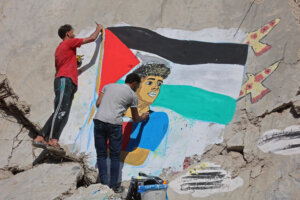
His comments decrying the situation in Gaza made him a hero in the enclave, where a mural depicting Hassan was painted on the rubble of a destroyed building. After Egypt’s ouster by Argentina, the coach confronted a fan who seemed to be taunting him with an Israeli flag; the referee of that game faced antisemitic smears afterward.

It was one of several incidents involving flags, as the stands became proxy battlegrounds for the conflict. One man waving an Israeli flag at an Iran game in Los Angeles had it confiscated, seemingly for provocation; the only official explanation reportedly provided was “security reasons.” with no mention of Israel’s war with Iran. Palestinian flags have flown in the terraces no matter who was playing, but especially at games involving first-time contestant Jordan.
There were larger protest actions, too: Thousands of Bosnian fans chanted “Palestina” in the streets of Toronto on their way to a game against Canada; Morocco fans broke out into “Free Palestine” chants in Houston. (There was a rumor that Morocco’s pro-Israel king, Mohammed VI, had a top player pulled from the team for waving a Palestinian flag on the pitch earlier this year.)
As the drama played out on fields across North America and in the concourses, a campaign to get Israel banned over the war from international soccer competition, which dates to 2024, continued apace. The national soccer federation of Norway, which became a tournament darling during the country’s first-ever run to the quarterfinals, joined several Middle Eastern nations in calls for Israel’s ouster from World Cup organizer FIFA and European soccer federation UEFA, citing those groups’ ejection of Russia following its invasion of Ukraine.
It was only logical that the relentless focus on Israel would culminate in Sunday’s final, where arguably the two biggest stars in the sport, Messi and Yamal, have played into the theme.
Messi’s appearances in Israel over the years on Barcelona and Argentina team trips — including a 2013 visit when he was photographed wearing a kippah at the Western Wall — have long made him a lightning rod for criticism and occasionally antisemitic slander from Arab leaders. Social media platforms filled with anti-Messi political sentiment in the last weeks as that photo recirculated.

The Argentine’s perceived Zionism — and if Yamal’s flag-waving is any indication, the apparent pro-Palestinian stance of Messi’s 19-year-old Spanish foil — mirrors the respective positions of the nations they play for. Spanish Prime Minister Pedro Sanchez has called to end arms sales to Israel and for travel bans on “anyone who has participated in the genocide.” Spain was also the site of the most successful anti-Israel protest in sports last year, when protesters repeatedly ground the Spanish Vuelta to a halt over the presence of an Israeli team.
On the other hand, breaking with its longstanding support for Palestinians, Argentina opposed their bid for statehood last September at the United Nations. Milei, who has described himself as the “most Zionist president in the world,” has proposed renaming Palestine Street in Buenos Aires to “Bibas Family Street” after the murdered Israeli hostages.
This simple but potent dichotomy has determined Sunday’s rooting interest for many neutral fans, and plenty non-neutral ones. Pro-Palestinian social media activists have built the case for Spain by pitting Messi against Yamal. Israelis — including Prime Minister Benjamin Netanyahu — have cited Milei’s support of Israel as a reason why they are rooting for Argentina. (To be sure, a lot of Israelis also just love the 39-year-old Messi because of what he can do with a soccer ball.)
The persistence of the conflict at the World Cup reflects the snowballing animus toward Israel in global cultural discourse. From Eurovision to literary societies to soccer, it’s all Israel all the time — an obsession that will feel disproportionate to the country’s supporters, but less so for Palestinians themselves. Saleem Al-Ashqar, a Palestinian goalkeeper, was shot dead by Israeli forces in Gaza last month; he is one of hundreds of Palestinian athletes who have been killed in the war that followed Oct. 7, 2023, according to Palestinian officials.
The international fixation on Israel at events like the World Cup is showing no signs of abating. The only thing that might dim the fervor is organizing bodies bowing to pressure to remove Israel — or the country itself altering course.
The post Israel didn’t play in this World Cup. It has dominated the games anyway. appeared first on The Forward.
Uncategorized
Lula’s reelection puts the brakes on Latin America’s pro-Israel shift
(JTA) — BUENOS AIRES – Brazilians reelected Luiz Inácio ‘Lula’ da Silva as president, defeating the center-right senator Flavio Bolsonaro, putting the breaks on a regional shift toward closer ties with Israel.
The current president, a left-wing leader of Partido dos Trabalhadores (Workers Party), obtained 51.79% of the valid votes, while Bolsonaro received 48.21%.
Bolsonaro, of the Liberal Party, had pledged a close diplomatic partnership with Israel and cultivated ties with Prime Minister Benjamin Netanyahu, while Lula has become a critic of Israel’s military campaign in Gaza. Bolsonaro said he did not accept the election results, although it is not clear how he could challenge them.
In January 2024, Lula’s government endorsed South Africa’s decision to bring a genocide case against Israel before the International Court of Justice. A month later, Lula compared Palestinian suffering in Gaza to Hitler’s murder of the Jews, triggering a diplomatic crisis between Brazil and Israel. Brazil’s Jewish umbrella organization, CONIB, publicly condemned the comparison as a distortion that offended the memory of Holocaust victims and their descendants.
The remarks were also criticized by the Holocaust Museum of Buenos Aires. Sen. Bolsonaro promised a big shift toward Israel when he spoke on June 28, 2026, in Buenos Aires in a meeting with Jewish leaders. “In 2027, Brazil will not only once again have an ambassador to Israel, but will also take the step of moving its embassy to Israel’s capital, Jerusalem,” he said.
That night he also lauded the 120,000 Jews in Brazil, saying, “They are men and women who rank among the brightest in Brazilian medicine, industry, science, culture and business.”
After Bolsonaro finished ahead of Lula in the first round on Oct. 4, Netanyahu sent a message the following day on X: “Congratulations @FlavioBolsonaro on yesterday’s vote and good luck in the final. I look forward to restoring the extraordinary friendship between Israel and Brazil. Best wishes for your great victory, my friend.”
Since 2023, several Latin American countries have strengthened ties with Israel, in some cases reversing policies adopted by their predecessors, among them:
Argentine President Javier Milei elected in 2023, who makes support for Israel central to his foreign policy and meets with families of hostages Hamas abducted in its deadly Oct. 7, 2023, raid on Israel, which launched the current war;
Bolivian President Rodrigo Paz Pereira, elected in 2025, who restored diplomatic relations with Israel severed by his predecessor;
President Nasry Asfura of Honduras, elected in 2025, who immediately formally recognized Israel’s new ambassador, a process his predecessor left in limbo;
Chilean President José Antonio Kast, elected in 2025, who is rebuilding ties with Israel diminished by his predecessor;
and Colombian President Abelardo de la Espriella, elected in May, who restored diplomatic ties with Israel severed by his predecessor, sent his foreign minister to inaugurate an embassy in Jerusalem and pulled out of the ICJ genocide case against Israel.
This article originally appeared on JTA.org.
The post Lula’s reelection puts the brakes on Latin America’s pro-Israel shift appeared first on The Forward.
Uncategorized
In anti-Muslim speech, Trump says Jews who support El-Sayed should be ‘ashamed’
(JTA) — President Donald Trump disparaged Jewish voters who support Abdul El-Sayed, Michigan’s Democratic Senate nominee, at a rally in Port Huron on Sunday.
“Any Jewish person that supports this guy should be ashamed of themselves,” Trump told some 4,000 supporters in the city north of Detroit, where he stumped for Republican nominee Mike Rogers. “You should never speak to them again.”
Hundreds of Michigan Jews have pledged to vote for El-Sayed, who polls indicate is narrowly leading Rogers in a race key to determining control of the Senate. Another subset of Jews has pressured El-Sayed, a staunch critic of Israel, to defend “Jewish safety — including for Zionist Jews” and “Jewish sovereignty in Israel.” Still others have urged their community members to reject El-Sayed outright and back Rogers.
El-Sayed opposes U.S. military aid to Israel, saying the country has committed genocide in Gaza and is “not an ally.” Those positions divided the Democratic party during his primary campaign against pro-Israel U.S. Rep. Haley Stevens, whom he narrowly bested in August. A former public health official, El-Sayed has also emphasized affordability in healthcare, housing and education. He has made a concentrated push to reach undecided Jewish voters in the homestretch before the Nov. 3 midterm election, hiring a Jewish outreach director last week.
Trump has in the past accused Jews who vote for Democrats of being “disloyal to Jewish people” and “disloyal to Israel.”
He said at the Port Huron rally that he is “polling at 99% in Israel,” which will hold national elections on Tuesday.
Trump did not cite evidence for the claim, which is unsupported by publicly available surveys. While he has historically scored high popularity among Israelis, a poll by the Jewish People Policy Institute in June found the Israeli public’s trust in him was declining. The poll said that 12% of Israelis reported having a great deal of trust in Trump, down from 21% in May, while the share of Israelis with complete distrust in him rose from 32% to 37%.
Trump joined his comments about Jews and Israel to anti-Muslim rhetoric about El-Sayed, who would become the first Muslim in the Senate if he is elected.
Trump baselessly called El-Sayed a “jihadist Muslim Brotherhood member” who was “on the side of the terrorists,” adding that he would “have to go through a metal detector before he’s allowed to go into the Senate.”
He threatened that “if Abdul and the Democrats win, they will open the floodgates and invite hordes of jihadists to our shores, creating a nightmare of violence and terror until you cannot even have a Christmas.”
Trump claimed that El-Sayed’s half sister, Eman Abdelhadi, celebrated the Hamas attacks on Israel on Oct. 7, 2023. On the first anniversary of the attack, Abdelhadi posted a video that said, “no matter how great the brutality, the oppression, the intensity of what we’re going through, the horizon of justice is just around the corner,” according to The New York Times. She did not directly mention or celebrate the violence.
Trump also said that El-Sayed’s mother had “worked for an organization that gave hundreds of thousands of dollars to Osama bin Laden and al-Qaeda.” A Times investigation reported that El-Sayed’s mother worked as a nurse in Missouri for a Muslim aid group that was later designated by the U.S. government as a supporter of terrorist groups. She was never accused of wrongdoing.
El-Sayed’s campaign has said that he “disagrees” with his sister on “a number of political positions and the rhetoric she’s chosen to use, including on foreign policy.” He was raised by his father and stepmother and has said that he had little relationship with his biological mother while growing up.
Former President Barack Obama campaigned with El-Sayed in Detroit on Saturday, saying the candidate was “fighting for change, real change, that will get money out of politics and put money in your pocket.”
This article originally appeared on JTA.org.
The post In anti-Muslim speech, Trump says Jews who support El-Sayed should be ‘ashamed’ appeared first on The Forward.
Uncategorized
CAIR Connecticut urges Greenwich schools to stop using Eisner Camp over Israel ties
(JTA) — GREAT BARRINGTON, Mass. – Greenwich Public Schools in Connecticut said it would proceed with a planned fall trip for sixth graders at a Jewish camp in Massachusetts as planned this week, despite pressure from a Muslim advocacy organization over the camp’s Israeli symbols and Israel-related programming.
CAIR Connecticut, the state chapter of the Council on American-Islamic Relations, objected to the trip, saying that programming at Eisner Camp in Great Barrington “incorporates connections to Israel,” the chapter’s board chair Farhan Memon wrote in a letter to Greenwich Superintendent of Schools Toni Jones dated Oct. 13.
The four-day Greenwich Schools field trip was organized by the Outdoor Classroom project, which works with seven locations in New England, including Eisner. Four of the camps are affiliated with Christian organizations, and two have no religious affiliation. With its clients, Outdoor Classroom coordinates nature-related learning programs for kids.
Memon wrote that some parents in Greenwich had viewed a video and photos of previous school events at Eisner and “identified Israeli flags and yellow ribbons prominently displayed in spaces used during school visits.”
“At the very least, spaces used by Greenwich students on any school trip should be free of national and political displays,” Memon wrote.
Eisner director Paul Isserles said in a statement shared with the Jewish Telegraphic Agency: “We welcome Outdoor Classroom to use our camp facilities. Throughout the year many outside organizations rent our facilities for various programs. URJ Eisner Camp is proud to have an Israeli flag displayed for our camp programs.”
When it comes to visiting groups, “Frankly, we are not regularly asked to do anything to remove those symbols or to cover them,” said Union for Reform Judaism president Rabbi Rick Jacobs in a telephone interview with JTA. “Because to be honest, we wouldn’t.”
Answering Memon’s letter on Oct. 14, Jones wrote in an email that her school district “acknowledges that individuals and families have vastly different views regarding global events” and that it intends to “provide an inclusive and safe educational environment for all Greenwich Public School students, including when they are on field trips under our care.”
She added that she had “made it clear to a few families that we will not take a political or religious stand.” JTA has seen both the CAIR letter and the email response.
CAIR Connecticut did not respond to JTA’s query.
CAIR’s national website says the organization promotes interfaith dialogue and “condemns all acts of violence against civilians by any individual, group or state.”
The Reform movement founded the 600-acre camp in 1958 as the Joseph Eisner Camp Institute for Living Judaism. It is located in the Berkshire Hills south of the town center of Great Barrington.
It is one of more than a dozen of the movement’s overnight camps in the North America. Many of those camps are rented throughout the year by groups that have nothing to do with Judaism, URJ’s Rabbi Jacobs said. “If a group rents the camp, they come up with their own agenda,” he said.
He added, “There are flags and other symbols of Judaism and of Israel in our camps, and we’re proud of that.”
Some parents had raised concerns about the venue as early as March. CAIR urged the district to stop using the camp in the Oct. 14 letter.
Removing decorations from the camp would not be enough, he said, noting that parents were upset after seeing promotional material about Eisner bringing Jewish campers to visit Israeli army bases under the Gadna, an Israeli military youth program.
A July 2019 post on Eisner Camp’s website says a group of participants in its Israel trip chose Gadna, stayed at an army base, practiced drills and learned to shoot at a target.
“URJ Eisner Camp participants who go to Israel have not participated in Gadna since 2023,” camp director Isserles said in a statement provided to JTA. “Our Israel programming at camp and in Israel is focused on Jewish identity, community, education, and connection to Israel.”
What CAIR is saying is that “A Jewish institution can be an unfit place for public-school children because it is visibly Jewish and identifies openly with Israel,” wrote blogger and Eisner alumnus Rabbi Jeff Salkin in his “Unfiltered” Substack on Oct. 19.
“A Jewish institution should not have to hide its Jewish identity to count as a fit place for other people’s children. You would not ask a church camp to remove a cross, or a Muslim camp to take down a crescent. A standard that demands such hiding makes Jewish identity itself the problem,” Salkin wrote.
This article originally appeared on JTA.org.
The post CAIR Connecticut urges Greenwich schools to stop using Eisner Camp over Israel ties appeared first on The Forward.
