



Uncategorized
Israel Expands Iran Strikes as Tehran Moves to Name New Supreme Leader

People stand near a destroyed vehicle as smoke rises after a reported strike on Shahran fuel tanks, amid the US-Israeli conflict with Iran, in Tehran, Iran, March 8, 2026. Photo: Majid Asgaripour/WANA (West Asia News Agency) via REUTERS
Israeli forces expanded their bombardment of Iran overnight, striking fuel depots near Tehran, while Bahrain said an Iranian attack had damaged one of its desalination plants, signaling a widening assault on vital infrastructure across the region.
As fighting escalated on day nine of the US-Israeli campaign against Iran, Tehran moved closer to naming a new supreme leader after the killing of Ayatollah Ali Khamenei, with every indication suggesting his powerful son Mojtaba could take charge.
Israel’s military threatened to kill any replacement for Khamenei, while US President Donald Trump said the war might only end once Iran’s military and rulers had been wiped out.
BLACK SMOKE HANGS OVER TEHRAN
Thick, choking black smoke hung over Tehran on Sunday, residents said, after strikes on oil storage facilities had lit up the night sky with plumes of orange flame.
Iran’s foreign ministry spokesperson Esmaeil Baghaei said the large-scale attack marked a “dangerous new phase” of the conflict and amounted to a war crime.
“By targeting fuel depots, the aggressors are releasing hazardous materials and toxic substances into the air, poisoning civilians, devastating the environment, and endangering lives on a massive scale,” he wrote on X.
Israeli military spokesman Lieutenant Colonel Nadav Shoshani told reporters the depots were used to fuel Iran’s war effort, including producing or storing propellant for ballistic missiles. “They are a legal military target,” he said.
Shortly after the attack, Israeli Prime Minister Benjamin Netanyahu said his government would press on with the assault and strike Iran’s rulers “without mercy.”
“We have an organized plan with many surprises to destabilize the regime and enable change,” he said in a video statement. “We have many more targets.”
Trump told reporters aboard Air Force One that he was not interested in negotiating an end to the conflict that has sent energy prices skyward, hurt business and snarled global travel.
“At some point, I don’t think there will be anybody left maybe to say, ‘We surrender,’” Trump said.
IRANIAN DRONES STRIKE GULF STATES
The governments of Saudi Arabia, Kuwait, the United Arab Emirates and Bahrain reported Iranian drone attacks in their countries on Saturday and early Sunday, with a huge fire engulfing a government office block in Kuwait.
Kuwait’s interior ministry said two of its officers were killed “while performing duties,” while the UAE said four migrant workers had died in Iranian attacks there so far.
Showing the intensity of the offensive, the UAE said air defense teams had knocked out 16 ballistic missiles and 113 drones fired towards the Gulf state on Sunday. One missile fell in the sea and four drones hit the country’s territories.
Bahrain said on Sunday that an Iranian drone attack had caused “material damage” to a desalination plant, though the country’s electricity and water authority said the strike had not disrupted water supplies.
It was the first time an Arab country has said Iran targeted a desalination facility during the conflict. On Saturday, Iran said a US attack had struck a freshwater desalination plant on its Qeshm Island, disrupting water supplies in 30 villages, calling it “a dangerous move with grave consequences.”
Saudi Arabia has told Tehran that continued Iranian attacks on the kingdom and its energy sector could push Riyadh to respond in kind, people familiar with the matter told Reuters.
Lebanon has also been pulled into the conflict after the Iran-backed militant group Hezbollah launched rockets and drones into Israel last week, with nearly 400 people killed by Israel over the past week, the health ministry said.
Israel killed at least four people when it struck a hotel in central Beirut on Sunday, saying it had targeted Iranian commanders operating in the city — the first such strike on the heart of the Lebanese capital — amid heavy bombardment of the southern suburbs and the country’s south and east.
IRAN GETTING CLOSER TO NAMING A NEW LEADER
The clerical body charged with choosing Iran’s next supreme leader could meet as soon as Sunday to name a successor to Khamenei, who was killed in an attack early in the conflict, Iranian media reported.
A majority consensus over the successor has more or less been reached, said Assembly of Experts member Ayatollah Mohammad Mehdi Mirbaqeri, according to the Mehr news agency.
Another member of the council, Ayatollah Mohsen Heidari Alekasir, said in a video that a candidate had been selected based on Khamenei’s guidance that Iran’s top leader should be “hated by the enemy.”
Two Iranian sources told Reuters last week that the clear favorite was Khamenei’s son, Mojtaba Khamenei, who amassed power under his father as a senior figure in the security forces and the vast business empire they control. Choosing him would signal that hardliners remain firmly in charge.
Trump has justified the biggest US military operation in the Middle East since the 2003 invasion of Iraq by saying Tehran posed an imminent threat to the United States, without providing evidence. He has also said Iran was too close to being able to build a nuclear weapon.
The US and Israel have discussed sending special forces into Iran to secure its stockpile of highly enriched uranium at a later stage of the war, Axios reported, citing four people with knowledge of the discussions.
Asked on Saturday about sending ground troops to secure nuclear sites, Trump said it was something they could do “later on.”
The US-Israeli attacks have killed at least 1,332 Iranian civilians and wounded thousands, according to Iran’s U.N. ambassador, Amir Saeid Iravani.
Iranian attacks have killed 10 people in Israel. At least six US service members have been killed, with Iran saying on Sunday it had struck US bases in Kuwait. Israel said on Sunday that two of its soldiers were killed in southern Lebanon.
Uncategorized
George Washington University Investigates Contaminated ‘Vial’ Which Injured Jewish Student

Demonstrators gather at The George Washington University in Washington, DC on March 21, 2025, to protest the war in Gaza. Photo: Bryan Dozier via Reuters Connect
George Washington University said this week that it was investigating a shocking report that someone possibly poisoned a Jewish student by placing contaminated “vials” near the site of an Israel Fest event held there last month.
“At least one student was injured by the incident, which is now under an investigation that will examine among other things whether individuals were targeted based on their Jewish faith,” the university, which sits just blocks away from the White House, said in a statement on Tuesday. “The university condemns this reprehensible and criminal action. Acts like this have no place in our community, which is a safe and inclusive space for individuals of all backgrounds, perspectives, and experiences.”
Jonathan Turley, a law professor at George Washington University (GW), wrote on his website that Israel Fest “is a celebration of Israeli food, music, and culture.”
“The event often draws protesters,” he continued. “I have spoken to Jewish students about their fear of attending, including visiting the popular camel brought to campus each year. Others have told me how students in classes for weeks have been bad-mouthing the planned event and have described those attending as ‘supporting genocide.’”
This latest threat against the Jewish community comes amid an epidemic of antisemitic violence in the US. According to the Anti-Defamation League’s (ADL) latest annual audit of US antisemitic incidents, assaults against Jews increased 4 percent in 2025, and perpetrators are more often resorting to using “deadly weapons” in the commission of their crimes. That raises the likelihood that their actions result in severe injury or death.
The advocacy group noted that the upward shift was reflected in the shocking murders of Jews in antisemitic attacks in the US for the first time since 2019. Two Israeli embassy staffers — a young couple set be engaged — were shot dead in Washington, DC last May, and weeks later a firebombing in Colorado claimed the life of an octogenarian. In both crimes, the alleged killers cited anti-Zionism as their motivating ideology.
Other incidents which stopped short of the worst possible outcome continue to create a sense of insecurity for American Jews. Over the past year, for example, The Algemeiner has reported on a public-school principal’s inveighing against “Jew money,” an attempted arson at the Hillel International chapter in San Francisco, California, and the movement of some conservative students into the far-right ecosystem of antisemitism — a path cleared by Nicholas Fuentes, Candace Owens, Kanye West, and troops of social media influencers.
“Behind every one of these incidents is a real person: a family threatened at their synagogue, a rabbi attacked on the street, a student harassed on campus,” ADL senior vice president Oren Segal said in a statement regarding the organization’s latest statistics on antisemitic violence and discrimination. “The safety of Jewish communities depends on our collective willingness to meet this moment with urgency, which is what we’re doing every day at ADL.”
George Washington University has allegedly been a microcosm of societal antisemitism, as reported by various claims described in court documents. One ongoing lawsuit alleges that the university enabled an eruption of antisemitic discrimination on campus by declining to intervene in a slew of incidents in which anti-Zionists threw rocks at Jewish students, vandalized the campus office of Hillel International, and uttered slurs such as “filthy k—ke.” Meanwhile, The Algemeiner has reported extensively on the activities of its Students for Justice in Palestine (SJP) chapter, which once threatened a Jewish professor and continues to spread antisemitic tropes about Israel.
“Given the history of antisemitic protests on campus, the [latest Isael Fest] incident is chilling for many on our campus,” Turley wrote.
However, rising hatred will not stop the campus Jewish community from being visible and unafraid, the school’s Hillel proclaimed in a statement issued on Wednesday.
“We are grateful to GW officials and security personnel for their swift response,” the group said. “Incidents like this will not deter our community. GW Hill will continue to support our students so they can proudly be Jewish.”
Follow Dion J. Pierre @DionJPierre.
Uncategorized
Shabbos Kestenbaum: The New Encampments
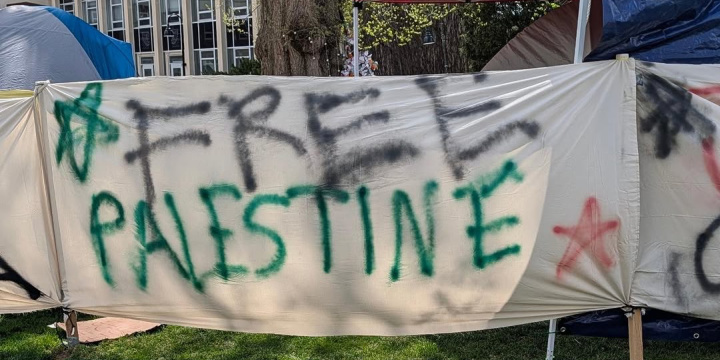
The “People’s University” encampment, established by Students for Justice in Palestine, on the campus of Smith College in April 2024. Photo: Screenshot
The encampments have returned. At Smith and Occidental Colleges, the ugliest form of campus bigotry since the 2024 Tentifada is back.
The 2023-2024 academic year saw an unprecedented wave of antisemitic incidents on American college campuses. Infamously, anti-Israel “encampments” — also known as the Tentifada — took over at least 80 campuses during this period. These pro-Hamas zones were designed to make Jewish students feel unsafe. Sadly, they’re here once again.
At Occidental College in Los Angeles, students set up the “Rafah to Jenin Liberated Zone.” Organizers recently called it the longest-lasting encampment since 2024. The radicals were handing out “No Zionists” pins and red inverted triangle stickers, a symbol Hamas uses to mark targets.
In 2024, Occidental settled a Title VI complaint filed by the Anti-Defamation League (ADL) and Brandeis Center, agreeing to implement sweeping reforms to address antisemitism. The agreement explicitly states that “no Zionist” litmus tests may constitute discrimination against Jewish or Israeli students.
At Smith College in Massachusetts, radicals occupied Chapin Lawn and renamed it “the People’s University.” They demanded divestment from Israel and called for a critical race theory curriculum. The president and chairwoman of the Board of Trustees agreed to sit down with the ringleaders. Despite this concession, the coordinators pledged to continue disrupting campus.
The Smith College jihad pajama party disbanded only after the college’s administration agreed to enter into sustained negotiations with the anti-Israel rule-breakers. The radicals openly stated that they will continue to disrupt campus life to demand divestment and threatened that “if the institution won’t give it to us, we will make it.”
Allowing these terror-supporting encampments to fester is a losing strategy for college administrators. It causes real damage, both physical and institutional, at the schools that fail to immediately disband them. Many colleges are now under investigation for failing to protect their students during the spring 2024 semester.
One of the most destructive tentifadas occurred at Columbia University. Pro-Hamas radicals seized the Butler library in May 2024, disrupted final exams, and targeted Jewish students. They besieged Hamilton Hall, smashed open the doors with hammers, injured security personnel, and barricaded themselves inside. Jewish faculty lost access to campus. Jewish students alleged structural antisemitism in a lawsuit. Ultimately, Columbia canceled in-person classes and commencement ceremonies for the remainder of the school year.
Across the United States, campus agitators vandalized property with swastikas and terrorist propaganda and defaced war memorials and statues of American heroes. They smashed and occupied buildings and poured cement into sewage systems. Jewish students faced violent threats and were blocked from getting to class. In some cases, physical violence resulted in the hospitalization of Jewish students. Due to the severity of the campus disruptions, many classes and graduation ceremonies were canceled across the country.
The Tentifada caused an estimated $3 million in property damage at the City College of New York, millions in damage at Cal Poly Humboldt, and $29 million across the University of California system, including new security measures, law enforcement, and the destruction of campus spaces. These incidents are just a small portion of the damage that was done by pro-Hamas radicals on American campuses during the 2023-2024 academic year.
The Tentifada was a dark chapter for American universities. Pro-Hamas campus radicals are now trying to start a new chapter of destruction and disorder. Administrators must not let them. The response should be immediate: disband the encampments, impose disciplinary proceedings, expel participants, and refer criminal conduct for prosecution. American universities exist to educate students, not to host pro-Hamas block parties.
Shabbos Kestenbaum is a political commentator at PragerU and a former lead plaintiff in a civil rights lawsuit against Harvard University.
Uncategorized
The Special Importance of Memory in Judaism
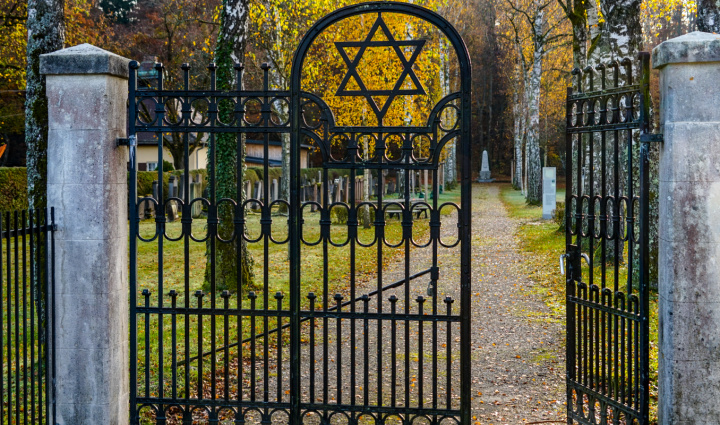
The entrance gate of a Jewish cemetery in Gauting, Starnberg, Upper Bavaria, Bavaria, Germany, on Nov. 8, 2020, is a wrought iron gate adorned with a Star of David. It stands between two stone pillars, leading into a tree-lined cemetery with gravestones and a pathway visible in the background. Photo by Michael Nguyen/NurPhoto via Reuters Connect
A few weeks ago, I conducted the funeral of Ron Plotkin, former owner of Monster.com and once a leading philanthropist in Los Angeles. In recent years, his life changed drastically — from prominence and influence to obscurity and hardship.
I knew Ron at his height and stayed in touch as others drifted away. By the time he died, there were no resources left — not even enough for a burial. We arranged for him to be laid to rest through charitable means at the Jewish cemetery in Commerce, California.
Sadly, we struggled to find 10 men to attend Ron’s funeral so Kaddish could be recited. A group from my synagogue agreed to come, but there were only nine of us. We stood in the blazing sun, waiting for a minyan.
Suddenly, a 10th man appeared: Shalom Raichik — originally from Los Angeles, now living in Baltimore — was at the cemetery just at that moment and agreed to join us.
After I recited Kaddish for Ron, Shalom asked if we could gather at another nearby grave to say Kaddish again, along with a memorial prayer.
“Who is it?” I asked. Shalom’s answer sent a chill through all of us. It is a story I cannot put out of my mind — a story about reclaiming someone who had disappeared from history.
We often think of death as a single, final event. But Jewish tradition introduces a powerful idea: a person can die twice. The first death is physical. The second is when they are forgotten — when no one remembers their name, or visits their grave, or even knows they existed.
The man we said Kaddish for that day is marked as “Ploni ben Avraham” — the Jewish equivalent of John Doe. We don’t know his name.
His story is tragic yet extraordinary: He survived the Holocaust, came to America alone, had no money and no family, and lived quietly in New York in obscurity.
At some point, he sought the help of Dr. Maurice Frey, a dentist and fellow refugee who had escaped Europe during the war. Dr. Frey was known for caring for penniless Holocaust survivors and treated this man without charge.
The patient, wanting to keep his dignity, insisted on giving something in return and arranged to donate his body to medical science, requesting his skull be given to Dr. Frey for educational use.
Years later, long after the encounter had been forgotten, a small package arrived containing the man’s skull. Dr. Frey tried to transfer it to the NYU School of Dentistry, but when they declined to take it, he kept it.
After his death, Dr. Frey’s widow moved to California, bringing the skull with her. There, she sought its disposal according to Jewish law and was directed to Chabad, who helped arrange a proper burial in 2021. Though only a skull remained, they honored the survivor and fulfilled the obligation to respect even the smallest remnant of a Jewish life.
Still, something was missing: There was no name, no marker, and no memory. Visitors to the cemetery unknowingly walked over his grave. A man who had survived the worst horrors was, even in death, being trampled, not by malice but by ignorance.
Finally, a small group decided to act, and this past January, they placed a modest stone, simply acknowledging that Ploni ben Avraham had existed and was not forgotten. And a few weeks ago, someone finally said Kaddish for him at his grave.
At Ron Plotkin’s funeral, having just buried a man once surrounded by success and admirers, but who died nearly alone, and then walking over to the grave of Ploni ben Avraham, I was struck by how fragile life and legacy can be.
Ron had a name and achievements, and was once celebrated, but at the end, there were barely 10 people at his funeral. Ploni ben Avraham had no name or notable achievements, and no family to remember him — yet, by chance, both were remembered on the same day. Their second death was averted.
At the end of Sefer Vayikra, in Parshat Bechukotai, the Torah presents consequences for the Jewish people’s fidelity or disregard for their responsibilities. It seems like a strict formula of reward and punishment: Follow God’s laws and you’ll receive blessings; abandon them, and hardship will follow.
And yet, within this passage, there is a quieter message. After the warnings and descriptions of suffering, the Torah offers a redemptive promise (Lev. 26:42): “I will remember My covenant,” says God.
That is the turning point. Even if everything falls apart — even if the people are scattered and shattered — God says: I will remember, I will always remember.
God teaches us that memory is the foundation of meaning. In Jewish thought, remembering is not merely recalling; it is restoring. When God says, “I will remember,” it is an active commitment: No matter how far we fall, we are never erased.
That is why we say Kaddish — not for the dead, but because memory sustains identity. It ensures a person’s life continues to echo in this world. We mark graves, tell stories, and cling to names — because the greatest tragedy is being forgotten.
That is why we tell stories about the dead, and that is why we refuse to let people disappear after they’re gone. Because the ultimate curse is not suffering, or even death. It is oblivion. And the ultimate redemption is not just survival. It is being remembered.
When we remember someone, we return them to the narrative. We restore their place in the story of our people. Ploni ben Avraham had no land, no family, and no possessions. He didn’t even leave a name. But we still remember him, and that is his redemption.
That day in the cemetery, I was reminded that in the end, what matters is not how loudly a person’s life is celebrated at its peak, but whether it is remembered after they are gone. And sometimes, in the most unexpected ways, we are invited to be part of that remembering.
The author is a rabbi in Beverly Hills, California.