


Uncategorized
Jewish authors get a lifeline

Susan Blumberg-Kason, a Jewish author whose work explores Jewish history and identity, was deep into a book about Golda Meir’s Milwaukee childhood when her literary agent abruptly dropped her early last year.
The agent offered only a vague explanation, saying, “We can no longer champion your career.”
Blumberg-Kason was surprised at the 180-degree turn by an agent who had been with her for years. But she soon discovered three other Jewish writers in her online community also had been suddenly dropped by their agents with little explanation other than the same phrase she heard: “We can no longer champion your career.”
It didn’t feel like coincidence.
“It wasn’t just that she dropped me,” Blumberg-Kason said. “It was that suddenly several of us were hearing the exact same sentence. It felt coordinated. It felt like something had shifted under our feet.”
It turns out many other Jewish writers have had similar experiences over the past two years, since the beginning of the Oct. 7 war and the boom in anti-Israel and antisemitic ferment that followed. In writers’ groups and forums, Jewish authors describe a sense that their work is being railroaded because they are Jewish. They’ve lost agents, publishers and book events. Some report that editors have cooled the moment Jewish themes appeared in their work.
In May 2024, anti-Israel boycotters propagated a shared spreadsheet called “Is your fav author a Zionist?” that went viral, “outing” Jewish writers for any kind of connection to Israel.
Author Elissa Wald felt the anti-Jewish sentiment so strongly that she created the Never Alone Book Club for Jewish authors to give one another support. The group now has 3,500 members, a Facebook community and a Substack, and it hosts Jewish book events and shares resources for writers who no longer feel safe in mainstream literary spaces.
The challenging climate prompted UJA-Federation of New York to begin funding projects aimed at helping Jewish authors, awarding a total of $300,000 in grants to six organizations working in different areas of the literary ecosystem.
“Supporting Jewish writers is an important part of UJA’s overall strategy to confront rising antisemitism,” said Eric S. Goldstein, CEO of UJA-Federation of New York. “Efforts to marginalize Jewish voices in culture and the arts must be met by even greater efforts to ensure they’re heard.”
The organizations receiving UJA grants are helping Jewish writers with everything from publishing logistics and visibility to offering emotional support.
“Jewish writers were being dropped, disinvited, and sidelined — and many were questioning whether they could continue writing Jewish stories,” said Rina Cohen, who manages strategy across UJA’s Combating Antisemitism portfolio. “By supporting them with tools and resources, UJA is sending a clear message: You deserve to create freely, and we’ll stand behind you as you do.”
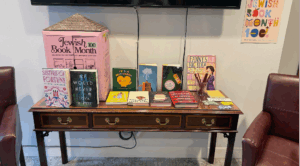
The Jewish Book Council used funding from UJA for a unique program to kick off the 100th anniversary of Jewish Book Month: The council designed and distributed 100 Jewish Book Kits to libraries and public spaces across New York City that offer a curated selection of Jewish literature, visual displays, QR codes and author highlights. The aim is to give librarians and community centers an accessible way to showcase Jewish books, helping make Jewish writing visible in the very spaces where many writers feared their work was being erased.
“Jewish books need visibility,” said Jewish Book Council CEO Naomi Firestone-Teeter. “We said: Let’s bring more Jewish books out into the world — into more readers’ hands — and build community around them. That’s what the kits do. They let people see Jewish books where they live their lives.”
It’s not always clear that a Jewish writer’s professional setback stems from antisemitism. Publishing is a brutal industry, and even successful writers experience abrupt and opaque rejection.
But many Jewish writers say that what they’re experiencing suggests something nefarious. They’ve felt their Jewishness was treated as suspect in classrooms, critique groups or conferences. They’ve felt pressure from editors to strip Jewish elements from their work.
When the Jewish Book Council opened a portal inviting Jewish writers to share incidents affecting their creative or professional lives, over 400 authors wrote in.
“Some of what we see is subtle and hard to pinpoint, and some of it is very direct: events canceled, students pushed out of MFA programs for being ‘Zionists,’ bookstores refusing to stock books,” Firestone-Teeter said. “Things are not okay. This is not just the normal difficulty of publishing.”
In addition to the Jewish Book Council, UJA’s other five grants went to Artists Against Antisemitism, PJ Library, the Jewish Theological Seminary, the Jewish Life Foundation and 70 Faces Media (the parent organization of the Jewish Telegraphic Agency).
In October, 70 Faces Media held a one-day Jewish Authors’ Summit, offering writers practical tools, digital strategy training and community-building to navigate this increasingly hostile publishing environment.
PJ library will hold a Jewish children’s book festival for authors and families at New York’s 92nd St. Y on Jan. 11, 2026. In just the first few days, an unprecedented 3,500 registrants signed up.
The Jewish Theological Seminary held a literary festival in September that brought together 450 writers, students and community members for masterclasses, public panels and craft development.
The Jewish Life Foundation is creating a TV and podcast series, “The People of the Book with Josh Radnor,” that will spotlight Jewish authors and conversations about Jewish identity and culture.
Artists Against Antisemitism created a full-day gathering for 140 authors, the Jewish Writers Mifgash, that included pitch sessions with literary agents, professional development workshops, mentorship matching and mental health support. Project Shema, a training and support organization focused on contemporary antisemitism, led a session at the conference on how to recognize antisemitism in creative spaces.
Elizabeth Berkowitz, one of the event’s organizers, said several authors came away with promising leads.
“Agents were asking, ‘Can you send me the full? I want to see more,’” Berkowitz said. “We definitely had some shidduchs made — real follow-ups between writers and agents who were actively seeking Jewish authors.”
Zeeva Bukai, a longtime editor who said she’d experienced open hostility in a professional editing group, said just being around others experiencing the same challenges was a welcome relief.
“I realized it’s not just me experiencing this; other are too,” she said. “That validation was just as important as the tools we learned to deal with it.”
That’s the point, said the Jewish Book Council’s CEO.
“We want authors to know we’ve got you on the other side,” Firestone-Teeter said. “Your job is to keep writing. Our job is to deal with the industry issues and build a community that celebrates you and your work. Jewish writers need to feel confident writing the books only they can write.”
The post Jewish authors get a lifeline appeared first on The Forward.
Uncategorized
Trump Says Gas Prices May Remain High Through November Midterm Election

U.S. President Donald Trump takes questions from reporters while Vice President JD Vance and Secretary of State Marco Rubio look on, as they attend a meeting with oil industry executives, at the White House in Washington, D.C., U.S., January 9, 2026. REUTERS/Kevin Lamarque
US President Donald Trump said on Sunday that the price of oil and gasoline may remain high through November’s midterm elections, a rare acknowledgement of the potential political fallout from his decision to attack Iran six weeks ago.
“It could be, or the same, or maybe a little bit higher, but it should be around the same,” Trump, who is in Miami for the weekend, told Fox News’ “Sunday Morning Futures With Maria Bartiromo” when asked whether the cost of oil and gas would be lower by the fall.
The average price for regular gas at US service stations has exceeded $4 per gallon for most of April, according to data from GasBuddy. Trump’s comments on Sunday came after weeks of asserting that the spike in prices is a short-term phenomenon, though his top advisers are cognizant of the war’s economic impacts, officials have said.
Earlier on Sunday, Trump announced on social media that the US Navy would blockade the Strait of Hormuz and intercept any ship that paid a crossing fee to Iran, after marathon talks between the US and Iran in Pakistan over the weekend did not yield a peace deal.
“No one who pays an illegal toll will have safe passage on the high seas,” he wrote on Truth Social.
Any US blockade is likely to add more uncertainty to the eventual resolution of the conflict, which is currently subject to a tenuous two-week ceasefire. The new tactic is in response to Iran’s own closure of the strait’s critical shipping lanes, which has caused global oil prices to skyrocket about 50%.
UNPOPULAR WAR HITS TRUMP’S APPROVAL
The war began on February 28, when the US launched a joint bombing campaign with Israel against Iran. The scope quickly expanded as Iran and its allies attacked nearby countries, while Israel targeted Hezbollah with massive strikes in Lebanon.
The war has buffeted global financial markets and caused thousands of civilian deaths, mostly in Iran and Lebanon.
Trump’s political standing at home has suffered, with polls showing the war is unpopular among most Americans, who are frustrated by rising gasoline prices.
The president’s approval rating has hit the lowest levels of his second term in office, raising concern among Republicans that his party is poised to lose control of Congress in the midterm elections. A Democratic majority in either chamber could launch investigations into the Trump administration while blocking much of his legislative agenda.
US Senator Mark Warner of Virginia, the ranking Democrat on the Senate Intelligence Committee, questioned the strategy behind Trump’s planned blockade.
“I don’t understand how blockading the strait is going to somehow push the Iranians into opening it,” he told CNN’s “State of the Union” on Sunday.
In a separate appearance on CBS’s “Face the Nation,” Warner said the blockade would not undermine Iranian control of the waterway.
“The Iranians have hundreds of speedboats where they can still mine the strait or put bombs against tankers in closing the strait,” he said. “How is that going to ever bring down gas prices?”
Although Trump has repeatedly said that the war would be over soon, Republican US Senator Ron Johnson of Wisconsin told ABC News’ “This Week” on Sunday that achieving US aims in Iran “could take a long time.”
“It’s going to be a long-term project,” said Johnson, who was not asked about Trump’s proposed blockade. “I never thought this would be easy.”
Uncategorized
Israel’s Ben-Gvir Visits Flashpoint Al-Aqsa Mosque Compound

Israeli politician Itamar Ben-Gvir walks inside the Knesset, in Jerusalem, Oct. 13, 2025. Photo: Chip Somodevilla/Pool via REUTERS
Israel’s far-right police minister Itamar Ben-Gvir visited the flashpoint Al-Aqsa Mosque compound in Jerusalem on Sunday, saying he was seeking greater access for Jewish worshipers and drawing condemnation from Jordan and the Palestinians.
The compound in Jerusalem’s walled Old City is one of the most sensitive sites in the Middle East. Known to Jews as Temple Mount, it is the most sacred site in Judaism and is Islam’s third-holiest site.
Under a delicate, decades-old arrangement with Muslim authorities, it is administered by a Jordanian religious foundation and Jews can visit but may not pray there.
Suggestions that Israel would alter the rules have sparked outrage among Muslims and ignited violence in the past.
“Today, I feel like the owner here,” National Security Minister Ben-Gvir said in a video filmed at the site and distributed by his office. “There is still more to do, more to improve. I keep pushing the Prime Minister (Benjamin Netanyahu) to do more and more — we must keep rising higher and higher.”
A statement from the Jordanian foreign ministry said it considered Ben-Gvir’s visit to be a violation of the status quo agreement at the site and “a desecration of its sanctity, a condemnable escalation and an unacceptable provocation.”
The office of Palestinian president, Mahmoud Abbas, said such actions could further destabilize the region.
Ben-Gvir’s spokesman said the minister was seeking greater access and prayer permits for Jewish visitors. He also said that Ben-Gvir had prayed at the site.
There was no immediate comment from Netanyahu’s office. Previous such visits and statements by Ben-Gvir have prompted Netanyahu announcements saying that there is no change in Israel’s policy of keeping the status quo.
Muslim, Christian and Jewish sites, including Al-Aqsa had been largely closed to the public during the Iran war. There was no immediate sign of unrest on Sunday after Ben-Gvir’s visit.
Uncategorized
Netanyahu Visits Troops Fighting Hezbollah in Southern Lebanon

Israeli Prime Minister Benjamin Netanyahu speaks during a press conference at the Prime Minister’s office in Jerusalem, Aug. 10, 2025. Photo: ABIR SULTAN/Pool via REUTERS
i24 News – Israeli Prime Minister Benjamin Netanyahu visited Israeli forces operating in southern Lebanon on Sunday as military operations against Hezbollah-linked targets continue.
Netanyahu toured forward positions alongside Defense Minister Yisrael Katz, Eyal Zamir, and Northern Command Commander Rafi Milo, meeting troops and receiving operational briefings from commanders on the ground.
Speaking to soldiers, Netanyahu praised their performance and said operations in the Lebanese security zone were ongoing.
“The war continues, including within the security zone in Lebanon,” he said, adding that Israeli forces were working to prevent infiltration attempts and neutralize threats such as anti-tank fire and missiles.
He described the northern campaign as part of a broader regional struggle involving Iran and its allies, saying Israel’s adversaries were now “fighting for their survival” following sustained Israeli military pressure.