


Uncategorized
Jews in Today’s South Africa Feel Embattled
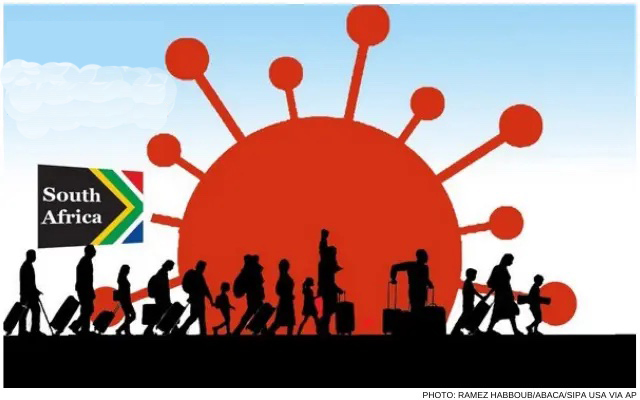
By HENRY SREBRNIK Since the Gaza war began last year, South African Jews feel like they are cats on a hot tin roof.
While South African Jews have risen to prominence and helped build the country, there is a deep-seated fear of the current government and for the community’s safety, because for the ruling African National Congress (ANC), the Palestine issue is a deeply felt ideological cause.
South African public opinion is vehemently pro-Palestinian. This was already the case before the current war, and since then, tensions have only increased. In the immediate aftermath of Hamas’ Oct. 7, 2023, attacks on Israel, South Africa’s International Relations Minister Naledi Pandor held high-level discussions with senior members of Hamas, a move that was met with criticism.
South African Chief Rabbi Warren Goldstein condemned the government at a pro-Israel rally. After Pandor’s diplomatic outreach to Hamas, Goldstein changed the Prayer for the Republic of South Africa, said regularly at congregations across the country, from asking God to protect “the president and the deputy president all members of the government,” to asking for protection for “all the people of this country,” a measure, he wrote in a letter to South African rabbis, that was taken in “extreme situations, for government violations of morality so grotesque they undermine the integrity of praying.”
To the estimated 60,000 South African Jews, their government appears to have shown little empathy for the Jewish victims of terror. The South African Jewish Board of Deputies (SAJBD), the umbrella organization that represents the country’s Jewish community, has noted a sharp increase in antisemitism.
Since then, the South African government, with broad popular support, has accused Israel of genocide before the International Court of Justice (ICJ). For many Jewish groups in the country, the decision to side against Israel was seen as evidence of antisemitism.
Now, the city of Johannesburg plans to rename the road on which the American consulate is located after Palestinian terrorist Leila Khaled. It was proposed by a former mayor, Thapelo Amad. Sandton Drive, its current name, is a central artery in Johannesburg, and Sandton, the neighbourhood in which the road is located, is home to many of South Africa’s Jews. The area is also home to at least four synagogues among other Jewish institutions.
Khaled, a member of the Popular Front for the Liberation of Palestine, who is now 80 years old, gained infamy in 1969 when she was part of a group who hijacked a Trans World Airlines flight on a journey from Rome to Tel Aviv, Israel. She became known as the first woman to hijack a plane.
“We stand with Hamas, Hamas stands with us, together we are Palestine and Palestine will be free,” Amad posted online. “With our souls, with our blood, we will conquer Al Aqsa.”
All of this is now reshaping how many South African Jews view themselves, their place in the country and their relationships with their fellow citizens. It is in this crucible that they are now forced to reconcile their own complex history in South Africa with the reality of a country whose national identity is increasingly built in opposition to a foreign country, Israel, that they hold dear.
Indeed, most Jewish institutions in South Africa today are oriented toward Israel. Herzlia, the primary Jewish school in Cape Town, is named after Theodor Herzl, and its motto (“Im Tirtzu”) is based on the famous Zionist line about willing Israel into existence.
The school has been the center of controversy, as the hard-left Economic Freedom Fighters political party last year called for it to be deregistered with the government, a move that would cause it to lose funding, for being too “pro-Israel.” Among other issues, the party cited the high number of Herzlia graduates who move to Israel and join the Israeli military. The exact number of Herzlia alumni who do so is unclear, but that hasn’t stopped it from becoming a highly contentious topic.
The rhetoric reached a boiling point last December, when a speaker at a large pro-Palestine rally in Cape Town targeted Herzlia directly, saying, “We know where the murderers come from — they come from Herzlia, here in Cape Town.” After the rally, the foreign ministry said it would investigate if any citizens were serving in the Israeli military and arrest any that had. These events were used by Jewish authorities as evidence of their threatened status in South Africa.
The South African Jewish community traces its lineage almost exclusively to the Lithuanian Jews who fled Europe before and during the Holocaust. They arrived in a country where they were greeted with skepticism. There were undeniable pockets of support for Nazism among some political parties at the time.
When the Afrikaner-led National Party took power in 1948, however, it didn’t elevate these views into the political discourse. Instead, the party focused on creating the apartheid system of minority rule and gaining the full support of all white citizens, including Jews.
Jews were significantly over-represented in the struggle against apartheid, with many in the ANC, but most lived with it. Not until 1985 did Jewish community leaders condemn it outright. As Cyril Harris, chief rabbi from 1987 to 2004, later told the Truth and Reconciliation Commission: “The Jewish community benefited from apartheid and an apology must be given.”
Many South African Jews today, though, fear that the country may fall into economic ruin. Israel has always been viewed as an exit plan thanks to its Law of Return, which grants them automatic Israeli citizenship.
Henry Srebrnik is a professor of political science at the University of Prince Edward Island.


Uncategorized
Hungary is poised to topple an authoritarian leader. American Jews have something to learn
An aspiring authoritarian, who has spent more than a decade shaping his country through a political project of popularist grievance and personal enrichment, may soon meet his electoral end.
That elected leader is not President Donald Trump, but Hungarian Prime Minister Viktor Orbán, who has ruled Hungary consecutively since 2010 (and who previously served as prime minister between 1998 and 2002). Hungarians will go to the polls on April 12, and Orbán’s Fidesz party is polling well behind the conservative, pro-European Tisza. That Trump, who is closely allied with Orbán, this week dispatched Vice President JD Vance to Budapest to campaign for Orbán may not be enough. (While there, Vance baselessly claimed EU interference in Hungary’s elections, turning back to the same old Trump playbook.)
There is much that Americans can learn from the Hungarian experience of years spent under the governance of someone accused of dismantling rule of law, a person whose inner circle has grown rich during his time in office. But American Jews in particular should pay attention. Because Orbán’s administration has used antisemitism as a political tool throughout his time in power, and is desperately turning to this hatred once again on its way, possibly, out the electoral door.
Examining the different purposes for which Orbán has employed antisemitism is instructive. The essential lesson: Antisemitism deployed by powerful people is often an attempt to evade accountability for their own bad actions.
The Orbán administration has tried to rewrite history so as to paint Hungary as a perpetual victim or victor — never a country responsible for misdeeds like, say, allying with Nazi Germany prior to being occupied by it. Orbán, like other politicians interested in historical revisionism, has tried to make adherence to his specific retelling of Hungarian history synonymous with being a true Hungarian. Anyone who challenges his vision is, in it, an enemy of the state.
For no one has that been more true than Hungarian-born Jewish billionaire philanthropist George Soros. In past elections, Orbán has inflated Soros to the status of a political adversary, campaigning against a spectral version of him instead of his actual political opponents. This approach, rife with antisemitic dog whistles, has been alarmingly effective.
“We are fighting an enemy that is different from us. Not open, but hiding; not straightforward but crafty; not honest but base; not national but international; does not believe in working but speculates with money; does not have its own homeland but feels it owns the whole world,” he said of Soros in the 2018 campaign, invoking any number of longstanding antisemitic tropes.
When Orbán’s authoritarian efforts extended to cracking down on liberal institutions and civil society, he turned again to antisemitism in the form of Soros conspiracy theories.
Under attack by Orbán, Central European University, the university that Soros founded, has mostly been pushed out of its original home of Budapest. When the Hungarian government passed legislation to criminalize helping those who wanted to claim asylum in the country, it was called “Stop Soros” legislation. NGOs in Hungary have long been smeared for receiving money from Soros’ Open Society Foundations, accused of being proxies through which Soros is “targeting” Hungary.
Recently, Orbán has pivoted, making Ukrainian President Volodymyr Zelenskyy the new scapegoat of his antisemitic conspiracy theories.
He has charged that support for Ukraine is expensive and even dangerous, and pushed the idea that Orbán and Fidesz are all that prevents such support from leading Hungary to disaster. Orbán and Fidesz have erected billboards showing Zelenskyy smirking with an outstretched hand, in a pose reminiscent of the antisemitic “happy merchant” meme. Perhaps most tellingly and menacingly, Fidesz has put up posters with Zelenskyy’s face, blazoned with nearly the same words that, almost a decade ago, accompanied campaign posters with Soros’s visage on them: “Let’s not let Zelenskyy have the last laugh.”
As Hungarians are asking what, exactly, the last decade and a half of autocracy have accomplished for them, their governing party appears to be suggesting that it is the only thing standing between them and the machinations of a nefarious Jew. Antisemitism can be many things, but in Hungary, again and again, it has been an attempt to trick citizens out of asking what good Orbán’s government has done for them.
This playbook has clear resonances in that deployed by Trump.
When threatened, Trump and his allies repeatedly turn to blaming Soros. They have used the idea of Soros as a sort of universal bogeyman to try to explain away Trump’s felony charges and to justify violence against citizens protesting ICE. The Department of Justice has tried to find ways to push for prosecutions of Soros and his allies, on far-fetched charges possibly including material support of terrorism.
What Orbán and Trump have both bet on is that dog whistling about all-powerful Jews will distract enough voters from noticing while they help themselves to their country’s rights and riches. If Orbán is defeated on Sunday, his loss will send an essential message to Americans: that strategy can only sustain a leader for so long.
Flailing about and sowing the seeds of antisemitic conspiracies cannot change the stubborn fact that neither Soros nor Zelenskyy is in charge in Hungary: Orbán is. Hungarians seem to see, now, that all that talk about Soros didn’t make their lives any better. Neither will going after Zelenskyy.
We can hope Hungarians remember that as they go to the polls. We, American Jews, should remind others, and ourselves, of it here, too. We often focus on trying to communicate that antisemitism is hateful and unfair toward American Jews. Perhaps, in addition, we should try to point out that Trump’s antisemitism, like Orbán’s, is not only hateful, but a hateful deflection.
The post Hungary is poised to topple an authoritarian leader. American Jews have something to learn appeared first on The Forward.
Uncategorized
Israel Expels Spain From US-Backed Gaza Coordination Center as Diplomatic Rift Deepens

Spanish Prime Minister Pedro Sanchez speaks during a press conference after attending a special summit of European Union leaders to discuss transatlantic relations, in Brussels, Belgium, Jan. 23, 2026. Photo: REUTERS/Yves Herman
Israel has expelled Spain from the United States’ Civil-Military Coordination Center (CMCC) in Kiryat Gat, a hub established to coordinate humanitarian operations in the Gaza Strip, marking a sharp escalation in an already deteriorating diplomatic rift between the two countries.
On Friday, Israeli Prime Minister Benjamin Netanyahu announced Spain’s expulsion from the CMCC, framing the move as a response to Madrid’s increasingly anti-Israel stance and what he described as continued hostility toward the Jewish state.
“Spain has defamed our heroes, the soldiers of the [Israel Defense Forces], the soldiers of the most moral army in the world,” Netanyahu said during a press conference. “Anyone who attacks the State of Israel instead of the terrorist regimes … will not be our partner in the future of the region.”
“I am not willing to tolerate this hypocrisy and this hostility,” the Israeli leader continued. “I do not intend to allow any country to wage a diplomatic war against us without paying an immediate price for it.”
In a press release, Israeli Foreign Minister Gideon Saar confirmed that the United States had been informed ahead of time, adding that the decision followed Spain’s serious harm to the interests of both Jerusalem and Washington.
The Spanish government has also been informed of the decision, though it has yet to issue any public statement or official response.
“Spain’s obsessive anti-Israel bias under [Prime Minister Pedro Sanchez]’s leadership is so egregious that it has lost all capability to serve a constructive role in implementing US President Donald Trump’s peace plan and the center operating under it,” the top Israeli diplomat wrote in a post on X.
For a long time, the government of Spain under @sanchezcastejon has been operating against the State of Israel in every way possible. Sánchez and his ministers level false blood libels against Israel and its army, defame and incite against Israel and Prime Minister Netanyahu. The…
— Gideon Sa’ar | גדעון סער (@gidonsaar) April 10, 2026
Established in October 2025 as part of US Central Command, the CMCC was set up to coordinate and manage the flow of humanitarian, logistical, and security assistance from the international community into Gaza under Trump’s peace plan for the enclave.
Since the start of the war in Gaza, and increasingly amid the war with Iran and broader regional escalation, Spain has launched a fierce anti-Israel campaign aimed at undermining and isolating the Jewish state on the international stage.
Earlier this week, Sánchez publicly condemned Israeli strikes in Lebanon and the widening regional escalation tied to the Iran conflict, renewing calls for the European Union to suspend its association agreement with Israel and urging an end to “impunity for [Israel’s] criminal actions.”
The Spanish leader also accused Netanyahu of breaching basic humanitarian norms, saying his “contempt for life and international law is intolerable.”
Spanish Foreign Minister José Manuel Albares has also publicly condemned Israel’s military campaign, describing the conflict as “the greatest assault on the civilization built upon the humanist ideals of reason, peace, understanding, and universal law over the abuse of power, brute force, and arbitrariness.”
In a phone call with his Spanish counterpart on Friday, Iranian Foreign Minister Abbas Araghchi praised Spain’s “principled and honorable” stance on what he called “US-Israeli aggression against Iran,” urging countries to take a firmer stand against what he described as war crimes.
“Spain’s valuable stances in defending international law and human values have been noted and praised by the Iranian nation and the international community, and will never be forgotten,” the top Iranian diplomat said.
Even though Spain welcomed the recently announced US–Iran ceasefire, Albares said, “Madrid will not applaud those who set the world on fire just because they show up with a bucket to put out that fire.”
As part of its broader anti-Israel campaign, Spain had recently closed its airspace to aircraft involved in what officials described as a “reckless and illegal confrontation” – another move welcomed by Iran’s Islamist government.
In one of its most controversial recent moves, Madrid also announced this weej the reopening of its embassy in Tehran.
According to data from Spain’s Ministry of Trade reported by Servimedia, the Spanish government exported more than €1.3 million worth of dual-use materials to Iran in 2024 and the first half of 2025, including explosive components, laboratory reagents, and specialized control software.
Uncategorized
DNC Fails to Pass Resolutions Condemning AIPAC, Pushing for Conditioning Aid to Israel

Crews prepare the stage at the annual AIPAC Policy Conference in Washington, DC, March 6, 2018. Photo: Reuters / Brian Snyder
A panel at the Democratic National Committee (DNC) on Thursday voted down a resolution to condemn the influence of the American Israel Public Affairs Committee (AIPAC), the foremost pro-Israel lobbying group in the US, in Democratic primary elections. The panel also deferred a decision on resolutions to push for conditioning military aid to Israel and to recognize a Palestinian state.
The resolutions, which were considered within the newly created Middle East Working Group, were introduced into the agenda by Florida DNC member Allison Minnerly, who saw it as an opportunity to bring those who have not been “seeing their party support Palestinian rights or stand against military conflict” back into the fold of the Democratic Party, she told The Intercept.
Minnerly’s effort comes as the gap continues to widen between the official stance of the Democratic Party, which has largely supported aid to Israel in recent decades, and the views of the Democratic base, which now has an overwhelmingly unfavorable view of Israel, according to recent polling.
In recent months, a number of potential Democratic presidential hopefuls — including some who were former donors and speakers at AIPAC conferences — have been distancing themselves from AIPAC, saying they would not take money from the bipartisan group in the future.
Illinois Governor J.B. Pritzker, for example, recently said he abandoned his support for AIPAC when it “began to lean much more to the right and much more pro-Trump.” Another prominent Democrat, US Sen. Cory Booker (NJ) told Politico in March that he is no longer going to receive funds from AIPAC.
Others who have made sure to have no association with AIPAC include California Gov. Gavin Newsom and former Chicago Mayor Rahm Emmanuel.
Aside from the fact that Israel is now seen less favorably by Democratic voters, AIPAC has also become a hot topic on the left as its allied super PACs have become increasingly influential in Democratic primaries, spending millions to back candidates aligned with their positions. Critics within the party argue that this influx of money, including donations from Republican-aligned contributors, risks distorting Democratic contests and elevating outside influence.
Even so, the resolutions specifically calling out AIPAC, aiming to condition aid to Israel, and pushing to recognize a Palestinian state did not pass. Meanwhile, a separate resolution calling out all dark money went through.
“Let’s be clear on what really happened: Today, the Resolutions Committee voted to pass a resolution condemning the corrosive influence of ALL dark money in Democratic primaries,” DNC chair Ken Martin posted on X. “We had various resolutions that focused on different industries and groups, and instead of going one-by-one, we passed a blanket repudiation.”
Meanwhile, Democratic Majority for Israel President & CEO Brian Romick said in a statement that the Democratic pro-Israel group was “pleased” with the outcome of the vote.
“We’re pleased that the DNC Rules Committee rejected a set of divisive, anti-Israel resolutions,” he said. “These measures would be a gift to Republicans, would further fracture our party, and do nothing to bring Israelis and Palestinians closer to peace.”
“DMFI will continue to stay engaged with the DNC and its Task Force on the Middle East as it relates to these harmful resolutions,” he added. “The DNC and party advocates need to keep focus where it belongs — on building a united Democratic Party that can win back Congress this November.”
AIPAC spokesperson Deryn Sousa said in a statement to Politico that the DNC “made clear today that all Democrats, including millions who are AIPAC members, have the right to participate fully in the democratic process. And we plan to do just that.”
Halie Soifer, CEO of the Jewish Democratic Council of America — an organization that aims to bring Jews into the Democratic Party — told Politico that the DNC “as a whole has not shifted from where it has been … which is an organization that is inclusive of Jewish Americans and is supportive of the US-Israel security relationship, as well as Israel’s future as a Jewish and Democratic state.”
She argues that “misconceptions” about this have been driven by “a vocal, far-left faction of our party.”
“But they are in no way leading here,” Soifer said.