



Uncategorized
Joe Kent Suggests Israel Behind Charlie Kirk Assassination, Controls US Foreign Policy in Tucker Carlson Interview

National Counterterrorism Center Director Joseph Kent attends a House Homeland Security hearing entitled “Worldwide Threats to the Homeland,” on Capitol Hill in Washington, DC, US, Dec. 11, 2025. Photo: REUTERS/Elizabeth Frantz
After Joe Kent, director of the US National Counterterrorism Center, resigned in protest of President Donald Trump’s military campaign against Iran, he appeared on Tucker Carlson’s podcast on Wednesday.
While on the podcast, Kent, who resigned from his position on Tuesday, argued that Israel dragged the US into the war against the Iranian regime, suggested that Israel may have been involved in the murder of conservative activist Charlie Kirk, claimed that Iran posed no imminent threat to the United States, and said that Iran was not pursuing a nuclear weapon.
Themes of Israel controlling US policy and conspiracy theories about Kirk’s assassination have become commonplace on Carlson’s podcast in recent months.
“We don’t know what happened with Charlie Kirk. I’m not saying the Israelis did this — I’m saying there are a lot of unanswered questions there, and there’s enough data to say there’s a good chance that President Trump feels he is under threat,” Kent said.
“The last time I saw Charlie Kirk on this earth was in June, in the West Wing stairway,” Kent said on Carlson’s podcast. “And he said very loudly to me … ‘Joe, stop us from getting into a war with Iran.’ Very loudly. He was single-minded.”
“So, when one of President Trump’s closest advisers who was vocally advocating against a war with Iran is suddenly publicly assassinated, and we’re not allowed to ask questions about that — it’s a data point. A data point that we need to look into,” Kent said, suggesting that Israel may have something to do with the assassination.
There has been no evidence to support claims of Israeli involvement in Kirk’s assassination. Tyler Robinson, 22, has been charged for murdering Kirk and potentially faces the death penalty. He was romantically involved with his transgender roommate, and prosecutors have reportedly argued that Kirk’s anti-trans rhetoric was a key factor that allegedly led him to shoot the Turning Point USA founder.
Kent also argued that the US is not really in charge of its own foreign policy: “Who is in charge of our policy in the Middle East? Who is in charge of when we decide to go to war or not?” he asked.
Ther former counterterrorism chief argued that Israel forced Washington’s hand by saying it would attack Iran and that the US would be forced to be caught up in Iran’s inevitable retaliation.
“The Israelis felt emboldened that no matter what they did, no matter what situation they put us in, they could go ahead and take this action, and we would just have to react. That speaks to the relationship — but also it just shows there was a lobby pushing for us to go to war,” Kent said.
In addition to claiming Israel was driving US foreign policy, he also claimed Iran was not close to achieving, or even pursuing, a nuclear-weapons capability. “No, they weren’t [on the verge of getting a nuclear weapon] — not three weeks ago when this started, and not in June [2025] either,” Kent said, referring to last year’s 12-day war between Iran and Israel
“The Iranians have had a religious ruling — a fatwa — against actually developing a nuclear weapon since 2004. That’s been in place since 2004. That’s available in the public sphere. But we also had no intelligence to indicate that that fatwa was being disobeyed or was on the cusp of being lifted,” Kent added.
Experts on Iran have widely dismissed the Iranian regime’s so-called fatwa against having nuclear weapons, noting Tehran has repeatedly lied about and tried to hide aspects of its nuclear program.
The interview occurred one day after Kent resigned from his senior intelligence position, saying he could not support the war and arguing Tehran posed “no imminent threat” to the United States. But it was Kent’s broader assertion, that pressure from Israel and pro-Israel voices influenced the decision to go to war, that especially drew swift pushback from the White House and national security experts.
In his resignation, Kent also drew parallels to the Iraq War, suggesting that similar dynamics shaped both conflicts by arguing that Israel pushed the US into the war.
“Iran posed no imminent threat to our nation, and it is clear that we started this war due to pressure from Israel and its powerful American lobby,” Kent wrote in his resignation letter.
The Trump administration forcefully disputed Kent’s claims, maintaining that the decision to strike Iran was based on credible intelligence about threats to US forces and interests in the region. Trump dismissed Kent as “weak on security,” defending the operation as necessary to deter Iranian aggression and protect American personnel and allies.
“When I read the statement, I realized that it’s a good thing that he’s out, because he said that Iran was not a threat,” Trump said. “Iran was a threat.”
Kent himself previously described Iran as a major threat that needed to be addressed.
In a September 2024 post on X, for example, he wrote that “Iran has been after Trump since January of 2020 after he ordered the targeted killing of the terrorist Qasem Soleimani. This isn’t a new threat.”
White House press secretary Karoline Leavitt lambasted Kent’s resignation letter as inaccurate.
“The absurd allegation that President Trump made this decision based on the influence of others, even foreign countries, is both insulting and laughable. President Trump has been remarkably consistent and has said for DECADES that Iran can NEVER possess a nuclear weapon,” she posted on social media.
Kent previously faced scrutiny during his US congressional runs in Washington state over links to far-right, antisemitic, and white nationalist figures, including Nick Fuentes.
Uncategorized
Antisemitic AI Videos Target Children With Disney-Pixar Style to Push Holocaust Denial, Report Shows
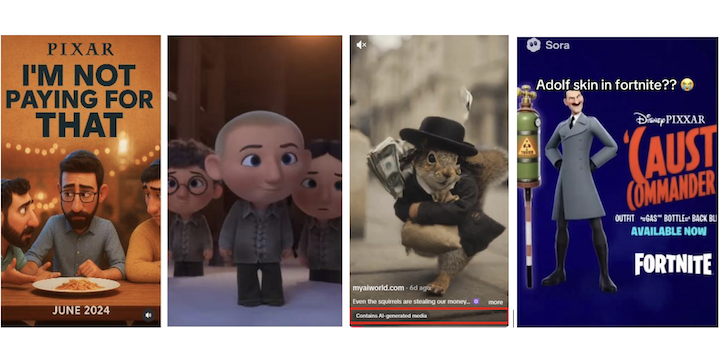
AI-generated videos found on TikTok, Meta, YouTube, and X imitated popular animation styles from Disney-Pixar movies to present Holocaust denial and antisemitic tropes to children. The image of a child second from the left is from a trailer depicting Jewish children in a concentration camp during World War II. Photos: Screenshot collage from CyberWell report.
A pathbreaking report released this week reveals that online users have started exploiting AI video generators to weaponize the nostalgia of Disney-Pixar styles, wrapping venomous hate in a candy-coated shell to reach youth.
On Sunday, CyberWell, a Tel Aviv-based nonprofit focused on monitoring antisemitism on social media, published research tracking 307 identified pieces of AI-generated content targeting Jews on social media between January 2025 and February 2026. The group found that the images and videos received 30 million views and more than 2.8 million user interactions such as likes or reshares. They observed animations created with OpenAI’s Sora, Google’s Veo, X’s Grok, and Suno.
While TikTok accounted for the biggest chunk of the content at almost 36 percent, the popular video-sharing service also came through with the highest level of enforcement at more than 88 percent. Instagram drove the top rates of engagement, accounting for almost 65 percent while its total antisemitic posts reached nearly 25 percent.
The Meta platform saw a removal rate of 67 percent, notably higher than Alphabet’s YouTube (28 percent) and billionaire Elon Musk’s X platform (20 percent). Musk recently incorporated X, xAI, and its Grok chatbot into his rocket company SpaceX before an anticipated IPO in June.
CyberWell found three primary narratives across the videos: 33.2 percent portrayed Jews as greedy or money-obsessed, 21.5 percent involved the Holocaust, and 21.2 percent presented violent rhetoric against Jews inspired by a specific event, in this case the June 2025 Israel-Iran conflict and the viral video “Boom, Boom, Tel Aviv.” The video features such lyrics as “Boom, boom, Tel Aviv. This is what you get for all your evil deeds […] You brought this upon yourself, it’s your time to bleed […] Humanity never expected good behavior from you Jews.”
The researchers called mid-2025 a turning point in the rise of AI-driven antisemitic videos, with 98.4 percent of identified content originating from that point forward.
The report describes “a recurring pattern in which users package AI-generated antisemitic content in formats designed to appeal to younger audiences. The most common examples include fabricated Disney-Pixar-style movie trailers and gaming-related audio clips that promote Holocaust-related mockery, antisemitic conspiracy theories, and hate speech targeting Jews.”
One of the techniques users attempt to evade moderation is to label such videos with tags claiming “satire” and “dark humor.” Others will use the term “Caust” instead of “Holocaust.”
One example presented features a fabricated trailer for a “Caust” movie created with Sora in the Pixar style. Researchers described how “set in a concentration camp, the trailer portrays Adolf Hitler in a lighthearted manner while following a group of Jewish child prisoners attempting a dramatic escape. By presenting the Holocaust in a playful, animated format, the video turns atrocity into entertainment and diminishes the gravity of Jewish suffering.”
The AI videos also exploit kids’ love for video games.
One TikTok video created with Sora and titled “CAUST COMMANDER” received 66,500 views, 4,623 likes, and 3,619 reposts. According to the report, “the post portrays Adolf Hitler in a playful, stylized manner while depicting him killing those around him. The video makes light of the Holocaust and the mechanisms used to exterminate Jews by presenting them in a gamified, commercialized format, including the promotion of fake merchandise such as Zyklon B gas, themed outfits, and ‘back bling.’”
On March 24, OpenAI announced the decision to shut down Sora following months of reporting on antisemitic content proliferating across the platform. Analysts judged that the decision was reportedly motivated by a need to free up computational power for the training of new models so OpenAI could remain competitive as Anthropic’s Claude surges in popularity among coders and Alphabet’s Gemini draws away users.
The report emphasizes the deep extent to which antisemitism has penetrated AI systems.
“Many of the websites used in AI training datasets function as active hubs for antisemitic discourse, raising concerns about their inclusion in model development,” the report says. “For example, Reddit ranks among the most cited domains across major AI systems, while analyses of ChatGPT outputs indicate that Wikipedia alone contributes to roughly half of generated responses. The reliance of AI companies on these websites underscores the risk that antisemitic narratives circulating online may become embedded in model inputs and later disseminated at scale.”
CyberWell CEO and founder Tal-Or Cohen Montemayor warned that AI had turbo-charged both the speed and intensity of online antisemitism.
“Artificial intelligence has fundamentally changed the scale and speed at which antisemitism can be produced and distributed online,” Cohen Montemayor said. “Generative AI now allows bad actors to industrialize hate, producing high-impact content that can reach millions, with enforcement often coming only after it has already been widely amplified.”
Cohen Montemayor added that CyberWell’s latest report “examining the circulation of antisemitic AI-generated content on major platforms provides critical insights for how social media platforms can take on the abuse of generative AI tools to spread antisemitism in the digital universe.”
CyberWell found that while the Pixar-fied, disarming aesthetics targeted children, it was the videos openly glorifying violence that provoked the highest level of shares reaching 33 percent of content but 41 percent of engagement.
Cohen Montemayor called for the platforms to “move beyond disclosure and invest in systems that identify harmful narratives at scale, including those embedded in audio, visuals and coded formats that evade traditional detection.”
Warning that AI was “being weaponized at scale,” Cohen Montemayor explained that “by strengthening automated detection, investing in competent and transparent human moderation, auditing training data and partnering with specialized external stakeholders, platforms and AI developers can address the complex and fast-evolving forms of online hate through sustained collaboration between technology companies, policymakers and expert partners.”
In one of the most closely watched legal battles in artificial intelligence, a jury on Monday ruled against Musk in a lawsuit the billionaire filed to force OpenAI to revert fully to its original nonprofit mission. Jurors decided that Musk had filed his suit too late.
The world’s wealthiest man faces potentially more severe legal challenges in response to his AI business in France, where prosecutors said they intended to pursue criminal charges due to the Grok chatbot’s promotion of Holocaust denial and generation of child sexual abuse images.
Uncategorized
Yeshiva University Holds Conference Calling for ‘Social Science’ Study of Rising Antisemitism

A graduate wears a Star of David on her graduation mortarboard during the commencement ceremony for Yeshiva University in New York City, US, May 2024. Photo: REUTERS/Andrew Kelly
Vital new data, scholarship, and moral encouragement were exchanged during a national conference Yeshiva University held earlier this month to promote the study of antisemitism as a “social science problem,” several academics who attended the event told The Algemeiner in exclusive interviews.
The “Antisemitism Conference” brought some 200 academics to the institution’s campus in Manhattan, New York amid a moment many Jewish community advocates have described as a “crisis” of antisemitism. Across the US, Jews have faced discrimination, battery, and even death over their Jewish identity and for being Zionists. Having seen the situation plunge to unprecedented lows, Yeshiva University called on scholars from a range of fields to use their expertise to explore and report on the matter.
Following the conference, Raeefa Shams of the Academic Engagement Network (AEN) told The Algemeiner that the academic community was responsive and arrived at the event with a harvest of findings and insight.
“They presented research they are in the process of conducting or in the process of publishing,” Shams said. “For example, we had one faculty member who presented on the correlation between anti-Israel attitudes and conspiratorial, antisemitic thinking. There was another scholar who presented on the experience of Jewish students with antisemitism post-Oct. 7. We had somebody else present about antisemitism within the American Psychological Association. We had a clinical psychologist talk about antisemitism and traumatic invalidation.”
The Algemeiner has covered a wide range of antisemitic incidents which transpired on the streets and campuses of the US since Hamas’s Oct. 7, 2023, attack on Israel unleashed a spike in global antisemitism. These included, among many other examples, a public-school principal inveighing against “Jew money,” an attempted arson at the Hillel International chapter in San Francisco, California, and the movement of some conservative students into the far-right ecosystem of antisemitism. In New York City, home to the world’s largest Jewish population outside of Israel, Jews have been targeted in the majority of all hate crimes this year despite comprising a small fraction of the total population.
The wave of hatred has changed how American Jews perceive their status in the US. According to the results of a previous survey commissioned by the Anti-Defamation League (ADL) and the Jewish Federations of North America, a striking 57 percent of American Jews believe “that antisemitism is now a normal Jewish experience.”
Higher education can lead the way in reversing this trend if it promotes the adoption of “trauma informed” policies, clinical psychologist Dr. Mari Bal-Halpern, told The Algemeiner.
“There needs to be a safe environment. That does not mean that we’re silencing voices, but it needs to be safe for everybody,” Bal-Halpern said, “We know how to do that; there are guidelines for how. Most universities say they are, but are they really following those guidelines? I doubt it.”
Antisemitic incidents in the US decreased overall in 2025, but violent attacks targeting American Jews remained at alarmingly high levels, according to the ADL’s latest Annual audit report. While antisemitic assaults increased by just 4 percent, from 196 in 2024 to 203 in 2025, perpetrators increased their use of “deadly” weapons by nearly 40 percent, the ADL said. Incidents of assault involving a deadly weapon increased to 32 in 2025 from 23 in 2024.
The advocacy group noted that the upward shift was reflected in the shocking murders of Jews in antisemitic attacks in the US for the first time since 2019. Two Israeli embassy staffers — a young couple set be engaged — were shot dead in Washington, DC last May, and weeks later a firebombing in Colorado claimed the life of an octogenarian. In both crimes, the alleged killers cited anti-Zionism as their motivating ideology.
Yeshiva University’s “Antisemitism Conference” was the first step toward amassing even more empirical data on this subject, another conference participant said.
“For all of us who are embarking on this area of research and investigation, we’re all dealing with this very large, amorphous, difficult to fully understand but very disturbing phenomena of rising antisemitism or rising anti-Israelism to the extent that there is a connection between them,” said Rutgers University psychology professor Dr. Kent Harber. “We’re trying to get some sense of the dimension and facets of it for our individual work.”
Follow Dion J. Pierre @DionJPierre.
