


Uncategorized
Just before Hanukkah attack, Jewish mayor of Bondi Beach region had been praised for fighting antisemitism
Three weeks before the Hanukkah mass shooting in Australia that has become the deadliest attack on Diaspora Jews in decades, the mayor of the affected region had been feted at a global summit for fighting antisemitism.
“I think it’s really important for us here in Australia, and particularly Waverley, to be proud that we’ve been put on the international stage talking about what we have done in Australia to combat antisemitism,” Will Nemesh, the mayor of the Sydney-area region of Waverley, told the Australian Jewish News about his appearance and panel discussion at the Combat Antisemitism Movement’s mayoral summit held in Paris.
Nemesh’s participation there followed one at an earlier event in September, with other Australian mayors, also put on by the Combat Antisemitism Movement. Jewish himself, Nemesh was committed enough to the cause of fighting antisemitism that he gave a presentation to his city council just days before the attack.
Nemesh’s staff was unable to make him available to comment for this article. But he spoke about his efforts to curb antisemitism during a gathering last week when he convened other mayors from the region in the aftermath of the terrorist attack in which a father and son who had pledged allegiance to ISIS killed 15 people and wounded more than two dozen others at a menorah lighting at Waverley’s Bondi Beach.
“The last time we gathered as mayors in this same place was in February of this year. We gathered with a mission calling for action on antisemitism,” Nemesh said. “We had seen hate spreading through our communities. We knew then, as we know now, that hatred targeted towards the Jewish people never ends there. It spreads like a virus, infects our social cohesion and our Australian way of life, and tragically now it has directly led the loss of life.”
About his fellow mayors, he added, “Being here demonstrates their commitment to combating antisemitism at a local level.”
The Combat Antisemitism Movement has long pressured governments and institutions to follow its playbook in order to prevent antisemitic incidents. Now, with a vocal adherent of its strategy having experienced a violent antisemitic attack under his watch, an emissary for the movement has nothing but praise for him.
“You can definitely not blame him. He’s the last person you can blame,” Yigal Nisell, an advisor for the Combat Antisemitism Movement’s Australia branch, told the Jewish Telegraphic Agency about Nemesh. “He’s not just a supporter of the Jewish community, he’s probably the most active mayor in Australia against antisemitism.”
At the same time, Nisell said, the organization has “a lot of anger coming out now for the government, massive anger.”
That anger, he said, should be directed at senior Australian officials, including Prime Minister Anthony Albanese, whom Nisell believes helped encourage the attack by recently recognizing a Palestinian state in the aftermath of the Oct. 7 Hamas attacks and Israel-Gaza war.
Nisell took little heart in statements from Albanese and others, both before the attack and after, that condemned antisemitism and vowed to root out influence from foreign actors like Iran.
“It’s all bulls–t,” he said. “They didn’t protect the Jewish community… If you look at other governments in the past, this would have never happened because they were very strict, they stood supportive of the Jewish community.”

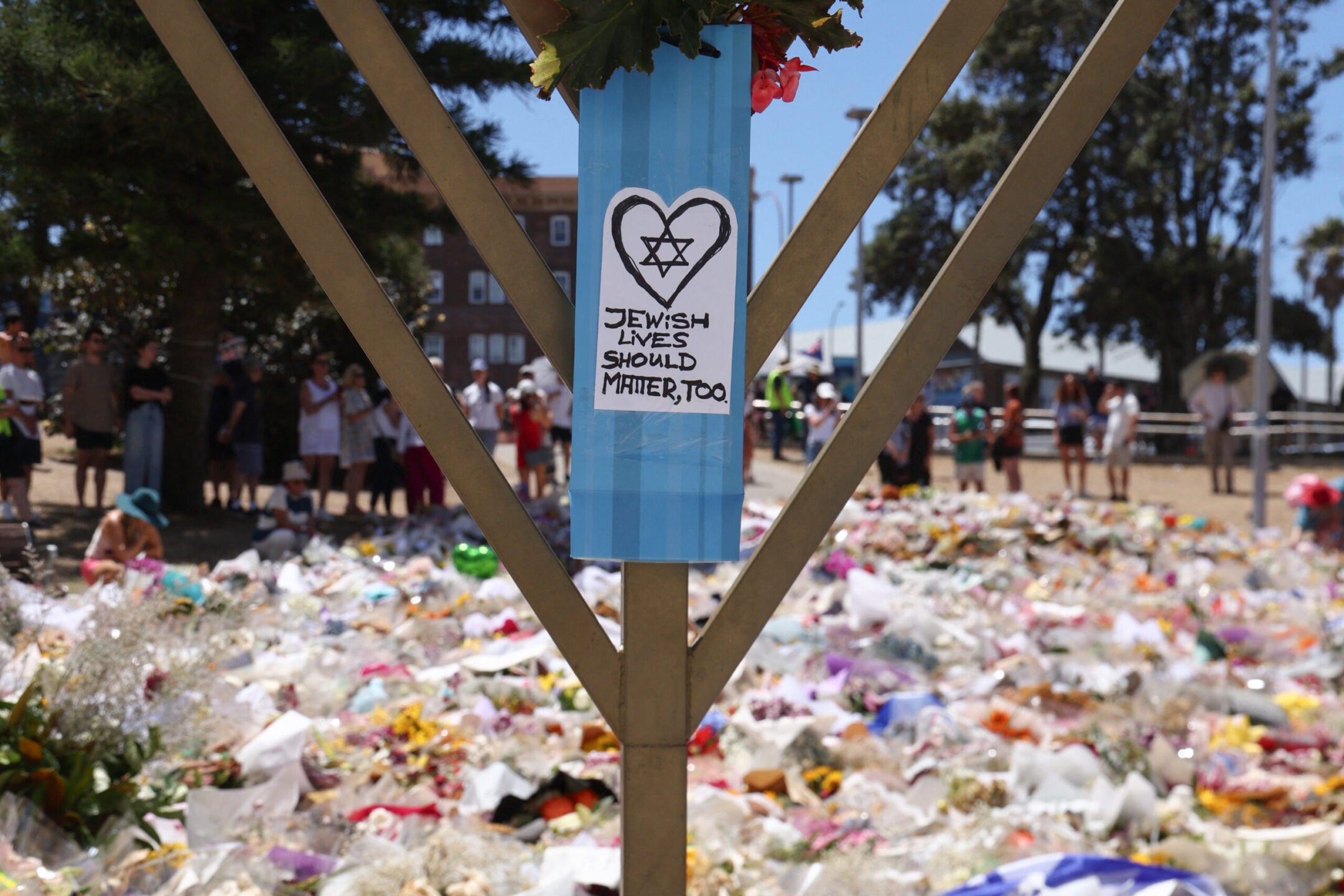
A sign reading “Jewish Lives Should Matter, Too” is seen at the floral tributes area outside Bondi Pavilion in Sydney on December 18, 2025, to honour victims of the Bondi Beach shooting. The attack at Bondi Beach on December 14 was one of the deadliest in Australian history. (Photo by DAVID GRAY / AFP via Getty Images)
Days after Nisell first spoke with JTA, Albanese gave an address in which the prime minister said he would “accept my responsibility” in failing to safeguard Australia from antisemitism. He unveiled a new plan that includes harsher penalties for speech targeting Jews, shortly after the United Kingdom announced that it would also begin stricter speech prosecution.
“It’s a very, very good step,” Nisell said of Albanese’s plan. “Unfortunately, we had to wait for this kind of incident to make it clear for him that this is necessary.”
But Albanese later declined to convene a state commission to investigate intelligence failings in the lead-up to the attack, inflaming his critics’ anger. Hundreds of thousands of people have signed an online petition calling for his resignation.
Nisell, who is a former senior executive at CAM, lived in Australia for years before moving to Israel in 2023. He is currently head of Mosaic United, a project of Israel’s Ministry of Diaspora Affairs and Combating Antisemitism.
In his time in Australia, he said, Nemesh was one of the few government officials who took the threat of rising antisemitism in Australia seriously.
“Will stood almost every day and warned the government that all these hate crimes were happening in his backyard, and warned them that if this won’t be stopped it could get much, much worse,” he said.
It was a mission that Nemesh felt acutely. Born and raised in Sydney, he is a member of Emanuel Synagogue, a leading liberal congregation in Sydney, and a former staffer at the New South Wales Board of Deputies, a Jewish representative body. In university, he was a leader in Australia’s Jewish student group. He was elected to the Waverley Council in 2017 and chosen for a two-year term as its mayor last year, making him the first Jew to hold the role in the heavily Jewish area in 16 years.
The election followed a controversy on the council, when a deputy mayor voted against condemning Hamas’ Oct. 7, 2023, attack on Israel.
“I think it’s very important to have a strong voice for the Jewish community. Particularly since October 7, communities have felt traumatized and, in some respects, marginalized,” Nemesh told the Australian Jewish news outlet J-Wire at the time, adding that he thought it was important to be “in a position to call out hate and particularly antisemitism and to show strong leadership on that.”
Just prior to the Bondi Beach attack, CAM — which frequently pressures governments to adapt more stringent policies to fight antisemitism — had celebrated Nemesh as one of the few officials doing the right thing.
The movement praised the “Model Antisemitism Strategy” Nemesh had instituted in Waverley, and had him share the strategy with European mayors in Paris. Nemesh’s plan, a CAM release stated two weeks ago, “offers a practical guide to support councils across the country to build their own locally tailored initiatives to counter antisemitism.”
Among the policies the group applauded was the promotion of the International Holocaust Remembrance Association’s definition of antisemitism. “If you are an anti-Zionist, you are an antisemite,” Nisell said, when asked what CAM’s biggest policy priorities are. “This is the biggest thing we want to be clear.”
Mayors have been a major focus of CAM’s activism in recent months, with the group engaging hundreds of such local leaders worldwide on the issue of curbing antisemitism in their communities.
But after the attack, Nisell downplayed the ability of mayors like Nemesh to stand as such bulwarks.
“His power is very, very limited,” he said, of Nemesh. “Will was very active. His council was very active promoting IHRA, promoting statements against antisemitism. I’m just making a point here that everything he has done is just a drop in the sea.”
In fact, Nisell theorized, the mayor’s embrace of such policies may have drawn more attention from antisemitic actors, because he was one of the few mayors in the country who adopted them.
“Because he was only one of very few leaders in Australia that stood against antisemitism, this happened. If there were more, this would never have happened,” Nisell said.
Does the fact that a mayor who proudly and openly embraced CAM’s policies still experienced such a horrific antisemitic attack on his watch mean that there is no way to prevent such incidents? Nisell doesn’t think so. CAM, he said, would continue to promote mayoral summits and policies like Nemesh’s. He hopes that mayors who had declined invitations to attend CAM’s last summit will be compelled by the attack to come to the next one.
On Tuesday the group released an open letter it had circulated to other mayors in its coalition in Australia and beyond, addressed to Nemesh, that offers words of solidarity and encouragement.
“As mayors and council members from around the world, we see firsthand that antisemitism is not an abstract threat — it manifests in our streets, our schools, and our communities,” the letter reads. “Cities are on the front lines of this fight, but governments at all levels must now fully assume their responsibility: to protect Jewish communities, to confront antisemitism decisively, and to ensure that those who incite or commit hatred face real consequences.”
It’s signed, “Mayors and Council Members from Around the World.”
Not every response to the letter has been positive. During the signing phase, an Australian council member told CAM that, while “I unequivocally condemn antisemitism in all its forms … it is essential to distinguish antisemitism from legitimate political and moral positions.”
“Being anti-occupation, anti-genocide, and anti-oppression does not equate to antisemitism,” the official, Cumberland City Councellor Ahmed Ouf, continued in an email shared with JTA. “Condemning the occupation of Palestine, the systematic oppression of the Palestinian people, and the mass killing of tens of thousands of civilians over the past two years is a stance grounded in human rights and international law, not hatred of Jewish people.”
(The open letter does not mention Israel or Palestinians. However, CAM’s ask to its partners includes the statement, “Support for Hamas and terrorist organisations must be illegal, calls for a global intifada investigated, and extremist incitement eradicated.”)
After the attack, Nisell said, he was in contact with Nemesh. “Honestly he couldn’t speak,” he recalled of the mayor. “He is so shocked. Nobody in their wildest dreams could think that this could happen.”
Nisell believes the larger Jewish community should spare Nemesh from its ire. “I really, really hope that this won’t break him, and that this community will show him support,” he said.
This article originally appeared on JTA.org.
The post Just before Hanukkah attack, Jewish mayor of Bondi Beach region had been praised for fighting antisemitism appeared first on The Forward.
Uncategorized
Downed Planes Raise New Perils for Trump as Tehran Hunts for Missing US Pilot

Traces of an Iranian missile attack in Tehran’s sky, amid the U.S.-Israeli conflict with Iran, in Tehran, Iran, April 3, 2026. Photo: Majid Asgaripour/WANA (West Asia News Agency) via REUTERS
Two US warplanes were downed over Iran and the Gulf, Iranian and US officials said on Friday, with two pilots rescued and a third still missing and being hunted by Tehran’s forces.
The incidents show the risks still faced by US and Israeli aircraft over Iran despite assertions from US President Donald Trump and his Defense Secretary Pete Hegseth that their forces had total control of the skies.
The first plane, a two-seat US F-15E jet, was shot down by Iranian fire, officials in both countries said.
The second plane, an A-10 Warthog fighter aircraft, was hit by Iranian fire and crashed over Kuwait, with the pilot ejecting, two US officials said.
Two Blackhawk helicopters involved in the search effort for the missing pilot were hit by Iranian fire but made it out of Iranian airspace, the two US officials told Reuters.
The degree of injuries among the crew of the aircraft remained unclear. The status and whereabouts of the missing F-15E crew member was not publicly known.
Iran’s Revolutionary Guard Corps said it was combing an area near where the pilot’s plane came down in southwestern Iran and the regional governor promised a commendation for anyone who captured or killed “forces of the hostile enemy.”
Iranians, who have been pummeled by American air power for weeks, posted gleeful messages celebrating the plane downings. Iran’s Parliament Speaker Mohammad Baqer Qalibaf said on X that the U.S. and Israel’s war had been “downgraded from regime change” to a hunt for their pilots.
Trump has been in the White House receiving updates on the search-and-rescue operation, a senior administration official told Reuters. The Pentagon and US Central Command did not immediately respond to requests for comment.
NO SIGN OF END TO WAR
The prospect of a US service person being alive and on the run inside Iran raises the stakes for Washington in a conflict with low public support and no sign of an imminent end.
Iran has officially told mediators it is not prepared to meet with US officials in Islamabad in coming days and that efforts to produce a ceasefire, led by Pakistan, have reached a dead end, the Wall Street Journal reported on Friday.
The US and Israel opened the campaign with a wave of strikes that killed Iran’s Supreme Leader Ayatollah Ali Khamenei on February 28. The war has killed thousands and threatened lasting damage to the global economy.
So far, 13 US military service members have been killed in the conflict and more than 300 have been wounded, according to the US Central Command.
Iran has rained down drones and missiles on Israel. It has also taken aim at Gulf countries allied to the US, which have so far held back from joining the war directly for fear of further escalation.
In a security alert on Friday, the US embassy in Beirut said Iran and its aligned armed groups may target universities in Lebanon and urged US citizens in the country to leave while commercial flights are still available.
Israel has been waging a parallel campaign against Iran-backed Hezbollah in Lebanon after the militant group fired at Israel in support of Iran.
TRUMP THREAT TO STRIKE BRIDGES, POWER PLANTS
On Friday, as Trump threatened to hit its bridges and power plants, Iran struck a power and water plant in Kuwait, underlining the vulnerability of Gulf states that rely heavily on desalination plants for drinking water.
On Thursday, Trump posted footage on social media showing dust and smoke billowing up as US strikes hit the newly constructed B1 bridge between Tehran and nearby Karaj, which was due to open this year, and said more attacks would follow.
“Our Military, the greatest and most powerful (by far!) anywhere in the World, hasn’t even started destroying what’s left in Iran. Bridges next, then Electric Power Plants!” he wrote in a subsequent post.
On Friday, a drone hit a Red Crescent relief warehouse in the Choghadak area of Iran’s southern Bushehr province.
Kuwait Petroleum Corporation said its Mina al-Ahmadi refinery had been hit by drones. Other attacks were also reported to have been intercepted in Saudi Arabia and Abu Dhabi. Missile debris landed near the Israeli port of Haifa, site of a major oil refinery.
Oil markets were closed after benchmark U.S. crude prices gained 11% on Thursday following a speech by Trump that offered no clear sign of an imminent end to the war.
Uncategorized
US-Iran: Diplomatic Push Falters as Qatar Steps Back and Pakistan Talks Stall

Qatari Prime Minister and Foreign Minister Sheikh Mohammed bin Abdulrahman Al Thani speaks after a meeting with the Lebanese president at the presidential palace in Baabda, Lebanon, Feb. 4, 2025. Photo: REUTERS/Emilie Madi
i24 News – Diplomatic efforts to secure a ceasefire between Washington and Tehran appear to have reached an impasse, as key regional mediators pull back and broader talks stall.
According to reporting by The Wall Street Journal, Qatar has informed US officials that it does not wish to take a central role in mediating between the two sides. Officials familiar with the matter said Doha has made clear it is “not willing” to lead negotiations or act as the primary broker.
At the same time, Pakistan-led efforts to bring Iranian and American officials together have also stalled. Mediators say Tehran has refused to attend proposed meetings in Islamabad, calling Washington’s conditions “unacceptable,” further underscoring the widening gap between the two sides and the growing difficulty of restarting dialogue.
Despite the deadlock, diplomatic channels have not fully closed. Turkey and Egypt are continuing parallel efforts to revive talks, with discussions underway about potential alternative venues, including Doha and Istanbul.
US President Donald Trump downplayed the impact of recent military developments on diplomacy, including the destruction of a US fighter jet during operations in Iran. Speaking in a brief exchange with an NBC News journalist, he said: “No, not at all. It’s war. We are at war.”
He further fueled speculation with a cryptic social media post on Truth Social, writing: “Keep the oil, anyone?” criticising international allies on Friday over rising fuel prices. Trump appeared to mock allies such as the United Kingdom, writing that they should “keep the oil.”
Uncategorized
Report: Iran Retains Significant Missile Capability Despite Weeks of US-Led Strikes

Iranian missiles are displayed in a park in Tehran, Iran, Jan. 31, 2026. Photo: Majid Asgaripour/WANA (West Asia News Agency) via REUTERS
i24 News – Despite weeks of sustained airstrikes by the United States and its allies, Iran has reportedly managed to retain a substantial portion of its military capabilities, particularly its ballistic missile arsenal.
According to a report by The New York Times citing US intelligence assessments, Tehran has developed methods to mitigate the impact of the strikes, allowing it to preserve and restore key parts of its missile infrastructure.
While the Pentagon has claimed responsibility for striking more than 11,000 targets over five weeks and reducing the rate of Iranian missile fire, intelligence officials now caution that the actual damage may be more limited than initially assessed. Iranian forces are reportedly able to rapidly repair or reactivate missile launchers stored in heavily fortified or underground facilities, sometimes within hours of being hit.
Analysts also point to the widespread use of decoy sites, which may have drawn strikes away from operational assets. Many of the targeted locations are believed to have contained dummy installations, complicating efforts to accurately gauge the degradation of Iran’s ballistic capabilities. Combined with deep underground bunkers and dispersed storage networks, this approach is seen as enabling Tehran to maintain a higher level of readiness than publicly estimated.
US intelligence officials assess that this resilience reflects a deliberate strategy: preserving a credible long-range strike capability as both a deterrent and a bargaining tool in any future negotiations, while ensuring regime survival and continued regional influence.
Despite sustained air dominance claimed by Washington and its allies, Iran’s adaptive tactics continue to complicate battlefield assessments, leaving the true balance of power in the conflict uncertain.