


Uncategorized
Media Amnesia: Zohran Mamdani’s Extremism Forgotten as Pro-BDS Socialist Wins New York City Mayoral Race

Democratic candidate for New York City mayor Zohran Mamdani reacts after winning the 2025 New York City Mayoral race, at an election night rally in the Brooklyn borough of New York City, New York, US, Nov. 4, 2025. Photo: REUTERS/Jeenah Moon
The clean-up has begun.
As votes rolled in and it became clear that Democratic nominee Zohran Mamdani had secured the big victory long predicted, the media whitewash was already underway.
Mamdani’s rise — from relative unknown to mayor of America’s largest city — is, politically speaking, extraordinary. He won more votes than any candidate in a New York City mayoral race in 50 years.
But it was also a campaign haunted by allegations of antisemitism, anti-Israel extremism, and sympathy for radical Islamist movements and chants like, “Globalize the intifada.” Those allegations were well-founded, which is precisely why the media — until now — felt obliged at least to mention them, if only to dismiss them as “smears.”
Now that he’s won, even that pretense of scrutiny is vanishing.
The Record the Media Are Erasing
These facts are not in dispute — and they have all been previously documented by HonestReporting and others:
-
May 2021 – Pro-Palestinian rally, Manhattan:
Led BDS chants and attacked city officials who traveled to Israel.Aug 4–6, 2023 – DSA National Convention, Chicago:
“When the boot of the NYPD is on your neck, it’s been laced by the IDF.” (Video resurfaced Oct 2025)2023–2025 – Multiple posts and interviews:
Repeatedly labeled Israel an “apartheid” state and accused the US of “subsidizing genocide.”June 5, 2025 – Media interview:
Refused to affirm Israel’s right to exist as a Jewish state, saying instead that he supports “a state with equal rights for all” and opposes any “hierarchy of citizenship… on the basis of religion.”June 8, 2025 – Cornell Tech boycott call:
Urged a boycott over the university’s partnership with Israel’s Technion.June 2025 – NBC’s Meet the Press:
Refused to condemn the slogan “globalize the intifada,” saying it’s “not language I use,” but stopping short of disavowing it.July 16, 2025 – Private meeting:
Said he wouldn’t use the phrase “globalize the intifada” going forward, but defended it as “a protest slogan against occupation.”Oct 1–2, 2025 – ABC’s The View:
Called the Gaza war a “genocide” to audience applause.Oct 27–28, 2025 – Debate fallout:
Told an emotional story about a hijab-wearing “aunt” who stopped riding the subway after 9/11 over “Islamophobia” fears — but discrepancies later emerged, forcing him to walk back the claim and clarify that he had actually been referring to a cousin.Nov 4, 2025 – MSNBC’s Morning Joe:
Declared, “I support BDS.”
The Whitewash in Real Time
Now that Mamdani has won, much of the media is pretending none of this ever happened.
What were once documented facts about his statements and positions are being rewritten as mere accusations by political opponents.
This is how media rehabilitation works: reframe the record, dilute the facts, and gaslight the public into thinking the extremism was never there.
Take CNN, which described Mamdani as having “reached out to New York’s Jewish community, which had been roiled by his criticisms of Israel’s government.”
Criticisms of Israel’s government?
Is claiming that Jews thousands of miles away are somehow responsible for police violence in New York — that “the boot of the NYPD is laced by the IDF” — merely a policy critique?
According to CNN, yes.
US Jews (& Israeli Jews) are entitled to & may have plenty of their own criticisms of Israel’s government.@CNN has completely missed the point re: Jewish concerns about Zohran Mamdani–a man who has a problem not with Israel’s government or leader but with its very existence. pic.twitter.com/dbdX1Dzp3S
— HonestReporting (@HonestReporting) November 5, 2025
Meanwhile, the Wall Street Journal insisted Mamdani “says Israel has a right to exist,” while the New York Times wrote that he simply “declined to say it should be a Jewish state.”
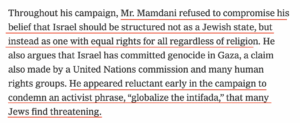
That is dishonest framing.
Mamdani has explicitly rejected the legitimacy of Israel as a Jewish state — which is what Israel is. To say you support Israel’s existence only if it stops being Jewish is not to affirm its existence at all.
It’s like declaring support for Japan’s right to exist — just not as a country run by Japanese people or speaking Japanese.
Zohran Mamdani clearly stated that he does not believe Israel has the right to exist as the Jewish state that it is, & instead should be a state with “equal rights.”
Newsflash: Israel already has equal rights for all. And the insinuation, as well as the targeting, of one… pic.twitter.com/ztA29X4cF9
— HonestReporting (@HonestReporting) November 5, 2025
Then there’s Rolling Stone, which bizarrely claimed Mamdani “hasn’t said or done anything antisemitic” and “did not call to ‘globalize the intifada.’”
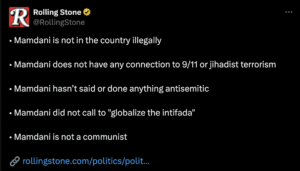
Such media examples aren’t hard to find. They are everywhere now — each one sanding off the rough edges of Mamdani’s record.
The Image Laundering Has Begun
The mainstream press has shifted into image-rehabilitation mode, presenting Mamdani as a unifying progressive rather than a divisive ideologue.
This isn’t so much journalism as it is public relations for an extremist whose record is a matter of record.
Make no mistake: the same outlets now gaslighting Jewish readers about who Mamdani is are the ones already hinting that this “Muslim socialist mayor” could one day be president.
And for that to happen, his Jew-hating, pro-terror past must be scrubbed from memory.
Welcome to the memory-holing of Zohran Mamdani.
The author is a contributor to HonestReporting, a Jerusalem-based media watchdog with a focus on antisemitism and anti-Israel bias — where a version of this article first appeared.
Uncategorized
Downed Planes Raise New Perils for Trump as Tehran Hunts for Missing US Pilot

Traces of an Iranian missile attack in Tehran’s sky, amid the U.S.-Israeli conflict with Iran, in Tehran, Iran, April 3, 2026. Photo: Majid Asgaripour/WANA (West Asia News Agency) via REUTERS
Two US warplanes were downed over Iran and the Gulf, Iranian and US officials said on Friday, with two pilots rescued and a third still missing and being hunted by Tehran’s forces.
The incidents show the risks still faced by US and Israeli aircraft over Iran despite assertions from US President Donald Trump and his Defense Secretary Pete Hegseth that their forces had total control of the skies.
The first plane, a two-seat US F-15E jet, was shot down by Iranian fire, officials in both countries said.
The second plane, an A-10 Warthog fighter aircraft, was hit by Iranian fire and crashed over Kuwait, with the pilot ejecting, two US officials said.
Two Blackhawk helicopters involved in the search effort for the missing pilot were hit by Iranian fire but made it out of Iranian airspace, the two US officials told Reuters.
The degree of injuries among the crew of the aircraft remained unclear. The status and whereabouts of the missing F-15E crew member was not publicly known.
Iran’s Revolutionary Guard Corps said it was combing an area near where the pilot’s plane came down in southwestern Iran and the regional governor promised a commendation for anyone who captured or killed “forces of the hostile enemy.”
Iranians, who have been pummeled by American air power for weeks, posted gleeful messages celebrating the plane downings. Iran’s Parliament Speaker Mohammad Baqer Qalibaf said on X that the U.S. and Israel’s war had been “downgraded from regime change” to a hunt for their pilots.
Trump has been in the White House receiving updates on the search-and-rescue operation, a senior administration official told Reuters. The Pentagon and US Central Command did not immediately respond to requests for comment.
NO SIGN OF END TO WAR
The prospect of a US service person being alive and on the run inside Iran raises the stakes for Washington in a conflict with low public support and no sign of an imminent end.
Iran has officially told mediators it is not prepared to meet with US officials in Islamabad in coming days and that efforts to produce a ceasefire, led by Pakistan, have reached a dead end, the Wall Street Journal reported on Friday.
The US and Israel opened the campaign with a wave of strikes that killed Iran’s Supreme Leader Ayatollah Ali Khamenei on February 28. The war has killed thousands and threatened lasting damage to the global economy.
So far, 13 US military service members have been killed in the conflict and more than 300 have been wounded, according to the US Central Command.
Iran has rained down drones and missiles on Israel. It has also taken aim at Gulf countries allied to the US, which have so far held back from joining the war directly for fear of further escalation.
In a security alert on Friday, the US embassy in Beirut said Iran and its aligned armed groups may target universities in Lebanon and urged US citizens in the country to leave while commercial flights are still available.
Israel has been waging a parallel campaign against Iran-backed Hezbollah in Lebanon after the militant group fired at Israel in support of Iran.
TRUMP THREAT TO STRIKE BRIDGES, POWER PLANTS
On Friday, as Trump threatened to hit its bridges and power plants, Iran struck a power and water plant in Kuwait, underlining the vulnerability of Gulf states that rely heavily on desalination plants for drinking water.
On Thursday, Trump posted footage on social media showing dust and smoke billowing up as US strikes hit the newly constructed B1 bridge between Tehran and nearby Karaj, which was due to open this year, and said more attacks would follow.
“Our Military, the greatest and most powerful (by far!) anywhere in the World, hasn’t even started destroying what’s left in Iran. Bridges next, then Electric Power Plants!” he wrote in a subsequent post.
On Friday, a drone hit a Red Crescent relief warehouse in the Choghadak area of Iran’s southern Bushehr province.
Kuwait Petroleum Corporation said its Mina al-Ahmadi refinery had been hit by drones. Other attacks were also reported to have been intercepted in Saudi Arabia and Abu Dhabi. Missile debris landed near the Israeli port of Haifa, site of a major oil refinery.
Oil markets were closed after benchmark U.S. crude prices gained 11% on Thursday following a speech by Trump that offered no clear sign of an imminent end to the war.
Uncategorized
US-Iran: Diplomatic Push Falters as Qatar Steps Back and Pakistan Talks Stall

Qatari Prime Minister and Foreign Minister Sheikh Mohammed bin Abdulrahman Al Thani speaks after a meeting with the Lebanese president at the presidential palace in Baabda, Lebanon, Feb. 4, 2025. Photo: REUTERS/Emilie Madi
i24 News – Diplomatic efforts to secure a ceasefire between Washington and Tehran appear to have reached an impasse, as key regional mediators pull back and broader talks stall.
According to reporting by The Wall Street Journal, Qatar has informed US officials that it does not wish to take a central role in mediating between the two sides. Officials familiar with the matter said Doha has made clear it is “not willing” to lead negotiations or act as the primary broker.
At the same time, Pakistan-led efforts to bring Iranian and American officials together have also stalled. Mediators say Tehran has refused to attend proposed meetings in Islamabad, calling Washington’s conditions “unacceptable,” further underscoring the widening gap between the two sides and the growing difficulty of restarting dialogue.
Despite the deadlock, diplomatic channels have not fully closed. Turkey and Egypt are continuing parallel efforts to revive talks, with discussions underway about potential alternative venues, including Doha and Istanbul.
US President Donald Trump downplayed the impact of recent military developments on diplomacy, including the destruction of a US fighter jet during operations in Iran. Speaking in a brief exchange with an NBC News journalist, he said: “No, not at all. It’s war. We are at war.”
He further fueled speculation with a cryptic social media post on Truth Social, writing: “Keep the oil, anyone?” criticising international allies on Friday over rising fuel prices. Trump appeared to mock allies such as the United Kingdom, writing that they should “keep the oil.”
Uncategorized
Report: Iran Retains Significant Missile Capability Despite Weeks of US-Led Strikes

Iranian missiles are displayed in a park in Tehran, Iran, Jan. 31, 2026. Photo: Majid Asgaripour/WANA (West Asia News Agency) via REUTERS
i24 News – Despite weeks of sustained airstrikes by the United States and its allies, Iran has reportedly managed to retain a substantial portion of its military capabilities, particularly its ballistic missile arsenal.
According to a report by The New York Times citing US intelligence assessments, Tehran has developed methods to mitigate the impact of the strikes, allowing it to preserve and restore key parts of its missile infrastructure.
While the Pentagon has claimed responsibility for striking more than 11,000 targets over five weeks and reducing the rate of Iranian missile fire, intelligence officials now caution that the actual damage may be more limited than initially assessed. Iranian forces are reportedly able to rapidly repair or reactivate missile launchers stored in heavily fortified or underground facilities, sometimes within hours of being hit.
Analysts also point to the widespread use of decoy sites, which may have drawn strikes away from operational assets. Many of the targeted locations are believed to have contained dummy installations, complicating efforts to accurately gauge the degradation of Iran’s ballistic capabilities. Combined with deep underground bunkers and dispersed storage networks, this approach is seen as enabling Tehran to maintain a higher level of readiness than publicly estimated.
US intelligence officials assess that this resilience reflects a deliberate strategy: preserving a credible long-range strike capability as both a deterrent and a bargaining tool in any future negotiations, while ensuring regime survival and continued regional influence.
Despite sustained air dominance claimed by Washington and its allies, Iran’s adaptive tactics continue to complicate battlefield assessments, leaving the true balance of power in the conflict uncertain.