


Uncategorized
Millennial anxieties are the ‘new normal’ in these Yiddish stories
This is a revised version of the original article in Yiddish which you can read here.
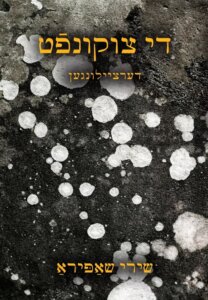
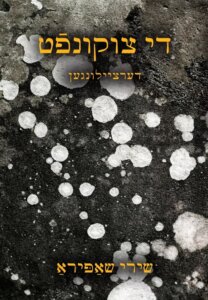
Di Tsukunft (The Future)
A book of short stories in Yiddish
by Shiri Shapira
Leyvik House, 2025
You may not have heard about Shiri Shapira yet but you may do so soon. She’s one of the few young Israeli writers who are choosing to write in Yiddish, the language of her East European ancestors. A collection of her short stories was recently published by the Tel Aviv publishing house, Leyvik House, with the support of Israel’s National Authority for Yiddish Culture.
Like the author herself, the protagonists in her new collection of short stories and autobiographical pieces, Di Tsukunft (The Future), are average Israeli men and women with everyday worries about their livelihood, families and health problems. But beneath their daily routine lies a latent personal experience that waits for a critical moment to be revealed. When that moment arrives, the characters often enter a new phase of life.
For the 13-year-old heroine of the opening story, also titled “The Future,” this happens in 2001. The terror attacks of 9/11 in New York City coincide with the onslaught of terror in her own town:
“The changes to daily life were immense. A seemingly endless series of discussion circles was held in memory of a victim from our school that I hadn’t known. Every morning I’d have to look at his smiling, pimpled face staring out from the enlarged photo that had been hung by the school gate.”
Thus 2001 ushered in the “terror attacks of the future […] up to the very skies, shining, silvery.” They became an indispensable part of the ‘new normal’ — for Shapira, the State of Israel and the entire world.
The word “future” is both the title of the book, and the name of the first and last stories in the collection. The term is key to Shapira’s work: for the author and her characters alike, the future is dangerous and uncertain.
Notably, “The Future” is also the name of one of the most important Yiddish literary periodicals, Di Tsukunft, published in New York from 1892-2010. In one of the more autobiographical pieces in the collection, also titled “Future”, Shapira writes about cataloging articles of Di Tsukunft for the Index to Yiddish Periodicals at the Hebrew University in Jerusalem. The concluding story “Future” highlights Shapira’s turning to Yiddish, which comes to loom so large in her life.
Shapira shares how she’d initially hoped to read the issues of Di Tsukunft and “learn everything about Jewish history.” Instead, she found herself reading the Israeli press, with its news of terror attacks in Israel, day after day, during the 2015-2016 wave of violence known as the “Intifada of the Individuals.” Israeli reality cancelled out the beautiful, visionary future of those long-ago Yiddish socialists: “What’s there to say about the future? The future’s a thing of the past.”
Shapira recalls: “As a child, I had the impression that I’d come too late for the past, and that someone whose past was shut off to them was of little use for the future.” Shapira references here a national oblivion around the “past”: Israeli society’s longtime neglect of Yiddish and Eastern European Jewish culture.
This neglect, however, served only to awaken her own interest in Yiddish. Historical inquiries and philosophical questions such as this one are woven skillfully into the narrative fabric of her stories.
Shapira’s characters live in Israel and speak Hebrew. Most of them don’t know Yiddish. Shapira herself is a Hebrew writer who has translated a significant number of works from German into Hebrew.
Sometimes Shapira’s tone is bitterly ironic, especially on the subject of the writer’s bleak lot in today’s society. The protagonist of “Self-Portrait as a Hebrew Writer” fantasizes about her ideal reader:
“He comes to an event celebrating my first book, my debut. […] He sits there, looking ridiculously handsome, listening to me babble about the difficult, wrenching labor of writing this text. When the musicians finish their part, he applauds energetically.”
The man reads her book twice and, as she comments ironically, “sees deep into her soul.” Their encounter takes them to the bedroom: “As he climaxes, he lets out a sweet sigh, a melody of contentment — like an enthused, eloquent review.”
So what role does Yiddish play here? Her stories suggest an answer.
In “Earthquake,” an elderly couple, Benny and Dalia, survive an earthquake in Jerusalem. Their modern apartment is unharmed, but many buildings in Shuafat, a Palestinian refugee camp in East Jerusalem, are destroyed, and around 700 people are killed. The couple’s Arab cleaning lady goes missing, and no one knows what happened to her.
For the couple, life goes on as usual. They quickly forget the cleaning lady, especially because they never even knew how to pronounce her name. Jews and Arabs make their home in the same town, but they live in completely different worlds.
Every night, Benny and Dalia eat dinner and nap a bit while watching a TV show. Something new does enter their routine; they sign up for a Yiddish class. Though they barely remember any of the Yiddish their parents once spoke, they hope they’ll “at least learn something before the next earthquake comes.”
The earthquake acts as a metaphor for the dramatic and tragic events that take place in Israel. These misfortunes cut through the monotony of the everyday, but soon enough life goes on as before. In such moments, Yiddish makes its appearance as a sort of phantom of Jewish history from which one might “at least learn something” before the next crisis hits.
Shapira remembers a feeling that used to disturb her as a child: “I was really young, and I thought that everyone besides me knew what to do in every situation, that they were grounded in their lives, while I was the only one floating in the air, not knowing where to land safely.” Yiddish, on the other hand, creates a kind of spiritual shelter, a ‘refuge’ where historical roots can be found.
Shiri Shapira has a keen sense of time in general and of the present moment in particular. In her stories, time flows naturally for months on end, then suddenly brings on changes in the lives of individuals and of society at large. Every day has the potential for danger. Written in Yiddish, Shapira’s stories build imaginary bridges between the troubling present and the past that has nearly disappeared from Israeli memory.
To buy the book, click here.
The post Millennial anxieties are the ‘new normal’ in these Yiddish stories appeared first on The Forward.
Uncategorized
High-Stakes US Special Forces Mission Rescues Airman From Iran After F-15 Crash

FILE PHOTO: A U.S. Air Force F-15E Strike Eagle aircraft takes off for a mission supporting Operation Epic Fury during the Iran war at an undisclosed location, March 9, 2026. U.S. Air Force/Handout via REUTERS/File Photo
US forces staged the audacious rescue of an airman behind enemy lines after Iran downed his fighter jet, officials said on Sunday, resolving a crisis for President Donald Trump as he weighs escalating the war, now in its sixth week.
The airman rescued by special operations forces, who Trump said was a colonel, was the weapons-systems officer on the downed F-15, a US official told Reuters.
“Over the past several hours, the United States Military pulled off one of the most daring Search and Rescue Operations in US History,” Trump said in a statement, adding that the airman was injured but “he will be just fine.”
The officer was the second of two crew members on the warplane that Iran said on Friday had been brought down by its air defenses. Iran’s Revolutionary Guards said several aircraft were destroyed during the US rescue mission, Tasnim news agency reported.
Reuters reported on Friday that the first crew member had been retrieved, triggering a high-profile search by both Iran and the United States for the remaining airman.
Iranian officials had urged citizens to help find him, hoping to gain leverage against Washington in the war Trump and Israel launched on February 28.
Trump has threatened to escalate the conflict in the coming days with attacks on Iran’s energy infrastructure.
Had Iran captured the airman, the ensuing hostage crisis could have shifted American public perception of a conflict that opinion polls show was already unpopular.
Trump said the airman was rescued “in the treacherous mountains of Iran” in what he said was the first time in military memory that two US pilots had been rescued, separately, deep in enemy territory.
The official told Reuters that as the weapons-systems officer was moved from near a mountain to a transport aircraft parked within Iran, US forces had to destroy at least one of the aircraft because it had malfunctioned.
U.S. AIRCRAFT HIT
The rescue effort, involving dozens of military aircraft, encountered fierce resistance from Iran.
Reuters reported on Friday that two Black Hawk helicopters involved in the search were hit by Iranian fire but escaped from Iranian airspace.
Separately, a pilot ejected from an A-10 Warthog fighter aircraft after it was hit over Kuwait and crashed, the officials said, though the extent of crew injuries was unclear.
Still, Trump was triumphant.
“The fact that we were able to pull off both of these operations, without a SINGLE American killed, or even wounded, just proves once again, that we have achieved overwhelming Air Dominance and Superiority over the Iranian skies,” he said in his statement.
US air crews are trained in what to do if they go down behind enemy lines, measures known as Survival, Evasion, Resistance and Escape, but few are fluent in Persian and face a challenge in staying undetected while seeking rescue.
The conflict has killed 13 US military service members, with more than 300 wounded, US Central Command says. No US troops have been taken prisoner by Iran.
While Trump has repeatedly sought to portray the Iranian military as being in tatters, they have repeatedly been able to hit US aircraft.
Reuters reported on US intelligence showing that Iran retains large amounts of missile and drone capability. Until just over a week ago, the US could only determine with certainty that it had destroyed about one-third of Iran’s missile arsenal.
The status of about another third was less clear, but bombings probably damaged, destroyed or buried those missiles in underground tunnels and bunkers, Reuters sources said.
The US and Israeli war on Iran has spread across the Middle East, killing thousands and hitting the global economy with soaring energy prices that are fueling fears of inflation.
Uncategorized
On Easter, Pope Leo Urges World Leaders to End Wars, Renounce Conquest

Pope Leo XIV waves from the main balcony of St. Peter’s Basilica after delivering his “Urbi et Orbi” (To the city and the world) message, on Easter Sunday at the Vatican, April 5, 2026. Photo: REUTERS/Remo Casilli
Pope Leo urged global leaders in his Easter message on Sunday to end the conflicts raging across the world and abandon any schemes for power, conquest or domination.
The pope, who has emerged as an outspoken critic of the Iran war, lamented in a special message to the thousands gathered in St. Peter’s Square that people “are growing accustomed to violence, resigning ourselves to it, and becoming indifferent.”
“Let those who have weapons lay them down!” the first US pope exhorted. “Let those who have the power to unleash wars choose peace!”
Leo did not mention any specific conflicts in the message, known as the “Urbi et Orbi” (to the city and the world) blessing. It was unusually brief and direct.
The pope said that the story of Easter, when the Bible says Jesus rose from the dead three days after not resisting his execution by crucifixion, shows that Christ was “entirely nonviolent.”
“On this day of celebration, let us abandon every desire for conflict, domination, and power, and implore the Lord to grant his peace to a world ravaged by wars,” Leo urged.
Leo, who is known for choosing his words carefully, has been forcefully decrying the world’s violent conflicts in recent weeks and ramping up his criticism of the Iran war.
In a sermon for the Easter vigil on Saturday night, he urged people not to feel numbed by the scope of the conflicts raging across the world but to work for peace.
The pope made a rare direct appeal to US President Donald Trump on Tuesday, urging him to find an “off-ramp” to end the Iran war.
In his address from the balcony of St. Peter’s Basilica on Sunday to the Square below, decorated with thousands of brightly colored flowers for the holiday, Leo offered brief Easter greetings in ten languages, including Latin, Arabic and Chinese.
The pope also announced he would return to the Basilica on April 11 to host a prayer vigil for peace.
Uncategorized
Temple Mount Set for Limited Reopening to Jews and Muslims

Israeli National Security Minister and head of Jewish Power party Itamar Ben-Gvir gives a statement to members of the press, ahead of a possible ceasefire between Israel and Hamas, in Jerusalem, Jan. 16, 2025. Photo: REUTERS/Oren Ben Hakoon
i24 News – Israeli authorities are preparing to partially reopen the Temple Mount in Jerusalem to both Jewish and Muslim worshipers for the first time since the start of the war with Iran, under a tightly controlled and highly restricted security arrangement, i24NEWS has learned.
According to details obtained by i24NEWS, the Israeli police, backed by National Security Minister Itamar Ben-Gvir, are also expected to permit limited access for Jewish worshipers to the Western Wall as part of the same phased plan.
Under the framework, access to the Temple Mount and surrounding holy sites would be restricted to small groups of up to 150 people at a time. In the event of a missile alert, all visitors would be immediately evacuated in accordance with emergency protocols.
The decision follows a recent Supreme Court ruling allowing demonstrations in a limited format. Police argue that a consistent standard must apply across both civic gatherings and religious sites, with Ben-Gvir insisting that “there cannot be one rule for demonstrations and another for the Temple Mount.”
However, the reopening contradicts recommendations from the Home Front Command, which has advised keeping sensitive sites closed due to the ongoing risk of missile attacks.
Israeli Justice Minister Yariv Levin has proposed transferring authority over such security-related decisions exclusively to defense officials, an initiative that could reshape the balance between the judiciary and security establishment regarding restrictions on public access.