


Uncategorized
Move over Thomas Edison, this deli savant is the Garden State’s newest inventor
First, in 1876, Thomas Edison opened up his “invention factory” in Menlo Park, New Jersey. Then, in 1941, Alexander Graham Bell’s Bell Labs moved its headquarters to Murray Hill at the northern end of the state.
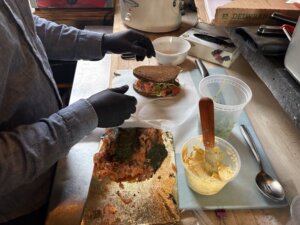
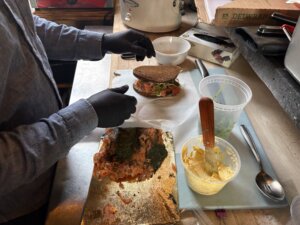
In 2021, another wide-eyed tinkerer set up shop in Jersey City, though his inventions would be molded out of rye, wheat and cured beef, not aluminum and tungsten.
The maverick’s name is Jason Stahl, a 48-year-old father with a career in publishing. He operates his food business under the name Hank Schwartz’s Delicatessen and Appetizing, cooking out of a ghost kitchen in Jersey City. And he does things with smoked fish that would make your bubbe blush.
Take his “Smoked Salmon Tartare,” for example. He mixes up capers, lemon, dill,and Dijon mustard so their breezy tartness lightens the Baltic smoke of nova. The pink concoction is a revelation, balancing out the fish’s brininess so that a diner would be tempted to eat an entire half-pound of the stuff in one sitting.
I speak from experience. I first tried Stahl’s cooking at Jersey City’s Riverview Farmer’s Market last fall, where he slings mind-bending, Jew-ish sandwiches, tartare, whitefish salad, olives, and various other noshes on a biweekly basis.
On a sunny day at the Farmer’s Market, a steady stream of customers poured in. One customer, a middle-aged man, asked about Stahl’s brisket sandwiches — Stahl had made shredded brisket and mixed it with horseradish mayonnaise to make a pulled meat sandwich, then layered it with caramelized onion jam.
Stahl was sold out. “Curse you,” the customer exclaimed.
From home cook to deli master
At the market, Stahl spoke softly to the people who came to his booth, greeting customers by their first names and chatting with boys about their favorite sports teams. His gentle cadence and warm smile bely what he says is an anxious disposition that his wife, and his cooking, help to temper.
Stahl says that, until recently, he had been more of a weekend warrior than a professional cook. “I’m not going to pretend I have this amazing culinary background, right?” he said. “I came into this more with a passion, and I’m learning.”

Still, he has hovered close to the restaurant world for a while. He has worked in media for decades, sometimes in food-adjacent roles (most recently as Food Editor at 1-800-Flowers.com). Stahl’s wife, Theresa Gambacourt, manages restaurants and writes cookbooks for a living.
Stahl learned to cook in part from studying cookbooks he got for free as a media professional. In his early days out of college, “I was always experimenting,” he recalled. “I messed up a whole bunch.”
Theresa showed him the tricks she picked up in restaurants, like using infused fats to make a confit. He uses that technique in his zaatar olives, which are submerged in a citrus garlic confit that adds a layer of refreshing depth to the Mediterranean staple.
Over time, his cooking became more and more elaborate. His wife asked the chef at Del Posto, a since-closed Italian fine dining stalwart, if Stahl could stage there; the chef agreed, and Stahl spent every Sunday evening for a year learning the ins-and-outs of the kitchen — including how to cure gravlax and slice meat.
Italy figures heavily in Stahl’s modern deli. His chopped liver, for example, is made with chopped capers and braised with red wine (he makes a mushroom version for those who fear chicken parts).
In around 2019, Theresa gave him Pastrami on Rye: An Overstuffed History of the Jewish Deli for his birthday, and the book planted an idea in his head: “What if we did this?” Stahl asked Theresa about the deli business.
What, she replied, would an amateur cook be able to contribute to such an endeavor?
“I can clean,” he recalls replying. “I’m really good at cleaning.”

Several years later, after the COVID-19 pandemic, he started selling pickles at Riggs Company Provisions, a vendor at the farmer’s market, and Riverview Wines, a nearby wine shop. Today, his pickles encompass classic dill pickles brightened with dried mint, spicy pickles spiked with habanero and Aleppo peppers (the latter a nod to Jewish communities in the Middle East), and sour green tomatoes with dill and celery seeds.
In 2023, the farmer’s market invited him to become a vendor, and he’s been selling there ever since. His repertoire has expanded beyond pickles to include such dishes as chopped liver, homemade sodas, and cured meat and fish sandwiches — all tweaked with the flair of a mad scientist.

Hank Schwartz’s gets its name from fictional characters that Stahl and Gambacourt made up years ago: Hank and Margaret Schwartz, two herrings who escape from a deli and go on adventures around New York City. In this imaginary world, Hank and Margaret hang out with their herring friends, like Charlie Goldberg, a bus driver, and the Crances, a bumbling couple.
A gallivanting, social fish is the perfect mascot for a cook whose relationships and wanderlust drive his cooking.
Take, for example, Stahl’s smoked salmon candy. Though readers in Alaska and the Pacific Northwest might be familiar with the salty-sweet treat, it has not yet taken off in the Northeast. In the Alaskan version, chunks of salmon are brined in brown sugar and salt before being smoked and glazed. Stahl has added dill to his in the past, and the week I tried it, he had rubbed in pastrami spices. The pink chunks were solid and slightly chewy — like firm gumdrops — and redolent of peppercorns, brown sugar and smoke: the type of addictive candy that the children of hipsters might clamor for in a 21st century deli.
‘This is a true story’
Stahl grew up on Staten Island eating sandwiches at both Jewish and Italian delis.
When I asked him how far a dish can veer from Jewish tradition while still being considered “Jewish,” he compared Hank Schwartz’s to the TV show Fargo, which starts with the line “This is a true story.”
Stahl once interviewed the series’ showrunner, Noah Hawley, who told him that in each episode, a single detail is pulled from a true story — for example, a news article about a dramatic car crash.
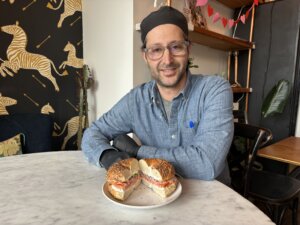
“In a way, like, I’m doing the same thing,” Stahl said — one Jewish element anchors each dish on his menu; the rest is up for his own interpretation.
During Super Bowl weekend, when the Seattle Seahawks played the New England Patriots, Stahl came up with a sandwich for each team. “The Seattle” consisted of citrus-cured gravlax (a Scandinavian relative of Jewish lox), scallion cream cheese and pickled cucumbers on pumpernickel with a teriyaki glaze, the latter a nod to Seattle’s Japanese community and its role in popularizing teriyaki sauce. “The New England” was Stahl’s take on a lobster roll — swapping in whitefish for treyf.
Stahl now holds a residency two days a week at the Cliff, a cafe in the same Jersey Heights neighborhood he has been plying with smoked fish and meats for the past few years. The pop-up helps him try out running a brick-and-mortar restaurant while he looks for investors and business partners to help him do just that. Surrounded by exposed brick and artwork, he slaps together irreverent sandwich combinations in front of customers. I tried the Schwartzøbrød, a cousin of the everyman Danish brown bread sandwich. Stahl makes his with a butter infused with lime, lemon and orange zest that glides through the heady flavor of cured salmon.
If there’s one element of the Jewish deli that Stahl seeks to maintain, it’s the deli’s status as a community hub. “In these times that we’re living in, people need more comfort. I feel like a Jewish deli is really needed,” he told me, as is “the warmth of a bowl of matzo ball soup. People just find comfort, they find nostalgia.” He recalled with fondness how the week before, the restaurant buzzed with customers enjoying his food and locked in conversation, rarely looking at their phones.
Stahl’s tight-knit community might be the perfect place for Jewish culinary innovation, for the same reasons that Menlo Park and Murray Hill served Edison and the company of Graham Bell. Proximity to New York affords you rare privileges — ethnic diversity and access to the titans of the Jewish-American deli, in Stahl’s case. But so, too, does distance. The sprawling brick buildings and saltbox houses of Jersey City offer cooks a little more room to breathe and try new things.
“Here, it’s less about the luxury” or “pretentiousness,” Stahl said. “It’s more about the care and the presentation of the food, right? They want to just offer the best dishes possible.”
The post Move over Thomas Edison, this deli savant is the Garden State’s newest inventor appeared first on The Forward.
Uncategorized
Mahmoud Khalil’s reassurances are bad for Jews but even worse for Palestinians
In his recent interview with the Forward, prominent Palestinian activist Mahmoud Khalil attempted to address claims that he’s an antisemite, that he supports Hamas, and that as a leader of Columbia’s anti-Israel encampments he helped foster hostility towards Jewish students and Jews generally.
Khalil says he’s offended by such claims, but by refusing to say whether Hamas deliberately targeted civilians on Oct. 7, confirmed by both Amnesty International and Human Rights Watch, how is he not providing coverage for Hamas?
The Forward attempts to present Khalil as a pragmatic moderate. But someone who can’t confirm what human rights investigators documented about the worst massacre of Jews since the Holocaust is not offering any real reassurances. Instead, he is only offering a performance.
An even deeper problem with Khalil is not what it means for Jews, but what it does to Palestinians. I say this as someone who has spent time in places where the gap between rhetoric and reality gets people killed.
In 2004, I was a young Marine officer building one of the first successful Iraqi military units in Iraq’s restive Al Anbar Province. My soldiers were mostly Shia, and many bore marks of torture from Saddam Hussein’s prisons, including scars and missing fingers.
One evening, I was watching the news with my Iraqi officers. We watched reports of Israeli tanks pushing into Gaza. I braced for anger and protests and was shocked when they started cheering for the Israelis. One of them quickly explained to me that Saddam had used the Palestinian cause to distract from his own atrocities at home. His support and alliance with Yasser Arafat and other Palestinian leaders was not out of solidarity, but rather as a tool of domestic control. My Iraqi soldiers had paid the price.
After leaving the Marines I visited Lebanon and Jordan, while working to help many of our translators we had left behind. During these visits, I walked through Sabra and Shatila, where Lebanese militias massacred hundreds, possibly thousands, of Palestinian civilians in 1982. I visited refugee camps in Jordan, not tents but cities, brick and mortar, generations deep, people suspended in political amber while the leaders who claimed to speak for them extracted whatever use they could.
During these visits, it was hard not to conclude that Palestinian suffering had been prolonged not only by Israel, but by a regional order that finds Palestinian statelessness useful. Khalil’s vision fits that order perfectly. It offers Palestinians justice in theory, but in reality only guaranteeing them decades of more suffering and tragedy. The people who benefit are not Palestinians in Gaza, but those who have built careers on book deals, speaking fees and endowed chairs on a cause they have no interest in resolving.
The brutal, tragic, and awful reality is that there is not a nation-state on Earth, maybe other than Iceland, that was not created through conflict and displacement. Throughout the Americas, it was the catastrophe that befell indigenous peoples, swept aside by European settlers over centuries of conquest and disease. Most of Western Europe’s borders hardened through revolution and the violent suppression of regional identities. Poland was erased from the map for a hundred years, then reconstituted after two world wars through mass population transfers that uprooted millions. The partition of India and Pakistan in 1947 displaced 15 million people and killed up to two million more. China’s borders were drawn through civil war, revolution, and the subjugation of non-Han peoples.
Every post-Ottoman Arab state, Jordan, Syria, Lebanon, Iraq, was created by European colonial powers drawing lines through tribal and sectarian areas with indifference to the consequences that are still felt today. The entire modern state system is built on this foundation: land taken, people moved, suffering endured, and eventually, when both sides accepted finality, a durable peace.
Either Khalil believes every nation-state on Earth should be dismantled, or he is applying a standard that exists for Jews and Jews alone. The entire Arab world spans 13 million square kilometers and nearly half a billion people. Israel barely covers 22,000 square kilometers and is home to only 7 million Jews. Khalil doesn’t call for the dissolution of Jordan, doesn’t demand China answer for Tibet, or push for the right of return for millions of Hindus and Muslims displaced by the partition of India and Pakistan. He saves that demand for the one Jewish state on Earth, a nation smaller than New Jersey, surrounded by a region that has tried to destroy its people repeatedly. This is antisemitism through the vocabulary of liberation.
Look at where peace has actually come from. Northern Ireland’s Troubles killed thousands over 30 years, a conflict soaked in ancient grievance, religious identity, and competing claims to land and sovereignty that each side considered non-negotiable. It ended not when one side achieved its maximal demands, but when the Good Friday Agreement gave both communities something short of victory and something better than war. Unionists did not get the permanent British Ulster they wanted. Republicans did not get the unified Ireland they had fought and died for. They got a future. In the Balkans, a decade of wars that produced ethnic cleansing, mass atrocity, and the worst European violence since World War II finally yielded to exhaustion and the hard work of partition and negotiated borders. The map that emerged was not just. It was livable. That distinction, between justice as an absolute and peace as a possibility, is the one Khalil refuses to make.
Khalil’s vision has been tried, in different forms and different names, for 70 years. It has not produced peace. It has produced more of exactly what he says he wants to end.
The only path forward is the one he refuses: two peoples, two states, a future neither side fully wants, but both can live with. Everything else is a jobs program for people who profit from the conflict, paid for in Palestinian lives.
His reassurances are hollow to Jews. They are fatal to Palestinians.
The post Mahmoud Khalil’s reassurances are bad for Jews but even worse for Palestinians appeared first on The Forward.
Uncategorized
Jonah Hill’s cancel culture dramedy makes an antisemitism exception — all about Kanye
Ye, the rapper formerly known as Kanye West, is having an interesting April.
Fans are hailing his new album Bully as a return to form. (Critics are more mixed.) He reportedly made $33 million from two sold-out shows in Los Angeles, but he was also banned from entering the U.K. owing to a pressure campaign by Jewish groups over a scheduled headlining performance at the Wired music festival, even as the artist, who recently attributed his antisemitic behavior to a brain injury and bipolar disorder, offered to have “meet and listen” sessions with the Jewish community.
On top of this mixed reception, add a movie premiere. Ye has a memorable cameo in Jonah Hill’s new AppleTV+ film The Outcome, about an A-list actor’s teshuvah tour. And that moment has something to say about what to do with the artist’s outbursts.
Hill’s character, a crass crisis lawyer named Ira, assembles a dream team to protect his client, Reef Hawk (Keanu Reeves), who is awaiting the release of an incriminating video. The nature of this video is unknown beyond its potential to derail his comeback after a five-year sabbatical to treat a secret heroin addiction. Among Reef’s potential defenders are a Gloria Allred-style lawyer (Laverne Cox), a Black minister legendary for his work on civil rights (Roy Wood Jr.) and an ambassador from the Asian-American community (Atsuko Okatsuka). Ira notes someone missing from the mix, one “Moshe, from the Antisemitism Committee,” perhaps a poorly-named stand-in for the ADL.
“We ran the numbers,” Ira’s assistant says by way of explanation. “It turns out that hating Jews doesn’t negatively affect a person’s career. In fact, it could help.”
And we cut to a black-and-white headshot of Ye, occupying the whole screen.
Hill explained this choice in an interview with TMZ, saying the scene wasn’t just there to score a cheap shot at Ye, who publicly (and compellingly) apologized in an ad in the Wall Street Journal in January.
“In the midst of all this Jew stuff, he did Instagram a picture of me in the 21 Jump Street poster,” Hill recalled. “And he said something along the lines of ‘I don’t hate Jews anymore because I love Jonah Hill.’”
“Me and him got no beef,” Hill continued.” I just put that in there like, ‘Yo, you’re gonna f—ing put the 21 Jump Street poster up there and say you don’t hate Jews anymore. That’s pretty wild. I’m gonna put a picture of you saying that like, hating Jews helps your career.’”
Clearly a sight gag and a bit of an inside joke. But is it true?
Running my own numbers, and not even accounting for this last week of ups and downs, Ye took a major hit to his net worth when he lost his Adidas partnership, backsliding all the way from billionaire to mere multimillionaire. Fans still turn up for Ye, and some even seem to like what I’ll call his Hitler catalogue. That said, it’s hard to imagine him making a full recovery, once again gracing the stage at the Grammys or headlining a major festival or getting a shot at the Super Bowl halftime show.
The difference between Ye’s transgression and that of others is instructive. There’s plenty of arguable antisemitism in the case of celebrities whose pro-Palestinian advocacy has crossed the line into something unsavory. Rappers Bob Vylan of “death, death to the IDF” fame and Kneecap, who chanted “up Hamas, up Hezbollah,” come to mind. They have had their own brushes with cancellation and been denied visas because of their antics — but also strong support from those who believe they are simply speaking up for Palestinians. The ascendancy of Israel conspiracies, echoing age old canards, has recently produced an odd coalition between pundits on the far-left and far-right, and hasn’t put a dent in their audience.
(Hill, though Jewish, was accused of dabbling in Jewish stereotypes his last film, You People, and he will likely get some flack for this movie, both for his character — a kind of grubby fixer who calls his client “Bubbie” — and for a joke where Man’s Search for Meaning is referred to as “the most lit Holocaust book.”)
Even in this environment, Ye is toxic for mainstream consumption, because when he went “death con 3” on the Jews, his words had no agenda beyond delusion-fueled animus about Jewish control of the media. Ye’s awareness of the Middle East was best expressed on the occasion he used a fish tank net and Yoo-hoo bottle to represent the Israeli prime minister. Vylan and Kneecap’s slogans are more subtle and plausibly deniable than one of Ye’s latest tracks, literally called “Heil Hitler.”
There was no hedging it, try as Candace Owens might. It was Jew Hate Classic, the original recipe. And it wasn’t, in the case of Mel Gibson, a pattern that emerged over relatively wide gaps of time with only one incident widely known to the general public. It was an endless, often marathon torrent of invective and odd tangents care of an unmedicated bipolar insomniac. It went on for months. Then died off. Then came back swinging in the form of an album the concept of which could, charitably, be defined as spiritually Hitlerian.
The sheer concentration of vitriol seems like proof that the outburst was the result of a manic episode, which could afford the rapper some grace. Instead, he now lives in a liminal space between relevance and punchline. This strain of antisemitism doesn’t boost careers — yet — but the man behind it can sell out stadiums in spite of it.
All the while, the question of what to do with Ye’s mental health, and how it factors into his cancellation makes him a conundrum, even if it should by rights be a better excuse than Mel Gibson’s squad car in vino veritas. (Gibson is mentioned in the film, in the context of a poppers-related Weekend at Bernie’s scenario, not his own scandal.) Before we render a judgment, we need commitments he won’t repeat his tirades and so continue to influence looksmaxxers, incels and their overlapping Venn Diagram of Nazi revivalists.
Hill’s belief that Ye’s antisemitic streak was good for business is symptomatic of something fundamentally off with the director’s treatment of cancel culture. It feels out-of-touch even — or maybe because — it draws from experience. Hill himself was the victim of cancellation some years ago, when his ex leaked texts in which he weaponized “therapy talk.” Hill’s project, with a cast that includes Reeves, Van Jones, Martin Scorsese, Drew Barrymore and a rare appearance from Cameron Diaz, is itself proof of how not all cancellations are created equal or indefinite.
The Outcome is in tension with itself, part Hill’s version of Don Henley’s “Dirty Laundry” and Seth Rogen’s The Studio, part earnest penance that may or may not be coming from the director-writer himself.
One of the lines, delivered by Reef’s reality star mother (soap opera icon Susan Lucci), as a crew films their rapprochement for Bravo, sums the film up nicely: “Just because it’s performative doesn’t mean it’s not the truth.” We’ll have to take her word for it.
When it comes to Ye, there is some truth that antisemitism alone can’t crater a career — with the exception of lesser talents, it never could. We need not wonder how it has affected Ye’s popularity with Hill, who cited him on TMZ as “probably the greatest artist whoever lived.”
As Ira departs the film, we see his bumper sticker: “Honk if you can separate the art from the artist.” Hill would blow out the horn, and hopes you might too.
Jonah Hill’s The Outcome debits April 10 on AppleTV+.
The post Jonah Hill’s cancel culture dramedy makes an antisemitism exception — all about Kanye appeared first on The Forward.
Uncategorized
Dollar Struggles to Rebound as Fragile US-Iran Ceasefire Keeps Markets Wary

U.S. $100 bills. Photo: Wikimedia Commons.
A fragile calm reigned across currency markets on Thursday as traders kept their eyes fixed on whether the ceasefire between the US and Iran would hold, a day after its announcement sent the dollar tumbling across the board.
The deal appeared to be on thin ice, as Israel bombed more targets in Lebanon, and there was no sign Iran had lifted its blockade of the Strait of Hormuz, which has caused the worst disruption to global energy supplies in history.
Iranian negotiators were expected to set off later on Thursday for Pakistan for the first peace talks of the war, but Tehran said there would be no deal as long as Israel was striking Lebanon.
President Donald Trump said all US ships, aircraft, and military personnel would stay in place in and around Iran until it fully complied with a deal.
The uncertainty left currency markets on edge.
The euro was up 0.17 percent at $1.1683. It had gained 0.6 percent on Wednesday, but retreated late in the day having touched a one-month high of $1.1721 earlier in the session.
Sterling similarly was 0.21 percent higher at $1.342, after gaining 0.77 percent on Wednesday, but retreating from as high as $1.348.
Meanwhile, the Japanese yen lost some ground, with the dollar up 0.3 percent at 159.055 yen, having briefly dropped below 158 on Wednesday.
With the Strait of Hormuz closed, “the entire ceasefire remains tenuous,” said Derek Halpenny, head of research global markets EMEA at MUFG. But, he added, “while the US dollar has rebounded, the moves in general have been modest.”
He said the fact that further talks scheduled in Pakistan were still going ahead was keeping any retracement of Wednesday’s moves in check.
Elsewhere, new personal spending data released on Thursday showed that US inflation increased as expected in February and likely rose further in March amid the war with Iran, a trend that is expected to discourage the Federal Reserve from cutting interest rates for a while.
The personal consumption expenditures price index climbed 0.4% after an unrevised 0.3 gain in January, the Commerce Department’s Bureau of Economic Analysis said on Thursday.
Japan’s consumer confidence worsened in March for the first time in three months, a government survey showed on Thursday, adding to a recent string of data pointing to the potential economic hit from the Middle East war, which would complicate the Bank of Japan’s rate-hike decision. The yen showed little reaction to the data.
Speaking in parliament, BOJ Governor Kazuo Ueda said real interest rates were clearly negative and were keeping the country’s financial conditions accommodative.
Other currencies were also broadly steady. The Australian dollar was 0.15 percent higher at $0.7054, while the New Zealand dollar was 0.46 percent higher at $0.585. In cryptocurrencies, bitcoin was last down 0.97 percent at $70,680.