



Uncategorized
Panel Picking Iran’s Supreme Leader Has Reached Consensus, Member Says

FILE PHOTO: A woman gestures while holding an image of Iran’s late Supreme Leader Ayatollah Ali Khamenei, on the day of an anti-Israeli and US rally, amid the US-Israeli conflict with Iran, in Tehran, Iran, March 6, 2026. Photo: Majid Asgaripour/WANA (West Asia News Agency) via REUTERS/File Photo
The clerical body that will choose Iran’s next supreme leader, succeeding the slain Ayatollah Ali Khamenei, has more or less reached a majority consensus, Assembly of Experts member Ayatollah Mohammadmehdi Mirbaqeri said on Sunday.
The Mehr news agency quoted him as saying “some obstacles” still needed to be resolved regarding the process.
On Saturday, a senior cleric in the Assembly of Experts said its members would meet “within one day” to choose the leader.
NEXT SUPREME LEADER MUST ‘BE HATED BY THE ENEMY’
Two members of the panel, Ayatollah Mohsen Heidari Alekasir and Ahmad Alamolhoda, said the assembly had chosen a successor, according to Iranian media.
Alamolhoda said the head of the assembly’s secretariat, Ayatollah Hashem Hosseini Bushehri, is responsible for announcing the assembly’s decision.
Iranian media said the group had a minor disagreement over whether they would need to meet in person to issue their final decision, or bypass this formality.
Heidari Alekasir said in a video released by Nournews on Sunday that an in-person meeting was not possible under current conditions, suggesting at remote and written alternatives.
“This is an extraordinary situation, the assembly cannot meet in a plenary,” he said, adding that targeting the assembly would only benefit Iran’s enemies and “harm the revolution”.
Since the war began on February 28, Israeli and US strikes have killed dozens of officials and commanders, including Supreme Leader Ayatollah Ali Khamenei, with Iranian media reporting on Tuesday that strikes flattened an auxiliary building of the Assembly of Experts in the city of Qom.
Heidari Alekasir said the candidate had been picked based on the late supreme leader’s advice that Iran’s top leader should “be hated by the enemy” instead of praised by it.
“Even the Great Satan (US) has mentioned his name,” the senior cleric said of the chosen successor, days after US President Donald Trump said Khamenei’s son, Mojtaba Khamenei, was an “unacceptable” choice for him.
Trump said on Thursday that the younger Khamenei, a mid-ranking hard-line cleric, was the most likely successor, according to Axios, but warned he would reject such an option and that he should be personally involved in selecting Iran’s next leader.
Mojtaba Khamenei, 56, was not in Tehran when his father was killed by air strikes early in the war, an Iranian source told Reuters on Wednesday.
He has close ties to Iran’s elite Revolutionary Guards and is one of the most influential figures in the Iranian clerical establishment, thanks to the influence he built behind the scenes and his role as his father’s gatekeeper, according to people familiar with the matter.
He has for years been seen as one of the top candidates to succeed the elder Khamenei, despite never holding a government position, aside from working in his father’s office.
Ali Khamenei ruled Iran from 1989 as supreme leader after serving as president for nearly eight years.
Mojtaba Khamenei was a particular target for criticism by protesters during unrest over the death of a young woman in police custody in 2022, after she was arrested for allegedly breaching the Islamic Republic’s strict dress codes.
He is seen as having leverage over Iran’s security apparatus, which has repressed several waves of protests in recent years.
Uncategorized
Miss Israel Melanie Shiraz Says Mamdani’s Wife Snubbed Her Because She’s From Jewish State

Melanie Shiraz being crowned Miss Israel 2025. Photo: Simon Soong | Edgar Entertainment
Melanie Shiraz, who represented Israel in the 2025 Miss Universe pageant, said on Wednesday that the wife of New York City Mayor Zohran Mamdani refused to take a photograph with her because the beauty queen is from the Jewish state.
Shiraz posted on Instagram a video that features a short clip of herself with Rama Duwaji, the first lady of New York City. The Israel native said in the video’s voice-over that she met Mamdani’s wife by chance in a coffee shop in New York City and the two sat next to each other. Duwaji was willing to take a photo with the beauty queen “until she found out that I was Miss Israel; until I told her that as an Israeli, I was disappointed in seeing the kind of rhetoric she was promoting online,” Shiraz said.
“I told her as part of my ideology as an Israeli is to have productive dialogue in which not one side is constantly dehumanized. But despite that, despite the setting being calm, the moment she found out I was Israeli, she refused to have a conversation with me,” continued the graduate of the University of California, Berkeley.
“If you can publicly apologize for dehumanizing Israelis, but you can’t get yourself to humanize one when you come face-to-face with them in real life, what does that say about you and what does that say about the state of our politics considering that is the wife of the mayor of New York City?” Shiraz added.
A Texas-born illustrator with Syrian roots, Duwaji has previously uploaded or “liked” numerous anti-Israel posts on social media. She has also “liked” several online posts that celebrated the deadly Hamas-led terrorist attack against Israelis on Oct. 7, 2023, and even defended the largest single-day massacre of Jews since the Holocaust, describing it as Palestinian “resistance.”
It was discovered that Duwaji shared social media posts praising female Palestinian terrorists who participated in plane hijackings and bombings in the 1960s and early 1970s. In 2015, she shared a post in which someone else wrote that Tel Aviv was occupying Palestinian land and “shouldn’t exist.” Duwaji also illustrated an essay co-edited by a Palestinian-American activist author who described the Oct. 7 attack as “spectacular” and called Jewish Israelis “rootless soulless ghouls.”
In April, Duwaji apologized for “harmful” social media posts she made as a teenager, which included anti-gay and anti-Black language, but did not directly address her more recent anti-Israel social media activity.
Mamdani, who has faced his own share of criticism for anti-Israel comments and actions, has previously defended his wife by saying she is a “private person.”
In the caption of her Instagram video, Shiraz said she was “not particularly” surprised by her interaction with Duwaji at the coffee shop in New York City.
“It is easy to apologize without meaningfully changing one’s behavior,” Shiraz explained. “It is easy to claim opposition to dehumanization in principle, but far more difficult to embody that in practice. She was polite throughout. But the shift in demeanor was evident, and the lack of willingness to engage even more so.”
“I approached the interaction with openness to a genuine, respectful conversation. That openness was not reciprocated,” Shiraz added. “And that, perhaps, is the more telling point: how often this disconnect appears, and how normalized it has become.”
Uncategorized
Rubio Questions Allies’ Support on Iran Following Italy Talks
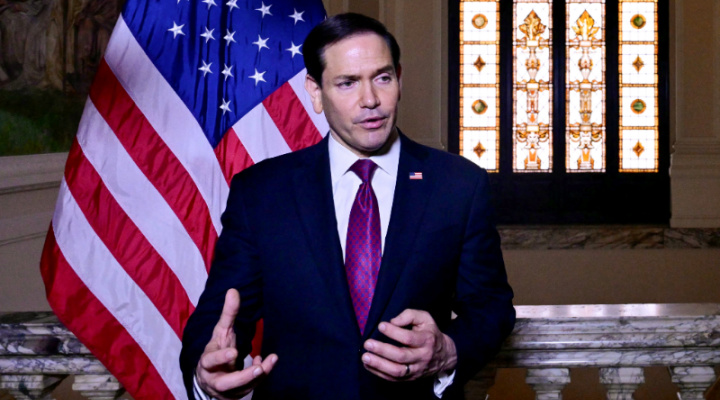
US Secretary of State Marco Rubio speaks to the press at the US Embassy in Rome, Italy on May 8, 2026. Photo: STEFANO RELLANDINI/Pool via REUTERS
US Secretary of State Marco Rubio met Prime Minister Giorgia Meloni on Friday and afterwards questioned why allies including Italy were not backing Washington’s efforts to confront Iran and re-open the Strait of Hormuz.
“I don’t understand why anybody would not be supportive,” Rubio told reporters, adding that countries needed “something more than just strongly worded statements” if they opposed Iran‘s actions.
Rubio was wrapping up a two-day trip aimed at easing ties with Pope Leo after attacks on the pontiff by President Donald Trump, while also addressing Washington’s frustration over Italy‘s refusal to support the US-Israeli war on Iran.
Meloni had been one of Trump’s firmest allies in Europe, cultivating close ties with him and presenting herself as a natural bridge between Washington and other EU states that had no natural political affinity with the Republican US leader.
But that alignment has come under increasing strain in recent months, as the Iran war has forced her to balance loyalty to the United States against Italian public animosity to the war and the growing economic cost of the conflict.
Meloni and Rubio met for 1-1/2 hours, in what she described in a post on social media platform X as “an extensive and constructive discussion,” saying the talks included the Middle East, Libya, and the peace processes in Lebanon and Ukraine.
“It was a frank dialogue between allies who defend their own national interests while fully recognizing the value of western unity,” Meloni said.
Rubio declined to give full details. However, he warned that Tehran’s claim to control access to Hormuz risked setting a dangerous precedent.
“The fundamental question every country, not just Italy … needs to ask themselves is, are you going to normalize a country claiming to control an international waterway? Because if you normalize that, you’ve set a precedent that’s going to get repeated in a dozen other places,” he said.
‘THE UNITED STATES NEEDS EUROPE AND ITALY‘
Italy and other European allies have said they would be willing to help keep the strait open once there was a lasting ceasefire or the conflict ends, but have refused to be drawn into direct confrontation with Iran.
Before seeing Meloni, Rubio met Italy‘s Foreign Minister Antonio Tajani, who said he hoped the visit had helped calm tensions with the United States.
“I am convinced Europe needs America, Italy needs America, but also that the United States needs Europe and Italy,” Tajani told reporters.
Besides the war in the Gulf, Meloni and Rubio had also been expected to discuss Russia’s war on Ukraine, US tariffs on European goods, and the outlook for Cuba, which Washington is seeking to isolate both diplomatically and economically.
The Italians were also keen for a readout on Rubio‘s meetings at the Vatican. Trump’s recent attacks on Pope Leo crossed a sensitive line in overwhelmingly Catholic Italy and prompted Meloni to call them “unacceptable.”
Her criticism in turn drew a sharp rebuke from Trump, who said she lacked courage. He subsequently threatened to withdraw US troops from Italy.
Rubio said he didn’t get into specifics about US bases, saying it was a decision for Trump to make.
Italy last month refused to allow US aircraft to use the Sigonella air base in Sicily for combat operations linked to the Iran conflict. Italian officials said Washington had not sought prior authorization from Rome for the use of the site.
Rubio did not mention this incident, but pointed to Spain’s decision not to allow its bases or airspace to be used to attack Iran. He said one of the main attractions of NATO for the US was to have forces in Europe that could be swiftly deployed elsewhere.
“Now that’s no longer the case, at least when it comes to some NATO members, that’s a problem and has to be examined,” he said.
Uncategorized
Irish Soccer Players, Sports Icons, Celebrities Call for Boycott of Upcoming UEFA Matches Against Israel

Soccer Football – UEFA Nations League Draw – Brussels Expo, Brussels, Belgium – Feb. 12, 2026, General view during the draw. Photo: REUTERS/Benoit Tessier
Prominent Irish soccer players, as well as other well-known sports figures and celebrities, have teamed up to pressure the Football Association of Ireland (FAI) to boycott two UEFA Nations League matches against Israel set for later this year.
The campaign group Irish Sport for Palestine published an open letter this week regarding a match set for Sept. 27, designated as an Israeli home match, and another future one on Oct. 4 in which Ireland will host Israel at Dublin’s Aviva Stadium.
The Israel Football Association said in February it hopes to host the Sept. 27 match in Israel, but a formal decision will reportedly be made in June.
The open letter calls for FAI to boycott both upcoming matches while accusing Israel of a “brutal system of apartheid,” committing “genocide” in the Gaza Strip, and carrying out “clear and ongoing breaches” of UEFA and FIFA statutes regarding Israeli soccer teams playing matches “on occupied Palestinian lands.”
“It is unconceivable that we would be willing to be silent and give cover to such crimes in the name of football,” the letter states. “We call on you to ensure the Irish football team is not used to mask UEFA rules breaches, apartheid, and war crimes.”
The letter was signed by players from both the men’s and women’s League of Ireland soccer teams, Ireland’s former men’s national team manager Brian Kerr, two-time women’s player of the year Louise Quinn, and other former soccer coaches, managers, and players.
Outside of the sporting world, the letter was also signed by Irish rock band Fontaines DC, the Irish hip-hop trio Kneecap, Irish musicians Mary Coughlan and Christy Moore, and Oscar-nominated Irish actor Stephen Rea, among others.
Included in the open letter is a statement from Shamrock Rovers captain and Professional Footballers’ Association of Ireland Chairman Roberto Lopes, who was born in Dublin.
“We can’t ignore the humanitarian catastrophe in Palestine; the sheer loss of life there has to take precedence over any sporting consideration,” Lopes said. “Ireland has an opportunity here to lead — to be a pioneer and do what others won’t. We need to be brave enough to say enough is enough. We can’t just stand by. Please, stop the game.”
The matchups for the 2026-27 UEFA Nations League were announced in February. At the time, the FAI said Ireland’s men’s national team will indeed compete against Israel in the scheduled games to avoid facing “disciplinary measures” by the UEFA, which may include “potential disqualification” from the competition. Months earlier, in late 2025, the FAI submitted a motion to have the UEFA ban Israel from competitions because of the country’s war in Gaza. The motions were rejected.
FIFA President Gianni Infantino previously said he believes FIFA “should actually never ban any country” from playing soccer “because of the acts of their political leaders.”
Irish Prime Minister Micheal Martin said he supports Ireland playing the two matches against Israel in September and October.
“We have been critics and have opposed very strongly Israeli government policy within Gaza in particular. We condemned the Hamas attack on Israel which was absolutely horrific,” he told the Irish Times. “I think sport is an area that can be challenging when it crosses into the realm of politics.”