


Uncategorized
Should synagogues remove the Israeli flag from bimahs now?
After the last of the living hostages in Gaza were released last week, a prominent New York synagogue faced a complicated question: Should it remove the Israeli flag on its bimah?
Central Synagogue in Manhattan had displayed the Israeli flag on an empty chair since the attacks of Oct. 7, 2023, along with a count of the days since Hamas killed 1,200 people in Israel and took about 250 hostage.
The Reform synagogue had committed to keeping the flag up “until they all came home,” Rabbi Angela Buchdahl told CBS News.
But after the living hostages had all been reunited with their families, the congregation faced a delicate choice: Is it time to take down that flag? Hamas had not returned the bodies of all deceased hostages, some of whom the group said it is unable to locate. And the Israeli flag’s place on the bimah continued to divide congregants who disagree about the role of the Jewish state in religious services — a debate intensified by Israel’s military campaign in Gaza the past two years.
During last week’s Shabbat service, Buchdahl explained the synagogue’s decision: The flag would be removed from the chair on the bimah — and placed in the Torah ark.
“We must mark this moment ritually,” Buchdahl told the congregation. “We must offer gratitude and celebrate this moment with joy.”
Buchdahl said that in making the decision she drew on customs surrounding Acheinu, the ancient Jewish prayer for the release of hostages, which traditionally is said only for living hostages. “Our tradition is giving us some guidance in this moment,” she said, “that now that our living hostages are returned we must mark this moment ritually.”
After the congregation said the prayer for hostages, Cantor Daniel Mutlu sang “Coming Home” as news clips of hostages reuniting with their families played on screen. Congregants rose to their feet while Dagan Shimoni, the synagogue’s Israeli shaliach or emissary, and Buchdahl folded the flag and the rabbi placed it in the ark alongside the Torah scrolls.
A different symbol would honor the deceased hostages whose bodies have not been returned. Among them is 19-year-old Itay Chen, who was serving in the Israel Defense Forces when he was killed by Hamas on Oct. 7. Chen’s father, Ruby, had spoken at Central and gifted Buchdahl a dog tag necklace in the aftermath of the attacks.
In honor of Chen and the other deceased hostages, Buchdahl and the clergy placed their dog tag necklaces on a Torah scroll. The necklaces will remain in the Ark until all of the bodies are returned, Buchdahl said.
“We know that there has been so much celebration and joy we saw in that video,” Buchdahl said. “But also so much healing that still needs to happen, for all of those returning, for those who are not returning.”
The flag on the bimah
In her Rosh Hashanah sermon, Buchdahl acknowledged how polarizing symbols like the Israeli flag had become.
“There are members of our own congregation who are disturbed by our weekly prayer for Israel,” she said. “Or who object to the Israeli flag on our bimah, even though the empty chair it covers stands for the 48 remaining hostages whose families still await their return.”
In some ways, Central Synagogue was unusual in its choice not to display an Israeli flag before Oct. 7.
In many U.S. synagogues, the bimah is flanked by both Israeli and American flags. The trend dates back to a wave of patriotism during World War I, when the American flag became common in synagogues and churches, according to Perry Dane, a member of the North American Vexillological Association, which studies flags.
The presence of the U.S. flag inspired some congregations to also display what was then the Zionist flag, Dane said. After Israel’s founding in 1948 — and again after the Six-Day War in 1967 — more synagogues added what became the Israeli flag.
But the presence of the Israeli flag on the bimah has long been debated, sparking discussion among Reform and Orthodox rabbis alike.
A 2015 Forward opinion piece by Alex Kane argued that flags “tether a diverse and opinionated Jewish community to nationalistic sentiments some members don’t agree with: support for the state of Israel and the U.S. government.” A response by Menachem Freedman argued for the Israeli flag, countering that the “political wellbeing of the state has a well-established place in the synagogue.”
Israel’s military campaign in Gaza over the past two years have made those discussions even more fraught.
This month, on the subreddit Jews of Conscience, which describes itself as “progressive, leftist” and “anti-Zionist,” members discussed whether an Israeli flag on the bimah would be a deterrent for attending a synagogue — and whether to confront a rabbi about removing it.
“This is not hypothetical for me. It’s why I left my synagogue,” one user wrote.
“Huge dealbreaker,” commented another.
Yet congregations that display the Israeli flag on the bimah may have different reasons for doing so.
Congregation Beth Shalom of the Woodlands in Texas explained in a June statement that the Reform synagogue displayed both American and Israeli flags “to express our gratitude and love for both countries,” quipping that, “We also love Texas, but there is not enough room on the bimah for another flag.”
In an April 2023 sermon titled “To a Non-Zionist Gen Z-er,” Rabbi Elliot Cosgrove of the Conservative Park Avenue Synagogue in New York City spoke about the Israeli flag as core to Judaism.
“Supporting Israel is, in my mind, fundamental to what it means to be a Jew today,” he said. “It is why we have the flag on the bimah, it is why we recite the prayer for Israel, it is why I am a proud Zionist, it is why I am politically engaged on behalf of Israel and why I ask that my congregants be as well.”
For Rabbi Hannah Goldstein of Temple Sinai, a Reform synagogue in Washington, D.C., the Israeli flag can have multiple meanings.
“Some of you have told us that when you see this flag, you see the flag of a modern country, a country that is responsible for the nightmare in Gaza, you see an occupation that has dragged on for 58 years,” Goldstein, who declined to comment to the Forward, said in this year’s Kol Nidre sermon. “And those are painful things to see and feel in a house of prayer.”
But for others, she said, the flag represents “the realization of a dream.’
Goldstein had sometimes “struggled to defend the place of the flag on this bimah,” she said. “But, I can’t seem to let go of the dream. Not the rose colored, incomplete version of my youth — but a dream for what Israel might be.”
The post Should synagogues remove the Israeli flag from bimahs now? appeared first on The Forward.
Uncategorized
Tidbits: A publishing firm for Jewish writers excluded by mainstream publishers
Tidbits is a Forverts feature of easy news briefs in Yiddish that you can listen to or read, or both! If you read the article and don’t know a word, just click on it and the translation appears. Listen to the report here:
אין ניו־יאָרק איז די וואָך געגרינדט געוואָרן אַ פֿאַרלאַג פֿאַר ייִדישע און ישׂראלדיקע שרײַבער וואָס זאָרגן זיך, אַז זייער אָפּשטאַם אָדער מיינונגען קאָנען שטערן צום פּובליקירן זייערע ביכער.
לויט אַ סטאַטיסטיק פֿונעם מחבר מעג קין, איז בײַ די הויפּט־פֿאַרלאַגן, צווישן 2023 און 2024, געפֿאַלן מיט 76% די צאָל בעלעטריסטישע ביכער, וואָס דערמאָנען ייִדן, ייִדישקייט אָדער ישׂראל.
„הײַלײַן פּאָבלישינג סטודיאָ“, וואָס האָט דעביוטיִרט אין ענגלאַנד מיט אַ חודש צוריק, האָט געעפֿנט אַן אַמעריקאַנער צווײַג אין מאַנהעטן בײַ „פּאָרט סאַיִד“, דעם רעסטאָראַן פֿונעם וועלטבאַרימטן קוכער איל שני (עיאַל שאַני).
„הײַלײַן“ איז לאַנצירט געוואָרן דורך ניל בלער, דעם לאַנגיאָריקן ליטעראַרישן אַגענט פֿון דזשיי קיי ראָלינגס — דער שרײַבערין פֿון די האַרי־פּאָטער ביכער.
„איך האָב שוין פֿון לאַנג באַמערקט, אַז אַ צאָל שרײַבער קענען נישט געפֿינען קיין פֿאַרלאַג,“ האָט בלער געזאָגט. „נישט צוליב דער קוואַליטעט פֿון זייער שרײַבן אָדער אַ דוחק פֿון אָריגינעלע געדאַנקען, נאָר ווײַל זייער וועלטבאַנעם שטימט נישט מיטן קוקווינקל פֿון די פֿאַרלאַגן — אָדער אפֿשר ווײַל זייער משפּחה־נאָמען איז אַ ייִדישער אָדער ישׂראלדיקער.“
די פּראָבלעם, זאָגט ער, איז געוואָרן נאָך ערגער נאָך די טעראָריסטישע אַטאַקן פֿונעם זיבעטן אָקטאָבער, האָט בלער געזאָגט. ער האָט למשל דערמאָנט די שוועריקייטן בײַם געפֿינען אַ הויפּטשטראָמיקן בריטישן פֿאַרלאַג פֿאַר אַ בוך פֿון אלי שרבי (עלי שאַראַבי) וועגן זײַנע איבערלעבונגען ווי אַן ערובֿניק אין עזה — נישט געקוקט אויף דעם וואָס אין אַמעריקע האָט מען שוין געהאַט פֿאַרקויפֿט הונדערטער טויזנטער עקזעמפּלאַרן דערפֿון. צום סוף האָט זײַן בוך אַרויסגעגעבן אַ קליינער בריטישער פֿאַרלאַג, „סוויפֿט בוקס“.
„הײַלײַן“ וועט באַשטיין פֿון צוויי אימפּרעזומס: „אָדעסאַ עדישאָנס“ און „אַנטידאָט בוקס“. „אָדעסאַ עדישאָנס“, אָנגעפֿירט פֿונעם רעדאַקטאָר דזשעקי קלײַן, וועט דרוקן ייִדישע און ישׂראלדיקע בעלעטריסטיק און פֿאַקטפּראָזע אויף טעמעס פֿאַרבונדן מיט דער ייִדישער געשיכטע, אַנטיסעמיטיזם, פֿילאָסאָפֿיע, עסן און קולטור.
„אַנטידאָט בוקס“ וועט דרוקן פֿאַקטפּראָזע מיט אַ שייכות צו טעכנאָלאָגיע, עטיק, דעמאָקראַטיע, אידענטיטעט און מאַכט.
קלײַן האָט געזאָגט, אַז מע וועט אויך באַטראַכטן מאַנוסקריפּטן פֿון אַראַביש־ישׂראלדיקע און נישט־ייִדישע שרײַבער, וואָס זייער אַרבעט פֿאַרנעמט זיך מיט דער ייִדישער קולטור, געשיכטע אָדער געדאַנקען.
צו לייענען וועגן דעם אויף ענגליש גיט אַ קוועטש דאָ.
To read about this in English click here.
The post Tidbits: A publishing firm for Jewish writers excluded by mainstream publishers appeared first on The Forward.
Uncategorized
In ‘Fatherland,’ Thomas Mann finds a Germany divided
Speaking at the Library of Congress, just before the end of World War II, Thomas Mann insisted “that there are not two Germanies, a bad and a good one, but only one whose best qualities were perverted by devilish cunning into evil.”
Two years later, in 1947, he would publish Doctor Faustus, a meditation on his homeland’s slide into fascism in the idiom of Germanic legend. Two years after that, accepting the prize named for Goethe, the Faust legend’s greatest chronicler, he would return to Germany, which, by then, had split in two.
Paweł Pawlikowski’s Fatherland, is about the 1949 trip Mann took with his daughter Erika from American-administered Frankfurt to East German Weimar, then in the grips of Soviet control. They glide through bombed-out streetscapes in a black, all-American Buick. During the tour, dignitaries try to win Mann over to one of two ideologies vying to replace the fascist model: that of the free market, or that of Communism.
By the time the film takes place, Mann was an American citizen who had lived outside of Germany for over a decade. He railed against the Nazis and appealed to the conscience of his countrymen in radio broadcasts from exile in California. He had married into a Jewish family, and his anti-Nazi credentials were beyond reproach. But at a press conference in Frankfurt, when an AP reporter asks “where is home,” he responds in English with a German word that English can only approximate.
“I am an American citizen,” Mann, played by Hanns Zischler, answers. “I am also a German writer. Where my heimat is, where I belong, is a much more difficult question.”
His country no longer exists.
Pawlikowski, a Polish director whose silken, black-and-white films excel in painting the surreality of the Iron Curtain, plucked this compelling episode from Colm Tóibín novel of Mann’s life, The Magician. Zeroing in on the 1949 tour, he’s crafted an intimate story of a father and daughter navigating a new political order where one’s allegiance, as summed up by Mann’s son Klaus, is either to “Stalin or Mickey Mouse.”
When Klaus (August Diehl) dies by suicide while Erika and Mann are in the middle of the excursion, and Mann insists on sticking to the itinerary, the Great Man’s faults are blown open: He believes his lecture tour, and the power of words, can improve conditions for a nation, but he had long ago declared his son a lost cause.
Zischler’s performance is at once understated and monumental. His response to Richard Wagner’s glad-handing grandchildren, who want him to put in a good word for reviving his festival in Bayreuth, is a punchy quotable: “The opera should be razed to the ground and your mother should be put on trial.” His mystified look when a Soviet colonel asks him to discuss “Mephistophelian dialectics,” is better than any bon mot.
Hüller is dependably excellent, glowering at the supposedly de-Nazified guests at a banquet and musing to a former war correspondent comrade about “what they were up four years ago.”
Mann’s controversial visit to Weimar is marked by a perfunctory pilgrimage to Goethe’s final home for a photo op. Among the effects are Goethe’s death mask, a blunt-force metaphor following Mann’s speeches, to East and West Germans, extolling how the great poet “rejected the German Romantic death cult.”
When Goethe’s dead, can the winner of his eponymous prize make the rejection last?
History has a verdict. While Mann rejects his own Faustian bargains — the invitation to put in a good word for Wagner or take a job as president of the Arts Academy in East Germany — his fate is teased when Erika sees a catalogue of “Fifth Columnists,” which has his headshot near Einstein and Arthur Miller.
Mann was a victim of McCarthyism, and left his adopted country in 1952 to settle — and die — in the neutral environs of Switzerland.
The film has enough restraint to spare us this epilogue. It ends with a father, a daughter and a sublime expression of grief and untainted German art. (Fitting for Pawlikowski, whose films so often center music, it is a Bach composition that delivers the final beat.)
Mann never did make his homecoming permanent, but on this score, he had a properly self-aggrandizing, if apt credo: “Where I am, there is Germany.”
The post In ‘Fatherland,’ Thomas Mann finds a Germany divided appeared first on The Forward.
Uncategorized
This deli serves ham and calls itself Jewish. New Jersey says it’s not kosher.
The Kibitz Room in Cherry Hill, New Jersey, just outside of Philadelphia, serves shrimp salad. It also has a ham sandwich, and its doors are open on Saturdays.
So the people who run it were surprised this month when a state investigator walked in carrying a notice saying a deli with a “Jewish cheesesteak” on the menu needs to tell customers, in writing, that it isn’t kosher.
The backstory and fallout involve a brisket-boosting talk radio host, a rock-and-roll dive bar in Los Angeles, a historian known as Dr. Pastrami, a famous rye bread ad, and a question Jewish diners have been fighting over for the better part of a century: Can a deli be Jewish if it isn’t kosher?
Here’s the beef. The New Jersey Division of Consumer Affairs, which, yes, has a kosher fraud enforcement unit, sent an investigator to the Kibitz Room with a simple message. If you call yourself a Jewish deli, state consumer-fraud rules say you also have to post a sign, or otherwise let customers know, that your food isn’t under kosher supervision. The state isn’t accusing the deli of passing itself off as kosher, and it isn’t banning the word “Jewish.” It just wants a disclaimer next to it.
Neil Parish, 62, who runs the Kibitz Room with his son, Brandon, wasn’t having it. He told the investigator, “You’re not going to come in here and dictate to me the verbiage that I’m going to put on my menu,” he said in an interview with the Forward.
Parish grew up working in delis, first as a dishwasher at 14, and then he was slicing meat by 16. Apart from a six-year stretch in a job with health insurance (“I wasn’t cut out for that,” he says), he’s been in delis ever since.
Which is why the notice struck him as absurd. In Parish’s telling, no observant customer has ever mistaken the Kibitz Room for a kosher deli.
The state is proposing a $1,000 penalty and wants a sign that’s visible to customers saying the deli isn’t kosher. For Parish, it’s the principle, and what he calls government overreach. He says he told the investigator, “I’ll see you in court. I hope the Supreme Court,” adding that “we’re taking this thing to the end. Period. I’m not stopping.”
The fraud squad
New Jersey’s kosher unit spends most of its time on businesses that say they’re kosher.
The biggest cases involve packaging. In 2014, ShopRite’s supplier cooperative agreed to pay a $35,000 penalty for putting a kosher symbol on private-label coffee bags without the certifying agency’s approval. The state leaves the definition of kosher to rabbis. Its job is to check that sellers are telling the truth.
Delis that call themselves Jewish without claiming to be kosher are a smaller slice of the caseload, but not an unheard-of one.
The spark seems to have been lit on Sept. 14, when NJ.com published “New Jersey’s 15 best Jewish delis, ranked for 2026.” The Kibitz Room came in eighth.
Shortly after, the state investigator walked into Radin’s Delicatessen, a mile down the road and ranked No. 7, to see whether it was passing itself off as kosher.
Radin’s owner is Russ Cowan, a fourth-generation deli man, and the original owner of the Cherry Hill Kibitz Room, which he opened in 2001. He was happy to schmooze with the inspector. “Jewish does not mean kosher, and kosher style does not mean kosher,” he said in an interview with the Forward. “But for me personally, I avoid saying either because I don’t want to confuse a customer that might think we are kosher.” His shop sells bacon, ham and cheeseburgers.
When people ask what line of work he’s in, he replies, “the corned beef and pastrami business.” He had replicas made of the neon signs from his family’s old Brooklyn delis, and he says he took the word “kosher” off them.
Rabbi Chaim Dovid Zwiebel, executive vice president of the Orthodox advocacy group Agudath Israel of America, has been watching these fights for more than 20 years. His group supported New York’s kosher fraud law back when it was battling for survival in court. He argues kosher claims should be policed like any other: “From a perspective of consumer fraud,” he said, “the fact that we happen to be speaking about religious items shouldn’t make a difference.”
He isn’t bothered by what New Jersey is asking of the Kibitz Room. “The least you can do is put the disclaimer,” he said, referring to a sign saying the deli isn’t under kosher supervision, posted where customers can see it.
But he sees another problem. The word “Jewish,” Zwiebel says, “kind of implies there are certain foods which are reserved exclusively for Jews.” The current controversy reminds him of an iconic ad campaign, he says.
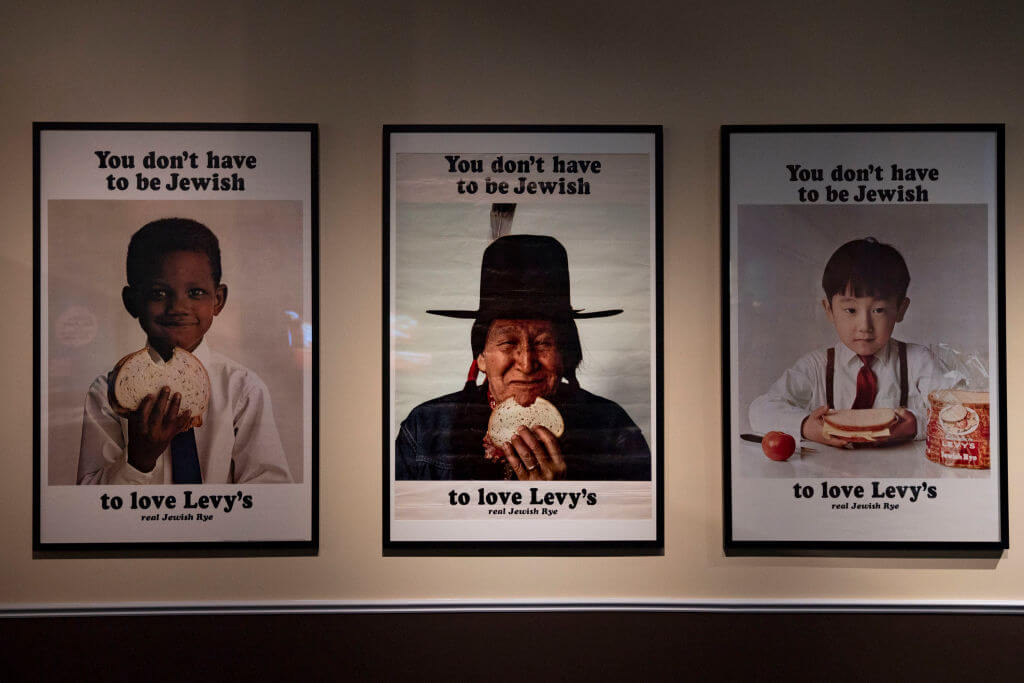
Starting in 1961, subway posters around New York showed an Italian grandmother, a Black child, an Asian kid and a Native American man, each enjoying a sandwich on Levy’s Real Jewish Rye, with the tagline: “You don’t have to be Jewish to love Levy’s.” The Brooklyn bakery had been losing customers as Jewish families moved to the suburbs. The campaign made Levy’s the top-selling rye in the city.

But Zwiebel takes umbrage with the larger concept. “Forget about the misleading nature that a phrase of ‘kosher style’ might be,” he says. “Jewish style is not so much misleading; it’s just deeply offensive.”
Offensive to whom, and why, depends on who you ask. And whether a deli can call itself Jewish without being kosher has been a fight for a long time.
‘A secular synagogue’
Ask people who’ve spent their careers thinking about Jewish delis what they make of the New Jersey news, and the first response is surprise.
To Jeffrey Yoskowitz — host of the podcast Meet Me at the Deli and co-founder of Gefilteria, which reimagines Eastern European Jewish cooking — the notice “clearly comes from a place of ignorance or not understanding.”
To understand the fight, start with how the Jewish deli began. In the 1880s, a wave of Jewish immigrants from Eastern Europe began arriving on the Lower East Side. They borrowed the format of the German delicatessen to sell the foods they’d left behind. Pastrami came from Romanian Jews. But hot pastrami on rye, says Yoskowitz, “is an entirely American innovation.”
Then the deli became a place to sit. Yoskowitz says it turned into what’s sometimes called a “secular synagogue,” where immigrants could feel Jewish, speak Yiddish and become American at the same time.
Kosher was part of the story, never all of it. In 1915, New York amended its false-labeling law to punish fraud in the sale of kosher meat, but that didn’t solve the problem. According to “I’ll Have What She’s Having,” a traveling deli exhibit, an estimated 40 percent of the meat sold as kosher in New York in 1925 wasn’t. Meanwhile, delis multiplied. By the early 1930s, the city had roughly 5,000 of them.
Lara Rabinovitch, who was a co-curator of the exhibit, isn’t sure the question can be answered. To really answer it, she says, “you have to get to the question of what is a deli, what is Jewish? What do those two words even mean?”
Rabinovitch has a PhD in Jewish food history from New York University. Back in grad school, her husband got tired of her long academic answers about her work and told her to “just say you have a PhD in pastrami.” The nickname stuck. She’s now Dr. Pastrami, and has a Substack newsletter.
The only part of the story that really troubles Rabinovitch is “whether the deli pays explicit homage to its namesake, the original Kibitz Room attached to Canter’s Deli” in Los Angeles. Missing that, she said, “would be a shanda.”
That Kibitz Room is a legend. It opened in 1961 as a cocktail lounge next to the dining room at Canter’s Deli. It has a full bar and a small stage, with live music or comedy most nights that often turns into a jam session by midnight. Everyone from Joni Mitchell to members of Guns N’ Roses and the Red Hot Chili Peppers has passed through. (Cowan, who founded the Cherry Hill Kibitz Room, says he was inspired by the Kibitz Rooms at Canter’s and at Attman’s in Baltimore.)

David Sax, author of Save the Deli, has been in the middle of this argument for years. He heard it constantly after his book came out, he says: deeply kosher people insisting a deli can only be Jewish if it’s kosher, and everyone else saying it’s Jewish if it serves kosher-style food.
“The same fight, the same battle, has been going on for the better part of a century,” he says. Can a deli be Jewish without being kosher? “Yeah, 100 percent.” Ban the non-kosher ones, he says, and you lose Katz’s, Carnegie, Canter’s and Langer’s, “almost every single famous and well-known Jewish deli” in the U.S.
“Does it make it less Jewish? Sure, if that’s your definition of Jewish,” Sax says. “But how do you define Jew? Who is a Jew?”
Brisket boosterism
By the second week of October, the notice to the Kibitz Room had found its way onto New Jersey 101.5, the statewide talk radio station, where host Bill Spadea spent most of his show pontificating about it.
Spadea grew up in Cherry Hill. Friday nights meant pizza from a shopping center in the Woodcrest neighborhood, next to a Jewish deli where his dad ordered the chicken livers and chopped egg. He admitted on the air that he had never been to the Kibitz Room. He wanted his listeners to go anyway. “Get them sold out today,” he said. Then, in case that was too vague, he added: Buy the brisket.
His theory of the case was that nobody was fooled. “No consumer was harmed in the creation of a kosher-style Kibitz menu item,” he argued. No observant diner, he figured, would see pastrami with Swiss and think they were in a kosher kitchen. A listener texted in that Little Caesars isn’t Italian food, it’s Italian-style.
Parish agreed with that logic. “When I go into an Italian restaurant, it doesn’t say ‘not authentic Italian American,’” he says.
What really got to him was the adjective. “You want a Jew to change his menu to not use the word Jewish,” Parish says. (The state isn’t asking the Kibitz Room to drop the word. It wants a disclaimer next to it.)
Parish says he is not planning to pay the penalty and that “a very powerful Washington D.C. law firm” will represent him at a hearing scheduled in the coming weeks.
To Parish, the notice didn’t arrive in a vacuum. He says it landed at a moment when Jews feel under threat, around the world but “especially in this country and in my community.” He says he has customers in Cherry Hill who have taken the mezuzahs off their doors “because they’re scared.” His daughter and son-in-law live on the Upper East Side, and the stories he hears from them about rising antisemitism in New York City are worse, he says.
So when the state investigator — who is Jewish — showed up to talk about his menu, Parish says he lost his temper. Echoing a quote from Israeli Prime Minister Menachem Begin, Parish says, “I’m not the trembling Jew. I’m not going to take this anymore.”
Which may explain the Kibitz Room’s Instagram bio, which now reads: “Not kosher. Still Jewish.”
The post This deli serves ham and calls itself Jewish. New Jersey says it’s not kosher. appeared first on The Forward.
