


Uncategorized
So, there was a swastika at my Airbnb
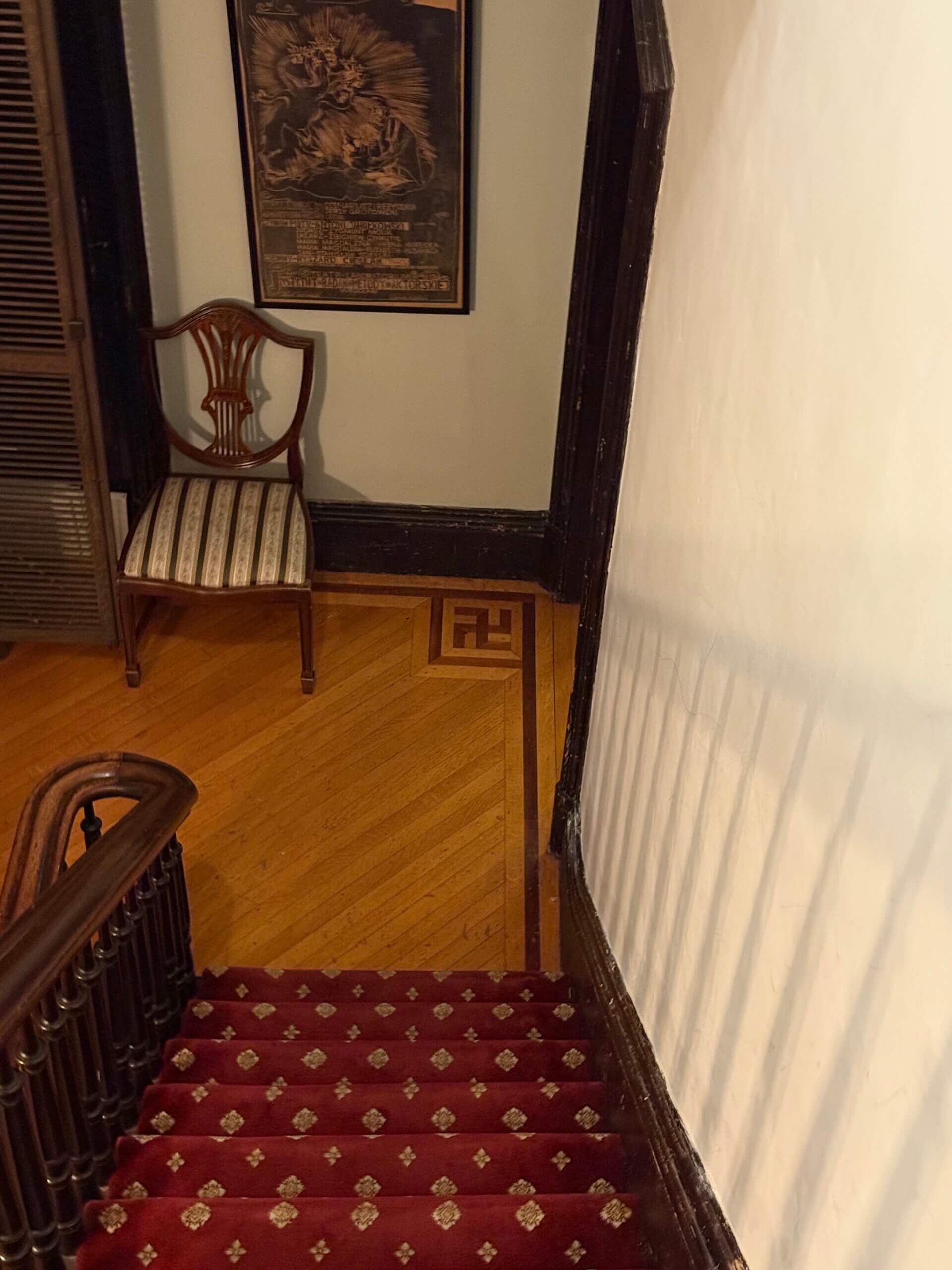
A few weekends ago I went upstate for a wedding, and briefly lived like a Victorian gentleman with a problematic taste in interior design.
Staying in a historic mansion (h/t Airbnb) in Newburgh, New York, I felt transported into a game of Clue, minus the murder. Was it me in the study with a sandwich? The parlor had a marble bust redolent of antiquity. From my top floor room there were panoramic views of the Hudson hills bursting with fall foliage. And then there was, at the corner of the landing … well, as I told my girlfriend, it’s more of a visual.
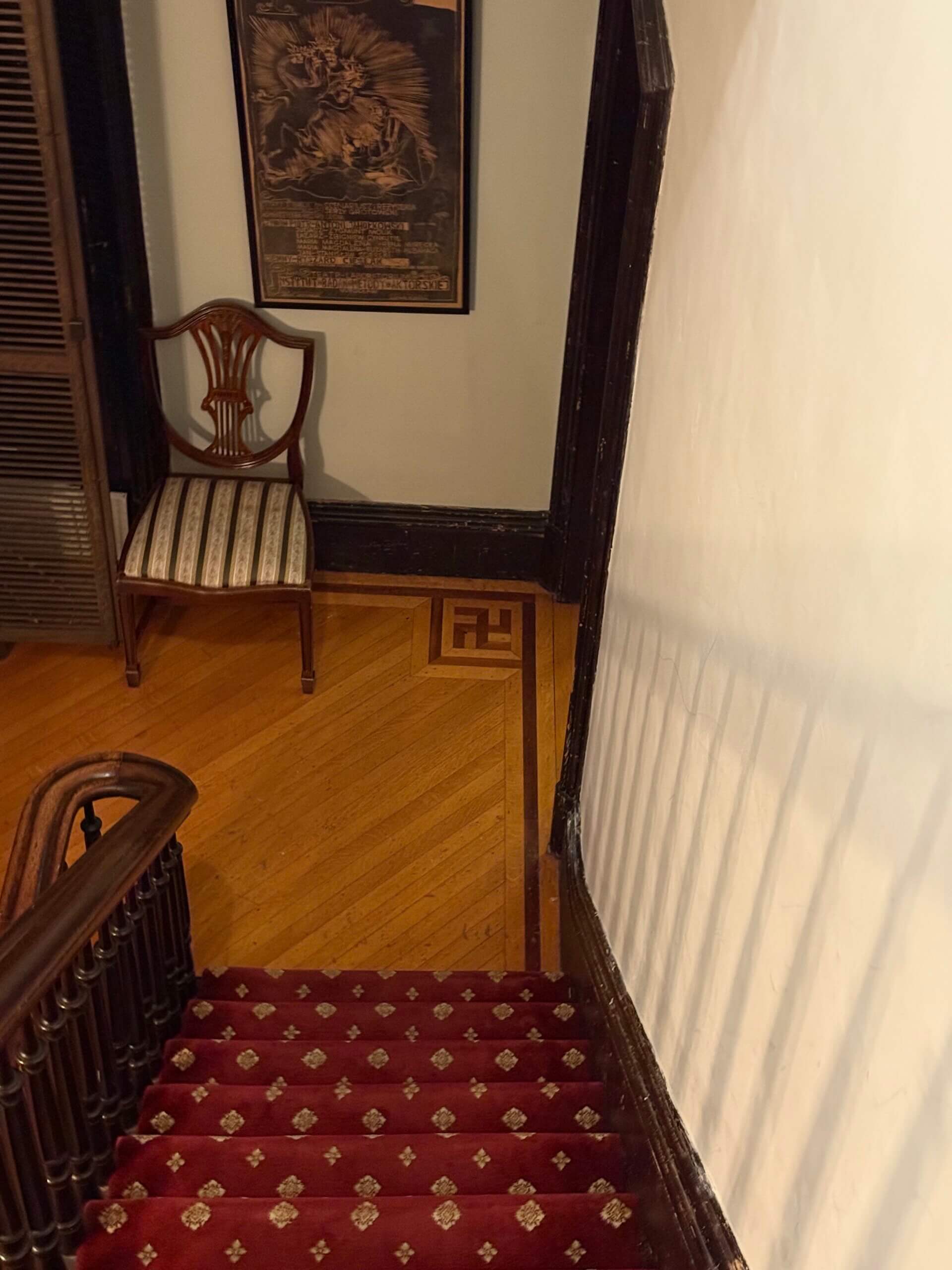
“Please do not be alarmed, but there are sauvastikas (more commonly known as swastikas) inlaid in the corners of the floors dating back to 1866, before Hitler was born,” the extensive house instructions said.
I wasn’t alarmed, more amused. (For context, the guests were almost entirely Asian with a couple of Ashkenazi Jews — and a miniature poodle.)
Of course I knew the Eastern origins of the motif. And I noted, as did our hosts, that these swastikas faced the opposite direction of the hooked cross favored by the Third Reich. The owners were right to say in their literature that the symbol “was stolen.”
Nazis really do ruin everything.
The architect, Frederick Withers, could only really be faulted for orientalism, which at the time wasn’t a dirty word. In any case, this was a landmark building registered with the historical society, and as such the swastikas couldn’t be altered. (“On a positive note,” our hosts added, “the original Tiffany stained glass window is well preserved up in the dining room.”)
At the wedding, I made the possible faux pas of mentioning the floors to friends of ours, one of whom grew up in India. It had just been Diwali, and he said kids draw swastikas everywhere during the festival.
“You’re taking it back,” I joked.
On the contrary, he said, they never really let it get taken away. Indians still use the swastika to signify peace and prosperity — its original meaning.
Maybe there’s a lesson there. Not really about ancient Indian symbols, but about what we feel comfortable letting Nazis get away with.
It’s long been a pet peeve of mine that so much of Jewish culture is boiled down to a period of about 12 years in a history that stretches back millennia. That public figures caught saying something antisemitic are immediately dispatched to the nearest Holocaust museum, rather than a Shabbat dinner or a museum of Jewish art.
When people online get defensive about their views on the Jews, they often mention how moved they were by Anne Frank’s diary, as if that was the answer key for understanding our peoplehood, and not just assigned reading. (In most schools in the U.S., the only time students hear anything about Jews is in a unit on the Holocaust.)
Members of the tribe are far from immune to this phenomenon. To be an educated, secular Jew, for many, is to have endured a screening of Schindler’s List — or, if you’re more ambitious, the more than 9 hours of Claude Lanzmann’s Shoah. You don’t see the Talmud in every Jewish home (granted, it takes up a lot of shelf space), but you can probably find a copy of William Shirer’s Rise and Fall of the Third Reich.
Jewish identity has been shaped by our persecution — and remembrance is an important Jewish imperative — but as I’m far from the first to point out, when we take history and memory culture to extremes, we end up ceding our own narrative to those who wanted to erase us.
As scholar Miriam Udel put it in her recent book, “The Holocaust is, in a profound sense, not a Jewish story.” This stopped me when I first read it, but the more I considered it, the more I saw her point. The way the Shoah is typically related, it’s not a story where Jews have a great deal of agency. Jews weren’t passive. Tales of resistance abound — and should be emphasized — but it’s still primarily a story in which something was done to the Jews, and for reasons the Jews had no real control over.
Indians don’t let Nazis have a monopoly on the swastika — why should Jews allow them to define Jewishness?
I am not advocating for the return of parquet-inlaid swastikas in Western homes, whatever their direction. I’m not even for a revival of the Hitler mustache that Michael Jordan once attempted to resuscitate in a Hanes undershirt commercial. But I do think there’s a wisdom in not permitting our enemies to distort our much older tradition.
In Yiddish, we say “mir veln zey iberlebn,” we will outlive them — them being Nazis, antisemites and the various Hamans that rise up in every generation. While today that seems aspirational, we must remember we were here first, and there’s far more to Jewish life than death.
The post So, there was a swastika at my Airbnb appeared first on The Forward.
Uncategorized
US Hits Military Targets on Iran’s Kharg Island, Vance Says No Change to Strategy

US Vice President JD Vance delivers remarks at the Wilshire Federal Building in Los Angeles, California, US, June 20, 2025. Phone: REUTERS/Daniel Cole
US strikes on Iran’s Kharg Island do not represent a change in American strategy, US Vice President JD Vance said on Tuesday as a US official separately told Reuters the additional strikes on military targets did not impact oil infrastructure.
The official, who spoke to Reuters on condition of anonymity, described at least some of the strikes as targeting sites that had been previously struck before and said the attack occurred in the early morning hours of Tuesday.
Vance, speaking separately in Budapest, said the strikes were not a change in US strategy, with the Trump administration confident that it can get a response from Iran by 8 pm (0001 Wednesday GMT) in negotiations to end the conflict. US President Donald Trump is demanding Iran forswear nuclear weapons and reopen the Strait of Hormuz, a critical oil transit waterway.
“We were going to strike some military targets on Kharg Island, and I believe we have done so,” Vance said.
“We’re not going to strike energy and infrastructure targets until the Iranians either make a proposal that we can get behind or don’t make a proposal,” he added. “I don’t think the news in Kharg Island … represents a change in strategy, or represents any change from the President of the United States.”
Uncategorized
French Nationals Leave Iran After Three and a Half Years Amid Softer France Tone on War

A woman walks past posters with the portraits of Cecile Kohler and Jacques Paris, two French citizens held in Iran, on the day of support rallies to mark their three-year detention and to demand their release, in front of the National Assembly in Paris, France, May 7, 2025. The slogan reads “Freedom for Cecile Kohler and Jacques Paris.” Photo: REUTERS/Abdul Saboor
Two French nationals were heading home on Tuesday after Iran allowed them to leave the country following three and a half years in detention, a surprise move that came as Paris sought to distance itself from the war in the region.
Cecile Kohler and Jacques Paris had been confined to France‘s embassy in Tehran since November, after being held since 2022 in the notorious Evin prison on spying charges that France has said were unfounded.
“This is a relief for all of us and obviously for their families,” President Emmanuel Macron said in a post on X. “Thank you to the Omani authorities for their mediation efforts.”
Neither the French presidency nor the foreign ministry responded to requests for comment on what had been agreed between the two sides to ensure their release.
Iran‘s official news agency IRNA said the couple were freed following an understanding under which France would in turn release Mahdieh Esfandiari, an Iranian student living in the French city of Lyon, and withdraw a complaint against Iran at the International Court of Justice.
However, both assertions were unclear. Esfandiari, who was convicted at the end of February for glorifying terrorism in social media posts, was released after serving almost a year in prison but has appealed the conviction.
It was not clear whether she had left the country, as ordered by the February ruling. France dropped the ICJ complaint last September.
Iran‘s Foreign Minister Abbas Araqchi spoke with his French counterpart Jean-Noel Barrot on Sunday, confirming the pair’s imminent release.
Macron has criticized US President Donald Trump’s approach to the US-Israeli war on Iran and said France would only help restore freedom of navigation to the Strait of Hormuz once there is a ceasefire and after consultations with Tehran.
France last week refused Israel permission to transfer weapons through French airspace for the war and has led efforts to water down a draft UN Security Council resolution that could have opened the door to forceful action in the strait.
A French official briefing reporters after the release denied that France had a softer position towards Iran and said Paris had warned the Iranians about the safety of their citizens given the escalation in the war.
“I think the Iranians rightly considered that if anything happened to our compatriots, the reactions here would have been extremely catastrophic,” the official said, declining to comment on the details of the negotiation.
French officials have also refused to comment on why a container ship belonging to French shipping group CMA CGM was able to pass through the Strait of Hormuz, a sign that Iran may not consider France to be a hostile nation.
Uncategorized
Gunfight Outside Israeli Consulate in Istanbul Leaves One Attacker Dead

A drone view shows police officers and medics standing at the scene, after a gunfire was heard near the building housing the Israeli consulate, according to a witness, in Istanbul, Turkey, April 7, 2026. Photo: REUTERS/Mehmet Emin Caliskan
One attacker was killed and two others were wounded in an extended gun battle with police outside the tower building housing the Israeli consulate in Istanbul on Tuesday.
Footage showed the backpack-wearing attackers firing with automatic rifles and handguns, and police officers returning fire and seeking cover, as they maneuvered among parked white police buses near a checkpoint. One body lay on the street.
Shots rang out for at least 10 minutes among the glass towers in Turkey’s main financial district, Reuters witnesses said. One person was seen covered in blood.
No Israeli staff were at the consulate, which occupies a floor in one of the towers, at the time of the attack, Turkish and Israeli authorities said.
Israeli diplomats had left Turkey shortly after the Hamas-Israel war in Gaza began in late 2023, a conflict that prompted large pro-Palestinian protests outside the consulate and across the country, and a deep chill in Turkish-Israeli diplomatic ties.
US ENVOY SAYS CONSULATE WAS TARGET
The three attackers had links to an organization that “exploits religion,” Interior Minister Mustafa Ciftci said, without giving any name. Two of them were brothers, and they had traveled in a rented car from the city of Izmit, he added.
While Turkish authorities did not say what motivated the attackers, Tom Barrack, the US ambassador to Turkey, said on X that it was an attack on the Israeli consulate and he condemned it.
President Tayyip Erdogan said the “heinous terrorist attack” would not dent Turkey’s trust and security. Israel’s foreign ministry said it appreciated Turkish security forces’ “swift action in thwarting this attack.”
Two police officers were also lightly wounded, Istanbul Governor Davut Gul told reporters at the scene of the midday incident, which occurred next to a major motorway as thousands of nearby workers were breaking for lunch.
DIPLOMATIC CHILL AMID GAZA WAR
Turkey, a fierce critic of Israel’s military operations in Gaza as well as in Lebanon and Iran, had recalled its ambassador from Israel in November 2023, and diplomatic relations have been effectively frozen since then.
At the same time that year, Israeli diplomats left Turkey due to security concerns, including the protests. Since then, heavily armed police and armored vehicles have been stationed in a broad area surrounding the consulate.
Militant violence has mostly subsided in Turkey in recent years after a violent spate from 2015 to 2016 when Islamic, Kurdish, and leftist militants carried out attacks amid the spillover from the Syrian civil war.
The latest incident was late last year when three Turkish police officers and six Islamic State terrorists were killed in a gunfight in the town of Yalova in northwest Turkey, amid raids on militant cells believed to be planning Christmas and New Year attacks.