


Uncategorized
The Energy Dilemma: Will Washington Let the Iranian Regime Survive?

A fire burns at South Pars gas field, in Tonbak, Bushehr Province, Iran, in this screen grab from a handout video released on June 14, 2025. Photo: Social Media/via REUTERS
For the first time since the “Second Iran War” began its lightning-fast escalation across the Persian Gulf, a palpable chill has settled over the direct line between the Prime Minister’s Office in Jerusalem and the White House.
While the last 24 hours have seen the Israel Defense Forces (IDF) systematically dismantle the command-and-control structures of the Islamic Republic, a new “Red Line” has emerged — not from Tehran, but from Washington.
Reports circulating early Wednesday suggest that the Trump administration has signaled a sharp hesitation regarding Israel’s planned strikes on Iran’s vital energy infrastructure, specifically the massive South Pars gas field.
As the IDF pushes for total “de-regimification,” the geopolitical friction between two of the world’s closest allies is reaching a boiling point. The question now haunts the halls of the Knesset: Will the American desire for global energy stability stop Israel from achieving a permanent victory?
The South Pars field is more than just a cluster of offshore platforms; it is the respiratory system of the Iranian regime. Holding an estimated 8% of the world’s natural gas reserves, it provides the hard currency that funds the Islamic Revolutionary Guard Corps (IRGC)’s regional proxies and its domestic oppression apparatus. For Israel, the logic is simple: you cannot kill the beast while you are still allowing it to breathe.
However, the global markets have reacted with predictable tremors. With the “Second Iran War” already pushing Brent crude toward historic highs, Washington’s reluctance is rooted in the fear of a global “energy shock” that could destabilize the US and world economy. The reported message from the White House to Israel has been one of containment– urging the IDF to “finish the job” on the military leadership. while leaving the energy faucets intact.
But for those who have spent decades analyzing the Middle East, this “half-measure” approach is a recipe for disaster.
Letting the Iranian Regime Survive to Fight Another Day
If the South Pars field remains operational, the regime retains the ability to re-arm, regroup, and wait out the current political storm. History is littered with “half-finished” wars that sowed the seeds of the next generation’s bloodshed. By drawing a red line at Iran’s energy assets, Washington is effectively offering the IRGC a lifeline just as it is gasping for air.
The strategic divergence is clear: Washington is playing a game of global economic management, while Jerusalem is fighting an existential war for the survival of the Jewish State.
The tension comes at a delicate moment. The elimination of Ali Larijani and Intelligence Minister Esmail Khatib signaled that the regime’s political “mask” had been shattered. The “Axis of Resistance” is crumbling, with even longtime “bridge-builders” like Qatar expelling Iranian diplomats in the wake of the latest missile skirmishes.
In the streets of Tel Aviv and the Jewish diaspora, the sentiment is one of “never again.” There is a deep-seated realization that if the Islamic Republic is allowed to survive this conflict with its economic engine intact, the cycle of terror — from Hamas to Hezbollah — will inevitably restart.
“We are not interested in ‘de-escalation’ for the sake of a cheaper gallon of gas,” one senior Israeli defense official reportedly said under the condition of anonymity. “We are interested in a Middle East where our children do not have to run to bomb shelters every six months. That requires the total neutralization of the threat.”
The Geopolitics of Victory
Peace only occurs when the enemy is convinced they have lost. By shielding Iran’s energy sector, the United States is signaling to the remnants of the mullahs that they still have cards to play. It reinforces the regime’s belief that they are “too big to fail” because of their grip on the world’s thermostat.
Moreover, the “Energy Red Line” risks alienating regional allies who have finally begun to pivot away from Tehran.
If the US appears to be protecting the regime’s assets, the incentive for Gulf states to fully align with the Abraham Accords framework diminishes. Why risk everything for a “new Middle East” if the old one is being kept on life support by Washington?
The Choice Ahead
President Trump, who has frequently touted his role as a “disruptor,” now faces his own paradox. He can choose the short-term stability of the global energy markets, or he can support the long-term stability of a world without a nuclear-armed, terror-funding Islamic Republic.
The stakes couldn’t be higher. We have seen what happens when the world chooses “management” over “victory.” It results in Oct. 7, 2023; it results in 1979; it results in a perpetual state of siege.
Israel is ready to finish the war. The only question remains: Will Washington let them win?
Amine Ayoub, a fellow at the Middle East Forum, is a policy analyst and writer based in Morocco. Follow him on X: @amineayoubx
Uncategorized
In rallies taking on Israel, a defiant Hasan Piker boosts Michigan Senate candidate Abdul el-Sayed
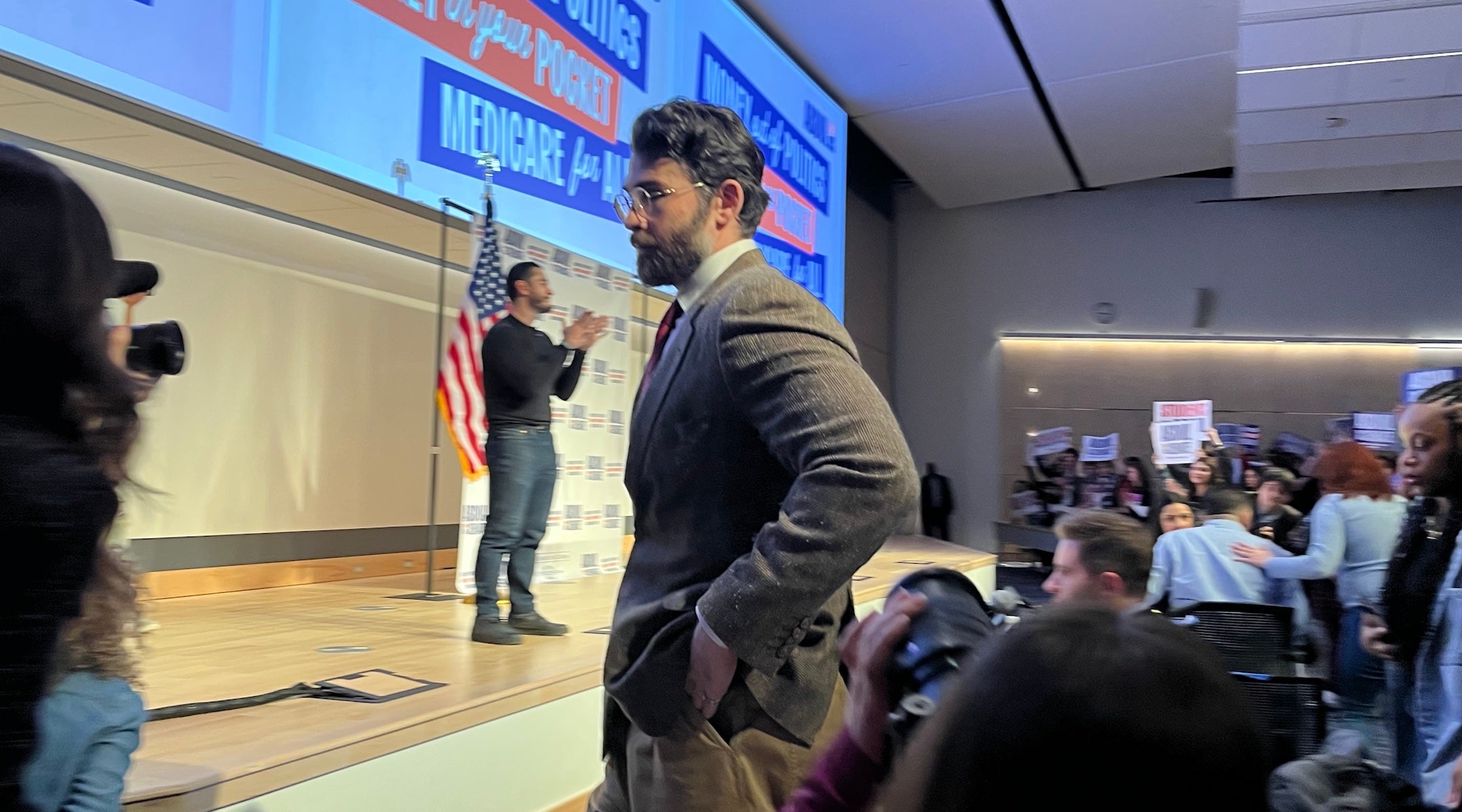
(JTA) — ANN ARBOR, Michigan — Outside, in a line that stretched around the block, the hundreds of people who turned out for Abdul el-Sayed’s campaign rally with Hasan Piker gave a range of reasons for showing up.
Some said they liked el-Sayed’s message of Medicare for All, a key plank of the former county health executive’s bid for an open Senate seat. Some were furious about the war in Iran, which the candidate has angrily denounced.
Others just liked the guy. “He’s a really great speaker and a really passionate person,” Natalie Gould, a master’s candidate in public health who had worked with el-Sayed in Detroit, told the Jewish Telegraphic Agency.
Inside, though, one issue made the crowd roar louder than any other: any time a speaker, from el-Sayed to Piker to the newly elected student body president, accused Israel of genocide. The progressive movement in which Piker has styled himself a kingmaker, one that is ardently pro-Palestinian while largely dismissive of any claims of antisemitism, was coalescing.
“In the beginning it was a lot lonelier when we spoke out. They used the same exact heinous smear: They said, ‘You’re antisemitic,’” Piker told the crowd. “And back then I felt a lot lonelier. But I don’t feel lonely anymore.”
Piker, the leftist Twitch streamer with millions of followers, was the evening’s biggest draw — and its biggest lightning rod. After el-Sayed announced the two would hold a pair of campaign stops together Tuesday, the streamer’s past clips and comments about Jews and Israel led numerous Jewish leaders and both of el-Sayed’s opponents to denounce the events. Some compared Piker to Nick Fuentes, the openly antisemitic far-right streamer who has divided Republicans. Leading Democrats called for the party to distance itself from Piker altogether.

Hasan Piker looks on as U.S. Senate candidate Abdul El-Sayed delivers a stump speech in Ann Arbor, Michigan, April 7, 2026. Piker, a popular Twitch streamer accused of antisemitism, prompted controversy for campaigning with El-Sayed. (Andrew Lapin/JTA)
Pushback continued until just before the events started. An hour before the first rally, at Michigan State University, that school’s president and governing board issued a joint statement affirming their campus free speech principles while also condemning antisemitism. The school’s Hillel chapter had already called Piker a “known antisemite,” expressing concern about his appearance.
At the next stop at the University of Michigan, el-Sayed told the crowd that the campus pro-Israel club Students Supporting Israel had planned to protest the event. But the group wasn’t visible outside the building, and the club’s Instagram page announced that its “March Against Extremism” had been “postponed,” which the group attributed to “extenuating circumstances” that it did not explain.
El-Sayed leaned into the energy, embracing Piker onstage and mocking the negative attention the rally had received. The rally overlapped with President Donald Trump’s deadline for Iran to make concessions or “a whole civilization will die,” which led to a temporary ceasefire in the U.S.-Israeli war on Iran.
“Apparently, the most important thing happening on Twitter was whether or not we were going to campaign with Hasan,” he told the crowd. “Somehow Fox News found it fit to cover this rally six f–king times and not talk about the fact the president wants to commit a genocide in Iran.”
Also leaning in were the night’s other speakers, who were all being showcased on Piker’s livestream — where, during downtime in-between speeches, he bemoaned what he described as a bad-faith campaign to paint him as antisemitic. (He also said he’d been hoping to eat at Zingerman’s, a famous Jewish-style gourmet deli in Ann Arbor.)
“I told Piker just now, I was like, ‘You’re never going to be canceled up in Michigan,’” Rep. Rashida Tlaib, the House’s fiercest critic of Israel, said during her own stump speech.
Rep. Summer Lee, of Pennsylvania, also delivered a speech, and Rep. Debbie Dingell, of Michigan, attended but did not speak.
Candidates for local office also stood next to Piker, including Amir Makled, a candidate for the university’s Board of Regents who was the legal defense for the school’s student pro-Palestinian encampment movement.
The crowd was young and diverse in age and race. While Piker received cheers when he shouted out his fans, some of the attendees told JTA they were more mixed on him, while others had little familiarity with his streams. But they all agreed he had juiced El-Sayed’s campaign.
“I mean, there’s tons of people here,” Ann Arbor resident Joey Ryan said while queuing up for the over-capacity rally outside, gesturing behind him. “I remember the Joe Biden Michigan stuff, and it was not like this. I remember the Bernie Sanders rally in early 2020, and it was more like this.”
Ryan said that Piker, like other streamers, operated in the “attention economy” space, where “saying inflammatory things sometimes can get you attention.” But, he said, “I also think it’s been blown completely out of proportion when you have the president of the United States calling Iranians non-human, as an example, to bomb them, and that includes the synagogue that was blown up in Iran today. Like, there are Jews in Iran as well. Is that not antisemitism?”
“Some of the stuff he says is kind of crazy. I’m not going to lie, there’s some stuff he said that I disagree with,” another attendee, a current University of Michigan student who declined to give her name, said of Piker. Content creators, the student said, can “get out over their skis.”
If anything, Piker and el-Sayed became more honed in on Israel as the day went on. At their first East Lansing stop, both made only a handful of comments about Israel and AIPAC. By the time they reached Ann Arbor that evening, the headliners had amped up their broadsides, with Piker referencing a new Pew Research Center study showing that 84% of Democrats under 49 have a somewhat or very unfavorable view of Israel.
“There’s only a handful of Democrats that are actually outspoken on this atrocity, outspoken on the relationship that we have with a foreign country that we simply always have to send unlimited billions of dollars to — a country that has health care, mind you,” Piker said. “You do not, but Israel has free health care.” The crowd booed at this line.

(L-r) U.S. Rep. Summer Lee, Senate candidate Abdul El-Sayed, and Twitch streamer Hasan Piker pose during a rally for El-Sayed, April 7, 2026. (Andrew Lapin/JTA)
As another rallying cry, he told them, “When you feel really sad, when you feel really angry, remind yourself of the worst fascist that you know. It could be Donald Trump, it could be Rabbi Shmuley. They’re going to be very excited if you stop fighting.” (Piker later told JTA that he was referring to Rabbi Shmuley Boteach, a pro-Israel Twitter gadfly who Piker said was “pro-genocide.”)
The candidate, too, amped up his criticisms of AIPAC in particular. The pro-Israel lobby, which has poured millions of dollars into congressional elections, is facing a resolution of opposition from the Democratic National Committee this week.
“AIPAC tells us that the number one goal of our foreign policy is to align with a foreign government,” el-Sayed said, to boos. “You know, when I talk about AIPAC, everybody says, ‘Well, it’s because you’re Arab Muslim.’ No it’s not. It’s because I’m f–king from Michigan, and I want my tax dollars back in Michigan.”
He also joked that AIPAC ads against him might finally give him something he’s dreamed about. “The one thing you’re supposed to have, as an American Muslim, is a nice beard,” he said. “And I was never gifted with that. But for three months this summer, AIPAC’s going to give me the beard of my dreams.”
At both campaign stops, El-Sayed, who grew up in a heavily Jewish Detroit suburb not far from Temple Israel, the synagogue that was attacked last month, also said he welcomed Jews to his movement.
“All of us love and revere Jewish folk, our Jewish neighbors, the faith of Judaism,” he said in Ann Arbor, to applause. “Trust me, nobody will fight harder against antisemitism than somebody who intimately understands what it’s like to be discriminated against because of how I look.”
He reiterated the point in an interview after the event.

Supporters of Michigan U.S. Senate candidate Abdul El-Sayed cheer Rep. Rashida Tlaib as she denounces Israel during a rally in Ann Arbor, Michigan, that also featured Twitch streamer Hasan Piker, April 7, 2026. (Andrew Lapin/JTA)
“I am so grateful I’ve grown up in a community with a large proportion of Jewish Americans. I learned a lot from the Jewish tradition. I’m grateful to have been invited to bar and bat mitzvahs and to be invited to Seders and to be invited to spend time at shul,” el-Sayed told JTA.
“I stand deeply and profoundly against antisemitism in the same way that I stand deeply and profoundly against Islamophobia,” he added. “Those two things always run together. It is not antisemitic to criticize a foreign government, and it’s not antisemitic to criticize a super PAC that is intent on aligning our interests with the foreign government.”
In the interview, the candidate also reiterated the sentiment behind his own statement on the Temple Israel attack, in which he had referenced the Israeli war in Lebanon. “I also think it’s just critical for us to understand that hurt people do hurt people, and the circumstances happening 6000 miles away can affect the lives that we live here,” el-Sayed said Tuesday.
At the end of the rally, Piker climbed back onto the stage with El-Sayed to a standing ovation. The two men embraced, then posed for a selfie with the crowd behind them.
This article originally appeared on JTA.org.
The post In rallies taking on Israel, a defiant Hasan Piker boosts Michigan Senate candidate Abdul el-Sayed appeared first on The Forward.
Uncategorized
The Iran war looks like a failure. Now comes the Trump-Netanyahu spin game
Within the space of a day, President Donald Trump’s genocidal threat to wipe out Iran’s “entire civilization” gave way to a two-week ceasefire that may well end the war — at least on the Iran front. In Israel and the United States, both of which are moving toward elections, a fierce reckoning will unfold over what this war achieved, what it cost and what it revealed.
A full accounting must await the results of talks due to begin in Pakistan on Friday. But judging by statements from Trump and other U.S. officials, these are something of a formality, and the war should be expected to end in exchange for Iran reopening the Strait of Hormuz and perhaps handing over its enriched uranium.
The latter outcome was essentially achievable before the war; the former solves a problem caused by the war. And while both Trump and Israeli Prime Benjamin Netanyahu will surely spin their gambit, which placed the entire world on edge, as successful, it is absolutely unclear whether this war was a strategic net gain or loss for both countries.
To begin an assessment, it’s important to remember what the operation’s initial aims were. The main goal stated by Trump at the outset was to halt and reverse Iran’s nuclear program. Even if the regime hands over its enriched uranium stockpile, it has made no promises to stop its nuclear efforts or allow intrusive international oversight. That is anything but a decisive shift.
Israel had wider goals, which American officials seemed to sometimes echo and often ignore. It wanted Iran to be relieved of the long-range missile capability used to target Israel with the biggest ballistic attacks in history. And it wanted to debilitate Iran’s web of proxy militias, including in Lebanon and Yemen, which perpetually threaten attacks.
Unlike with the nuclear program, Iran is not even willing to discuss these issues, and here, too, there is no evidence that the war has moved its position by an inch.
In the background, of course, there was the hope that the regime would mercifully just fall. Indeed, Trump said on the first day that the people of Iran would be able to take their country back, and Netanyahu made similar statements.
Normally, external regime change efforts are a bad idea — interference is both hard to defend legally and unlikely to succeed. But in this case, with the regime having damaged the region for decades and killed tens of thousands of its own citizens to stamp out the protest movement in January, the ambition seemed justified, as long as there was a realistic plan for it to work
Spin, spin, spin
There was no such plan.
What there was, instead, was some hope that the regime’s decapitation in the war’s early hours would lead to a spontaneous shift. This would have required the arranging of a plan with elements in the Iranian security apparatus to seize power once the leaders of the theocracy were gone. Efforts on this front were meager: days into the war, Trump acknowledged that the candidates the U.S. had seen as most likely to be good new leaders for Iran had themselves been killed by airstrikes.
The window for regime change, cracked open at the war’s onset, quickly began to close as the regime adapted and projected continuity.
What was left to aim for was the degradation of the regime’s abilities. Here the ledger looks more successful, although still mixed.
Even though the regime has reconstituted, an array of very senior political and military figures were killed, which will set the country back. Essential military facilities — including missile launchers, research sites, operational headquarters, checkpoints and much of its entire naval fleet — were destroyed.
A normal regime might be cowed after such a thrashing, but these are fanatical jihadists, and all of this can be rebuilt. Moreover, Iran was still firing missiles at Israel for a few hours even after the ceasefire was announced. So this amounts, at best, to what Israeli officials call a “mowing of the grass.” Selling it as a huge victory is basically spin.
We’ve seen that move before. After the 12-day war last June, Trump and Netanyahu vastly exaggerated the effort: Trump insisted the nuclear program had been “totally obliterated” and that any journalist who questioned this was “doing a really bad job,” and Netanyahu declared that Israel had “set back for generations” not just Iran’s nuclear threat but the one from ballistic missiles. Neither has attempted to explain the contradiction between those claims and the pretext for the renewed war.
Military and political losses
Meanwhile, the war’s costs have been profound.
There is significant loss of civilian life in Iran and Lebanon, most devastatingly the erroneous U.S. attack on an Iranian school that killed more than 100 children on the war’s first day. 23 Israeli civilians have been killed, as well as at least 13 American service members.
The strategic loss may be the most meaningful. Iran demonstrated that it can hold the world for ransom by blocking the Strait of Hormuz, through which a fifth of the world’s crude supply travels. Oil prices spiked, and the inflationary effects via petroleum-based and other products, supply chain disruptions, and the systemic trust breakdown are dire. They could have long-term consequences even once the Strait reopens.
Moreover, it looks like Iran is still somehow hoping to charge ships to pass through the strait, at least during the ceasefire and possibly more long term — which, of course, must categorically not be allowed. That Iran is even toying with this idea reflects the regime’s belief that it has emerged from the war with more leverage, not less.
That belief itself marks a serious negative outcome to the war. An Iran that is emboldened is an Iran that is more dangerous, even with its capabilities degraded.
For Trump, there is a personal political cost as well. The war was seriously unpopular in the U.S. He will likely go in search of a scapegoat: a prime candidate is Netanyahu, whom many in the MAGA movement have accused of misleading the capricious and superficial Trump into believing that the Iranian regime would easily collapse. That could spell dire consequences for the U.S.-Israel relationship, already made more brittle by strains over the Gaza war.
Americans should be troubled by what the war revealed about their impetuous political leadership and its standing in the world. The NATO nations refused to join the war, causing Trump to threaten that the U.S. might pull out of the alliance that has helped keep global peace for almost 80 years. This caused enough angst to send Secretary-General Mark Rutte on an emergency mission to Washington today.
However the geopolitical dust settles, there must be lasting consequences over Trump’s Tuesday social media post in which he wrote “A whole civilization will die tonight, never to be brought back again. I don’t want that to happen, but it probably will.” Anyone who thinks that words should carry weight might conclude that what will be remembered of this war is that the U.S. president is a person capable of making such dire and cavalier threats.
The post The Iran war looks like a failure. Now comes the Trump-Netanyahu spin game appeared first on The Forward.
Uncategorized
US and Iran agree to ‘fragile’ 2-week ceasefire; Israel says deal does not extend to Lebanon
(JTA) — Israel struck Hezbollah targets in Lebanon on Wednesday as a tenuous ceasefire took hold in its monthlong war with Iran, which it has conducted jointly with the United States.
U.S. President Donald Trump and the prime minister of Pakistan, which brokered the truce talks, announced the two-week halt in hostilities late Tuesday, as Trump’s deadline for Iran to open the Strait of Hormuz or risk annihilation neared. Vice President JD Vance called “fragile” as Iranian officials said they would keep their “finger on the trigger” in case of further attacks.
Israel said it would abide by the truce but said the deal did not extend to Lebanon, where Hezbollah, an Iranian proxy, is based — despite comments by Pakistan’s prime minister asserting the opposite.
Hezbollah joined the Iran war shortly after the United States and Israel launched it with a wave of strikes on Feb. 28; it has since pummeled northern Israel with hundreds of rockets, causing damage, disruption and death.
Israel’s Home Front Command, the military unit advising civilians, said there would be no immediate changes to guidelines barring large gatherings and that Israelis should still be prepared to find shelter in the case of sirens warning them of incoming missiles.
Israeli Prime Minister Benjamin Netanyahu reportedly urged Trump not to agree to a ceasefire, arguing that pausing attacks meant to curb Iran’s nuclear threat would carry risks. On Wednesday, after the ceasefire set in, Trump said on Truth Social that there would “no enrichment of Uranium, and the United States will, working with Iran, dig up and remove all of the deeply buried (B-2 Bombers) Nuclear ‘Dust,’” signaling a commitment to reining in Iran’s nuclear program.
Trump also said the United States had concluded that Iran “has gone through what will be a very productive Regime Change.” Trump cited regime change as one of multiple evolving goals of the war. After the assassination of Iran’s supreme leader, Ayatollah Ali Khamenei, on the war’s first day, Iran appointed his son Mojtaba to take his place; Mojtaba, a hardliner, was injured and may remain comatose, U.S. intelligence reportedly believes.
This article originally appeared on JTA.org.
The post US and Iran agree to ‘fragile’ 2-week ceasefire; Israel says deal does not extend to Lebanon appeared first on The Forward.