


Uncategorized
‘The Girl in the Red Jacket’: A Testimony From Inside Iran

Cars burn in a street during a protest over the collapse of the currency’s value, in Tehran, Iran, Jan. 8, 2026. Photo: Stringer/WANA (West Asia News Agency) via REUTERS
I am Maddie, a millennial woman from Iran and an eyewitness to a bitter reality impossible to unsee.
I woke up on the morning of January 7, 2026, and checked my phone, scrolling through clips of my favorite shows. I walked into the living room with my phone still in my hand, when I realized that protests had broken out in the capital, Tehran.
At first, I ignored it. I had seen this before. In the 2019 “Bloody November” protests (Aban-i-Khoonin), the streets did not just protest; they bled. What started as fury over oil prices became a desperate fight for survival and freedom. The only thing more deafening than the gunfire was the chilling realization that this regime would rather rule a graveyard than lose its throne.
In 2022, the death of Mahsa Jina Amini in police custody sparked a new wave of demonstrations, and headscarves were burned. Streets filled again. Bullets tore through the chants; the shadow of the gallows grew longer every passing day. For every burned scarf, a life was taken.
Every time the streets stir, that old terror returns. The memory of what happens to empty hands never really fades. Our only weapon is our voices, but voices don’t stop bullets. You can’t save your loved one with chants; the memory of the consequences of rising against a totalitarian regime is etched in the pavements of this land in the form of stains.
This time, I knew the protests would be suppressed as they always are, and people would be forced back into silence. I put on my hoodie and left to buy eggs and dog food. I hadn’t been to the market for over a week. At the counter, I handed my card to the shopkeeper. The card machine beeped and showed an insufficient funds error. I knew I had money; I was certain of it. I asked the shopkeeper why the payment was being declined. He looked at me and said I didn’t have enough.
That was when I realized what had happened. Prices had tripled in less than two weeks. The US dollar had surged past 150,000 toman. At that moment, something broke inside me. I was not just shocked. I was angry, frustrated, and humiliated. Standing there, unable to pay for basic necessities, I understood that the crisis was no longer something happening on screens in Tehran. It had reached my hands, my wallet, and my life.
I spent the day reading, watching videos, and playing with my dogs. By the afternoon, I had to go to work. I went, finished my shift, and came back home. When I returned, I asked my uncle whether there had been any protests where we live. He said there were none.
“This is a small city,” he said. “Everyone knows everyone, you can’t just disappear in a crowd, so even if there are protests, you are not going anywhere.”
I nodded and went out to see my friends. We talked about ordinary things while the news played in the background, the way people do when fear has become a routine. Injustice lingered in the air like a toxin, impossible to escape. Near the main street, I noticed two men and a few young boys and girls standing together in silence. A police van parked in front of them, close enough to silence them without a word. Chanting wasn’t allowed. No banners, no organization — this alone was dangerous.
I went home with a pounding heart. I took off my shoes, then put on a black mask and wrapped a black shawl around my head and neck. In my rush, I forgot to change my red jacket. I found myself already moving before I had fully decided.
Uncle called out, “Where are you going?”
“I am just going to see, not going to do anything!”
“It is dangerous, they will find out, this is a small town,” he warned me about the consequences.
“Ten minutes? I will keep my distance,” I pleaded.
“Only ten minutes! Don’t do anything stupid.”
This is how we negotiate with fear, through time limits and promises that no one believes.
I put my shoes on in a hurry and stepped outside, overwhelmed by adrenaline, moving fast, almost without thinking.
Every step felt like calculating a potential death sentence. Every corner felt like a risk that couldn’t be undone. Here, opposition is not met with dialogue; it is met with batons, bullets, prison, and execution without trial. We grow up knowing the names of the dead even when their stories are erased. We know that a protest is never just a protest; it is a gamble with your future, your freedom, and your life.
As I turned the corner, I saw a few protesters standing apart from one another, careful not to form a crowd. I stopped at a distance. My legs were shaking. My hands would not stay still. I leaned against a wall, trying to steady my breathing. It was my first time standing this close to a protest. I noticed that everyone was wearing black jackets and black masks, as if color itself could be used against us.
I glanced down at my own red jacket and thought of the girl in the red coat in Schindler’s List, a symbol of how innocence and visibility offer no safety when violence is systematic. I stood there for less than a minute, fully aware that in this country, a minute is more than enough to change everything.
Before I could think any further, one of the girls stepped out from the group and walked towards me. I didn’t recognize her at first.
“Maddie, come,” she said.
I didn’t answer. I didn’t have to. My feet moved even as my mind resisted. When I reached the group, I recognized a few of my friends not by their faces, but by their eyes. That was visible.
One of them whispered. “Why are you wearing red? Are you crazy?”
“I didn’t think about it,” I said. I’ll wear black tomorrow.”
We stood there without speaking. One by one, others joined us. Ten people in total. No chants. No movement. Only bodies assembling quietly under constant watch in a small town crowded with the Revolutionary Guard and Basij.
I came home.
Uncle asked. “How did it go?”
“It was fine, I won’t wear a red jacket tomorrow,”
“Tomorrow?” He was quiet. He didn’t say another word.
All night, I kept turning from side to side, consumed by the consequences of having joined a protest. In my family, repression is not an abstract idea. Many of our relatives were killed in the 1970s. We never supported what was called a revolution; what actually took place was a coup d’état. The memories came back uninvited.
During the “Bloody November 2019-2020,” one of my family members was arrested and tortured in a detention center. He spent months as a political prisoner before being released on bail. Those months were filled with a familiar terror: not knowing where your loved ones had been taken, waiting weeks and months without answers, imagining every possible outcome just to survive the silence.
To quiet my thoughts, I downloaded an audiobook from YouTube, The Song of Achilles, my favorite book of all time. In the middle of fear, it offered a strange kind of warmth.
The next evening, at 8 PM, I put on a black jacket and a black mask and returned to the protest with two of my friends, Zahra and Melena. This time it was larger. The ground itself seemed to tremble under the weight of so many feet. Men, women, and children stood together, all dressed in black. The children I was used to seeing run freely through the streets now looked serious, alert.
“Why didn’t you bring your dogs?” one of them asked. They recognized me.
“They might bite you,” I said, and they laughed.
I noticed Snow — a white stray dog — near the sidewalk, looking for me. He finds me wherever I go. I ran home, brought him food, and returned. Dogs are considered filthy and forbidden under Islamic Sharia rules. I have faced constant opposition and mockery simply for feeding and caring for them. That story alone could fill pages.
Snow ate his food and stayed close. When we began walking towards the avenue, he followed along the sidewalk, frightened by the crowd. As we moved, more people joined us.
Then the chants began.
“Death to Khamenei!”
“Death to the dictator!”
“This land will not be free until the clerics are dead.”
The silence was gone, replaced by the brave people who enveloped the town whole.
Those who could not walk with us showed up with their cars, driving slowly in front of and behind the crowd. Their continuous honking, clapping through open windows, and making their presence known gave me the courage to keep walking and chanting even as my heart pounded and I felt certain I could be shot at any moment.
At that moment, Zahra grabbed my arm and shouted at the top of her lungs, “You know what I feel, Maddie?”
“What?” I shouted back.
“I feel free, I feel free to scream, for once in my life I am feeling that my voice is liberated, I have the right to shout.”
I looked at her — the only thing I found was the glistening eyes behind that mask, which was supposed to be a barrier between us and death itself. I nodded, and we held each other’s hands firmly.
That night, I returned home to find the Internet completely cut off. The blackout had begun. I didn’t care; I threw my phone onto the bed, and slept. In the morning, I realized it wasn’t just the Internet. Phone calls didn’t go through. Messages wouldn’t send. I couldn’t reach friends in other cities. Desperate for information, I watched television, scanning for any mention of what was happening elsewhere.
Reports emerged that a hospital in Ilam had been attacked and besieged by police. In Marvdasht, in Fars province, residents had taken up weapons against security forces. The situation was escalating. Authorities brought in forces from other provinces to regain control.
On the third night, again at 8 PM, we went out again; this time the crowd was even larger. Soon after, security forces opened fire on protesters in a nearby town. The crackdown intensified. Families were harassed. Homes were raided. Tear gas, metal pellets, and live ammunition were used. People were shot in the head and in the back, killed or permanently paralyzed.
A 16-year-old boy I knew was murdered. His name was Mehdi. The IRGC and Basij abducted him and his friend from the protest, beat them with rifle butts, sexually assaulted them, and then shot them. One died on the spot, the other remains in a coma.
This is not an exception; this is the life we have been living for decades. The following day, Iranian Intelligence began calling families of the protesters one by one, threatening them, ordering them to turn themselves in, and to stop protesting. Homes were raided. My friends and family were targeted.
Families were told their lives would be destroyed. In some cases, relatives of those killed were forced to sign documents falsely stating their loved ones had been killed by the “Mossad agents and terrorists.”
My uncle received a call. “Tell your family to stay home, or there will be consequences.”
We did not stop, but I began to lose strength when I could no longer reach my friends in other cities.
Eleven days after the massacre began, I briefly regained Internet access. The first thing I did was message friends in larger cities. One of them, from eastern Tehran, I won’t mention his name, told me that the regime had shot everyone who came out; the streets were flooded with blood. Security forces executed wounded protesters by shooting them in the head while they were receiving medical care. Families were forced to pay a ransom to retrieve the bodies of their children.
There is credible evidence that Iraqi, Afghan, and Pakistani militia, many of whom fought in Syria for Bashar al-Assad, were deployed to suppress protesters.
Another friend from Tehran sent me videos he recorded himself. In it, bodies were tagged and placed into bags. These were not anonymous images pulled from social media; they were scenes witnessed firsthand by people I know. The dead were not statistics; they were protesters who had stepped into the streets just like me, and never returned. Every name was a story. A dream.
What Iranians are suffering is not unrest. It is a calculated campaign of terror. The Islamic regime has turned public spaces into a killing ground, medical centers into execution sites, and mourning families into targets of extortion and intimidation. Violence is applied methodically, meant not only to crush protests, but to teach an entire nation what dissent costs.
This is not a momentary crisis. It is the continuation of a system that has perfected repression over decades, one that survives by bloodshed, silence, and the deliberate erasure of human dignity.
Many Islamic countries remain silent. Their narrative is a lie painted over a massacre. While our streets ran red, the leaders of the Muslim countries looked the other way. Seeing them shake hands with the very men who ordered our slaughter is a sickening sight.
My request is direct and urgent.
World leaders, the UN, and international human rights organizations! The Islamic Republic does not recognize international law. It violates it openly and repeatedly. Human rights abuses are central to its survival. Repression is not a policy failure. It is the policy.
The regime promised it would not execute protesters. From early January up till now, it carried out multiple executions. These were acts of intimidation, intended to terrorize a population into submission. Many political prisoners are at risk of execution.
The world must stop treating this regime as a legitimate governing authority and begin treating it as what it is: a system sustained by violence, fear, and the systematic destruction of human life. Silence, neutrality, and delay are not neutral positions. They are choices with consequences measured in blood.
This is not a warning.
It is a record.
It is an appeal to action, before more victims are added to the documented toll of the Islamic regime’s state violence.
Long live Iran.
پاینده باد ایران
Maddie Ali is a teacher and philosophy student based in Iran. In addition to her academic work, she has been involved in civic activity in her hometown, including participating in and helping organize local protests alongside friends and family. Her name has been changed to protect her identity.
Uncategorized
Mahmoud Khalil wants to reassure you
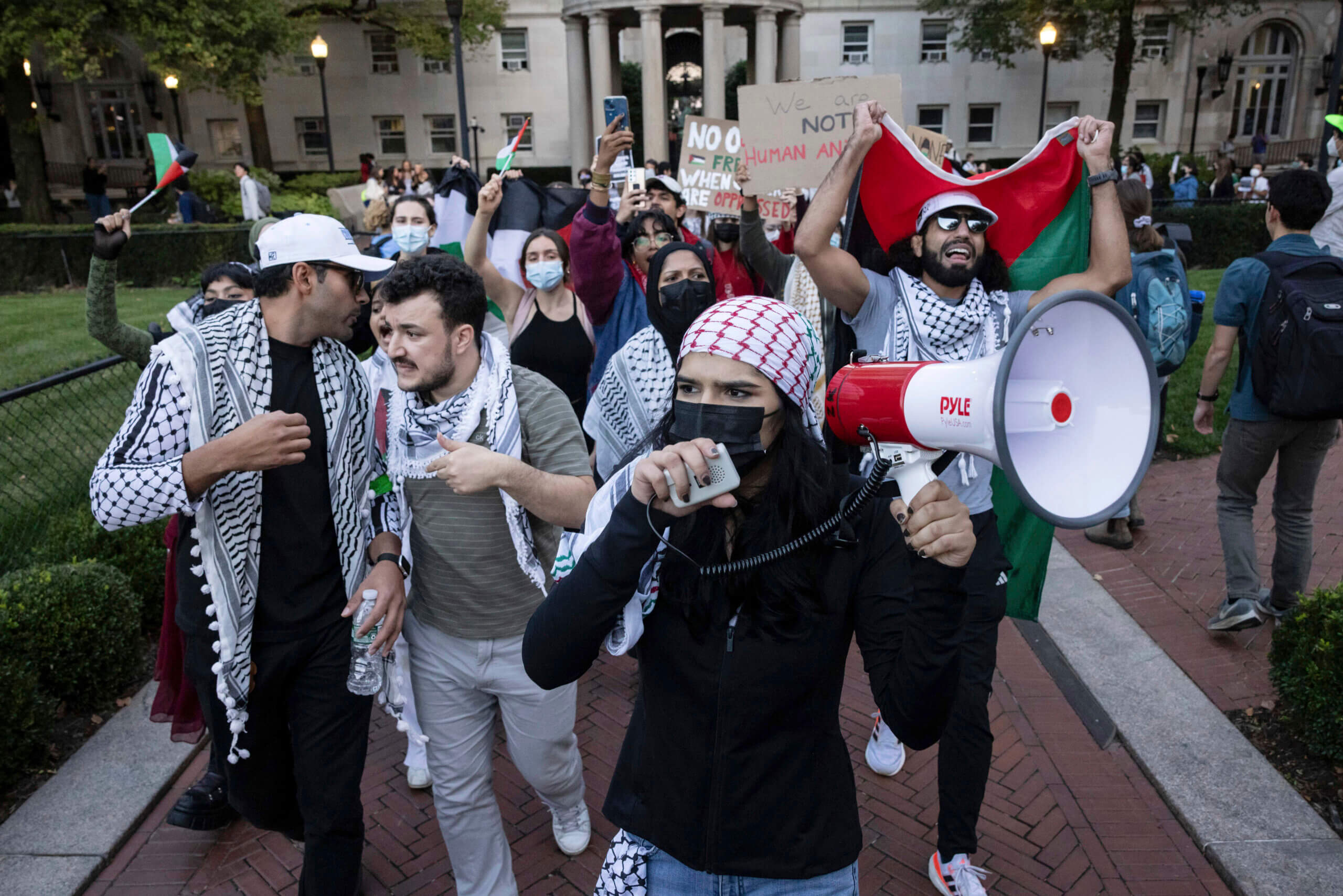
Mahmoud Khalil knows what you’ve heard about him. That he is an antisemite. That he supports Hamas.
That he fostered “a hostile environment for Jewish students in the United States,” as Secretary of State Marco Rubio wrote in a letter seeking to deport Khalil on national security grounds.
It’s not just that these claims offend Khalil — though they do.
Or that they jeopardize his ability to continue living in New York City with his wife and baby son — though they do that, too.
“This is what we should aspire for: to get a place where there’s no more conflict, no more killing in that place and it’s open to anyone who wants to call it their home.”
On what a ‘free Palestine’ should look like
The major reason that Khalil put on a baseball hat and sunglasses and traveled from Brooklyn to a conference room in Manhattan last week to meet with the Forward is that he believes misplaced Jewish fear remains a major obstacle to achieving what he and other protesters consider to be the liberation of Palestine.
Speaking extensively about Hamas, Oct. 7 and his preferred political solution to the conflict, Khalil sought to reassure American Jews that the protest movement he participated in and helped lead at Columbia University recognizes “absolutely a Jewish connection” to Israel and does not seek to drive Jews out of the region.
“The Jewish people are part of the land and they should remain that way,” Khalil told me. “I want to liberate everyone.”
Face of a movement
When federal agents arrested Khalil in the lobby of his Columbia student housing last March, he was transformed overnight into an emblem of the campus demonstrations against Israel. Even many of those who objected to his detention accepted the Trump administration’s premise that he was an antisemitic extremist.
“I abhor many of the opinions and policies that Mahmoud Khalil holds and supports,” Senate Minority Leader Chuck Schumer said at the time, before suggesting that his arrest might violate the First Amendment.
But despite occasionally speaking to the media on behalf of protesters, and negotiating between students and the administration, Khalil was not the movement’s face until he was arrested — and it was unclear what exact opinions and policies Schumer and his other critics were actually referring to.
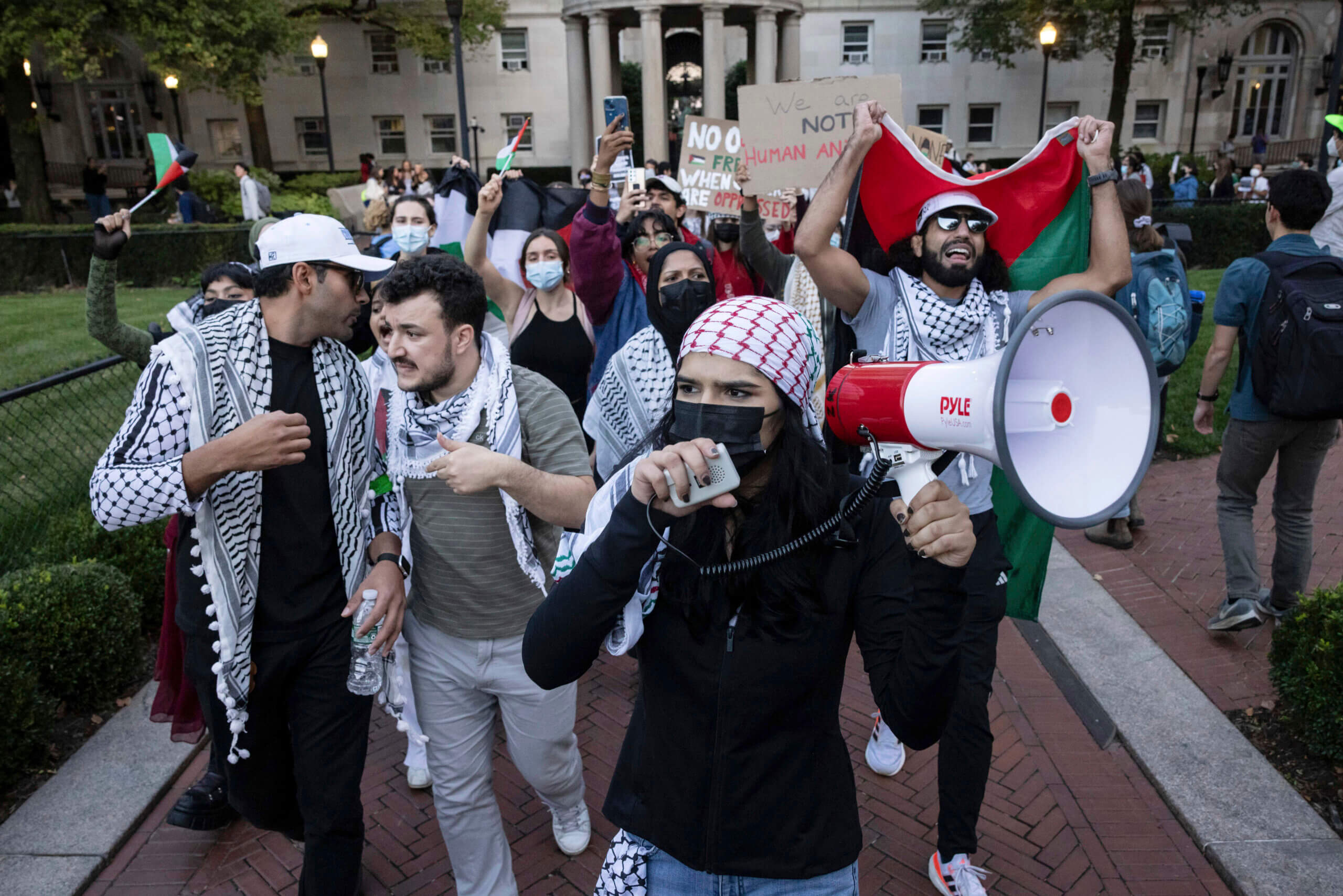
Khalil, who is now 31, did not have any public social media accounts before his arrest. Unlike others at Columbia, he had not posted a video of himself saying “Zionists don’t have a right to live,” or held a sign labeling pro-Israel counterprotesters as “Al-Qasam’s next targets” or been caught on camera yelling at anyone to “go back to Europe.”
The protest movement at Columbia was fractious and, while Khalil managed to retain the respect of most encampment participants, on key issues — including whether a student who had insisted he had the right to kill Zionists should apologize, whether protesters should occupy Hamilton Hall, and whether to embrace the slogan “globalize the intifada” — he aligned himself with those calling for the more conciliatory approach.
His media tour following a court order releasing him from immigration detention in rural Louisiana last June largely confirmed this. There were flashes of anger, especially when he spoke about missing the birth of his son Deen last April, and resolve. “Even if they would kill me, I would still speak up for Palestine,” he told reporters immediately after his release.
But in repeated interviews, Khalil condemned antisemitism and violence against Israeli civilians, and spoke with passion about the important role of Jewish students he had demonstrated alongside.
All this made Khalil, who graduated from Columbia with a master’s degree in public administration shortly before his arrest, a poor poster child for the protest movement’s excesses.
And yet nobody has wanted to confront this reality because it requires acknowledging that the movement had both moderates and extremists. Khalil’s opponents rejected the premise that there were any moderates in the movement, while his supporters rejected the premise that there were any extremists.
A balancing act
Khalil, like the movement he came to represent, is adamant that Zionism is racist. He opposes any two-state solution that seeks to preserve a Jewish majority in Israel.
“Rejecting the self-determination of the Jewish people on the Palestinian land in itself is not antisemitism,” Khalil said during our interview. “You are denying other people’s rights in the land.”
Khalil goes beyond accusing Israel of genocide and has said that its goal is to kill all the Palestinians in Gaza — a claim Israeli officials have strenuously denied, insisting that civilian casualties are the inevitable result of dense urban warfare. In our interview, he questioned whether militants sought to kill, rather than kidnap, Israeli civilians on Oct. 7. He is sympathetic to support for Hamas among Palestinians in the West Bank and Gaza. And like most of the Palestinian liberation movement, he views liberal Zionist groups that support Israel while seeking to push its government to the left as an obstacle.
He is reluctant to criticize the movement’s excesses, and ready with explanations for even the tactics and rhetoric he finds unproductive. Khalil argues that Israel is to blame for anti-Zionism sometimes slipping into antisemitism because its government has intentionally held itself out as representative of Jews and Judaism while carrying out what more than 40% of Americans — and the vast majority of Democrats — considered to be a genocide in Gaza.
Khalil keeps a magnet on his fridge with a map of Israel, the West Bank and Gaza overlaid with the pattern of a keffiyeh, the traditional Palestinian scarf, that reads: “I will stay a traveler until I go back to my home country, Palestine.”
There is nothing moderate about any of this for Jews who believe that anti-Zionism is always an expression of antisemitism.
“I have a nuanced view of the Zionist project that goes beyond ‘Zionism is bad.’”
On what he learned from engaging with liberal Zionism
But Khalil’s views are ubiquitous among those who have protested against Israel over the past two years — and are coming into the mainstream as Americans turn against Israel at a rapid pace. Its support has cratered to a paltry 13% among Democrats, and an endorsement from the AIPAC has become a liability for liberal politicians at a time when the former leader of a Students for Justice in Palestine chapter just became mayor of New York City while other Democrats who share his views on Israel are winning Democratic primaries, and liberal members of Congress are rejecting funding even for Israel’s defensive missile systems.
Pro-Israel groups have been able to convince Republicans to enforce prohibitions on anti-Zionism by force — epitomized by the White House’s unprecedented attempt to deport Khalil — but the conservative vanguard is turning on this approach, with some blaming Jews for the war in Iran and referring to politicians who prioritize countering antisemitism as “J-pilled.”
If anti-Zionism is here to stay, Khalil advocates a remarkably pragmatic direction for the movement. He is critical of Hamas — including its embrace of political Islam and violations of international law — and his vision for a free Palestine includes safety and security for its Jewish residents. He is attuned to concerns over antisemitism, rejects an oppositional stance toward Jews who disagree with his beliefs and cares about bringing more of them into his tent.
“For a lot of people, all Zionists are bad,” Khalil said. “To me, no — it’s not like that.”
From Khan Eshieh to Columbia
A good place to start Khalil’s political journey is at 16, when he boarded a bus from Khan Eshieh, the Palestinian refugee camp on the outskirts of Damascus where he was born, bound for the foothills of the Golan Heights.
The Syrian military normally restricted access to the border, but on May 15, 2011 — Nakba Day, marking the anniversary of the 1948 Palestinian expulsion during the establishment of the new state of Israel — soldiers allowed thousands of protesters to stream into the demilitarized zone and toward Israeli territory.
Khalil had been raised on stories of his grandparents’ expulsion from a village near Tiberias to Khan Eshieh, which Yasser Arafat nicknamed the “Camp of Return,” because of its distance just 20 miles from Israeli territory. And the Arab Spring had awoken something in him.
He marched toward the border. Khalil says it was peaceful. The Israeli military says demonstrators tried to breach the border fence and threw rocks. Gunfire broke out. An Israeli soldier shot Khalil in the leg, he said, and four protesters were killed.
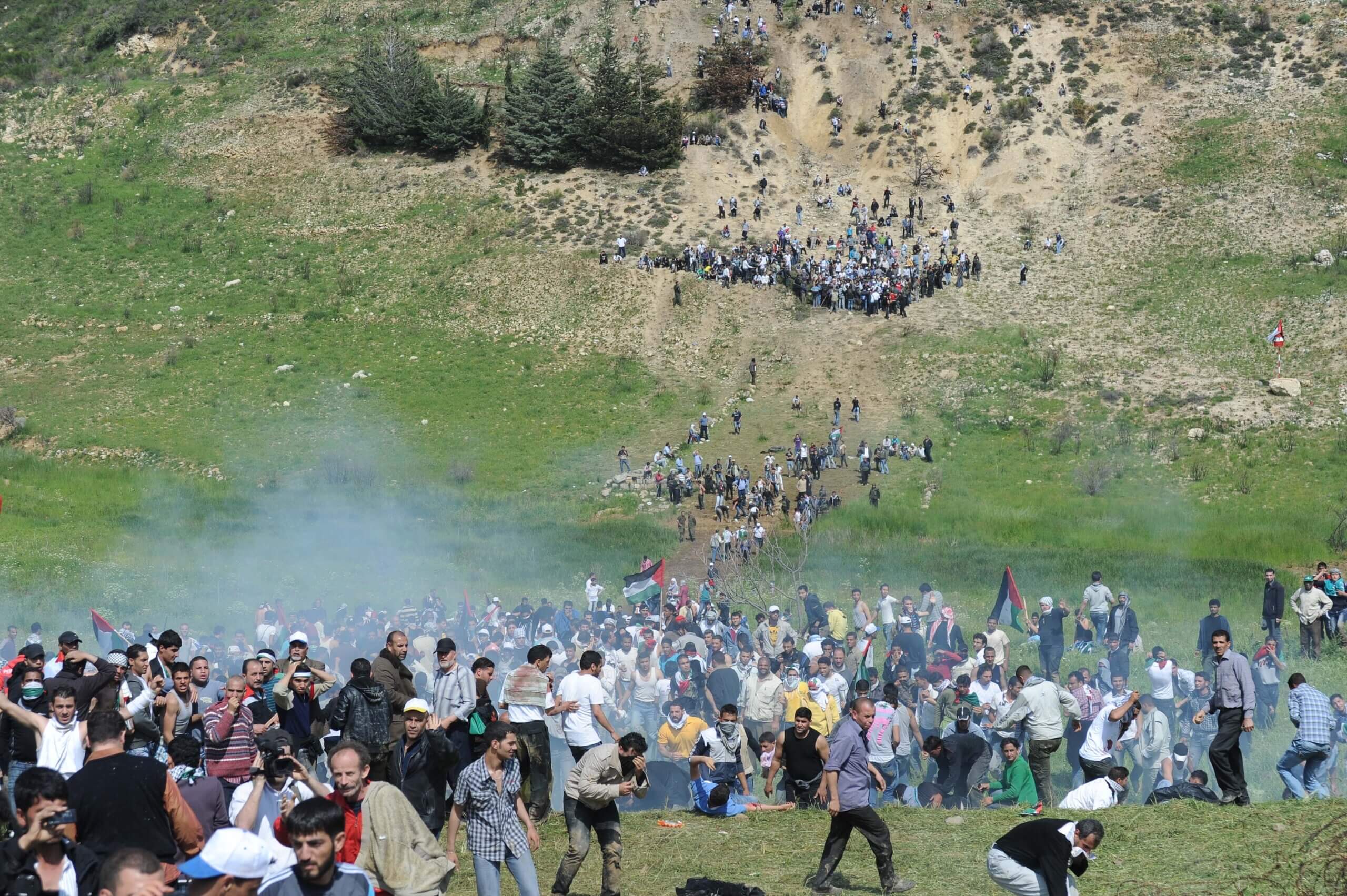
The incident adds credibility to Khalil’s insistence more than a decade later that he would die for Palestine. “This is a tradition of the Palestinian resistance,” Khalil said. “Longing for home.”
But the march was not a neat morality play.
The Palestinian factions inside the Syrian refugee camps — Hamas, Fatah, the Popular Front for the Liberation of Palestine — had tried to stop the march from taking place because they were afraid that Bashar al-Assad’s government was using it as a distraction from mounting protests against his authoritarian rule.
A few weeks later, a similar march took place with even deadlier results. Israeli soldiers killed 22 demonstrators, sparking a Palestinian uprising in the Syrian camps that targeted their own leadership for playing into Assad’s hands and ultimately spurred a crackdown that forced Khalil to flee to Lebanon.
It was there, around the time he graduated from the American University in Beirut, that Khalil began to wonder whether he had been indoctrinated into his political beliefs about Israel.
“Growing up I was baffled by why this was happening to us — like, it’s clear this is our home, we did not do anything wrong — why were we exiled from our home?” he said.
And so Khalil began spending time in pro-Israel chatrooms on Clubhouse, a short-lived audio-only social media platform, and scrolling through Zionist discussion boards on Reddit.
“I started going into these conversations and just understanding why Israelis felt so strongly about Israel — the same way we feel so strongly about Palestine,” he said. “One of the points that caught my attention was the miscommunication and misunderstanding about what we are, and who we are, and who they are.”
Khalil suggested this lack of knowledge fueled a fear of Palestinians and the movement he participated in.
“People think that we want to drive all Jews to the sea,” he said. “We don’t believe that.”
Conflicting messages
It wasn’t always clear to outsiders what the campus protests following Oct. 7, including those at Columbia, were actually about.
The first set of demands from Students for Justice in Palestine and Jewish Voice for Peace chapters at Columbia were relatively narrow: That Columbia’s senior administrators apologize for official statements about Oct. 7 that did not mention Palestinians, “divest from companies profiting from Israeli apartheid” and end the school’s partnership with Tel Aviv University.
But these calls received far less attention than the statement the two groups released days after the Hamas attack lauding it as an “unprecedented historic moment for the Palestinians of Gaza” and a “counter-offensive against their settler-colonial oppressor.”
The protests often ran along these two tracks: The formal demands directed at university leadership, and the rhetoric and posturing that accompanied those demands.
Some of the students recognized that the inflammatory slogans and tactics could work against the movement. Especially after the first tent encampment started in April, fissures began to develop. Some participants — including Khalil, who emerged as a mediator between demonstrators and the administration — called for a more measured approach, while others wanted to aggressively escalate. “One of the reasons I was chosen to negotiate on behalf of these students is because I’m more pragmatic,” Khalil told Hasan Piker during a July livestream. “I can meet you in the middle.”
“There were maybe some bad actors who believed only in the theory of resistance — and believed themselves to be part of it — while Palestinians were like, ‘No, it doesn’t work this way.””
On divisions within the protest movement at Columbia
These divisions were often invisible on the outside. Everyone at the encampments was facing pressure from university administrators, who repeatedly called police to sweep the areas and arrest students, and from outside organizations that sought to identify and blacklist them as antisemites.
Even when students thought some of their peers had gone too far, the impulse was to circle the wagons rather than be seen as giving ammunition to enemies of the protest movement.
For instance, Khalil maintained that the slogan “globalize the intifada” was unproductive. “I don’t use it just because — to me, my goal at Columbia is to get it to divest,” he told Piker. But even now, he is careful to explain that it’s not intended to invoke violence and that he would never discourage others from using it.
“Even if the students used a normal word like globalize the ‘uprising’ they would receive the same sort of backlash,” Khalil said in our interview. “The point is not about their slogan, the point is about silencing them.”
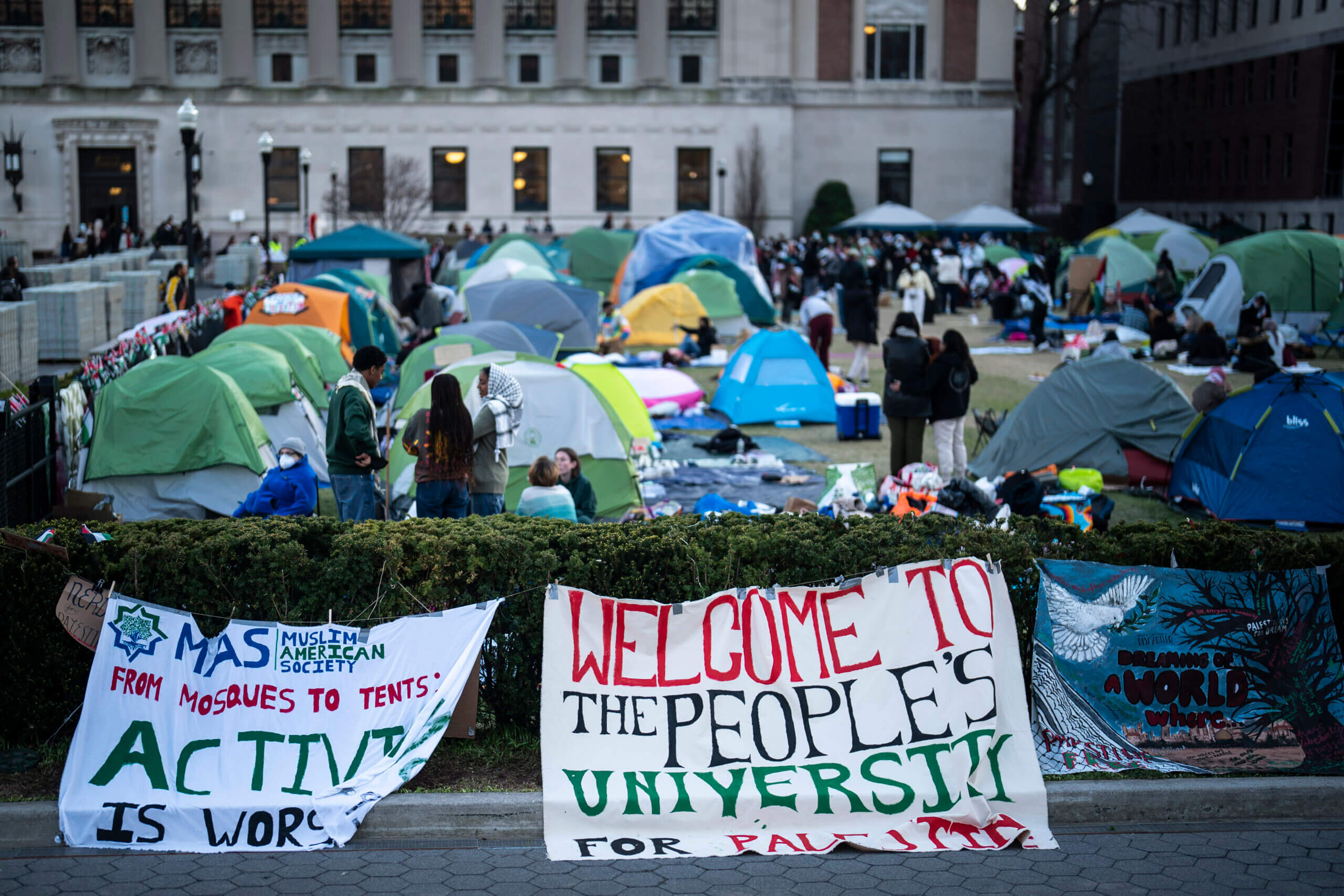
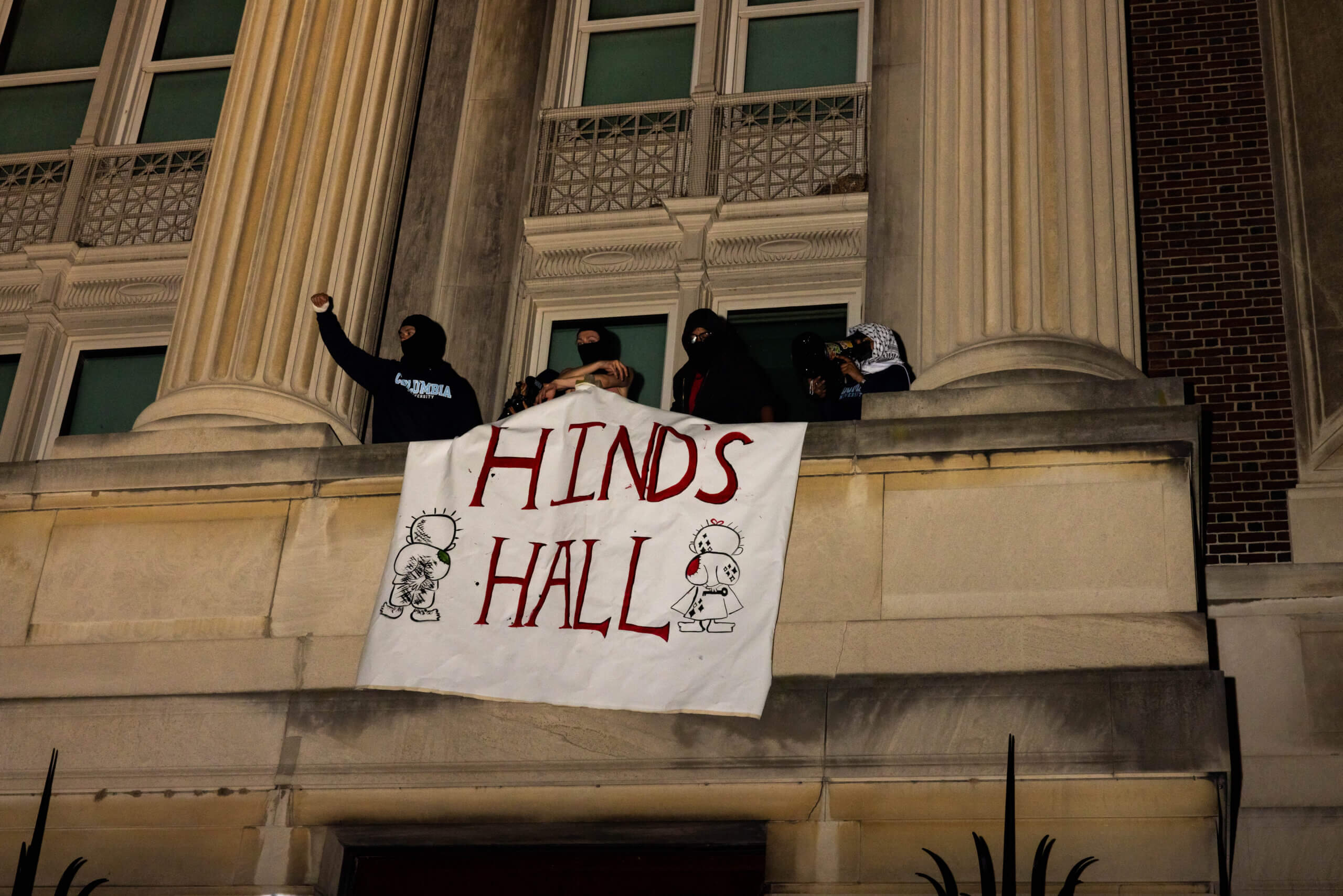
But cracks began to show the following school year. A few days after the first anniversary of Oct. 7, a group of Palestinian students broke away from Columbia University Apartheid Divest, the coalition that had organized the encampments. “We refuse to have our liberation dictated for us,” the anonymous organizers wrote in the Columbia Spectator. “We refuse to allow anyone to speak over us.”
The article also included a veiled swipe at the increasingly cavalier attitude some participants in the movement had been taking toward violence against Israeli civilians. It said the new group supported armed resistance against Israel under two specific provisions of international law but that “equally and firmly, we wholeheartedly disavow any violence outside of this context.”
Maryam Alwan, a Palestinian-American undergraduate at Columbia who had been a leader of Students for Justice in Palestine, unleashed on CUAD in an interview last month with The Blue and White, a student magazine on campus.
“They started making these crazy-ass posts,” Alwan said, referring to their Instagram account. She referred to Khymani James, the student who had said the school should be “grateful that I’m not just going out and murdering Zionists” as an “opp,” slang for enemy.
Alwan said that she and the other Palestinian students at the encampment had opposed the occupation of Hamilton Hall, in which demonstrators smashed glass door panes and two janitors said they were assaulted before police swept the building and arrested 44 people, but that they’d been ignored before being asked to defend the occupation to reporters.
The leadership of CUAD became increasingly centralized and extreme in part because students that Columbia had suspended pending expulsion — already, in many cases, those willing to take the most radical actions — now had more time for activism as other members became turned off by the organization’s direction and went back to their studies. “Anyone who could’ve talked them down was gone,” said Alwan, who described herself as being close friends with Khalil.
Khalil’s role in CUAD has been hotly contested as part of his legal case. The government accused him of failing to disclose membership in CUAD on his green card application, but the group had no formal members and Khalil’s lawyers have argued that he served as a negotiator on behalf of student protesters rather than as a representative of the coalition itself.
Either way, he is more forgiving than Alwan and emphasized that many of the students involved were teenagers who suddenly found themselves at the center of an international news story. But he has also said the occupation of Hamilton Hall was not the right move and that he was barred from entering the building while it was occupied.
“There were maybe some bad actors who believed only in the theory of resistance — and believed themselves to be part of it — while Palestinians were like, ‘No, it doesn’t work this way,’” Khalil said. “A lot of them had only read the literature of the Palestinian struggle, rather than living within it.”
The Hamas question
Khalil made headlines for declining to condemn Hamas during interviews following his release, arguing that the question represented “selective outrage” and was unfairly directed toward Palestinian activists.
He has also said that, while he is opposed to any violence against civilians, he cannot dictate what Palestinians who experience Israeli human rights abuses should do. “To them, it’s not about supporting Hamas, it’s about resisting the occupation, resisting the status quo, resisting the injustices, resisting the killing,” he said during our interview. “All of that pushed people toward any resistance to Israel: ‘Whether it’s Hamas or anyone else, we want to resist Israel.’”
But in his most detailed public comments about Hamas itself, Khalil told me that the organization is “not up to the Palestinian aspiration for liberation.”
“Hamas came to power as a result of Israel’s concerted effort to delegitimize the PLO,” Khalil said, referring to the Palestinian Liberation Organization controlled by Fatah, which continues to rule Palestinian areas in the West Bank. “The Netanyahu government was allowing funding for Hamas because they see it as a way to maintain the division within the Palestinian political sphere.”
(Netanyahu’s working relationship with Hamas has been widely reported.)
Khalil, who is Muslim, added that his personal faith and politics did not align with Hamas. “I come from a family that doesn’t believe in political Islam,” he said. “You have to separate between these two.”
More broadly, Khalil argued that most of the grassroots support for Hamas that does exist among Palestinians came about because Israel had eliminated the organizations that could pose a serious threat to its power while failing to deliver on the promise of the Oslo Accords.
“When you have the PLO, who signed the Oslo agreement — agreeing to 22% of the land, yet you see Israel continuing its settlements, blocking any attempts for the realization of Palestinian statehood — that pushed people to think, ‘This is not working,” Khalil said. “So you’re left with Hamas.”
Khalil cautioned that the support some participants in the student movement expressed for Oct. 7 and occasionally for Hamas itself — embracing the inverted red triangle symbol used in Hamas propaganda videos, for example — did not mean they believed in the organization’s ideology.
“There should be a distinction between supporting legitimate armed resistance and supporting Hamas.”
On allegations that pro-Palestinian activists support Hamas
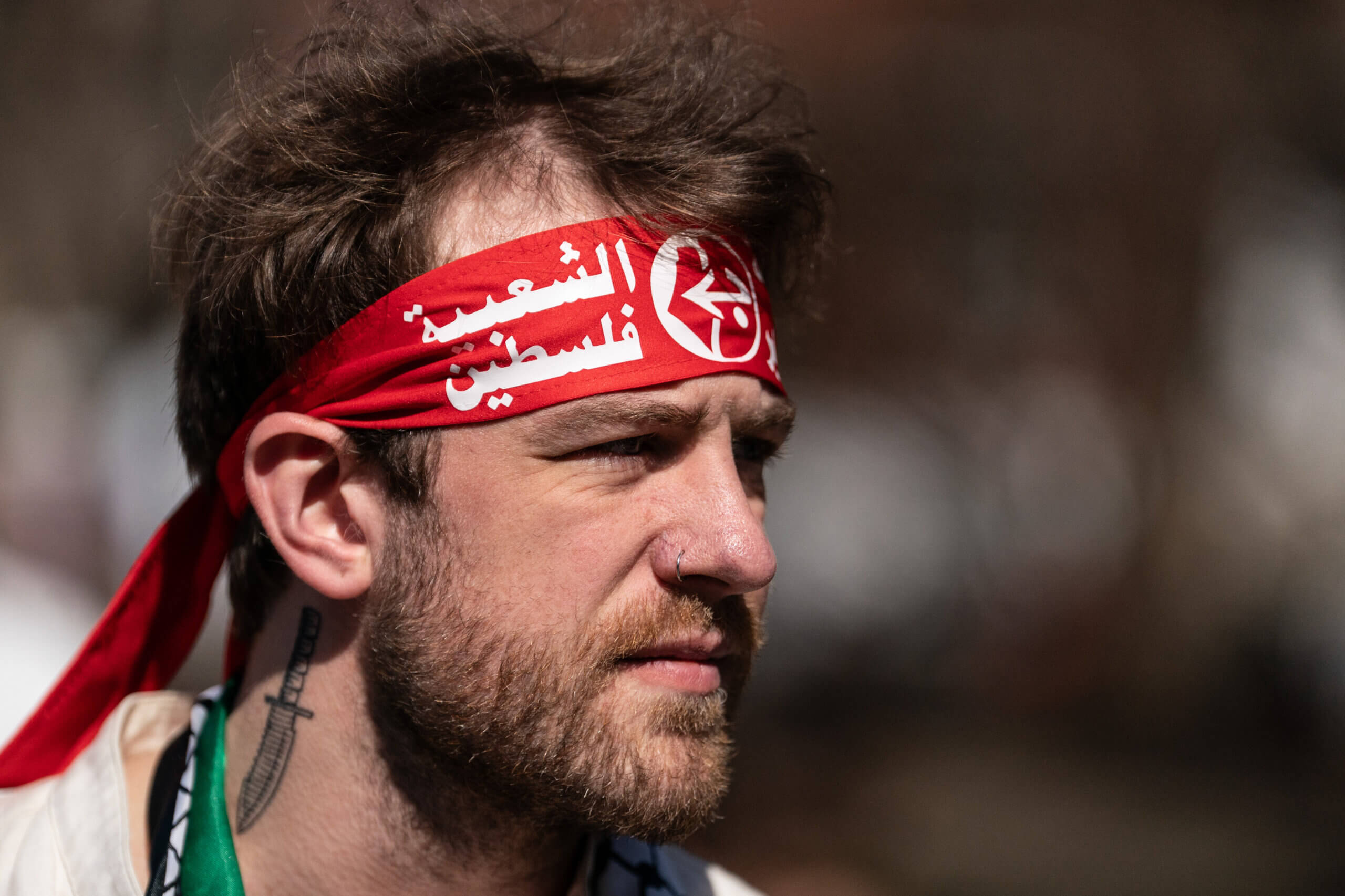
“A big part of this movement is LGBTQ, and of course they don’t support Hamas,” he said. “That’s why you see a lot of PFLP affection in this country just because it’s the left-iest organization carrying out armed resistance.”
(The Popular Front for the Liberation of Palestine is a Marxist organization that has faded in relevance since the 1990s but operates a militia that participated in the Oct. 7 attacks alongside Hamas.)
“There should be a distinction between supporting legitimate armed resistance and supporting Hamas,” Khalil said.
The question of what armed resistance is “legitimate” is one that has divided pro-Palestinian activists.
Some of the most radical voices argue that Jewish civilians in Israel are acceptable targets because they can be called to serve in the Israeli military, or because as settlers on ostensibly stolen land they do not deserve any expectation of safety. Others simply state that Palestinians have a right to resist “by any means necessary.”
Khalil, like the Palestinian student breakaway group at Columbia, is adamant that targeting civilians is unacceptable. “I grew up in a community that valued human rights and valued principles beyond religion, beyond race,” he said. “I would never, in any context, justify the killing of a civilian for any reason.”
Those who support the right of Palestinian armed resistance, but oppose violence against civilians, generally point to provisions of international law that say national liberation movements may use force against countries that deny them independence while remaining subject to the laws of war. “In short: Right to resist, including armed resistance: Yes. Right to indiscriminately kill or target civilians: No. It’s as simple as that,” Ihsan Adel, the founder of Law for Palestine, wrote in the aftermath of Oct. 7.
Many pro-Palestinian activists see the events of Oct. 7 very differently than most American Jews do. Where pro-Israel groups condemned the attacks as an unprovoked act of brutality, most pro-Palestinian organizations portrayed them as a reaction to the tight Israeli control of travel and trade into Gaza since it withdrew from the territory in 2005 and its killing of more than 4,000 Palestinians during four major military operations over that time period. Many student demonstrators also expressed skepticism about the extent to which the violence targeted Israeli civilians.
“Hamas, yes, targeted civilians to take them hostage, which is another crime — that doesn’t absolve them of anything like, ‘I want to kidnap them rather than kill them.’ That’s the same, as it turned out later.”
On whether Hamas intended to kill Israeli civilians on Oct. 7
Khalil said there should be an independent and transparent international investigation into Oct. 7, something the Israeli government has generally sought to prevent.
“I wouldn’t say Hamas were saints or angels and did not commit any crimes,” Khalil said. “The fact that civilians were caught up in such violence and the killing means that there were crimes committed, and Hamas has a responsibility for that.”
He demurred when I pressed him on whether he believed the Israeli civilians killed had merely been “caught up” in a hostage-taking operation that also targeted military installations near the Gaza border. “I have no idea, to be honest,” he said.
Khalil referred to the Hannibal Directive, in which the Israeli military can be authorized to kill its own citizens to prevent them from being taken hostage. Haaretz has reported that the protocol was used in several instances on Oct. 7.
“Hamas, yes, targeted civilians to take them hostage, which is another crime — that doesn’t absolve them of anything like, ‘I want to kidnap them rather than kill them.’ That’s the same, as it turned out later,” he added.
But while it’s true that Israel has interfered with inquiries into Oct. 7, Khalil’s insistence that it is impossible to know whether Hamas targeted civilians overlooks that several independent investigations have found that it did.
Amnesty International concluded that Hamas and other Palestinian armed groups “were part of a systematic and widespread assault against the civilian population,” while Human Rights Watch determined that Hamas and its allies “bear responsibility for the worst abuses” committed during the attack.
“I wouldn’t rule out that Hamas targeted civilians, but I wouldn’t confirm it either,” Khalil said. “That’s my position on this.”
Seeking a ‘utopia’
The recent and dramatic shift in American attitudes on the Israeli-Palestinian conflict make it hard to imagine that the U.S. government will be able to maintain its longstanding policy of ironclad support for Israel in the years ahead.
Influential Republicans like Tucker Carlson and Marjorie Taylor Greene have described Israel as a major burden for the U.S. and suggested that the Trump administration should wash its hands of the conflict, withdrawing military and diplomatic support rather than conditioning it on a solution.
But on the left, the question is whether the U.S. should demand a two-state solution that would preserve a Jewish majority in Israel while creating a new Palestinian state in most of the West Bank and Gaza, or press for something more radical: a “free Palestine,” an aspiration that is often left undefined.
Khalil is firmly in the latter camp.
“It’s too late to tell people like, ‘Go back to Poland, go back to Russia’ or wherever.”
On Jewish concerns about the implications of anti-Zionism
He is adamant that preserving a Jewish majority in the 1948 borders of Israel is a nonstarter. “I don’t think this framework is realistic. We would still end up in the same vicious cycle of violence that we are in right now,” he said.
That rules out cooperation with organizations like J Street, the liberal Zionist advocacy group that has called for limits on American military aid to Israel and pushed for policies that would compel the Israeli government to grant Palestinian statehood.
“J Street takes everything from a lens of Israel’s security, or a lens of Jewish security, not from a lens of human rights for everyone,” Khalil said. “They want a two-state solution because that’s better for Israel, not because that’s better for the Palestinians.”
He added: “We should fight against this.”
Jeremy Ben-Ami, J Street’s president, said in a statement that Khalil’s “characterization was incorrect” and that his organization is “grounded in a commitment to the equal rights, dignity, and security of both Israelis and Palestinians.”
This is more than a simple policy debate. One of the main reasons that some Jews found the campus protest movement to be antisemitic was because they felt that demonstrators were hinting, if not outright stating, that Jews needed to be purged “from the river to the sea.”
Khalil recognized that for many Jews the vehement opposition to the encampments was rooted in this fear, and emphasized that he rejects any solution based on “driving anyone out of the place that they were born in,” including Israeli Jews.
“It’s too late to tell people like, ‘Go back to Poland, go back to Russia’ or wherever,” he said.
He said that a “free Palestine” means a democratic country — or multiple countries — with equal rights for all citizens, and the right for Palestinian refugees and their descendants to return to the land from which they fled or were expelled during Israel’s War of Independence.
“Anyone fearing persecution can live in that country without fear,” he said. “I know it might sound like a very ideal utopia, but this is what we should aspire for: to get a place where there’s no more conflict, no more killing in that place and it’s open to anyone who wants to call it their home or their Holy Land.”
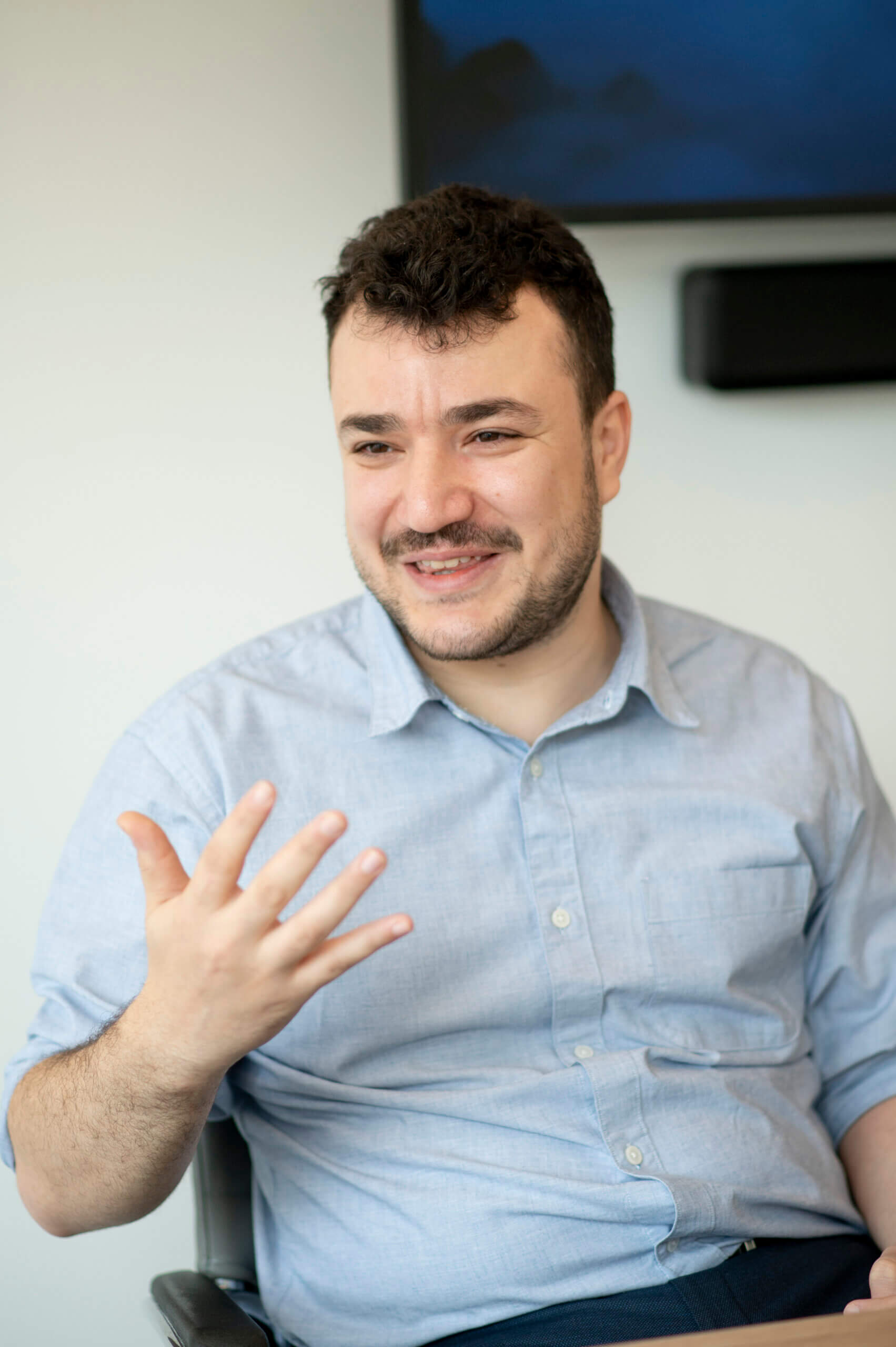
Another concern among many Jews, including Jewish college students who did not participate in the demonstrations, was that protesters were quick to ostracize anyone who did not wholeheartedly support this vision of a liberated Palestine.
Khalil has described Zionism as “very, very racist,” and suggested a “Jewish and democratic” state is a logical fallacy because a democracy cannot elevate one group over its other citizens.
Yet he has also proven sympathetic to Jewish claims to the land and recommended My Promised Land, the liberal Zionist history of Israel by journalist Ari Shavit, during his appearance on Ezra Klein’s New York Times podcast. “A lot of Jewish people subscribe to the idea of Zionism because of the fear of persecution,” he told me. “I have a nuanced view of the Zionist project that goes beyond ‘Zionism is bad’ — no, there are different layers to that project that unfortunately aren’t being seen across the Arab world or among Palestinians.”
Khalil said that many of his Jewish friends began as Zionists but changed their views over time, something he believes will need to happen more in order to achieve the right of return for Palestinian refugees, and a system of equal rights across Israel, the West Bank and Gaza. “Palestinians don’t have the power to make this happen,” Khalil said during an event with journalist Peter Beinart in November. “It’s the Jewish community — whether inside or outside of Israel — that can influence that.”
And despite blaming the Israeli government for conflating itself with Jews, Khalil said his movement had an obligation to root out bigotry. “Some anti-Zionist actions may touch on antisemitism that we absolutely oppose and don’t want and need to be educated about,” Khalil said, adding that he believes the protest movement did a good job of keeping this at bay.
Khalil said that, for the same reason, he is wary of growing far-right wing opposition to Israel among figures like Nick Fuentes and Candace Owens who mix a generalized hostility for Jews with dovish positions on American foreign policy.
“A lot of it is coming out of antisemitism, not out of support for Palestinian rights,” he said. “As someone who is taking a rights-based approach — a principled approach — I have to be careful that I don’t ally with people who are not genuine about their support.”
A mistake — or a message?
The tentative reaction to Khalil’s arrest by some leading Democrats and major Jewish organizations suggested a belief that some evidence was going to emerge that showed he was part of the most radical vanguard at Columbia.
That never happened.
“When the administration started with the smears, they did not provide any evidence or any quotes from me,” he said. “But people believed them because I’m Palestinian and I’m an Arab man named Mahmoud so that alone means you’re guilty.”
Canary Mission, which compiles blacklists of activists it considers to be antisemitic, only managed to find a quote in which he said that armed resistance was legitimate under international law.
Khalil’s case continues to work its way through the legal system and he could still be deported. But once it became clear that Khalil was prepared to condemn antisemitism and avoid inflammatory rhetoric, the image that the White House sought to paint of him seems to have fallen flat.
David Lederer, a pro-Israel student activist at Columbia, lamented in a video he shared on social media that the media “fell in love” with Khalil, while Nerdeen Kiswani, founder of Within Our Lifetime, who holds more strident views and was the recent target of a foiled alleged assasination plot, referred to him as the “perfect victim”: “A green card holder, top student, with no criminal record or radical affiliations.”
A poll of Jewish voters taken the month following Khalil’s arrest found that only 20% believed that arresting and deporting pro-Palestinian protesters would reduce antisemitism.
But there are other ways of understanding Khalil’s arrest.
One is that it was meant to send a message, as part of a larger Trump administration crackdown, that nobody who participated in the protests should feel safe.
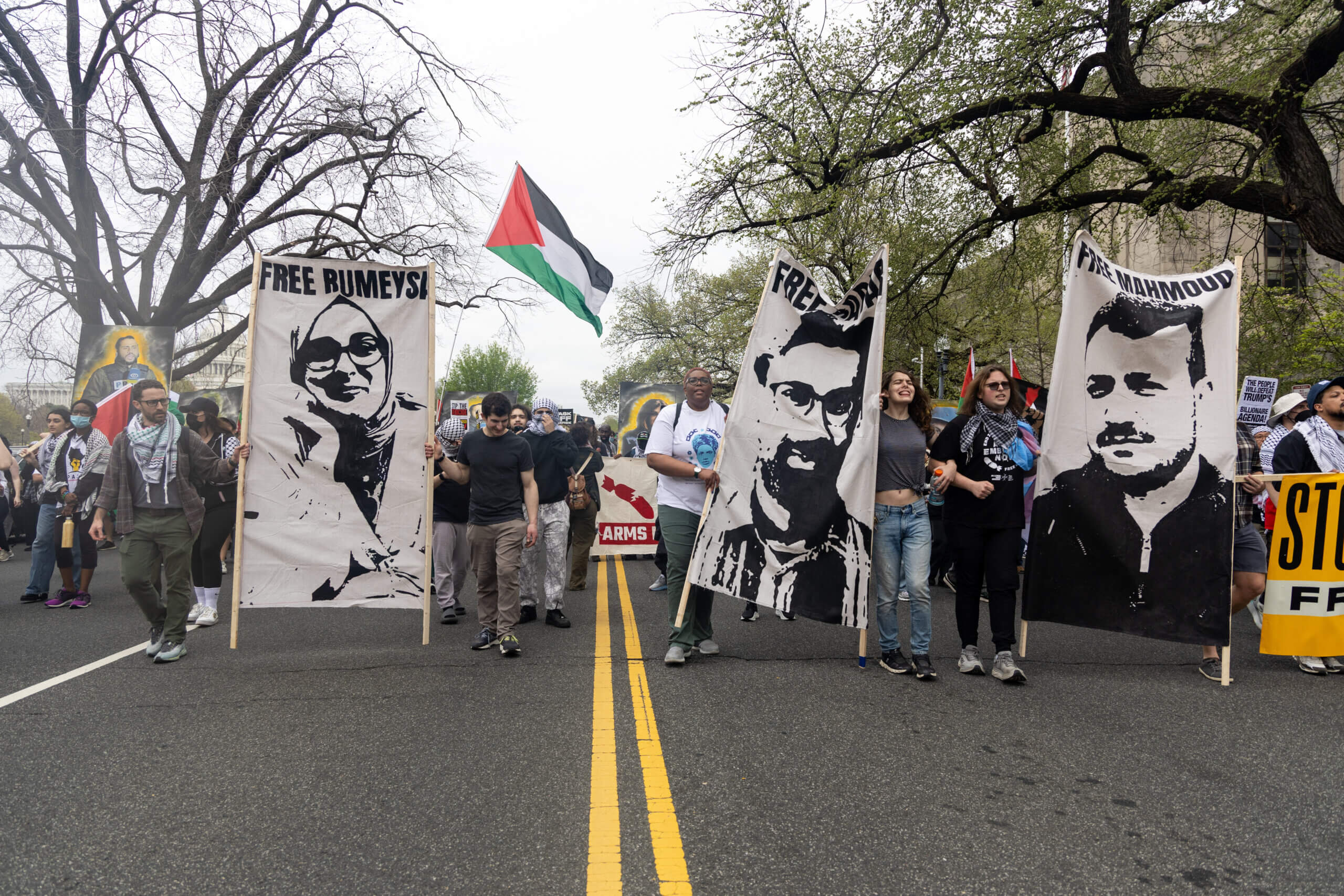
After Khalil was arrested, immigration agents also detained Leqaa Kordia and Mohsen Mahdawi, two other international students who had participated in the Columbia protests, Rümeysa Öztürk, a Turkish graduate student at Tufts University who had written an op-ed critical of Israel, and Badar Khan Suri, an Indian Georgetown researcher. The arrests were part of a sweeping crackdown that ultimately resulted in the State Department canceling more than 800 student visas, though not all were targeted for political reasons.
The government has struggled to keep those it arrested in detention and Kordia, Mahdawi, Öztürk and Khan Suri have since been released — Kordia just last week — though the Justice Department is still seeking to deport Kordia, Khalil and Mahdawi.
“It felt like we were being hunted,” Alwan, the Columbia undergraduate student leader, told The Blue and White. “Even as a U.S. citizen, I was scared because it felt like we had exited the realm of law and logic.”
Khalil thinks something else was at play.
He believes the government was incompetent and did not understand that some protesters were more radical — and easier to paint as threats to national security — than others, and may have erred in turning him into something of a poster child for the movement.
But he believes the pro-Israel groups that targeted him online, and encouraged the Department of Homeland Security to deport him, realized that it was the very nature of his moderate brand of anti-Zionism that made him a threat.
“It was very malicious and very targeted,” Khalil said. “They did not want someone who can actually present a viable solution where everyone can live in peace.”
The post Mahmoud Khalil wants to reassure you appeared first on The Forward.
Uncategorized
Contributor to Drop Site News Says Israelis Should ‘Be Removed From Our Planet’

Abubaker Abed reporting from Gaza. Photo: Screenshot
Abubaker Abed, a self-described Palestinian journalist and contributor to the far-left news outlet Drop Site News, has come under intense scrutiny following the circulation of social media posts in which he called for the “wiping out” of Israel and said that Israelis “mustn’t feel safe.”
The remarks, which quickly spread across multiple online platforms, have prompted widespread condemnation and renewed skepticism over the credibility and coverage of Drop Site News, a controversial publication fiercely critical of Israel and US foreign policy in the Middle East.
“Wiping out Israel off the planet is not enough revenge. Israelis mustn’t feel safe anymore. Haunt them and go after them where they go. These terrorist parasites must be removed from our planet,” Abed posted on an Instagram story.
Drop Site co-founder Ryan Grim responded to the incident by clarifying that Abed’s comments do not reflect the editorial position or institutional stance of his publication. Grim, a far-left investigative reporter who has repeatedly accused Israel of committing “genocide” in Gaza, did not condemn the statements by Abed.
“We also are never going to police the language of anyone who survived a genocide,” Grim posted on X.
Abed, a social media influencer from Gaza who evacuated to Ireland during the Israel-Hamas war, has previously suggested that attacks on Jewish institutions might be justified if they signal support for Israel.
Following the recent attack on the Temple Beth Israel Synagogue in Michigan, Abed resurfaced a photo from the synagogue featuring an Israel soldier. Abed wrote that the attempted mass casualty event was justified because the assailant defended himself.
“A person is not criminally responsible if they act reasonably to defend themselves against an imminent and unlawful use of force,” Abed wrote in a since-deleted post on X. “Israel murdered his relatives and is illegally bombing and invading his country.”
The FBI said last week that the attack on the largest Jewish temple in Michigan was an “act of terrorism” inspired by Hezbollah, the Iran-backed Lebanese terrorist group committed to Israel’s destruction.
Drop Site, a new media organization which debuted in July 2024, has found itself under immense criticism over its coverage of the Israeli-Palestinian conflict and the broader Middle East. The outlet has consistently characterized Israel as a “genocidal” aggressor stoking chaos and violence throughout the region.
Meanwhile, Drop Site depicts internationally recognized terrorist groups such as Hamas, Hezbollah, and the Houthis in a far more favorable light. Drop Site lead reporter Jeremy Scahill routinely refers to Hamas as “the resistance” and has given softball interviews to Hamas leaders.
Drop Site has also defended the Iranian regime from accusations of terrorism, asserting that Tehran’s goals “center on national sovereignty.” The site contends that Iran has “sought to project influence regionally through allied governments and forces (Hezbollah, Hamas, Houthi, Iraqi Militants, etc.) what’s often called the ‘Axis of Resistance.’”
Some observers have raised alarm bells over the outlet’s growing popularity among establishment mainstream liberals. Ben Rhodes, a former Obama administration official and co-host of the popular “Pod Save America” podcast, has praised the outlet on his social media profile and confirmed he is a subscriber.
Drop Site’s expanding influence does not seem to be confined to left-wing or liberal ideological circles. Right-wing media personality Mike Cernovich contended on X that young conservatives are increasingly reading Drop Site “for Israel news.” Joe Kent, the former director of the US National Counterterrorism Center, over the weekend reposted a Drop Site article pushing Iranian regime propaganda falsely claiming the US was actually trying to kill a downed American airman — just hours before he was dramatically rescued.
Uncategorized
Frankfurt cinema declines to participate in Jewish film festival, spurring backlash
(JTA) — A Frankfurt cinema’s decision not to participate in the local Jewish film festival is spurring allegations of antisemitism, even as its manager says the move was financial.
The Jewish Community of Frankfurt announced last week that the Astor Film Lounge did not wish to host movies during Jewish Film Days this year. The cinema, it said, had cited its workers’ reluctance to staff movies that are part of the biennial festival, as well as concerns about the security required to host Jewish events.
“The decision unequivocally signifies that Jewish life, Jewish people, and a Jewish media presence are no longer welcome at the Astor Film Lounge,” the community said in a statement.
“This line of reasoning is not only disappointing, but sends a devastating societal signal: If Jewish life and Jewish presence are suppressed out of fear of potential reactions, then this effectively amounts to a capitulation to antisemitic pressure,” the statement continued. “The fact that Jewish life can only take place under police protection is already shameful. That this necessity for police protection is now being used as a pretext to completely prevent Jewish events is a scandal.”
But the cinema’s managing director, Tom Flebbe, contested the Jewish Community of Frankfurt’s interpretation of events. In a statement cited in a leading local newspaper, he said the theater had withdrawn this year for economic reasons, as only 40 to 50 guests had come to screenings last year.
Flebbe said a lower-level manager had made unauthorized and inaccurate remarks about security concerns.
“Economic viability is a legitimate and necessary basis for business decisions — regardless of the thematic context of an event,” Flebbe said, adding that other joint projects with the Jewish community will continue as planned.
“The ASTOR Film Lounge MyZeil views Jewish life as a natural and welcome part of this society,” the statement concluded. “The decision against participating in the 2026 Jewish Film Days is not against Jewish people, Jewish culture, or Jewish presence. It is the result of a careful consideration of economic factors. We regret that our reasoning has been interpreted in this way and stand by our decision.”
During the 2024 festival, a half-dozen venues hosted screenings as part of Jewish Film Days. The Astor Film Lounge hosted one screening, of the film “March ’68,” a love story set during the Polish government’s antisemitic campaign following Israel’s Six-Day War.
Film festivals have emerged as a frontier for tensions over Israel and antisemitism. Germany’s largest film festival, the Berlinale, was roiled by tensions this year as its jury head fended off calls to criticize Israel. A major Toronto film festival, meanwhile, ruffled feathers last year by first canceling and then screening a documentary about the Oct. 7 attack on Israel. And a Jewish film festival was canceled in Malmo, Sweden, last year because too few cinemas would agree to show movies for it.
Flebbe’s explanation for why Astor Film Lounge would not participate in this year’s Jewish Film Days did not satisfy everyone who heard it. The Berlin-based German-Jewish Values Initiative, a non-partisan think tank, in an open letter called the economic justification a “mere pretext.”
“To the best of our knowledge, the Jewish Community of Frankfurt was prepared to guarantee a minimum revenue” for the film festival, the letter said. By apparently giving in to “threats and antisemitic pressure,” it added, the cinema has capitulated “to the very forces seeking to drive Jews out of the public sphere.”
The post Frankfurt cinema declines to participate in Jewish film festival, spurring backlash appeared first on The Forward.