



Uncategorized
Trump Says He Is Likely to Reject Peace Proposal as Iran Has ‘Not Yet Paid a Big Enough Price’

Ships and boats in the Strait of Hormuz, Musandam, Oman. Photo: May 1, 2026. REUTERS/Stringer
US President Donald Trump said that he had yet to review the exact wording of a new Iranian peace proposal but he was unlikely to accept it, because the Iranians had not yet “paid a big enough price.”
Trump’s remarks on social media concluded a day in which he publicly mused about the possibility of restarting airstrikes, the latest mixed signal as he seeks to end the war he launched more than two months ago.
On Sunday, Israel ordered thousands of Lebanese to leave villages in southern Lebanon, an escalation of a war between Israel and Iran’s Hezbollah allies that has run in parallel to the Iran war and could further complicate wider peace efforts.
Iran has said talks with Washington cannot resume unless a ceasefire also holds in Lebanon, which Israel invaded in March to attack Hezbollah after the Iranian-backed Lebanese group fired across the border in support of Tehran.
Lebanon and Israel agreed to a separate truce last month, but fighting has continued, though on a smaller scale. The Israeli military issued an urgent warning on Sunday to residents of 11 towns and villages in Lebanon’s south, urging them to evacuate their homes and move at least 3,300 feet away to open areas.
The military said it was conducting operations against Hezbollah following what it described as a violation of the ceasefire, warning that anyone near Hezbollah fighters or facilities could be at risk.
PEACE APPEARS NO CLOSER
The United States and Israel suspended their bombing campaign against Iran four weeks ago, but appear no closer to a deal to end a war that has caused the biggest disruption ever to global energy supplies, roiled global markets and raised worries about the possibility of a wider global economic downturn.
In his post on social media, Trump wrote: “I will soon be reviewing the plan that Iran has just sent to us, but can’t imagine that it would be acceptable in that they have not yet paid a big enough price for what they have done to Humanity, and the World, over the last 47 years.”
On Saturday, a senior Iranian official had said Iran’s proposal would first open shipping in the Strait of Hormuz and end a US blockade of Iran, while leaving talks on Iran’s nuclear program for later.
Though Trump had already said on Friday that he was not satisfied with the Iranian proposal, he said on Saturday he had yet to hear all the details.
“They told me about the concept of the deal. They’re going to give me the exact wording now,” he said. Asked if he might restart strikes on Iran, Trump replied: “I don’t want to say that. I mean, I can’t tell that to a reporter. If they misbehave, if they do something bad, right now we’ll see. But it’s a possibility that could happen.”
IRAN’S PROPOSAL APPEARS TO CONTRADICT WASHINGTON’S DEMANDS
Iran’s proposal to delay talks on nuclear issues until later appears to contradict Washington’s repeated demand that Iran give up its stockpile of more than 400 kg (900 pounds) of highly enriched uranium as a condition to end the war.
Washington says the uranium could be used to make a bomb. Iran says its nuclear program is peaceful but it is willing to discuss curbs on it in return for the lifting of sanctions, as it accepted in a 2015 deal that Trump abandoned.
Reuters and other news organizations have reported over the past week that Tehran was proposing to reopen the strait before nuclear issues were resolved. The senior Iranian official confirmed that this new timeline had now been spelled out in a formal proposal conveyed to the United States through mediators.
While saying repeatedly he is in no hurry, Trump is under domestic pressure to break Iran’s hold on the strait, which has choked off 20% of the world’s oil and gas supplies and pushed up US gasoline prices. Trump’s Republican Party faces the risk of a voter backlash over higher prices when the country votes in midterm congressional elections in November.
Iranian media said Tehran’s 14-point proposal included the withdrawal of US forces from areas surrounding Iran, lifting the blockade, releasing Iran’s frozen assets, payment of compensation, lifting sanctions and ending the war on all fronts, including Lebanon, as well as a new control mechanism for the strait.
Iran has been blocking nearly all shipping from the Gulf apart from its own for more than two months. Last month, the US imposed its own blockade of ships from Iranian ports.
Speaking on condition of anonymity to discuss confidential diplomacy, the senior Iranian official said Tehran believed its latest proposal to shelve nuclear talks for a later stage was a significant shift aimed at facilitating an agreement.
“Under this framework, negotiations over the more complicated nuclear issue have been moved to the final stage to create a more conducive atmosphere,” the official said.
Uncategorized
Israel Court Extends Detention of Gaza Flotilla Activists
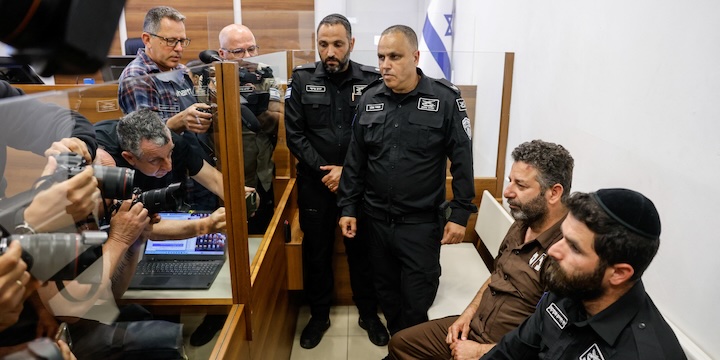
Activist Saif Abu Keshek, a member of the Global Sumud Flotilla detained by Israel, sits at a magistrate’s court for a detention extension hearing in Ashkelon, southern Israel, May 3, 2026. REUTERS/Amir Cohen
An Israeli court has extended by two days the detention of two activists arrested aboard a Gaza-bound flotilla that was intercepted by Israeli forces in international waters near Greece, their lawyer said on Sunday.
Saif Abu Keshek, a Spanish national, and Brazilian Thiago Avila were detained by Israeli authorities late on Wednesday and brought to Israel, while more than 100 other pro-Palestinian activists aboard the boats were taken to the Greek island of Crete.
A court spokesperson confirmed that their remand had been extended until May 5.
The governments of Spain and Brazil issued a joint statement on Friday calling their detention illegal.
The activists were part of a second Global Sumud flotilla, launched in an attempt to break Israel’s blockade of Gaza by delivering humanitarian assistance. The ships had set sail from Barcelona on April 12.
Israeli authorities requested a four-day extension of their arrest on suspicion of offenses that include assisting the enemy during wartime, contact with a foreign agent, membership in and providing services to a terrorist organization, and the transfer of property for a terrorist organization, said rights group Adalah, which is assisting in the activists’ defense.
Hadeel Abu Salih, the men’s attorney, said that the two deny the allegations. Their arrest was unlawful due to a lack of jurisdiction, she told Reuters at the Ashkelon Magistrate’s Court after the hearing, adding that the mission was meant to provide aid to civilians in Gaza, not to any militant group.
Abu Salih said that Abu Keshek and Avila were subjected to violence en route to Israel and kept handcuffed and blindfolded until Thursday morning.
Asked for comment, the Israeli military referred Reuters to the Israeli foreign ministry, which said that staff were compelled to act to stop what it described as violent physical obstruction by Abu Keshek and Avila. All measures taken were lawful, it said.
Uncategorized
Israel Initiates Project to Counter Drone Threats in Sweeping Military Upgrade Plan

Israeli Prime Minister Benjamin Netanyahu participates in the state memorial ceremony for the fallen of the Iron Swords War on Mount Herzl, Jerusalem on Oct. 16, 2025. Photo: Alex Kolomoisky/POOL/Pool via REUTERS
i24 News – Israel is moving forward with a new initiative to counter drone threats, as part of a broader strategy to expand military capabilities and reduce reliance on foreign defense suppliers, Prime Minister Benjamin Netanyahu said.
The drone project, ordered several weeks ago, is already in development, with officials preparing to review its initial progress. While details remain limited, the effort reflects growing concern over the increasing use of unmanned aerial systems in regional conflicts.
Netanyahu framed the initiative within a wider defense doctrine centered on “strengthening and independence,” emphasizing the need for Israel to maintain a decisive military edge. He noted that Israel is acquiring two squadrons of advanced fighter jets, including the F-35 Lightning II and the F-15IA, to reinforce its air superiority.
“These aircraft strengthen Israel’s overwhelming air superiority,” he said, referencing recent military operations as evidence of that advantage. He added that Israeli pilots are capable of operating at long range if necessary.
Alongside procurement, the government is planning a major expansion of domestic defense manufacturing. Netanyahu announced that Israel will allocate an additional 350 billion shekels ($95 billion) to the defense budget over the next decade, aiming to produce more of its own armaments and reduce dependence on foreign countries.
He also pointed to future ambitions to develop advanced aircraft domestically, describing the effort as potentially transformative for Israel’s defense industry.
The drone defense program, though still in early stages, is expected to become a key component of this strategy. Netanyahu acknowledged that the project will take time to fully develop but stressed that it is actively being pursued.
Despite the evolving nature of the threats, he reiterated Israel’s long-standing objective of maintaining military superiority across all domains.
Uncategorized
Iran Presents US 3-Step Plan to Move from Ceasefire to End of War

Atomic symbol and USA and Iranian flags are seen in this illustration taken, September 8, 2022. Photo: REUTERS/Dado Ruvic/Illustration/File Photo
i24 News – Iran has reportedly submitted a new draft agreement to the United States outlining a three-stage framework aimed at de-escalating regional tensions and restructuring oversight of its nuclear program, according to reporting from Al Jazeera.
The proposal was allegedly delivered via Pakistan and combines military, maritime, and nuclear commitments with a long-term regional security vision.
The first phase calls for transforming the current ceasefire into a permanent end to hostilities within 30 days, alongside a regional non-aggression pact that would include Iran’s allies and Israel. It also proposes steps such as gradually reopening the Strait of Hormuz, easing maritime restrictions on Iran, and reducing military activity in surrounding waters.
The second phase focuses on Iran’s nuclear program. It reportedly includes a freeze on uranium enrichment for up to 15 years, followed by a return to limited enrichment at 3.6%, in line with earlier international agreements.
The draft explicitly rejects dismantling Iran’s nuclear infrastructure. It also outlines possible arrangements for existing uranium stockpiles, including export or reprocessing, and calls for a structured sanctions relief mechanism tied to compliance milestones.
The final phase envisions broader regional engagement, with Tehran proposing a strategic dialogue between Iran and Arab states to establish a comprehensive security framework across the Middle East.