


Uncategorized
Trump’s pick for surgeon general gets her ‘daily dose of inspiring Kabbalah wisdom’
Casey Means, President Trump’s nominee for U.S. surgeon general, preaches a broad, loosely-defined spirituality that blends ideas such as the “divine feminine,” meditation, and connection with nature. In her email newsletter, she has endorsed practices such as full moon rituals and talking to trees. And, though she was raised Roman Catholic, she has expressed interest in kabbalah, the ancient Jewish mystical tradition focused on esoteric interpretations of scripture and the nature of the soul, the cosmos, and the divine.
In May 2025, she wrote about drawing inspiration from Kabbalah teacher and influencer David Ghiyam to help deal with those who judge her for taking breaks from work to rest and recover during certain phases of the lunar cycle, which she views as essential to “feminine creativity.” She directed her readers to follow Ghiyam “for a daily dose of inspiring Kabbalah wisdom.”
Cathy Heller, a Jewish wellness influencer who preaches mindfulness and manifestation drawing on her studies of Jewish mysticism with rabbis in Israel, told the Forward in a phone interview that Means is a close friend — and often asks her to share wisdom about the Torah and kabbalah.
“She loves it,” Heller said. “She sees such beauty and wisdom in this body of work, and how universal it is and how applicable it is.”
Means’ interest in mysticism expands well beyond kabbalah. In Good Energy, a book she co-wrote with her brother, Calley Means, who works as a senior advisor to Health and Human Services Secretary Robert F. Kennedy Jr., she quotes Rumi, an influential figure in Sufism — the mystical dimension of Islam — and encourages her readers to practice yoga, tai chi, or qigong, try aromatherapy, and consider taking psychedelics. She has also opposed bans on raw milk despite the risk of serious bacterial infections, said more research is needed on a possible link between vaccines and autism, and criticized hormonal contraception as reflecting a “disrespect of life.”
Means’ interest in Kabbalah seems to reflect less a desire to engage in Jewish religious observance than a core belief of the Make America Healthy Again movement: that physical ailments often have underlying spiritual causes, and that tapping into the mind-body connection has the power to heal. Her promotion of kabbalah also represents the further mainstreaming of an ancient practice once reserved for only the most learned of Jewish scholars — repackaged for non-Jewish audiences and finding its way into spaces as unlikely as the U.S. Public Health Service.
“The idea that it’s controversial that we should BOTH trust unbiased scientific information AND our divine intuition is a sign of darkness in our culture,” Means wrote in November 2024.
‘A manifester’
Heller met Means in 2024 through a mutual friend in Los Angeles who hosts sound baths and other wellness events. They now take long walks and hikes together, share meals, and have celebrated several Shabbat dinners.
On one hike in Los Angeles, they came across a rabbi, and Heller says she asked him to offer a teaching. He shared an explanation of why Jacob’s name derives from the Hebrew root for “heel,” saying that Jacob had the capacity to draw the highest consciousness down into the lowest places.
Means “was literally beaming from ear to ear. We both had tears in our eyes,” Heller recalled. “I said, ‘What’s your name?’ And he said, ‘Rabbi Heller,’ which is funny because that’s my last name. And Casey’s like, ‘You’re such a manifester, that’s crazy.’”
In November 2024, Means promoted Heller’s book, Abundant Ever After: Tools for Creating a Life of Prosperity and Ease on her blog.
“Cathy is a goddess friend and her message resonates with me profoundly about how to live a limitless and spiritual life. Abundant Ever After is a transformative guide blending Jewish mysticism, meditation, and practical tools,” Means wrote. “Manifestation is real. Why wouldn’t we want to learn?”
One month later, Means appeared on Heller’s podcast, “Everything is Energy with Cathy Heller,” where she said that meeting Heller felt like “divine timing” and that their relationship was helping her make sense of concepts from Good Energy, including her belief that everything is interconnected.
“This idea that we’re oneness and everything is connected, it’s not a metaphor. It’s not hippie,” Means said on the podcast. “It’s literally truth on the physical, chemical level. And it’s so absent from our paradigm of healing.”
MAHA and religion
Adrienne Krone, a professor at Allegheny University and author of Free-Range Religion: Alternative Food Movements and Religious Life in the United States, sees a direct connection between the MAHA movement and religious ways of thinking about food, health and the body.
She said that the internet has accelerated a broader shift in wellness culture and its relationship to spirituality. On social media, mystical teachings can often be mistranslated and blended together, she said, sometimes losing their original cultural context.
“Some of what’s going on is people are picking up other religious ideas, other secular ideas, scientific research, and they bring it all together,” Krone said. “That’s what forms their understanding of what they’re supposed to eat, how they’re supposed to treat their bodies, what kinds of extra exercise regimens they should be doing. And so it doesn’t surprise me that Casey Means has this kind of collection of ideas that are more accessible than they used to be.”
Still, Means’ spirituality seems to be an outlier among the traditional Christian conservative worldview touted by most of Trump’s other nominees. Her calls to “EMBRACE THE ‘WOO WOO’” and engage in various spiritual ceremonies have drawn the ire of some activists, including conservative talk radio host Erick Erickson, who critiqued Means as “a near Wiccan” who has “dabbled in occult practices that amount to witchcraft.”
Two Republican senators, Susan Collins of Maine and Lisa Murkowski of Alaska, have not yet committed to vote “yes” on Means’ confirmation, and pressed Means at her confirmation hearing about her stance on vaccines and past use of psychedelic mushrooms.
If confirmed as the nation’s top doctor, Means has signaled that spirituality will play a significant role in how she approaches the position.
“I do believe that Americans are ready to hear about spirituality when it pertains to medicine,” Means said at her confirmation hearing.
The post Trump’s pick for surgeon general gets her ‘daily dose of inspiring Kabbalah wisdom’ appeared first on The Forward.
Uncategorized
Ceasefire and political pressure test U.S.-Israel Iran war pact
Israel is now in a precarious position following President Donald Trump’s sudden declaration of a ceasefire in the Iran war, say experts on security and the Middle East.
On Tuesday evening, President Trump announced in a Truth Social post that he would declare a two-week pause to the war that began on February 28, just an hour and a half before his ultimatum to Iran was set to expire. He had demanded that Tehran reopen the Strait of Hormuz — which had been closed for weeks, choking global energy markets — or face a catastrophic military assault, warning that “a whole civilization will die tonight.”
The Pakistani Prime Minister, who had mediated between the U.S. and Iran, announced that the truce was “effective immediately” and would apply not only to the U.S. and Iran, but also to “their allies” — namely Israel and Lebanon, both of which had been involved in recent exchanges of fire.
But Israel had other ideas. Prime Minister Benjamin Netanyahu — while stating that the U.S. had coordinated with Israel before agreeing to the ceasefire — disputed the Pakistani claim that the ceasefire included Lebanon. Israel has continued to strike its northern neighbor hard in the wake of the announcement.
Netanyahu maintains the U.S. had assured him it would continue to press on issues critical to Israeli security — namely seeking to ensure that “Iran no longer poses a nuclear, missile and terror threat to America, Israel, Iran’s Arab neighbors and the world.” So far, Iran has resisted such demands.
Despite the ceasefire announcement, Iran struck Israel and Gulf countries well into the evening, and Israel, too, carried out several strikes in the immediate aftermath of the announcement.
Split support
The ceasefire has underscored growing differences between Washington and Jerusalem over both the conduct and goals of the war.
According to Jonathan Panikoff, the director of the Scowcroft Middle East Security Initiative at the Atlantic Council and a former U.S. intelligence official, Israeli and U.S. objectives were misaligned from the outset. Israel sought not only to degrade Iran’s military capabilities but also to pursue regime change.
For the U.S., “it was always less clear … the regime change question was always much more up in the air, and even on the nuclear program, you haven’t seen nearly as much effort against it in the same way as obviously happened during June,” said Panikoff, referring to the 12-Day-War during which the U.S. targeting Iranian nuclear infrastructure with unprecedented force.
Panikoff also said that coordination between Israel and the U.S. on the ceasefire agreement itself was somewhat dubious. “The U.S. almost certainly talked to Israel about the potential ceasefire, but it’s unlikely that Israel played a meaningful role in the decision,” said Panikoff, who believes Israel would have preferred to continue the war to “get through the remainder of the target list.”
Misaligned public opinion in the two countries regarding the war is likely driving the divergence. While the majority of Americans do not support the war, with 61% saying they do not approve of Trump’s handling of the conflict, Israeli support has remained broad across the political spectrum, even amid sustained missile attacks. For Israelis, confronting Iran is viewed as existential. “Iran is a fundamental thing. On the American side, it just is not the same threat,” Panikoff said.
According to Dana Stroul, the Director of Research at the Washington Institute and a former deputy assistant secretary of defense for the Middle East in the Pentagon, Israel’s actions in the immediate aftermath of the ceasefire reflect that gap. She noted that Israel carried out additional strikes in Iran, “which indicates that they still had more targets on their strike list that they wanted to work through, and they were willing to risk, for a brief moment in time, not complying with the ceasefire to do more.”
Stroul said the U.S.-Iran peace talks scheduled to take place on Friday in Islamabad have exposed further tensions. Disputes over whether Israeli operations in Lebanon should halt have already complicated talks between Washington and Tehran. “The Iranians are saying, ‘if Israel doesn’t stop in Lebanon, we won’t go to Islamabad.’”
As a result, she said, “the issue of Israeli behavior and Israeli military action will become a hinge of whether these negotiations proceed on the ceasefire.”
“Within less than 24 hours, the debate shifted from whether or not the parameters for the talks on Friday in Islamabad are acceptable for U.S. national security interests, to where Israel is within this framework,” said Stroul.
Stroul said that this could also create a moment of “peak vulnerability for Netanyahu,” who tied his political future to his alignment with Trump.
Israeli opposition leader Yair Lapid has already taken a swing at Netanyahu in a post on X, stating: “Netanyahu led us to a strategic collapse. There was here a disgraceful combination of arrogance, irresponsibility, negligent staff work, lies sold to the Americans that damaged the trust between the countries. A military success that turned into a diplomatic disaster.”
He added, “Israel had no influence whatsoever on the agreement signed tonight between the United States and Iran. Netanyahu turned us into a protectorate state that receives instructions over the phone on matters concerning the core of our national security.”
Finger-pointing at Israel
The ceasefire coincided with revelations published in the New York Times on internal White House deliberations as Trump weighed military intervention in Iran earlier this year. According to the Times, Netanyahu used a private meeting with Trump and key U.S. officials at White House to present a plan outlining how the U.S. and Israel could work together to bring down the Islamic Republic, including a montage featuring potential alternative leaders for Iran.
While the presentation appeared to have impressed Trump, the report indicates that the President did not completely buy Netanyahu’s argument that regime change was a viable outcome. Instead, he relied on U.S. intelligence assessments that concluded the U.S. had the capacity to decapitate Iran’s leadership and dismantle its military capabilities, but that hopes for regime change were “detached from reality.”
Based on those assessments, Trump moved forward with a strategy focused on more limited and easily achievable objectives, though working in lockstep with Israel.
The report is unlikely to quell criticism from those who argue that Israel pushed the U.S. toward confrontation with Iran at the expense of U.S. interests.
Panikoff warned of potentially broad political consequences for the longtime allies depending on the outcome of the peace talks and any future fighting. “If this war ends with Iran being in a stronger strategic position regionally.… I think you’re going to get a lot of Republicans, especially in the MAGA wing of the Republican Party, who are going to start to question how this relationship has gone forth. When you combine that with where the Democratic Party is and with Democratic bases right now, I think it portends some real future challenges for the U.S.-Israel relationship.”
The post Ceasefire and political pressure test U.S.-Israel Iran war pact appeared first on The Forward.
Uncategorized
Why I interviewed Mahmoud Khalil
Since he was targeted for deportation by the Trump administration, Mahmoud Khalil has become both a celebrity among those who supported the campus protests against Israel and a villain for Jews who thought the demonstrations fueled antisemitism and sought Israel’s violent destruction.
While Khalil had addressed general allegations that the protests had created a hostile climate on campus in previous interviews — arguing that they may have made students uncomfortable but not unsafe — he had not spoken in detail about some of the most pressing questions for Jews who may have been alarmed by his arrest but were unsure about his actual beliefs.
What did a “free Palestine” — a core demand of the protesters — mean to Khalil?
What did he think about Oct. 7 and Hamas?
And how did he think the protest movement should relate to Jews who don’t share their views?
When a representative for Khalil reached out last month asking whether I wanted to interview him, it presented an opportunity to present his answers to these questions to the Forward’s audience.
I had no illusion that Khalil was going to assuage the concerns of every reader who believe he is antisemitic or otherwise misguided, but I saw my job as trying to understand where he was situated within a protest movement that is gaining political power and influence but remains more fractious than many people outside the movement are aware.
These divisions include divergent views over what the acceptable forms of Palestinian resistance are, what the ultimate objective of anti-Zionism should be, and how the movement should treat Americans — and especially American Jews — who disagree with it.
I know that such distinctions may not matter for those who think that any failure to recognize Israel’s right to maintain a Jewish majority, or opposition to Zionism, period, crosses a red line.
But even those who find anti-Zionism unacceptable may appreciate the opportunity to grapple with how and why a growing number of Americans, including Jews, are turning away from support for Israel in the wake of the wars in Gaza and now Iran. The question of who is going to harness that political sentiment and what they plan to do with it is becoming more important.
I wanted to know where Khalil stood on looming questions.
***
His answers, corroborated through conversations with others who knew and worked with him during the encampments at Columbia as well as his past public statements, were revealing.
Overall, they situated Khalil as a leader of the more conciliatory wing of the protest movement when it came to how it should engage with Israel’s supporters. He has read about and seriously engaged with liberal Zionism, and expressed sympathy for Jews who support Israel; he said Hamas was not a true representative of the Palestinian people, and that it was unacceptable for them to target and kidnap Israeli civilians; and he said that Israeli Jews should remain in a “free Palestine” with full rights.
He supported the statement from protest leaders that condemned a Columbia student who had said “Zionists don’t have a right to live,” opposed the ultimately violent takeover of Hamilton Hall and avoided the slogan “globalize the intifada.”
But his answers also underscored the gulf between even the more moderate protesters and the position of many liberal American Jews, who believe Israel committed war crimes or genocide in Gaza but remain horrified by the atrocities committed by Hamas on Oct. 7 and think that a two-state solution is the only way to preserve Jewish safety while respecting Palestinian rights.
Khalil wanted to assuage Jewish fears that he believed were at least partly responsible for the appeal of Zionism, and yet he did not acknowledge the full extent of violence on Oct. 7 — that Palestinian militants intentionally killed Israeli civilians — which perfectly epitomized a major source of these fears.
Whatever you may think of Khalil or his political views, I’m glad that the Forward can serve as a forum for people both inside and outside the Jewish community to speak with American Jews and I hope you’re able to learn something about Khalil and the movement he helped lead from our conversation.
The post Why I interviewed Mahmoud Khalil appeared first on The Forward.
Uncategorized
In rallies taking on Israel, a defiant Hasan Piker boosts Michigan Senate candidate Abdul el-Sayed
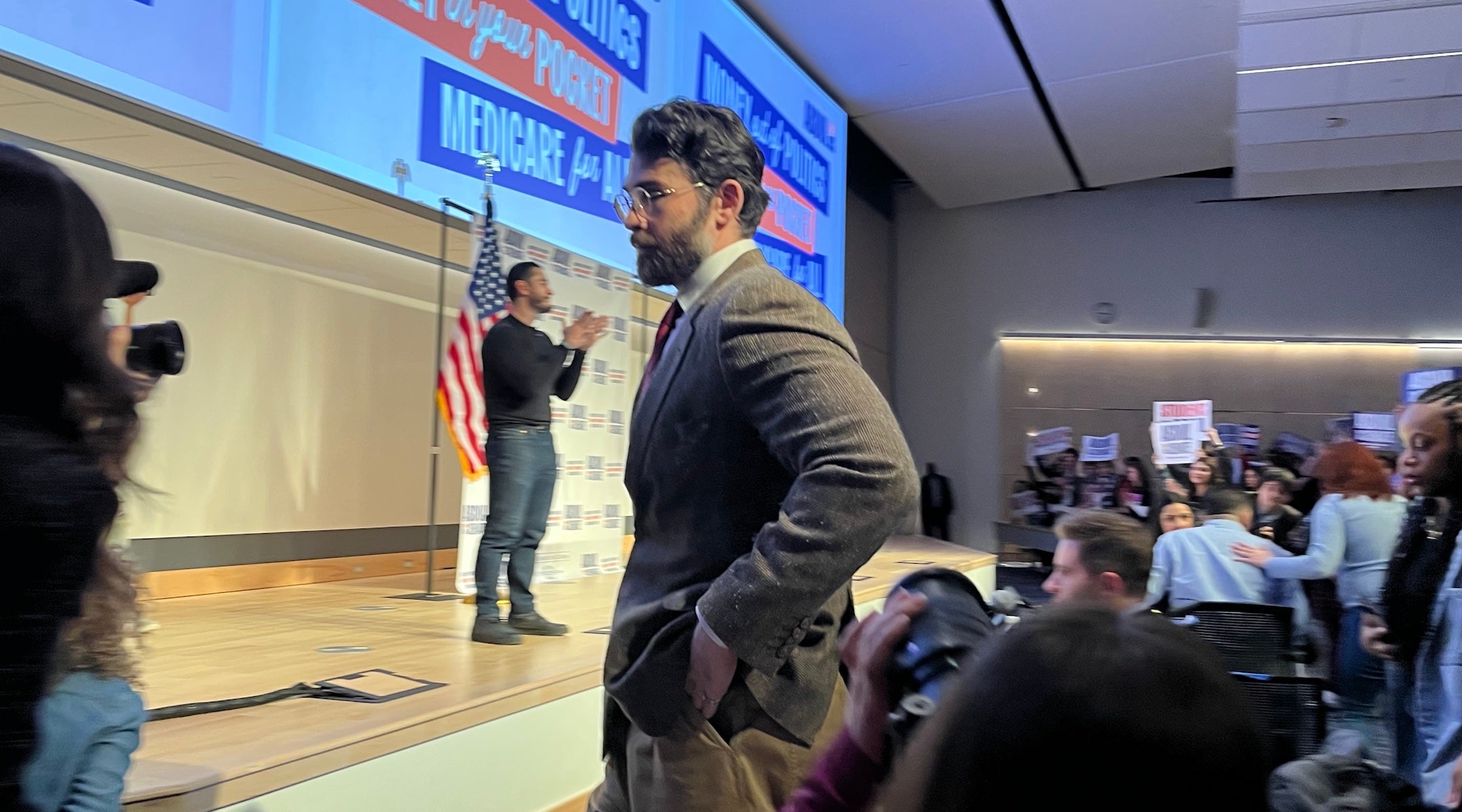
(JTA) — ANN ARBOR, Michigan — Outside, in a line that stretched around the block, the hundreds of people who turned out for Abdul el-Sayed’s campaign rally with Hasan Piker gave a range of reasons for showing up.
Some said they liked el-Sayed’s message of Medicare for All, a key plank of the former county health executive’s bid for an open Senate seat. Some were furious about the war in Iran, which the candidate has angrily denounced.
Others just liked the guy. “He’s a really great speaker and a really passionate person,” Natalie Gould, a master’s candidate in public health who had worked with el-Sayed in Detroit, told the Jewish Telegraphic Agency.
Inside, though, one issue made the crowd roar louder than any other: any time a speaker, from el-Sayed to Piker to the newly elected student body president, accused Israel of genocide. The progressive movement in which Piker has styled himself a kingmaker, one that is ardently pro-Palestinian while largely dismissive of any claims of antisemitism, was coalescing.
“In the beginning it was a lot lonelier when we spoke out. They used the same exact heinous smear: They said, ‘You’re antisemitic,’” Piker told the crowd. “And back then I felt a lot lonelier. But I don’t feel lonely anymore.”
Piker, the leftist Twitch streamer with millions of followers, was the evening’s biggest draw — and its biggest lightning rod. After el-Sayed announced the two would hold a pair of campaign stops together Tuesday, the streamer’s past clips and comments about Jews and Israel led numerous Jewish leaders and both of el-Sayed’s opponents to denounce the events. Some compared Piker to Nick Fuentes, the openly antisemitic far-right streamer who has divided Republicans. Leading Democrats called for the party to distance itself from Piker altogether.

Hasan Piker looks on as U.S. Senate candidate Abdul El-Sayed delivers a stump speech in Ann Arbor, Michigan, April 7, 2026. Piker, a popular Twitch streamer accused of antisemitism, prompted controversy for campaigning with El-Sayed. (Andrew Lapin/JTA)
Pushback continued until just before the events started. An hour before the first rally, at Michigan State University, that school’s president and governing board issued a joint statement affirming their campus free speech principles while also condemning antisemitism. The school’s Hillel chapter had already called Piker a “known antisemite,” expressing concern about his appearance.
At the next stop at the University of Michigan, el-Sayed told the crowd that the campus pro-Israel club Students Supporting Israel had planned to protest the event. But the group wasn’t visible outside the building, and the club’s Instagram page announced that its “March Against Extremism” had been “postponed,” which the group attributed to “extenuating circumstances” that it did not explain.
El-Sayed leaned into the energy, embracing Piker onstage and mocking the negative attention the rally had received. The rally overlapped with President Donald Trump’s deadline for Iran to make concessions or “a whole civilization will die,” which led to a temporary ceasefire in the U.S.-Israeli war on Iran.
“Apparently, the most important thing happening on Twitter was whether or not we were going to campaign with Hasan,” he told the crowd. “Somehow Fox News found it fit to cover this rally six f–king times and not talk about the fact the president wants to commit a genocide in Iran.”
Also leaning in were the night’s other speakers, who were all being showcased on Piker’s livestream — where, during downtime in-between speeches, he bemoaned what he described as a bad-faith campaign to paint him as antisemitic. (He also said he’d been hoping to eat at Zingerman’s, a famous Jewish-style gourmet deli in Ann Arbor.)
“I told Piker just now, I was like, ‘You’re never going to be canceled up in Michigan,’” Rep. Rashida Tlaib, the House’s fiercest critic of Israel, said during her own stump speech.
Rep. Summer Lee, of Pennsylvania, also delivered a speech, and Rep. Debbie Dingell, of Michigan, attended but did not speak.
Candidates for local office also stood next to Piker, including Amir Makled, a candidate for the university’s Board of Regents who was the legal defense for the school’s student pro-Palestinian encampment movement.
The crowd was young and diverse in age and race. While Piker received cheers when he shouted out his fans, some of the attendees told JTA they were more mixed on him, while others had little familiarity with his streams. But they all agreed he had juiced El-Sayed’s campaign.
“I mean, there’s tons of people here,” Ann Arbor resident Joey Ryan said while queuing up for the over-capacity rally outside, gesturing behind him. “I remember the Joe Biden Michigan stuff, and it was not like this. I remember the Bernie Sanders rally in early 2020, and it was more like this.”
Ryan said that Piker, like other streamers, operated in the “attention economy” space, where “saying inflammatory things sometimes can get you attention.” But, he said, “I also think it’s been blown completely out of proportion when you have the president of the United States calling Iranians non-human, as an example, to bomb them, and that includes the synagogue that was blown up in Iran today. Like, there are Jews in Iran as well. Is that not antisemitism?”
“Some of the stuff he says is kind of crazy. I’m not going to lie, there’s some stuff he said that I disagree with,” another attendee, a current University of Michigan student who declined to give her name, said of Piker. Content creators, the student said, can “get out over their skis.”
If anything, Piker and el-Sayed became more honed in on Israel as the day went on. At their first East Lansing stop, both made only a handful of comments about Israel and AIPAC. By the time they reached Ann Arbor that evening, the headliners had amped up their broadsides, with Piker referencing a new Pew Research Center study showing that 84% of Democrats under 49 have a somewhat or very unfavorable view of Israel.
“There’s only a handful of Democrats that are actually outspoken on this atrocity, outspoken on the relationship that we have with a foreign country that we simply always have to send unlimited billions of dollars to — a country that has health care, mind you,” Piker said. “You do not, but Israel has free health care.” The crowd booed at this line.

(L-r) U.S. Rep. Summer Lee, Senate candidate Abdul El-Sayed, and Twitch streamer Hasan Piker pose during a rally for El-Sayed, April 7, 2026. (Andrew Lapin/JTA)
As another rallying cry, he told them, “When you feel really sad, when you feel really angry, remind yourself of the worst fascist that you know. It could be Donald Trump, it could be Rabbi Shmuley. They’re going to be very excited if you stop fighting.” (Piker later told JTA that he was referring to Rabbi Shmuley Boteach, a pro-Israel Twitter gadfly who Piker said was “pro-genocide.”)
The candidate, too, amped up his criticisms of AIPAC in particular. The pro-Israel lobby, which has poured millions of dollars into congressional elections, is facing a resolution of opposition from the Democratic National Committee this week.
“AIPAC tells us that the number one goal of our foreign policy is to align with a foreign government,” el-Sayed said, to boos. “You know, when I talk about AIPAC, everybody says, ‘Well, it’s because you’re Arab Muslim.’ No it’s not. It’s because I’m f–king from Michigan, and I want my tax dollars back in Michigan.”
He also joked that AIPAC ads against him might finally give him something he’s dreamed about. “The one thing you’re supposed to have, as an American Muslim, is a nice beard,” he said. “And I was never gifted with that. But for three months this summer, AIPAC’s going to give me the beard of my dreams.”
At both campaign stops, El-Sayed, who grew up in a heavily Jewish Detroit suburb not far from Temple Israel, the synagogue that was attacked last month, also said he welcomed Jews to his movement.
“All of us love and revere Jewish folk, our Jewish neighbors, the faith of Judaism,” he said in Ann Arbor, to applause. “Trust me, nobody will fight harder against antisemitism than somebody who intimately understands what it’s like to be discriminated against because of how I look.”
He reiterated the point in an interview after the event.

Supporters of Michigan U.S. Senate candidate Abdul El-Sayed cheer Rep. Rashida Tlaib as she denounces Israel during a rally in Ann Arbor, Michigan, that also featured Twitch streamer Hasan Piker, April 7, 2026. (Andrew Lapin/JTA)
“I am so grateful I’ve grown up in a community with a large proportion of Jewish Americans. I learned a lot from the Jewish tradition. I’m grateful to have been invited to bar and bat mitzvahs and to be invited to Seders and to be invited to spend time at shul,” el-Sayed told JTA.
“I stand deeply and profoundly against antisemitism in the same way that I stand deeply and profoundly against Islamophobia,” he added. “Those two things always run together. It is not antisemitic to criticize a foreign government, and it’s not antisemitic to criticize a super PAC that is intent on aligning our interests with the foreign government.”
In the interview, the candidate also reiterated the sentiment behind his own statement on the Temple Israel attack, in which he had referenced the Israeli war in Lebanon. “I also think it’s just critical for us to understand that hurt people do hurt people, and the circumstances happening 6000 miles away can affect the lives that we live here,” el-Sayed said Tuesday.
At the end of the rally, Piker climbed back onto the stage with El-Sayed to a standing ovation. The two men embraced, then posed for a selfie with the crowd behind them.
This article originally appeared on JTA.org.
The post In rallies taking on Israel, a defiant Hasan Piker boosts Michigan Senate candidate Abdul el-Sayed appeared first on The Forward.