



Uncategorized
UK Raises Threat Level to ‘Severe’ After London Antisemitic Terror Attack
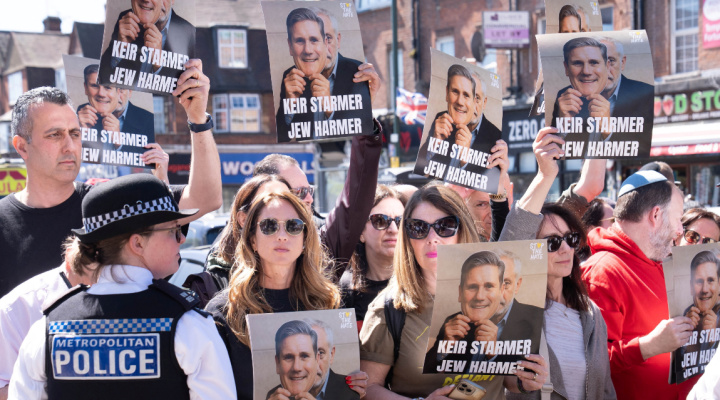
Protesters hold up placards against British Prime Minister Keir Starmer during his visit to Golders Green, northwest London, following a terror attack on April 29, 2026, in which two men were stabbed, in London, Britain, April 30, 2026. Photo: Stefan Rousseau/Pool via REUTERS
Britain on Thursday raised its national terrorism threat level to “severe,” signaling that a terrorist attack was considered “highly likely,” following an antisemitic stabbing in north London.
Interior minister Shabana Mahmood said the level had been increased from “substantial” after the attack in the Golders Green area on Wednesday, adding that the decision reflected a broader and rising threat environment rather than a single event.
“I know this will be a source of concern to many, particularly amongst our Jewish community, who have suffered so much,” the minister said in a statement. “As the threat level rises, I urge everyone to be vigilant as they go about their daily lives and report any concerns they have to the police. And I can assure everyone that our world-class security services and the police are working day and night to keep our country safe.”
Meanwhile, Prime Minister Keir Starmer vowed to take action to protect the Jewish community in Britain, acknowledging that Jews were scared a day after the stabbing left two Jewish men, one in his 70s and one in his 30s, hospitalized in stable condition.
The attacked followed a spate of antisemitic attacks in the British capital.
Starmer, who has faced severe criticism from some in the Jewish community for the government’s response, promised more police in Jewish areas, a crackdown on those spreading antisemitism, and new legislation to deal with state-sponsored threats from the likes of Iran.
He had earlier been jeered and heckled by a small crowd waving banners reading “Keir Starmer Jew Harmer” when he visited Golders Green where the two Jewish men were stabbed on Wednesday.
‘PEOPLE ARE SCARED’
“People are scared, scared to show who they are in their community, scared to go to synagogue and practice their religion, scared to go to university as a Jew, to send their children to school as a Jew, to tell their colleagues that they are Jewish,” Starmer said in a televised statement.
The suspect in the Golders Green attack, a 45-year-old British national who was born in Somalia, had a history of serious violence and mental health issues, police said.
They also confirmed he had previously been referred to the counter radicalization scheme Prevent in 2020, while local media reported he had served time in prison for an incident in 2008 when he stabbed an officer and a police dog.
Amid widespread calls for more to be done to protect the about 290,000 Jews living in Britain, Starmer said the government would do “everything in our power to stamp this hatred out,” with stronger powers to shut down charities promoting extremism and a clampdown on “hate preachers.”
The government has also said it would fast-track legislation allowing the prosecution of people acting as proxies of a state-sponsored group, so they can be dealt with in the same way as spies for foreign intelligence services.
“We need stronger powers to tackle the malign threat posed by states like Iran, because we know for a fact that they want to harm British Jews,” Starmer said.
A pro-Iranian government group has claimed responsibility for several recent attacks while last month, two men were charged under Britain’s existing National Security Act with being tasked by Iran to carry out hostile surveillance.
Tehran has rejected such accusations.
PROTEST PROBLEM
One of the major issues which has caused anger amongst the Jewish community in Britain has been anti-Israel marches, which have become commonplace since the October 2023 Hamas assault on the Jewish state that triggered the war in Gaza. Critics say the protests have generated hostility and become a hotbed of antisemitism.
“If you stand alongside people who say, ‘Globalize the Intifada,’ you are calling for terrorism against Jews, and people who use that phrase should be prosecuted,” Starmer said. “It is racism, extreme racism, and it has left a minority community in this country, scared, intimidated, wondering if they belong.”
The recent incidents in London are part of a rising number of antisemitic attacks.
Last October, two people were killed after an attack at a synagogue in the northern English city of Manchester. A week later, two men went on trial over a plot to kill hundreds in an Islamic State-inspired gun rampage against the Jewish community.
They were found guilty in December, just over a week after a mass shooting at a Jewish Hanukkah celebration on Australia’s Bondi Beach.
Britain’s independent reviewer of terrorism legislation, Jonathan Hall, told the BBC the British attacks had become “the biggest national security emergency” since 2017, when there was a string of high-profile attacks.
Mahmood said additional funding would pay for more protective security for the country’s synagogues, schools, places of worship, and community centers, boosting police numbers in areas with a large Jewish community.
According to the British government, an additional £25 million ($34 million) will be invested to increase security for Jewish communities.
“We are seeing a huge increase in antisemitism, and that’s why the government’s work on education and stamping out antisemitism across other parts of the public sector is also an incredibly important part of this picture,” Mahmood said.
She did not say the legislation would be used against Iran’s Islamic Revolutionary Guard Corps (IRGC) but told Sky News: “I expect to be making decisions in the very near future about the groups that we will be designating as state-linked.”
Several countries have designated the IRGC as a foreign terrorist organization.
Uncategorized
‘It’s the Jews’: San Diego mosque shooters decried ‘the universal enemy’ in hate-filled manifesto


The two young men who killed three people at a San Diego mosque on Monday published a conspiracy theory-filled manifesto whose primary focus was on Jews, calling them the “universal enemy.”
The manifesto’s contents also suggest they may have had additional plans to target Jewish institutions.
Authorities have identified Cain Lee Clark, 17, and Caleb Liam Vazquez, 18, as the shooters who killed a security guard and two members of the Islamic Center of San Diego. The two livestreamed the attack before both were found dead in a car by apparent suicide, blocks away from the mosque.
The three killed at the mosque were Amin Abdullah, 51, Mansour Kaziha, 78, and Nadir Awad, 57.
Jewish leaders across the country and in San Diego widely condemned the attack.
The 74-page manifesto, which contains a section written by each shooter, reveals a wide-ranging hatred rooted in white Christian nationalist ideas, including Great Replacement Theory, and fueled by the two teenagers’ own social alienation. Among the other groups attacked in the document are Muslims, women, Black people, gay and transgender people, and immigrants.
But the shooters’ deepest resentment seemed reserved for Jewish people.
‘The universal enemy’
The manifesto listed previous antisemitic shootings at the Tree of Life synagogue and Chabad of Poway among the teens’ many sources of inspiration, calling the assailant in the latter incident a “saint.” It called the Jews “the children of Satan.” It denied the Holocaust as a “complete fabrication.” Vazquez called Adolf Hitler his hero; in his section, Clark wrote out the Fourteen Words, a neo-Nazi declaration.
“Everyone has their own idea of who is to blame for all the wrong in the world,” Vazquez wrote in a section titled “The Universal Enemy.”
He printed his answer to the question four times in a row in all capital letters: “It’s the Jews.”
Authorities have said the shooters met online before realizing they both lived in the San Diego area, without specifying the platform where they met.
But the document’s cover pages also provided a clue to their radicalization, bearing the insignia of Atomwaffen Division, a neo-Nazi group that emerged during the first Trump administration.
Atomwaffen members are part of a network of mostly online extremist groups that subscribe to “accelerationism,” the idea that forcing societal collapse through an all-out race war is the only way to restore white supremacy and save civilization. The idea is propounded by a white nationalist named James Mason, author of a book called Siege that both shooters cited.
“Though officially I was not a part of any groups or organizations there are many I support, I would even go so far as to say I did it for Atomwaffen Division, Terrorgram, The Base, and North Korea,” Vazquez wrote.
Atomwaffen members have been convicted in previous antisemitic murders. In 2019, one named Samuel Woodward lured a gay and Jewish college student named Blaze Bernstein to an Orange County park before stabbing him to death. Woodward, who was 20 at the time, is now serving a life sentence, and Atomwaffen fractured into other groups in the years after his arrest.
Secondary targets
Whereas the shooters were unsparing toward Jews in the manifesto, with Vazquez calling them the “most evil creature in the world,” they espoused mixed feelings about Muslims in the document before they killed three. “I don’t hate Muslims, at least not really,” Vazquez wrote. “What I hate is the religion of Islam itself and them invading my country.”
He added that Islam “is completely contradictory to both Western morals and values and Christianity.”
But he wrote only three paragraphs about Islam and Muslims — about one page — before the section ends with the word “unfinished” in brackets.
Clark appeared more committed to the eradication of Islam in his writing. Muslims and Jews, he said, “must be isolated and exterminated.” Yet he, like Vazquez, wrote several pages denigrating Jewish people.
The shooters did not state why they ultimately targeted a mosque. Vazquez wrote their plan was to “cause as much death and destruction” as fast as possible with a “diverse” selection of targets. The document provides lines for listing three separate locations, but none of them are filled out.
“All locations were surveyed and mapped out to the best of our ability,” he wrote.
The post ‘It’s the Jews’: San Diego mosque shooters decried ‘the universal enemy’ in hate-filled manifesto appeared first on The Forward.
Uncategorized
Rep. Dan Goldman urges ‘no’ vote on proposed Brooklyn Israel boycott, warning of antisemitism
Rep. Dan Goldman of New York and his primary challenger Brad Lander are wading into the contentious debate over a proposed boycott of Israeli products at a Brooklyn cooperative grocery store ahead of an expected vote next week.
In a statement shared exclusively with the Forward on Wednesday, Goldman urged members of the popular Park Slope Food Coop in Brooklyn to attend a May 26 vote and cast ballots against the boycott resolution — and condemned the measure as antisemitic.
“Everyone is free to criticize the Israeli government — which I do not hesitate to do — but joining a movement that was founded on the principle of the elimination of Israel will have no impact on the Israeli government or the Israeli economy,” Goldman said in his statement. “Instead, it only succeeds at shifting the responsibility for the Israeli government’s actions to American Jews — which is quintessential antisemitism.”
Goldman said that he is aligning himself with Rabbi Rachel Timoner of Congregation Beth Elohim, a progressive leader, as the debate has spilled into local politics and Jewish communal life in the progressive neighborhood.
The resolution says the boycott would persist “Until Israel complies with international law, including by ceasing unlawful discriminatory practices, in its treatment of Palestinians.”
Timoner addressed the proposal in her weekly Shabbat sermon earlier this month.
“Many simply want to see the Palestinian people be free and safe and equal, and I do too, but this is not the way,” Timoner said. “This way is wrong.
Calling it a “proxy war” to what has been dividing Americans in recent years over the Israeli-Palestinian conflict, one “that is laced with antisemitism, Timoner said that many members of her congregation — she and herself — would be forced to resign from their co-op membership if the resolution passes.
The rabbi’s sermon reflected the careful line she has tried to walk since the Oct. 7, 2023 Hamas attack and the war in Gaza — openly criticizing Israeli government policies while rejecting the singling out of Israel. In March 2024, Timoner attended for the first time what was then a weekly protest to call for a bilateral ceasefire and hostage deal, one that Lander attended regularly. In her remarks she said that she had held back until then from calling for a ceasefire in Gaza “because it was being used by people who celebrated Oct. 7, people who do not hold Hamas responsible, and people who want to eliminate the state of Israel — and I did not want to be associated with that.”
Timoner is a co-founder and board member of the New York Jewish Agenda, a progressive advocacy group formed in 2020 to be a voice for liberal Jews in New York. Lander is a member of NYJA’s leaders network. A Goldman campaign official noted that the congressman and Timoner have met several times privately to discuss issues affecting the district and that Goldman has attended services at Beth Elohim in the past.
Goldman, the two-term incumbent, challenged his Democratic primary rival to publicly oppose the measure as well, “to stand with our neighbors, and make it clear that this dangerous bigotry has no place in our city.”
Lander, a close ally of New York City Mayor Zohran Mamdani, told the Forward he isn’t a member of the Coop but would vote against the resolution if he were, pointing to Timoner’s sermon. “Principled people can disagree here,” Lander said in a statement that did not take a position on the resolution. “Boycotts, divestments, and sanctions are legitimate tools of advocacy campaigns. Unlike my opponent, I don’t believe all opposition to Israel is antisemitic.”
A long-running boycott fight
The proposal to boycott Israeli products has riven the Brooklyn institution’s roughly 16,000 members. It was introduced in 2024 by a local advocacy group called Park Slope Food Coop Members for Palestine. The resolution would require the Coop to boycott Israeli-made products “until Israel complies with international law in its treatment of Palestinians.”
Coop4Unity, opposing the resolution, is urging shoppers to “bring back cooperation” and “stop polarization.”
The measure is largely symbolic, given that the Coop only carries a handful of items imported from Israel, like EcoLove shampoo and conditioner. At least one, Al Arz tahini, is made by an Israeli Arab in Nazareth. The coop first considered a boycott resolution in 2012.
The debate has grown increasingly heated in recent months, erupting most recently publicly during a general meeting when a member made said “Jewish supremacism is a problem in this country,” a remark that many attendees and Jewish organizations condemned.
The comment — which received applause at the meeting — came during a second resolution that would lower the voting threshold for boycott measures from 75% to 51%.
Goldman strongly condemned the remarks in his statement on Wednesday. “That is not a critique of Israeli policy or advocacy for Palestinian rights,” he said. “It is an old and ugly antisemitic conspiracy theory that fueled the Nazis and then was used by David Duke and the Ku Klux Klan.”
A heated primary over support for Israel
The boycott fight is the latest issue in an already heated primary challenge to Goldman being largely battled over Israel and antisemitism.
Last month, Lander, who has described himself as a liberal Zionist, joined some progressive House members in calling for an end to U.S. aid to Israel. Lander — who described Israel’s actions in Gaza as “genocide” — said he would apply that as well to Israel’s defensive Iron Dome system, high-tech missile interception that protects lives, property and infrastructure against assaults from Iran and allied groups, including Hamas and Hezbollah. Lander said that Israel has the ability to purchase its defense with its own funds.
The 10th Congressional District, which includes Borough Park and Park Slope in Brooklyn as well as parts of lower Manhattan, voted heavily for Mamdani, an outspoken critic of Israel. Mamdani is backing Lander in the primary.
Goldman, an heir to the Levi Strauss fortune and former Trump impeachment prosecutor who was elected in 2022, is aligned with the mainstream positions of national Democrats on Israel: supportive of Israel’s security while finding a pathway for a two-state solution, sharply critical of Prime Minister Benjamin Netanyahu’s right-wing government, and opposed to settlement expansion and settler violence.
Recent polling has shown Goldman trailing Lander in the June 23 primary.
Goldman framed the Coop dispute as about something larger than electoral politics. “It’s time we unite together on this issue,” he said, “and fight for the safe, loving, inclusive community we all deserve.”
Additional reporting by Mira Fox.
The post Rep. Dan Goldman urges ‘no’ vote on proposed Brooklyn Israel boycott, warning of antisemitism appeared first on The Forward.
Uncategorized
Itamar Ben-Gvir draws criticism from Netanyahu for video taunting detained flotilla activists
(JTA) — Prime Minister Benjamin Netanyahu has joined a chorus of Israelis and Jews denouncing his national security minister, Itamar Ben-Gvir, for posting a video that showed Ben-Gvir taunting detained activists from a Gaza-bound aid flotilla that had been intercepted by the Israeli navy.
“Welcome to Israel, we are the masters,” Ben-Gvir said in the video as he waved a large Israeli flag above the detained activists, who could be seen blindfolded and kneeling on the ground with their hands behind their backs.
Roughly 430 activists that took part in the Global Sumud Flotilla, which set sail from Turkey last Thursday, were brought to the city of Ashdod aboard Israeli naval ships on Wednesday, marking the latest in a long-running series of confrontations between Israel and activists seeking to break its naval blockade of Gaza.
In a second video posted on social media, Ben-Gvir said that the activists “came here all full of pride like big heroes. Look at them now,” appealing to Netanyahu to grant him permission to imprison them.
ככה אנחנו מקבלים את תומכי הטרור
Welcome to Israel 🇮🇱 pic.twitter.com/7Hf8cAg7fC
— איתמר בן גביר (@itamarbengvir) May 20, 2026
Netanyahu said in a statement that he had instructed authorities to deport the activists “as soon as possible.” But he also offered a public rebuke of Ben-Gvir.
“Israel has every right to prevent provocative flotillas of Hamas terrorist supporters from entering our territorial waters and reaching Gaza,” Netanyahu said. “However, the way that Minister Ben Gvir dealt with the flotilla activists is not in line with Israel’s values and norms.”
The foreign ministers of several countries, including Canada, Spain, France, the Netherlands and Italy, also condemned the videos and summoned their Israeli diplomats to answer for the display.
But some of the sharpest criticism came from within Israel, where Ben-Gvir plays a crucial role in maintaining the governing coalition while also engaging in antics that threaten to flare tensions and undercut the country’s claims that it behaves in accordance with international law.
Ben-Gvir is “not the face of Israel,” tweeted Foreign Minister Gideon Saar in English.
“You knowingly caused harm to our State in this disgraceful display — and not for the first time,” Saar wrote. “You have undone tremendous, professional, and successful efforts made by so many people — from IDF soldiers to Foreign Ministry staff and many others.”
Ben-Gvir’s videos come as his antics and rhetoric have drawn new scrutiny in recent days. Last week, he departed from longstanding norms and waved an Israeli flag on the Temple Mount, a Muslim holy site, in a show of Jewish supremacy. His oversight of Israeli prisons, where he has said he wants to see prisoners given only the minimum of food and comfort as required by law, also drew attention because of a New York Times column alleging sexual abuse of Palestinian prisoners.
Progressive groups heavily criticized Ben-Gvir’s video, saying that it was inappropriate for him to be part of the Israeli government.
“The disgusting images of Israel’s National Security Minister abusing detainees from the Gaza flotilla are not just bad optics,” tweeted Mickey Gitzin, the acting CEO of the New Israel Fund. “A government that gives a Kahanist this kind of power has already abandoned any notion of decency. These grotesque images are the real face of current Israeli policy.”
Ben-Gvir’s videos showing the treatment of participants in the latest flotilla offered a contrast to other recent interceptions in which Israel has released footage appearing to show activists being treated without force. When past arrestees from flotillas have alleged abusive treatment, Israel has denied it.
The organizers of the Global Sumud Flotilla said all of its boats had been intercepted by Israel by Tuesday evening, accusing Israel of employing “illegal, high-seas aggression.” The Israeli Foreign Ministry said no live munition was used during the operation, which it said was necessary because it will “not permit any breach of the lawful naval blockade on Gaza.”
Among the activists aboard the more than 50 boats in the flotilla was the sister of Irish President Catherine Connolly. On Tuesday, Connolly, who was elected in October and has a record of anti-Israel rhetoric, called the detention of Irish activists aboard the flotilla “unacceptable.”
The post Itamar Ben-Gvir draws criticism from Netanyahu for video taunting detained flotilla activists appeared first on The Forward.