



Uncategorized
US and Iran Explore Short-Term Deal to End Fighting
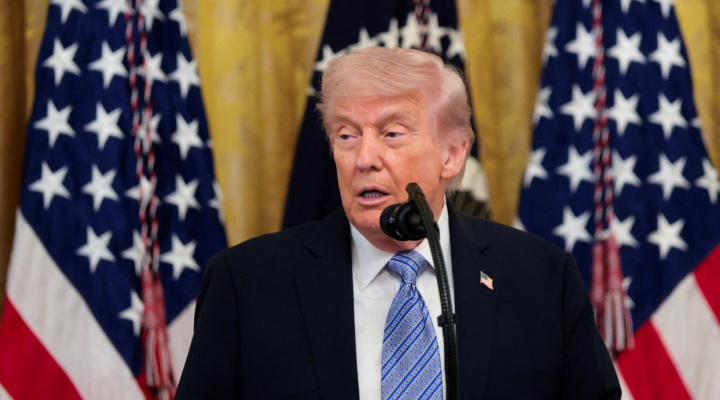
US President Donald Trump speaks during a Small Business Summit in the East Room at the White House in Washington, DC, US, May 4, 2026. Photo: REUTERS/Kylie Cooper
The United States and Iran are edging toward a temporary agreement to halt their war, sources and officials said on Thursday, with Tehran reviewing a proposal that would stop the fighting but leave the most contentious issues unresolved.
Iran‘s foreign ministry spokesperson said Tehran had not yet reached a conclusion on the emerging plan, which, according to the sources, centers on a short–term memorandum rather than a comprehensive peace deal, underscoring deep divisions between the two sides.
Hopes that even a partial deal could lead to the reopening of the Strait of Hormuz have already moved markets, with oil prices sliding again on bets that supply disruptions could ease and global stocks largely holding onto record highs.
Tehran and Washington have scaled back ambitions for a sweeping settlement as differences persist, particularly over Iran‘s nuclear program – including the fate of its highly enriched uranium stockpiles and how long Tehran would halt nuclear work.
Instead, they are working toward a temporary arrangement set out in a one-page memo aimed at preventing a return to conflict and stabilizing shipping through the strait, the sources and officials said.
“Our priority is that they announce a permanent end to war and the rest of the issues could be thrashed out once they get back to direct talks,” a senior Pakistani official involved in mediation between the two sides told Reuters.
The proposed framework would unfold in three stages: formally ending the war, resolving the crisis in the Strait of Hormuz, and launching a 30-day window for negotiations on a broader agreement, according to the sources and officials.
Tehran said Foreign Minister Abbas Araqchi held a phone call on Thursday with Ishaq Dar, his counterpart in Pakistan, which has taken a leading role in mediation efforts.
“We remain optimistic,” Pakistan’s foreign ministry spokesperson Tahir Andrabi told a briefing in Islamabad when asked how quickly a deal could come.
“A simple answer would be that we expect an agreement sooner rather than later.”
TRUMP OPTIMISTIC, IRAN SKEPTICAL
US President Donald Trump – who has repeatedly played up the prospect of a breakthrough since the war began on Feb. 28 with US-Israeli strikes on Iran – has also struck an optimistic tone.
“They want to make a deal … it’s very possible,” he told reporters at the White House on Wednesday, adding later that “it’ll be over quickly.”
The proposal would formally end the conflict in which full-scale warfare was paused by a ceasefire announced on April 7. But it leaves unresolved key US demands that Iran suspend its nuclear work and reopen the Strait of Hormuz, the sources said.
In a sign of the US keeping up pressure, it imposed sanctions on Thursday on Iraq’s deputy oil minister and three militia leaders over what it said was their support for Iran.
Israel, which has also been fighting Iran-backed Hezbollah in Lebanon, said on Thursday it had killed a Hezbollah commander in an airstrike on Beirut a day earlier, the first Israeli attack on the Lebanese capital since a ceasefire there was agreed last month.
Hezbollah triggered its latest conflict with Israel by opening fire in support of Iran on March 2. A halt to Israeli strikes in Lebanon is another key Iranian demand in negotiations with Washington.
Iranian officials signaled skepticism over the US proposal to end the wider war. A foreign ministry spokesperson said Tehran would respond in due course, while lawmaker Ebrahim Rezaei described the proposal as “more of an American wish list than a reality.”
Iran‘s parliament speaker Mohammad Baqer Qalibaf appeared to mock reports that indicated the two sides were close, writing on social media that “Operation Trust Me Bro failed” and portraying the talks as US spin after its failure to reopen the strait.
DEAL HOPES DRIVE OIL DOWN, SHARES RISE
Reports of a possible agreement pushed Brent crude down by 3% to around $98 a barrel, having tumbled nearly 8% on Wednesday.
Global share prices also rose, and bond yields fell on optimism about an end to a war that has disrupted energy supplies. [O/R] [MKTS/GLOB]
“The contents of the US-Iran peace proposals are thin, but there is an expectation in the market that further military action will not take place,” said Takamasa Ikeda, a senior portfolio manager at GCI Asset Management.
MILITARY, REGIONAL TENSIONS
Trump on Tuesday paused a two-day-old naval mission aimed at reopening the blockaded strait, citing progress in talks.
NBC News, citing two unnamed US officials, said Trump decided on the pause after Saudi Arabia suspended the US military’s ability to use a Saudi base for the operation.
Saudi officials were surprised and angered by Trump’s announcement that the US would help escort ships through the strait, leading them to tell Washington they would deny the US permission to fly military aircraft out of a Saudi base or through Saudi airspace, NBC reported.
The White House did not immediately respond to a request for comment on the report. The US military has kept up its own blockade on Iranian ships.
KEY DEMANDS LEFT OUT
The source briefed on the mediation said the US negotiations were being led by Trump’s envoy Steve Witkoff and son-in-law Jared Kushner. If both sides agreed on the preliminary deal, that would start the clock on 30 days of detailed negotiations to reach a full agreement.
The sources said the memorandum did not mention several key demands Washington has made in the past, which Iran has rejected, such as limits on Iran‘s missile program and an end to its support for proxy militias in the Middle East, including Hezbollah.
The sources also made no mention of Iran‘s existing stockpile of more than 400 kg (900 pounds) of near-weapons-grade uranium – one of Washington’s central concerns.
Uncategorized
California man pleads guilty in 2023 death of pro-Israel protester
The man accused in the 2023 death of a pro-Israel protester will avoid a prison sentence after pleading guilty this week to all charges against him.
Loay Alnaji, 53, was at a pro-Palestinian protest in Ventura, California, in November 2023 when he allegedly struck a pro-Israel counterprotester named Paul Kessler with a megaphone. Kessler, who was 69, then fell, hitting his head on the pavement. He died several hours later, with the death ruled a homicide by blunt-force trauma.
Trial proceedings had been set to begin next week, with Alnaji facing up to four years in prison. But Ventura County Superior Court judge Derek Malan offered Loay Alnaji, 53, a deal on Tuesday that allowed Alnaji up to one year in jail followed by three years on probation.
Alnaji accepted the offer. His attorney, Ron Bamieh, told the Ventura County Star that Malan had determined “two old guys had a dispute and an accident happened.”
Alnaji pleaded guilty to the two counts against him — felony involuntary manslaughter and felony battery causing serious bodily injury — and admitted aggravating factors, namely that he used a weapon and that the victim was particularly vulnerable.
He will be sentenced June 25.
The plea deal was too lenient in the eyes of Kessler’s family — which wanted the maximum sentence, according to the Star — as well as Ventura County District Attorney Erik Nasarenko.
“Alnaji should be sentenced to prison for his violent behavior, and our office strongly objects to any lesser sentence,” Nasarenko said in a statement. “While no amount of punishment will ever fully account for the Kessler family loss, a prison commitment underscores the severity of this crime and will deter others from committing similar acts of violence.”
The Kessler family could not be reached for comment.
The guilty plea brings a tragic saga that began in the early days of the Israel-Hamas war closer to an end. Kessler and Alnaji were among 75 to 100 people who descended upon a busy intersection in Thousand Oaks — about 25 miles north of Los Angeles — for dueling protests related to the Israel-Hamas war.
What happened during the altercation remains unclear. Bamieh said Kessler put his phone in Alnaji’s face; when Alnaji swatted the phone away, the megaphone inadvertently hit Kessler’s face. (He also said Kessler had previously been diagnosed with a brain tumor, though the coroner has stated the tumor was not a factor in his death.) After Kessler’s fall, he was bleeding from the head and mouth, but was responsive at the scene and evacuated to a hospital. His condition worsened overnight and he died there early the next day.
Alnaji, who at the time was a computer science professor at Moorpark College, was placed on administrative leave by the school after his arrest and subsequent release on $50,000 bail.
Rabbi Noah Farkas, chief executive of the Jewish Federation of Greater Los Angeles, welcomed the guilty plea for what he called a “heinous crime.”
“While we would have liked a harsher sentence that better reflects the pain of the Kessler family, we respect the legal process,” Farkas said in a statement. “Our hope is that today’s news helps bring closure to his family and gives our community the ability to demonstrate safely.”
The post California man pleads guilty in 2023 death of pro-Israel protester appeared first on The Forward.
Uncategorized
After Beirut Strike, Netanyahu Says ‘No Immunity’ for Terrorists

Rescuers work at the site of an Israeli strike that took place yesterday, in the southern suburbs of Beirut, Lebanon, May 7, 2026. Photo: REUTERS/Mohamad Azakir
Prime Minister Benjamin Netanyahu said on Thursday there was no “immunity” for Israel’s enemies, a day after the Israeli military targeted a Hezbollah commander in its first strike on Beirut‘s southern suburbs since a ceasefire declared last month.
Israel said the attack killed the commander of the Iran-backed terrorist group’s elite Radwan force.
Hezbollah, which controls Beirut‘s southern suburbs, has yet to issue any statement on the strike or the commander’s status.
“He likely read in the press that he had immunity in Beirut. Well, he read it and it is no longer the case,” Netanyahu said in a statement.
Hostilities between Israel and Hezbollah reignited on March 2 when the Islamist group opened fire at Israel after Tehran came under US-Israeli attack.
Wednesday’s strike raises pressure on the Lebanon ceasefire that emerged in parallel to a truce in the wider Middle East war, with a halt to Israeli strikes in Lebanon being a key Iranian demand in Tehran’s negotiations with Washington.
Announced on April 16 by US President Donald Trump, the Lebanon ceasefire has led to a reduction in hostilities: the Beirut area was not struck by Israel for weeks before Wednesday’s attack.
But the sides have continued to trade blows in the south, where Israel has carved out a self-declared security zone.
Netanyahu said the Hezbollah commander, identified as Ahmed Ali Balout by the Israeli military, “thought he could continue to direct attacks against our forces and our communities from his secret terrorist headquarters in Beirut.”
“I say to our enemies in the clearest possible way: No terrorist has immunity,” he said.
LEBANESE PM: TOO EARLY FOR ‘HIGH-LEVEL’ MEETING
More than 2,700 people have been killed in the war in Lebanon since March 2, Lebanon’s Health Ministry says. Some 1.2 million people have been driven from their homes in Lebanon, many of them fleeing from southern Lebanon. According to Israeli officials, the majority of those killed have been Hezbollah terrorists.
Israel has announced 17 soldiers have been killed in southern Lebanon, along with two civilians in northern Israel.
At least 11 people were killed in Israeli strikes in three different areas of south Lebanon on Wednesday, according to a tally of Lebanese health ministry announcements.
Hezbollah said it carried out 17 operations against Israeli forces in southern Lebanon on Wednesday, while the Israeli military said it had struck more than 15 militant infrastructure sites in the south the same day.
The Israeli military says Hezbollah has fired hundreds of rockets and drones at Israel since March 2.
Hezbollah says it has the right to resist Israeli forces occupying the south.
Israel’s control zone extends as deep as 10 km (6 miles) into southern Lebanon. Israel says it aims to protect northern Israel from Hezbollah terrorists embedded in civilian areas.
The Lebanon ceasefire was announced for an initial 10 days and then extended for an additional three weeks during a meeting between the Lebanese and Israeli ambassadors to Washington, hosted by Trump at the Oval Office.
Hezbollah strongly objects to the Lebanese government’s contacts with Israel, which reflect deep differences between the group and its critics in Lebanon.
Trump said last month he looked forward to hosting Netanyahu and Lebanese President Joseph Aoun in the near future, and that he saw “a great chance” the countries would reach a peace deal this year.
But on Wednesday, Lebanese Prime Minister Nawaf Salam said that it was premature to talk of any high-level meeting between Lebanon and Israel, and said that shoring up a ceasefire would be the basis for any new negotiations between Lebanese and Israeli government envoys in Washington.
Uncategorized
A View From My Campus: Sacrificing Science and Innovation for Political Symbolism

Illustrative: A BDS demonstration outside the School of Oriental and African Studies in London. Photo: Wikimedia Commons.
In 2021, then-president of Rutgers, Jonathan Holloway, traveled to Tel Aviv to sign a partnership with Tel Aviv University (TAU) for future research at a cutting-edge facility being constructed in New Brunswick, The HELIX, which stands for The Health and Life Science Exchange.
This project includes collaborations with Robert Wood Johnson Hospital, Nokia Bell Labs, the NJ Economic Development Authority (NJEDA), Devco, and the American Technological University, all aimed at advancing innovation across industries.
The $665 million project offers “premier workspaces & laboratories for both startups and established companies operating across the gamut of healthcare, biotech, pharma, and, most broadly, the life sciences.” According to the NJEDA’s calculations, the cross-cultural development will bring an economic benefit of $340.4 million to the state.
But amongst Rutgers’ anti-Israel student groups, and Boycott, Divestment, and Sanctions (BDS) activists, there have been calls to terminate the partnership between Rutgers and Tel Aviv University, one of the leading research universities in the Middle East. This opposition came long before Oct. 7, 2023, and the war that followed.
According to these groups at Rutgers, the partnership with “Israeli universities play[s] a key role in supporting Israel’s system of apartheid rule,” and they call for “nothing less than complete divestment from these egregious investments, which drown our endowment fund and university facilities in blood.”
Note that they don’t actually care if this program or TAU connects in any way to the Israeli military or government; treating any Israeli, regardless of affiliation, like a human is apparently beyond the pale.
Notably, TAU was the first university in Israel to establish a Commission for Equity, Diversity, and Community, and has increased the representation of Arab students on campus to close to their proportion in the general population, a feat that is only possible in a place like Israel. It’s also important to note that, like many other universities in Israel, TAU leadership has gone out of its way to advocate for Palestinians.
Yet, somehow in the distorted truth of the BDS movement, TAU is complicit in “genocide.” Morally focused political movements on campus have historically claimed to fight for justice and against discrimination, exemplifying the higher education ideals of open-mindedness and critical thinking. And yet, these groups want to terminate partnerships for research, for innovation, for healthcare-based initiatives, for job and economic growth, and for expanding the academic frontier.
The Endowment Justice Collective, a Rutgers anti-Israel group, sent a letter to the administration claiming, “[a]ny collaboration which serves to bolster TAU’s reputation, provide it with a public platform, or materially support its operations shores up the legitimacy of an institution which aids and abets Israel’s oppression and genocide of Palestinians.”
But what will ending this huge project achieve, apart from a symbolic show of solidarity to a global movement whose priorities seem to obsessively focus on attacking Jews at Palestinians’ expense?
By taking intellectual pursuits such as the HELIX and dismissing them as politically motivated human endeavors, they become the very thing they seek to speak out against. TAU has the Neubauer Fellowship, an initiative specifically for Palestinian PhD students and faculty in STEM fields to provide high-level lab access and funding to elevate Palestinian representation in advanced research. When calls to cut ties like these set a precedent, they put such fellowships at risk as well. Rather than advancing equity, these efforts can ultimately backfire, restricting opportunities for Palestinian researchers and weakening the academic partnerships that make such programs possible.
Academic research and partnerships remain among higher education’s greatest strengths. They drive medical breakthroughs, technological innovation, and cross-cultural understanding. When groups like SJP demand the severance of ties with institutions like Tel Aviv University, they don’t just protest a government, but wall off the very pathways of discovery that benefit all of humanity. On our part, we must reject the close-mindedness of movements that prioritize ideological purity over global progress.
The author is a CAMERA Fellow at Rutgers University. Opinions expressed are those of the author and do not necessarily reflect those of CAMERA.