



Uncategorized
US Begins Blockade of Iran’s Ports, Tehran Threatens Retaliation

A billboard with a graphic design about the Strait of Hormuz on a building in Tehran, Iran, April 13, 2026. Photo: Majid Asgaripour/WANA (West Asia News Agency) via REUTERS
The US military began a blockade of ships leaving Iran’s ports on Monday, President Donald Trump said, and Tehran threatened to retaliate against its Gulf neighbors’ ports after weekend talks in Islamabad on ending the war broke down.
A US official said there was continued engagement with Iran, and forward motion on trying to get to an agreement. Pakistani Prime Minister Shehbaz Sharif also said efforts were still under way to resolve the conflict.
But oil prices climbed back over $100 per barrel, with no sign of a swift reopening of the Strait of Hormuz to ease the biggest ever disruption in supplies and broader concerns over the durability of a two-week ceasefire agreement reached last week.
Trump said Iran had been in touch on Monday and wanted to make a deal but that he would not sanction any agreement allowing Tehran to have a nuclear weapon.
“Iran will not have a nuclear weapon,” Trump told reporters at the White House. “We can’t let a country blackmail or extort the world.”
Since the United States and Israel began the war on Feb. 28, Iran effectively shut the Strait of Hormuz to all vessels except its own, saying passage would be permitted only under Iranian control and subject to a fee.
Trump has said Washington would block Iranian vessels and any ships that paid such tolls and that any Iranian “fast-attack” ships that went near the blockade would be eliminated.
Brigadier General Reza Talaei-Nik, a spokesperson for Iran’s Ministry of Defense, warned that foreign military efforts to police the strait would escalate the crisis and instability in global energy security.
NATO allies including Britain and France said they would not be drawn into the conflict by taking part in the blockade, stressing instead the need to reopen the waterway, through which about one-fifth of the world’s oil normally passes.
CEASEFIRE UNDER STRAIN
The ceasefire that halted six weeks of US and Israeli airstrikes looked in jeopardy, with only a week left to run. Washington said Tehran rejected its demands at weekend talks in Islamabad, the highest-level discussions between the two nations since Iran’s 1979 Islamic Revolution.
The US military’s Central Command said the blockade would be “enforced impartially against vessels of all nations” entering or leaving Iranian ports in the Gulf and Gulf of Oman.
“The blockade will not impede neutral transit passage through the Strait of Hormuz to or from non-Iranian destinations,” Central Command said in a note to seafarers seen by Reuters on Monday.
Two Iranian-linked tankers, the Aurora and New Future, left the strait laden with oil products on Monday before the deadline, according to LSEG data.
An Iranian military spokesperson called any US restrictions on international shipping “piracy,” warning that if Iranian ports were threatened, no port in the Gulf or Gulf of Oman would be secure. Any military vessels approaching the strait would violate the ceasefire, Iran’s Revolutionary Guards said.
Trump said Iran’s navy had been “completely obliterated” during the war, adding that only a small number of “fast-attack ships” remained.
“Warning: If any of these ships come anywhere close to our BLOCKADE, they will be immediately ELIMINATED, using the same system of kill that we use against the drug dealers on boats at Sea. It is quick and brutal,” Trump, much of whose communications are on social media, wrote on his Truth Social site.
He was apparently referring to the US strikes carried out against suspected drug boats in the Caribbean and Pacific. The strikes, which began in September, killed more than 160 people.
LEBANON FACES ATTACKS
Trump has also lashed out at US-born Pope Leo, who has spoken out against the war, denouncing him as “terrible” in a rare direct attack by a US president on a pontiff.
With rising energy prices causing political blowback, Trump paused the US-Israeli bombing campaign last week after threatening to destroy Iran’s “whole civilization” unless it reopened the strait.
Israel has continued to bombard Lebanon and on Monday Israeli troops launched an attack it said was intended to seize a key south Lebanon town from Iran-backed terrorist group Hezbollah. Israel and the US have said the campaign against Hezbollah was not part of the ceasefire, while Iran has insisted it is.
Iran has brought new demands, including recognition of its control of the waterway, lifting of sanctions, and the withdrawal of forces from US military bases across the Middle East.
Trump has declared victory, despite so far not fully achieving the objectives he set out at the start of the war: to eliminate Iran’s ability to strike its neighbors, end its nuclear program, and make it easier for Iranians to topple their government.
Benchmark oil prices, which had eased last week after the ceasefire was announced, traded around 6% higher on Monday, off the day’s peaks but still above $100 a barrel.
Traders say the main benchmarks – used to set prices for trillions of dollars’ worth of commodities worldwide – actually understate the severity of a disruption with no precedent in modern times.
Uncategorized
Hezbollah Pays Steep Price in Battle to Reverse Its Fortunes
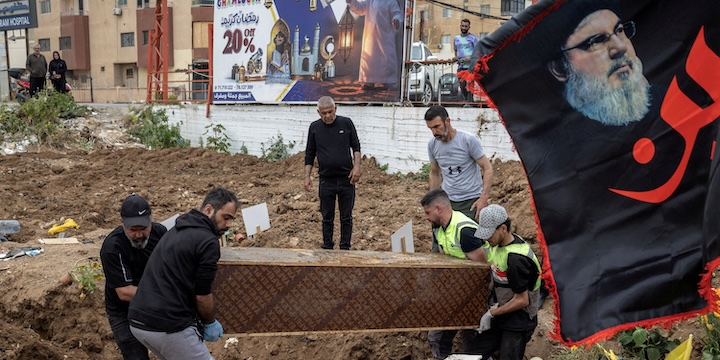
Workers remove a coffin with a body from temporary graves and prepare for transport for a funeral ceremony of four Hezbollah fighters and two civilians, amid a temporary ceasefire between Lebanon and Israel, in Tyre, southern Lebanon, April 26, 2026. Photo: REUTERS/Marko Djurica/File Photo
Hezbollah has paid a heavy price for going to war with Israel on March 2: Israel has occupied a chunk of southern Lebanon, displaced hundreds of thousands of its Shi’ite Muslim constituents and killed as many as several thousand of its fighters, according to previously unreported casualty estimates from within the group.
The move has brought severe political consequences, too. In Beirut, opposition has hardened to its status as an armed group, which domestic rivals see as exposing Lebanon to repeated wars with Israel.
In April, Lebanon’s government held face-to-face talks with Israel for the first time in decades, a decision Hezbollah firmly opposed.
However, more than a dozen Hezbollah officials told Reuters they see a chance to reverse deteriorating fortunes by aligning with Tehran in its war with Israel and the United States. The group, founded by Iran’s Islamic Revolutionary Guard Corps in 1982, opened fire two days into the conflict, which began with U.S. and Israeli strikes on Iran on February 28.
The group’s calculations are based on the assessment that its participation would force Lebanon onto the agenda of U.S.-Iranian negotiations, and that Iranian pressure can secure a more robust ceasefire than one that took effect in November 2024 following a conflict sparked by the war in Gaza, the officials said.
Hezbollah was mauled in the last war, which killed its leader, Hassan Nasrallah, along with some 5,000 fighters, and weakened its long-dominant hold over the Lebanese state.
Rearmed with Iranian help, it has used new tactics and drones, surprising many with its capabilities after a fragile 15-month truce during which Hezbollah held fire, even as Israel continued to kill its members.
Hezbollah lawmaker Ibrahim al-Moussawi denied the group was acting on Iran’s behalf when it resumed hostilities, as alleged by opponents. He told Reuters Hezbollah saw a window to “break this vicious cycle … where the Israelis can target, assassinate, bombard, kill, without any revenge.”
He acknowledged losses and damage in southern Lebanon but said “you don’t go into making calculations of how many are going to be killed” when “pride and sovereignty and independence” are at stake.
Hezbollah’s media office said the figure of several thousand fighters killed in the present war was false.
While a US-mediated ceasefire that took effect on April 16 has led to a significant reduction in hostilities, Israel and Hezbollah have continued to trade blows in the south, where Israel maintains troops in a self-declared “buffer zone.”
Yezid Sayigh, a senior fellow at the Carnegie Middle East Center in Beirut, said Hezbollah had “shown more resilience than many thought possible, but that was not a strategic gain in itself.”
“The only thing that will contain Israel is a comprehensive US-Iran deal,” he said. “Without a deal, there’s going to be a lot of pain for everyone. At best, a hurting stalemate.”
GRAVES FRESHLY DUG, AND QUICKLY FILLED
More than 2,600 people have been killed since March 2, around a fifth of them women, children and medics, Lebanon’s health ministry has reported. Its toll does not distinguish between civilians and combatants.
Three sources, two of them Hezbollah officials, said the ministry’s figures do not include many of the group’s casualties. They said several thousand Hezbollah fighters have been killed, though the group does not have the full picture yet.
In a statement to Reuters, Hezbollah’s media office denied the figures cited by the sources, and that the numbers published by Lebanon’s health ministry included its members killed in Israeli strikes.
One source, a Hezbollah commander, said scores of fighters had gone to the frontline towns of Bint Jbeil and Khiyam intending to fight to the death. Their bodies have yet to be recovered.
In the Hezbollah-controlled southern suburbs of Beirut, more than two dozen freshly dug graves were quickly filled with fighters’ bodies in the days after the ceasefire took hold. Simple marble tombstones identify some as commanders, others as fighters.
In one southern village alone, Yater, the council recorded the deaths of 34 Hezbollah fighters.
Lebanon’s Shi’ite Muslim community has borne the brunt of Israel’s attacks, forced to flee into Christian, Druze and other areas, where many blame Hezbollah for starting the war.
Israel has been entrenching its hold over a security zone stretching as far as 10 km (6 miles) into Lebanon and demolishing villages, saying it aims to shield northern Israel from attacks by Hezbollah militants embedded in civilian areas.
An Israeli government official said Hezbollah had abrogated the November 2024 ceasefire by firing on Israeli citizens on March 2. The threat to northern Israel would be eradicated, the official said, adding thousands of Hezbollah militants had been killed, and Israel was steadily destroying the group’s infrastructure.
The Israeli military says Hezbollah has fired hundreds of rockets and drones at Israel since March 2. Israel has announced 17 soldiers killed in southern Lebanon, along with two civilians in northern Israel.
Citing ongoing Israeli strikes, Hezbollah has called the April ceasefire meaningless and continued to attack.
IRAN ‘WILL NOT SELL’ THEIR FRIENDS
A diplomat who has contact with Hezbollah described its decision to enter the war as a big gamble and a survival strategy, saying it felt it needed to be part of the problem so it could be part of an eventual regional solution.
It has yet to be seen if the gamble will pay off.
Tehran has demanded that Israel’s campaign against Hezbollah be included in any deal on the wider war. But US President Donald Trump said last month that any deal Washington reaches with Tehran “is in no way subject to Lebanon.”
A spokesperson for Pakistan’s Foreign Ministry, Tahir Andrabi, referred Reuters to an April 16 statement in which he said peace in Lebanon was essential to the talks it is mediating between the U.S. and Iran.
A Western official said they saw a possibility the US and Iran might eventually reach a settlement that does not address the war in Lebanon.
Asked about this, the US State Department, Iran’s mission to the United Nations in Geneva and Lebanon’s government did not immediately comment.
Hezbollah’s Moussawi said a ceasefire in Lebanon continues to be a top priority for Iran, adding Tehran shares Lebanon’s objectives, including that Israel halt attacks and withdraw from Lebanon. Hezbollah has “full trust in Iran – that the Iranians will not sell their own friends”, he said.
The State Department referred Reuters to an April 27 interview Secretary of State Marco Rubio did with Fox News, in which he said Israel had a right to defend itself against Hezbollah’s attacks, and that he didn’t think Israel wanted to maintain its buffer zone in Lebanon indefinitely.
The United States has urged Israel “to make sure their responses are proportional and targeted,” he said.
When the April 16 ceasefire was announced, Israeli Prime Minister Benjamin Netanyahu said Hezbollah’s disarmament would be a fundamental demand in peace talks with Lebanon.
Hezbollah has ruled out disarmament, saying the matter of its weapons is a topic for a national dialogue. Any move by Lebanon to disarm the group by force would risk igniting conflict in a country shattered by civil war from 1975 to 1990.
Lebanon’s President Joseph Aoun and Prime Minister Nawaf Salam have sought Hezbollah’s peaceful disarmament since last year. On March 2, the government banned the group’s military activities.
Hezbollah has demanded the government cancel that decision and end its direct talks with Israel.
Lebanese officials have told Reuters they believe direct talks with Israel under the auspices of the US are the best way to secure a lasting ceasefire and the withdrawal of Israeli troops, as only Washington has enough leverage with Israel to achieve those aims.
Uncategorized
US President Trump Tells Israeli Media: ‘I Studied Iran’s New Proposal, It Is Not Acceptable to Me’

US President Donald Trump arrives to award the medal of honor to Master Sgt. Roderick ‘Roddie’ W. Edmonds, Staff Sgt. Michael H. Ollis, and retired Command Sgt. Maj. Terry P. Richardson during a ceremony in the East Room of the White House in Washington, DC, USA, 02 March 2026.
US President Donald Trump said he has reviewed Iran’s latest proposal and described it as “unacceptable” in an interview with Israeli broadcaster Kan News on Sunday. Trump added that ongoing efforts related to the conflict are “progressing very well,” without providing further details. He also renewed his call for clemency for Israeli Prime Minister Benjamin Netanyahu, arguing that Israel needs a leader focused on wartime priorities rather than legal matters.
Uncategorized
Israel Court Extends Detention of Gaza Flotilla Activists
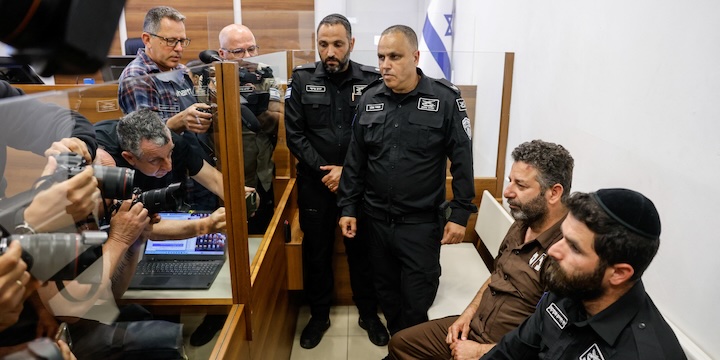
Activist Saif Abu Keshek, a member of the Global Sumud Flotilla detained by Israel, sits at a magistrate’s court for a detention extension hearing in Ashkelon, southern Israel, May 3, 2026. REUTERS/Amir Cohen
An Israeli court has extended by two days the detention of two activists arrested aboard a Gaza-bound flotilla that was intercepted by Israeli forces in international waters near Greece, their lawyer said on Sunday.
Saif Abu Keshek, a Spanish national, and Brazilian Thiago Avila were detained by Israeli authorities late on Wednesday and brought to Israel, while more than 100 other pro-Palestinian activists aboard the boats were taken to the Greek island of Crete.
A court spokesperson confirmed that their remand had been extended until May 5.
The governments of Spain and Brazil issued a joint statement on Friday calling their detention illegal.
The activists were part of a second Global Sumud flotilla, launched in an attempt to break Israel’s blockade of Gaza by delivering humanitarian assistance. The ships had set sail from Barcelona on April 12.
Israeli authorities requested a four-day extension of their arrest on suspicion of offenses that include assisting the enemy during wartime, contact with a foreign agent, membership in and providing services to a terrorist organization, and the transfer of property for a terrorist organization, said rights group Adalah, which is assisting in the activists’ defense.
Hadeel Abu Salih, the men’s attorney, said that the two deny the allegations. Their arrest was unlawful due to a lack of jurisdiction, she told Reuters at the Ashkelon Magistrate’s Court after the hearing, adding that the mission was meant to provide aid to civilians in Gaza, not to any militant group.
Abu Salih said that Abu Keshek and Avila were subjected to violence en route to Israel and kept handcuffed and blindfolded until Thursday morning.
Asked for comment, the Israeli military referred Reuters to the Israeli foreign ministry, which said that staff were compelled to act to stop what it described as violent physical obstruction by Abu Keshek and Avila. All measures taken were lawful, it said.