


Uncategorized
US teen deported, Israeli rabbi wounded as tensions mount for Jewish activists in the West Bank
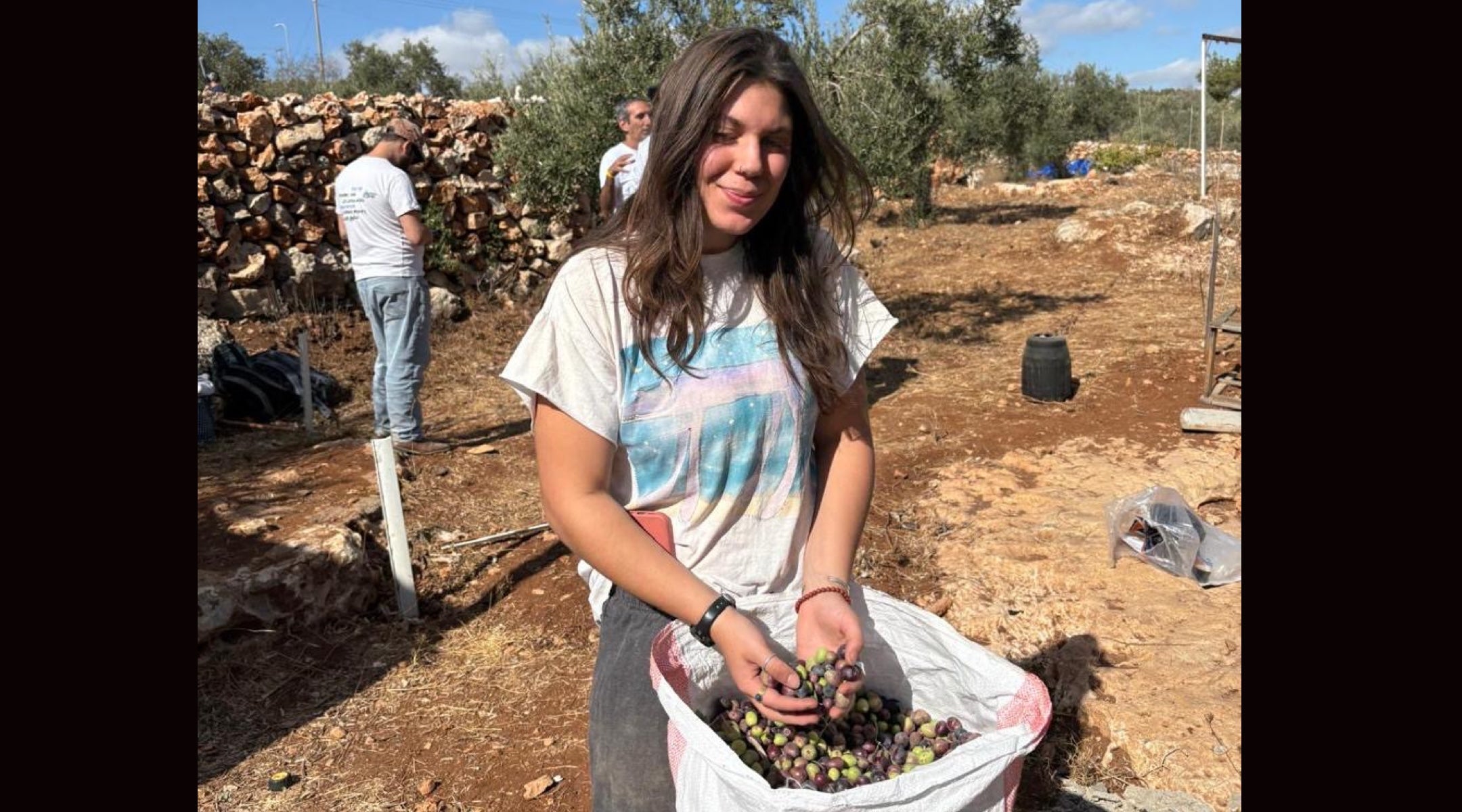
(JTA) — JERUSALEM — Having spent the night in an immigrant detention center in Ramle, Israel, Leila Stillman-Utterback, still handcuffed, began to daven shacharit, the morning prayers, as dawn broke.
“I think the police officers were very confused, because that was not the image of an activist that they had,” said the 18-year-old Vermont native.
Now, after being deported and banned by Israel for 10 years, she is unsure when she will be able to confuse people in Israel again.
In two separate incidents this past week, the right-wing Israeli government’s conflict with the Jewish left, both at home and abroad, reached new heights as American and Israeli Jews attempted to accompany Palestinians during their olive harvest in the West Bank. Harvesters have faced repeated restrictions by the Israeli military and a string of threats and attacks by local Israeli settlers.
In the first incident, Stillman-Utterback and another Jewish American were accused of violating the terms of their tourist visas and entering a closed military zone. The two were detained, deported and banned for 10 years from Israel.
Days later, armed Israeli settlers confronted a delegation of Jewish American activists. An Israeli dressed in partial military fatigues shot a live bullet into the air and a drone struck and injured a rabbi on the scene. The incident was caught on camera.
“These two incidents, one after another, are just evidence both of the danger of what’s happening, and that the Israeli government has made a decision that, rather than address the horrific violence by settlers, they’re going to … penalize American Jews who are here because they care about this land and the people who live here,” said Rabbi Jill Jacobs, the executive director of the progressive Jewish organization T’ruah, who was present at the second incident.
The clashes and deportations of American Jewish activists, most of whom with deep connections to their Jewish communities as well as Israel, left Jewish groups and those affected dismayed.
The rabbinical associations for the Reform, Conservative and Reconstructionist movements issued a joint statement saying they were “appalled by the attack on a group of rabbis, including members from all three of our organizations, by radical settlers” in the West Bank.
“We demand that the attackers be held accountable for their actions and that the Israeli government use its authority to end such provocations and attacks,” they said. An Israeli Reform rabbi and member of parliament, Gilad Kariv, plans to raise the issue in the Knesset.
This year has seen an uptick in Israeli and international activists providing a protective presence for Palestinians attempting to complete the all-important olive harvest, which is a cultural touchstone as well as an economic lifeline for rural Palestinians facing high unemployment.
Between Oct. 1 and Oct. 27, the UN’s Office for the Coordination of Humanitarian Affairs documented 126 olive harvest-related settler attacks against Palestinians resulting in casualties, property damage, or both, a record pace. In addition, Palestinian farmers have been consistently presented with closed military zone orders for up to 24 hours in the areas they wish to harvest.
In mid-October, Israel detained and deported 32 foreign activists who were accompanying Palestinian harvesters near Burin.
Stillman-Utterback joined 10 other Jews — seven Israelis, and three other foreigners — on Oct. 29 as part of a solidarity harvest in Burin organized by Rabbis for Human Rights.
When she graduated from high school this past spring, Stillman-Utterback knew she wanted to spend a gap year in Israel. Stillman-Utterback’s mother is a rabbi, and she worked as a Hebrew school teacher while spending her summers at Eden Village, a Jewish summer camp in upstate New York. She was also on the Jewish Youth Climate Movement’s executive board in high school, and she was named a Bronfman Fellow, a cohort of high-achieving Jewish teens, two years ago.
“My anchors in my life and a lot of my communities that are really important to me are all Jewish,” Stillman-Utterback told JTA.
Having gone on multiple summer trips to Israel over the years, Stillman-Utterback spent the 2022-2023 school year living in Jerusalem with her family. She attended many of the pro-democracy protests outside the Knesset that year, calling them “inspiring.”
“I learned about Israel through the perspective of Jewish values like tikkun olam and b’tselem elohim,” she explained, using Hebrew terms meaning social action and the concept that all humans are created in God’s image. “That every human being is made in the image of Hashem, and that is how I was learning about and looking at the conflict.”
Along with the other woman deported by Israel, Stillman-Utterback had come to Israel this fall as a part of the Achvat Amim program, which is connected to the socialist Zionist youth group Hashomer Hatzair. The five-month volunteer program in Jerusalem focuses on “self-determination of all people.”
Stillman-Utterback joined half a dozen harvests before the one that led to her deportation.
Before the latest and last action, the activists were stopped by Israeli soldiers at a “flying checkpoint” at the entrance of the village of Burin. An organizer was handed a closed military zone order, prohibiting the group from entering the area. According to one of the volunteers, they decided to take another route to join the harvest in an area that they believed was not included in the order.
Shortly after arriving at the new area, organizers learned that their bus drivers had been detained by the Israeli military, with their keys confiscated. Upon hearing this, they decided to bring the group to the soldiers, according to one volunteer present. The volunteer asked for anonymity because Israeli authorities later demanded the activists sign a statement promising not to speak publicly about the incident.
After the activists were held for 90 minutes by the soldiers, Israeli police arrived and announced they were detaining the entire bus because the participants were aware they had entered a closed military zone. The volunteers were escorted to the police station in the Israeli settlement of Ariel. Those with Israeli citizenship or with visas other than a student or tourist visa were released shortly thereafter.
According to Michal Pomerantz, the lawyer for the deported women, Stillman-Utterback and another Jewish-American woman on tourist visas were brought to an immigration tribunal in Ramle. With the proceedings carried out in Hebrew, they were unaware that it was a deportation proceeding and that the man they were speaking to was a judge, according to Pomerantz.
Israeli authorities say the participants ignored the initial warning and were aware they were in a closed military zone. One of the other detained participants said the group believed they had moved to an area that was not under the order.
“The policeman asked [Stillman-Utterback], ‘Why didn’t you get off the bus?’” recounted Pomerantz. “I mean, it was an 18-year-old in the middle of the West Bank. She had no idea where she was.”
The head of Hashomer Hatzair wrote a letter to Israeli authorities vouching for the two women while asserting they were engaged in a Zionist program oriented around “coexistence.” Pomerantz says this plea didn’t make a difference to immigration officials. Neither did telling Israeli officials that they were Jewish.
Faced with either appealing the decision and spending the weekend in an immigration prison or accepting a flight out of Israel, both women accepted the offer to be flown out, leaving the country on Friday.
“They basically are getting deported over being in a closed military zone for a couple of minutes,” said Becca Strober, the executive director of Achvat Amim.
The deportation of foreign Jews engaged in solidarity activism with Palestinians is a relatively new phenomenon. Strober recalled one such action she and others took in 2016 in which they deliberately entered a declared closed military zone. In that case, while six Israeli activists were detained, the American citizens were left alone.
The closest example to the case in Burin is that of Leo Franks, a British Jew who arrived in Israel last year on a tourist visa with plans to immigrate. After being detained for pro-Palestinian activism work in the West Bank, Franks had his immigration application denied and was ordered to leave the country within seven days.
“For a state that claims to be a Jewish state for all Jews,” said Strober, “if you just show up one day and stand in support of Palestinians by doing something as basic as picking olives together, actually, then your Jewishness is irrelevant.”
Jewish and other groups organizing solidarity harvests this year complain that while there were previously mechanisms for coordinating harvests with the military, this year they are largely unable to do so.
Organizers for Rabbis for Human Rights say they have been presented with closed military zone orders the majority of the time they arrive at Palestinians’ olive groves. Pomerantz and a team of lawyers have been involved in an ongoing case with the Israeli Supreme Court for the last three years, claiming that military zone closures are being misused by the army for political instead of security purposes.
“Our ability to be protected by the army has really broken down,” said one of the other Jewish volunteers who was detained in Burin. “And especially with this Netanyahu-led coalition, we’re treated as traitors. We’re treated as suspects, as anarchists, as people coming with some kind of foreign agenda.
“But we affirm that we’re doing this for the sake of Israeli society, as much as we’re doing it for the liberation of Palestinians.”
In a joint statement made by the IDF and Israeli police after the incident, authorities said they had conducted an operation in Burin together with the Population and Immigration Authority after discovering activities by Israeli and foreign activists in the area that were “endangering public security and causing friction on the ground.” Subsequently, they worked to “locate and stop foreign elements involved in incitement and provocations which create disturbances of the public order.”
The statement went on to say that the two women had violated the terms of their tourist visas. Though at first promising to do so, a spokesperson for the IDF did not comment further to JTA.
Rabbi Jacobs said she organized a trip to the West Bank this year in response to the changing conditions on the ground.
“Settler violence has just gone up extraordinarily in the last couple of years during the war,” Jacobs told JTA. “When we’ve been watching it from afar, as many of our Israeli and Palestinian colleagues have been affected by it, it seemed appropriate that even if we can’t as Americans be here every day, that we would at least find a time for a group of us to be here.”
Working with Rabbis for Human Rights on the ground, Jacobs and eight other rabbis — several of whom had already flown to Israel to attend the World Zionist Congress — first went out picking olives in the Palestinian village of Battir before staying overnight with Palestinian shepherds in the Jordan Valley. Such shepherds report an onslaught of physical attacks by Israeli settlers while being mostly prevented by settlers and soldiers from grazing their flocks in lands now often located in military firing zones or nearby Israeli settlements or outposts.
On Tuesday, the group then went to fields near Deir Istiya to pick olives with local Palestinians, joining other solidarity activists, a few of whom wore markers of Jewish observance such as tzitzit and kippot. The local Palestinians had been unable to reach their olive groves this year due to restrictions from Israeli soldiers and local settlers. The rabbis and Palestinians managed to pick the olives for a short time as a drone buzzed overhead. At times the drone came close to the harvesters.
At one point, the drone swooped down and struck Rabbi Dana Sharon from Rabbis for Human Rights, leaving a deep gash on her shoulder.
Soon after, two armed Israelis arrived, dressed in partial military fatigues and claiming to be a part of the security coordinator team of the nearby settlement of Revava. “The drone is a property of the [settlement security guards]!” shouted the men. Though the drone was returned, shouting ensued, with one of the harvesters shouting back. One of the men then shot a live round in the air before retreating.
Soon after, Israeli soldiers in uniform approached the group of olive harvesters, saying they were told by the two armed Israelis that the group of rabbis and olive harvesters had taken their drone and attacked them. These soldiers relented when shown videos by the harvesters suggesting otherwise.
The shock of the encounter was palpable among the group of visiting American rabbis, who hailed from a combination of Reconstructionist, Reform and Conservative congregations. One stunned rabbi asked an Israeli working for Rabbis for Human Rights about the gunshot, “That was a blank, right?” It was not.
The men have not been identified but appear to reflect a blurring of the lines between settlers and soldiers in the West Bank.
In a statement to JTA, the IDF identified the men the group thought were armed settlers as soldiers.
“IDF soldiers operated a drone that hit harvesters,” the statement said. “The incident is under review.”
According to the IDF, the soldiers arrived “to collect the drone, during which they fired shots in the air.” The incident was “unusual” and ”included unprofessional behavior” by the soldiers, said the IDF, which said without offering specifics that “disciplinary action” would be taken.
According to Jacobs, different IDF soldiers in uniform were present from the beginning when the group began the harvest. By Jacobs’ account, these soldiers did nothing as the drone came closer and when the armed men confronted the group.
“I don’t think this [incident] is unusual, though,” she said. “Settlers in IDF uniforms harass Palestinians every day and sometimes wound and kill them. What was unusual was that this group included American and Israeli rabbis, which is likely the reason the IDF is responding at all [to requests for comment].”
Rabbi Sarah Reines, of Temple Emanu-El in New York, looks back on her three-day trip in the West Bank heartened by the Palestinian communities she visited and committed to continued solidarity.
Reines praised “these people’s resilience and their ability to discern the difference between Israelis who threaten them and cause them harm, those who are neutral, and those who are friends.”
She added, “The rising danger only increases my resolve to represent the highest Jewish values of respect, lovingkindness, peace and preservation of life in the land Jews call home.”
In the case of Stillman-Utterback, her deportation and banning left her with “a sense of betrayal,” one that she is now processing from back in the United States.
“It sent me the message that, despite being Jewish in a state that was created for Jews, I’m not the right kind of Jew, or maybe not even Jewish at all, in the eyes of the state and the army and the police,” said Stillman-Utterback.
The post US teen deported, Israeli rabbi wounded as tensions mount for Jewish activists in the West Bank appeared first on The Forward.
Uncategorized
High-Stakes US Special Forces Mission Rescues Airman From Iran After F-15 Crash

FILE PHOTO: A U.S. Air Force F-15E Strike Eagle aircraft takes off for a mission supporting Operation Epic Fury during the Iran war at an undisclosed location, March 9, 2026. U.S. Air Force/Handout via REUTERS/File Photo
US forces staged the audacious rescue of an airman behind enemy lines after Iran downed his fighter jet, officials said on Sunday, resolving a crisis for President Donald Trump as he weighs escalating the war, now in its sixth week.
The airman rescued by special operations forces, who Trump said was a colonel, was the weapons-systems officer on the downed F-15, a US official told Reuters.
“Over the past several hours, the United States Military pulled off one of the most daring Search and Rescue Operations in US History,” Trump said in a statement, adding that the airman was injured but “he will be just fine.”
The officer was the second of two crew members on the warplane that Iran said on Friday had been brought down by its air defenses. Iran’s Revolutionary Guards said several aircraft were destroyed during the US rescue mission, Tasnim news agency reported.
Reuters reported on Friday that the first crew member had been retrieved, triggering a high-profile search by both Iran and the United States for the remaining airman.
Iranian officials had urged citizens to help find him, hoping to gain leverage against Washington in the war Trump and Israel launched on February 28.
Trump has threatened to escalate the conflict in the coming days with attacks on Iran’s energy infrastructure.
Had Iran captured the airman, the ensuing hostage crisis could have shifted American public perception of a conflict that opinion polls show was already unpopular.
Trump said the airman was rescued “in the treacherous mountains of Iran” in what he said was the first time in military memory that two US pilots had been rescued, separately, deep in enemy territory.
The official told Reuters that as the weapons-systems officer was moved from near a mountain to a transport aircraft parked within Iran, US forces had to destroy at least one of the aircraft because it had malfunctioned.
U.S. AIRCRAFT HIT
The rescue effort, involving dozens of military aircraft, encountered fierce resistance from Iran.
Reuters reported on Friday that two Black Hawk helicopters involved in the search were hit by Iranian fire but escaped from Iranian airspace.
Separately, a pilot ejected from an A-10 Warthog fighter aircraft after it was hit over Kuwait and crashed, the officials said, though the extent of crew injuries was unclear.
Still, Trump was triumphant.
“The fact that we were able to pull off both of these operations, without a SINGLE American killed, or even wounded, just proves once again, that we have achieved overwhelming Air Dominance and Superiority over the Iranian skies,” he said in his statement.
US air crews are trained in what to do if they go down behind enemy lines, measures known as Survival, Evasion, Resistance and Escape, but few are fluent in Persian and face a challenge in staying undetected while seeking rescue.
The conflict has killed 13 US military service members, with more than 300 wounded, US Central Command says. No US troops have been taken prisoner by Iran.
While Trump has repeatedly sought to portray the Iranian military as being in tatters, they have repeatedly been able to hit US aircraft.
Reuters reported on US intelligence showing that Iran retains large amounts of missile and drone capability. Until just over a week ago, the US could only determine with certainty that it had destroyed about one-third of Iran’s missile arsenal.
The status of about another third was less clear, but bombings probably damaged, destroyed or buried those missiles in underground tunnels and bunkers, Reuters sources said.
The US and Israeli war on Iran has spread across the Middle East, killing thousands and hitting the global economy with soaring energy prices that are fueling fears of inflation.
Uncategorized
On Easter, Pope Leo Urges World Leaders to End Wars, Renounce Conquest

Pope Leo XIV waves from the main balcony of St. Peter’s Basilica after delivering his “Urbi et Orbi” (To the city and the world) message, on Easter Sunday at the Vatican, April 5, 2026. Photo: REUTERS/Remo Casilli
Pope Leo urged global leaders in his Easter message on Sunday to end the conflicts raging across the world and abandon any schemes for power, conquest or domination.
The pope, who has emerged as an outspoken critic of the Iran war, lamented in a special message to the thousands gathered in St. Peter’s Square that people “are growing accustomed to violence, resigning ourselves to it, and becoming indifferent.”
“Let those who have weapons lay them down!” the first US pope exhorted. “Let those who have the power to unleash wars choose peace!”
Leo did not mention any specific conflicts in the message, known as the “Urbi et Orbi” (to the city and the world) blessing. It was unusually brief and direct.
The pope said that the story of Easter, when the Bible says Jesus rose from the dead three days after not resisting his execution by crucifixion, shows that Christ was “entirely nonviolent.”
“On this day of celebration, let us abandon every desire for conflict, domination, and power, and implore the Lord to grant his peace to a world ravaged by wars,” Leo urged.
Leo, who is known for choosing his words carefully, has been forcefully decrying the world’s violent conflicts in recent weeks and ramping up his criticism of the Iran war.
In a sermon for the Easter vigil on Saturday night, he urged people not to feel numbed by the scope of the conflicts raging across the world but to work for peace.
The pope made a rare direct appeal to US President Donald Trump on Tuesday, urging him to find an “off-ramp” to end the Iran war.
In his address from the balcony of St. Peter’s Basilica on Sunday to the Square below, decorated with thousands of brightly colored flowers for the holiday, Leo offered brief Easter greetings in ten languages, including Latin, Arabic and Chinese.
The pope also announced he would return to the Basilica on April 11 to host a prayer vigil for peace.
Uncategorized
Temple Mount Set for Limited Reopening to Jews and Muslims

Israeli National Security Minister and head of Jewish Power party Itamar Ben-Gvir gives a statement to members of the press, ahead of a possible ceasefire between Israel and Hamas, in Jerusalem, Jan. 16, 2025. Photo: REUTERS/Oren Ben Hakoon
i24 News – Israeli authorities are preparing to partially reopen the Temple Mount in Jerusalem to both Jewish and Muslim worshipers for the first time since the start of the war with Iran, under a tightly controlled and highly restricted security arrangement, i24NEWS has learned.
According to details obtained by i24NEWS, the Israeli police, backed by National Security Minister Itamar Ben-Gvir, are also expected to permit limited access for Jewish worshipers to the Western Wall as part of the same phased plan.
Under the framework, access to the Temple Mount and surrounding holy sites would be restricted to small groups of up to 150 people at a time. In the event of a missile alert, all visitors would be immediately evacuated in accordance with emergency protocols.
The decision follows a recent Supreme Court ruling allowing demonstrations in a limited format. Police argue that a consistent standard must apply across both civic gatherings and religious sites, with Ben-Gvir insisting that “there cannot be one rule for demonstrations and another for the Temple Mount.”
However, the reopening contradicts recommendations from the Home Front Command, which has advised keeping sensitive sites closed due to the ongoing risk of missile attacks.
Israeli Justice Minister Yariv Levin has proposed transferring authority over such security-related decisions exclusively to defense officials, an initiative that could reshape the balance between the judiciary and security establishment regarding restrictions on public access.