


Uncategorized
What is Elbit Systems, and why did LA synagogue protesters target the Israeli company?
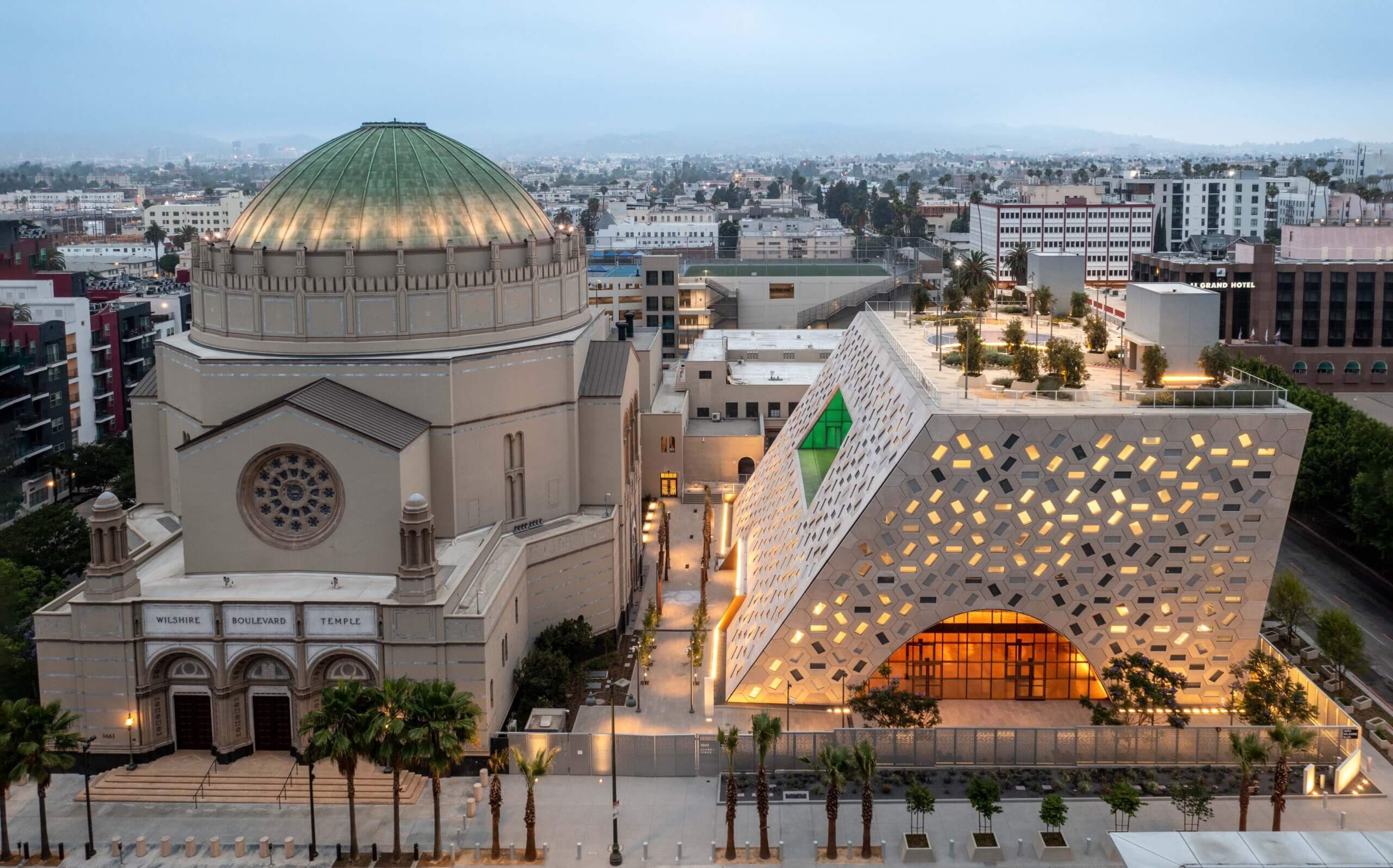
A protest outside Wilshire Boulevard Temple — one of Los Angeles’ oldest synagogues — ended with two arrests Wednesday after demonstrators confronted attendees at an event featuring a speaker from Elbit Systems, the Israeli defense firm whose technology is widely used by Israel’s military and, in some cases, by U.S. law-enforcement and border-security agencies.
Videos posted online showed protesters gathering outside the synagogue’s Audrey Irmas Pavilion, unfurling banners that read “Elbit out of Los Angeles” and “Genociders not welcome.” They handed out flyers accusing the company of supplying “weapons and technology that Israel uses against Palestinian civilians” and that Immigration and Customs Enforcement uses in the U.S.
The reaction was swift. “This behavior is abhorrent and has no place in Los Angeles,” Mayor Karen Bass said. The Jewish Federation of Greater Los Angeles called the demonstration “antisemitism and hate disguised as dissent,” while ADL California said, “Blocking or invading a house of worship is not legitimate protest. It’s intimidation.”
The confrontation underscored the growing attention on Elbit Systems — and the tensions that surround it.
What is Elbit Systems?
Elbit Systems is Israel’s largest privately run defense contractor. Founded in 1966, it has evolved into a multinational firm that manufactures drones, surveillance systems, border-security towers, targeting equipment, and other military electronics used by Israel and a number of foreign governments.
The company has roughly 20,000 employees — most based in Israel — with offices around the globe. Its U.S. subsidiary operates facilities across the country and has long supplied equipment to American defense and homeland-security agencies.
Elbit did not respond to a request for an interview.
Why does Elbit draw protests?
Two main issues animate opposition: Elbit’s role in Israeli military operations and its work for U.S. law enforcement.
Flyers at Wednesday’s demonstration accused the company of producing technology “used against Palestinian civilians.” Protest organizers argue that Elbit’s equipment enables Israeli operations in Gaza and the West Bank.
The Palestinian Youth Movement, one of the groups involved in the synagogue protest in Koreatown, wrote on Instagram: “We KNOW that these technologies are created on the targeting and killing of Palestinians in Gaza and the West Bank, and will do the same to vulnerable communities in Ktown.”
Protest literature also claimed Elbit provides surveillance tools used by ICE and Customs and Border Protection. The company has received contracts to build border-surveillance towers and related systems along parts of the U.S.–Mexico border. It is also on a list of potential contractors for the Pentagon’s Golden Dome missile defense program, a project inspired by Israel’s Iron Dome.
U.S. Elbit facilities are protest sites
Based in Fort Worth, Texas, Elbit Systems of America employs around 3,200 people across 10 states. Several of their U.S. facilities have been the sites of protests.
Merrimack, New Hampshire: An Elbit plant was targeted by pro-Palestinian activists, some of whom climbed onto the roof, deployed smoke devices, spray-painted equipment, smashed windows, and locked building entrances. Among those arrested in the Nov. 2023 incident was a former Disney Channel actress.
Cambridge, Massachusetts: There were repeated protests at this facility beginning in Oct. 2023, five days after the Hamas attack that started the war in Gaza. The office eventually closed down in Aug. 2024.
Ladson, South Carolina: There have been weekly protests at Elbit’s Charleston-area facility since Oct. 2024, with criticism over tax incentives granted to the company. Demonstrators have questioned whether public funds should support a defense-industry site.
Protests are not just in the United States
Since the onset of the Israel-Hamas war, several Elbit facilities in the United Kingdom have been targeted by pro-Palestinian activists — including six who are currently on trial over a 2024 break-in at an Elbit site in Bristol. One is accused of striking a police officer with a sledgehammer. The Bristol facility unexpectedly closed down in September.
In Britain, the government is defending its decision to ban Palestine Action — a group that has repeatedly targeted Elbit facilities — under anti-terror laws. The ban makes membership or public support for the group a criminal offense punishable by up to 14 years in prison.
Last month, activists in six countries — Austria, France, Germany, Spain, Taiwan and the U.K. — simultaneously defaced the offices of Allianz, a global insurer that allegedly undewrites Elbit Systems.
Why did the L.A. protest take place at a synagogue?
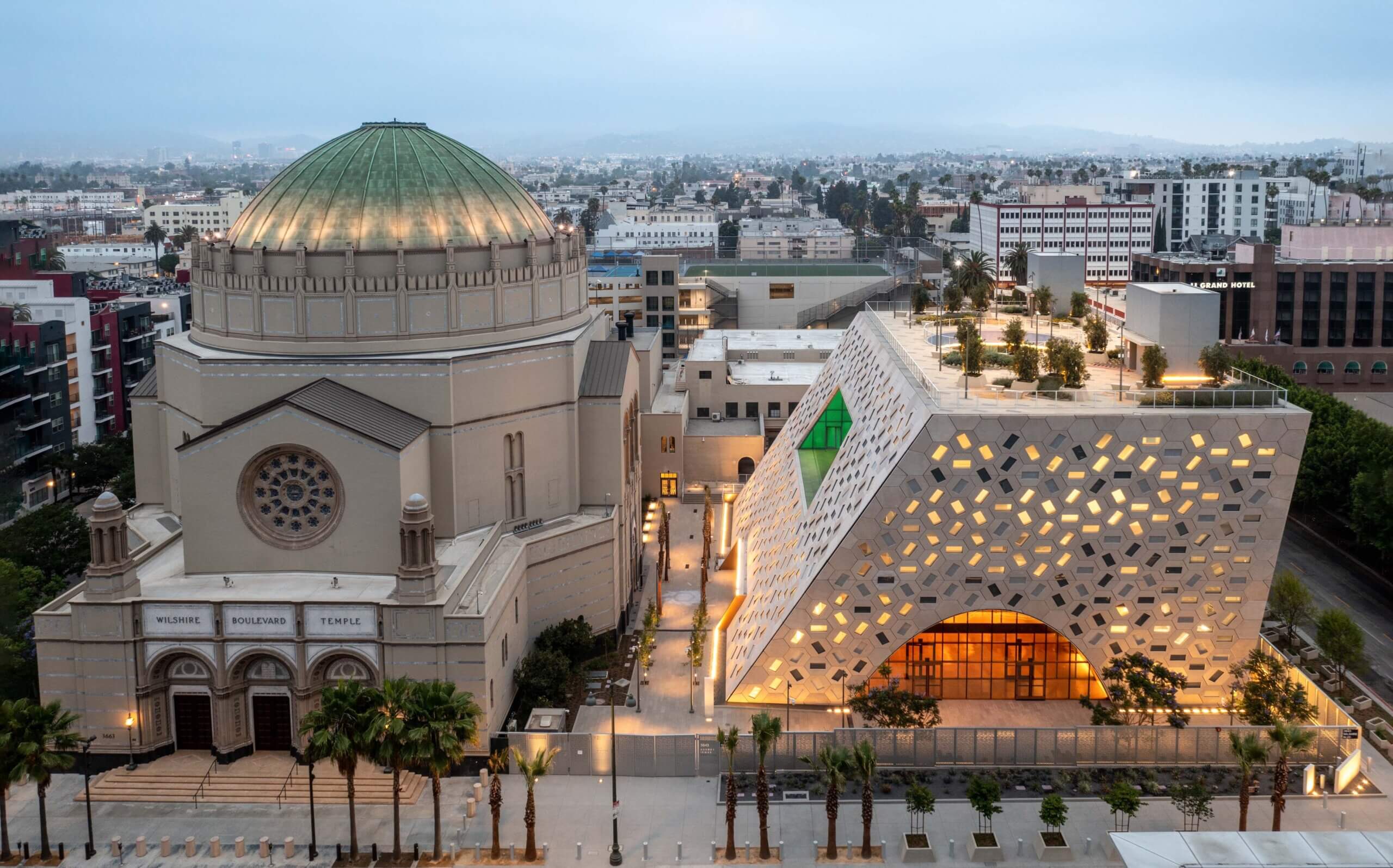
Wednesday’s talk — titled “Innovating Safety, Empowering Communities” — outside Wilshire Boulevard Temple was co-hosted by the Israeli Consulate General of Los Angeles and included speakers from Elbit, the Israeli police, and the local Jewish federation.
Activist groups, including Koreatown for Palestine, the Palestinian Youth Movement, and People’s City Council Los Angeles, urged supporters to contact the synagogue and arrive early to picket the event.
Jewish leaders argued that demonstrating outside a house of worship crossed a line. Protest organizers framed the action around the event itself and Elbit’s participation in it.
What happens next?
Jewish institutions say they face heightened security concerns when Israel-related events take place in their buildings. Last month, protesters demonstrated at Manhattan’s Park East Synagogue, which was hosting a program on immigration to Israel, including West Bank settlements, which are considered illegal under international law.
Mayor-elect Zohran Mamdani faced criticism from parts of the Jewish community after he said, through a spokesperson, that “sacred spaces should not be used to promote activities in violation of international law.” Dozens of Jewish groups plan a solidarity rally Thursday night outside Park East.
On Wednesday, a group of New York lawmakers proposed banning protests within 25 feet of houses of worship — the latest indication of how rapidly the debate over safety, speech, and protest is shifting.
Louis Keene contributed to this article.
The post What is Elbit Systems, and why did LA synagogue protesters target the Israeli company? appeared first on The Forward.
Uncategorized
High-Stakes US Special Forces Mission Rescues Airman From Iran After F-15 Crash

FILE PHOTO: A U.S. Air Force F-15E Strike Eagle aircraft takes off for a mission supporting Operation Epic Fury during the Iran war at an undisclosed location, March 9, 2026. U.S. Air Force/Handout via REUTERS/File Photo
US forces staged the audacious rescue of an airman behind enemy lines after Iran downed his fighter jet, officials said on Sunday, resolving a crisis for President Donald Trump as he weighs escalating the war, now in its sixth week.
The airman rescued by special operations forces, who Trump said was a colonel, was the weapons-systems officer on the downed F-15, a US official told Reuters.
“Over the past several hours, the United States Military pulled off one of the most daring Search and Rescue Operations in US History,” Trump said in a statement, adding that the airman was injured but “he will be just fine.”
The officer was the second of two crew members on the warplane that Iran said on Friday had been brought down by its air defenses. Iran’s Revolutionary Guards said several aircraft were destroyed during the US rescue mission, Tasnim news agency reported.
Reuters reported on Friday that the first crew member had been retrieved, triggering a high-profile search by both Iran and the United States for the remaining airman.
Iranian officials had urged citizens to help find him, hoping to gain leverage against Washington in the war Trump and Israel launched on February 28.
Trump has threatened to escalate the conflict in the coming days with attacks on Iran’s energy infrastructure.
Had Iran captured the airman, the ensuing hostage crisis could have shifted American public perception of a conflict that opinion polls show was already unpopular.
Trump said the airman was rescued “in the treacherous mountains of Iran” in what he said was the first time in military memory that two US pilots had been rescued, separately, deep in enemy territory.
The official told Reuters that as the weapons-systems officer was moved from near a mountain to a transport aircraft parked within Iran, US forces had to destroy at least one of the aircraft because it had malfunctioned.
U.S. AIRCRAFT HIT
The rescue effort, involving dozens of military aircraft, encountered fierce resistance from Iran.
Reuters reported on Friday that two Black Hawk helicopters involved in the search were hit by Iranian fire but escaped from Iranian airspace.
Separately, a pilot ejected from an A-10 Warthog fighter aircraft after it was hit over Kuwait and crashed, the officials said, though the extent of crew injuries was unclear.
Still, Trump was triumphant.
“The fact that we were able to pull off both of these operations, without a SINGLE American killed, or even wounded, just proves once again, that we have achieved overwhelming Air Dominance and Superiority over the Iranian skies,” he said in his statement.
US air crews are trained in what to do if they go down behind enemy lines, measures known as Survival, Evasion, Resistance and Escape, but few are fluent in Persian and face a challenge in staying undetected while seeking rescue.
The conflict has killed 13 US military service members, with more than 300 wounded, US Central Command says. No US troops have been taken prisoner by Iran.
While Trump has repeatedly sought to portray the Iranian military as being in tatters, they have repeatedly been able to hit US aircraft.
Reuters reported on US intelligence showing that Iran retains large amounts of missile and drone capability. Until just over a week ago, the US could only determine with certainty that it had destroyed about one-third of Iran’s missile arsenal.
The status of about another third was less clear, but bombings probably damaged, destroyed or buried those missiles in underground tunnels and bunkers, Reuters sources said.
The US and Israeli war on Iran has spread across the Middle East, killing thousands and hitting the global economy with soaring energy prices that are fueling fears of inflation.
Uncategorized
On Easter, Pope Leo Urges World Leaders to End Wars, Renounce Conquest

Pope Leo XIV waves from the main balcony of St. Peter’s Basilica after delivering his “Urbi et Orbi” (To the city and the world) message, on Easter Sunday at the Vatican, April 5, 2026. Photo: REUTERS/Remo Casilli
Pope Leo urged global leaders in his Easter message on Sunday to end the conflicts raging across the world and abandon any schemes for power, conquest or domination.
The pope, who has emerged as an outspoken critic of the Iran war, lamented in a special message to the thousands gathered in St. Peter’s Square that people “are growing accustomed to violence, resigning ourselves to it, and becoming indifferent.”
“Let those who have weapons lay them down!” the first US pope exhorted. “Let those who have the power to unleash wars choose peace!”
Leo did not mention any specific conflicts in the message, known as the “Urbi et Orbi” (to the city and the world) blessing. It was unusually brief and direct.
The pope said that the story of Easter, when the Bible says Jesus rose from the dead three days after not resisting his execution by crucifixion, shows that Christ was “entirely nonviolent.”
“On this day of celebration, let us abandon every desire for conflict, domination, and power, and implore the Lord to grant his peace to a world ravaged by wars,” Leo urged.
Leo, who is known for choosing his words carefully, has been forcefully decrying the world’s violent conflicts in recent weeks and ramping up his criticism of the Iran war.
In a sermon for the Easter vigil on Saturday night, he urged people not to feel numbed by the scope of the conflicts raging across the world but to work for peace.
The pope made a rare direct appeal to US President Donald Trump on Tuesday, urging him to find an “off-ramp” to end the Iran war.
In his address from the balcony of St. Peter’s Basilica on Sunday to the Square below, decorated with thousands of brightly colored flowers for the holiday, Leo offered brief Easter greetings in ten languages, including Latin, Arabic and Chinese.
The pope also announced he would return to the Basilica on April 11 to host a prayer vigil for peace.
Uncategorized
Temple Mount Set for Limited Reopening to Jews and Muslims

Israeli National Security Minister and head of Jewish Power party Itamar Ben-Gvir gives a statement to members of the press, ahead of a possible ceasefire between Israel and Hamas, in Jerusalem, Jan. 16, 2025. Photo: REUTERS/Oren Ben Hakoon
i24 News – Israeli authorities are preparing to partially reopen the Temple Mount in Jerusalem to both Jewish and Muslim worshipers for the first time since the start of the war with Iran, under a tightly controlled and highly restricted security arrangement, i24NEWS has learned.
According to details obtained by i24NEWS, the Israeli police, backed by National Security Minister Itamar Ben-Gvir, are also expected to permit limited access for Jewish worshipers to the Western Wall as part of the same phased plan.
Under the framework, access to the Temple Mount and surrounding holy sites would be restricted to small groups of up to 150 people at a time. In the event of a missile alert, all visitors would be immediately evacuated in accordance with emergency protocols.
The decision follows a recent Supreme Court ruling allowing demonstrations in a limited format. Police argue that a consistent standard must apply across both civic gatherings and religious sites, with Ben-Gvir insisting that “there cannot be one rule for demonstrations and another for the Temple Mount.”
However, the reopening contradicts recommendations from the Home Front Command, which has advised keeping sensitive sites closed due to the ongoing risk of missile attacks.
Israeli Justice Minister Yariv Levin has proposed transferring authority over such security-related decisions exclusively to defense officials, an initiative that could reshape the balance between the judiciary and security establishment regarding restrictions on public access.