


Uncategorized
When roast goose was a Hanukkah delicacy, and latkes were fried in its schmaltz
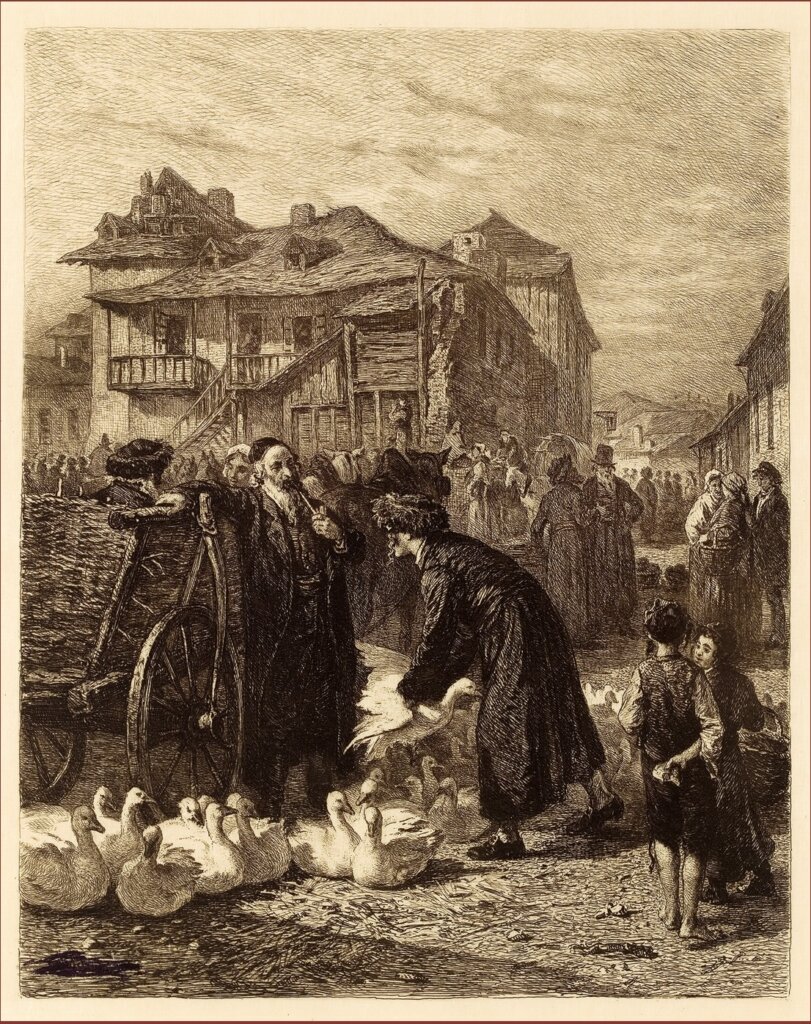
As someone who grew up with the tradition of eating potato latkes with smetene, or sour cream, I was completely thrown when I first read Sholem Aleichem’s story “Khanike-gelt,” about the gifts of money traditionally given on Hanukkah.
In the story, a boy in a shtetl describes what the first night of Hanukkah was like at his house. Near the beginning, the father tells his two young sons to go call their mother from the kitchen so that she can hear him bless the Hanukkah candles.
“Mama, quick, time to light the Hanukkah candles!”
“Oy, Hanukkah candles!” Mama exclaimed, tossed aside her utensils (she had slaughtered geese, was frying the goose fat and was making leavened latkes) and hurried into the living room, with Brayne the cook close behind.
I remember wondering: How could she make latkes with goose fat — schmaltz, in Yiddish — when this Hanukkah delicacy is supposed to be eaten with sour cream? After all, there’s no mixing meat and milk in a kosher home.
As it turns out, eating latkes with sour cream wasn’t nearly as popular in the shtetl as having them fried in goose fat. Accounts from the 19th and early 20th centuries report that geese were confined and force-fed during the autumn to fatten them up, Yiddish folklore scholar Barbara Kirshenblatt-Gimblett wrote in this YIVO article.
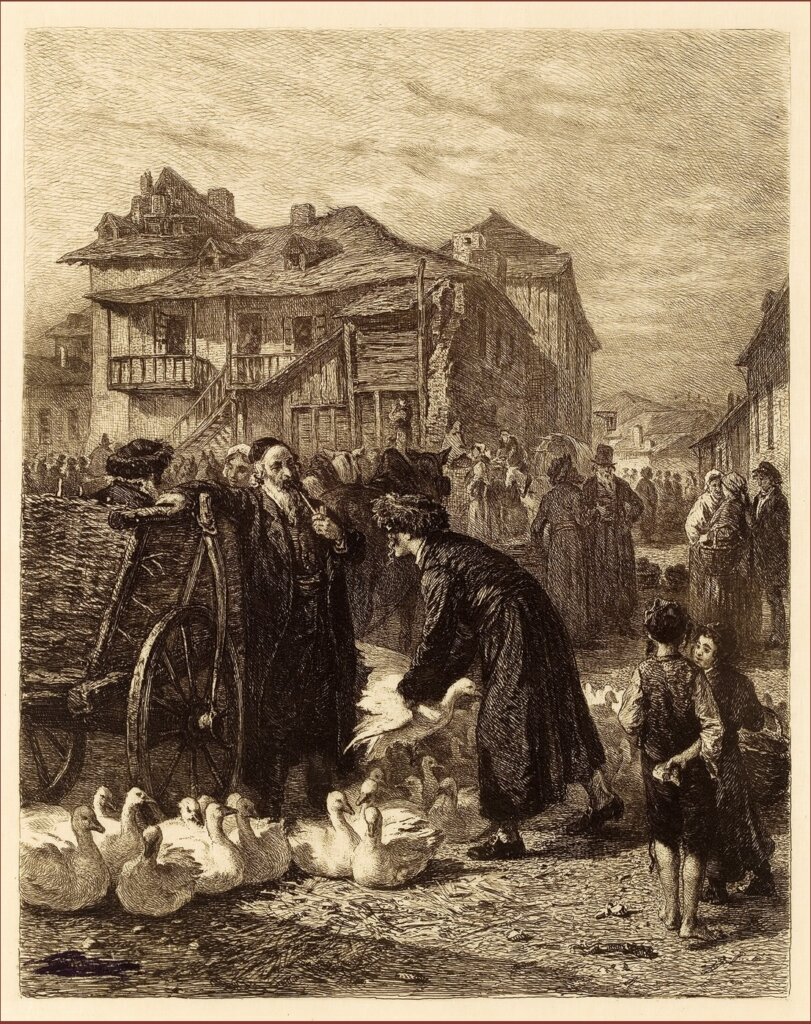
“They were slaughtered before Hanukkah in order to render enough fat to last through the winter, when butter was scarce. The thick goose skins were rendered with the fat, which was later strained; the cracklings, grivn (or grieven or gribenes), a great delicacy, were stored separately,” Kirshenblatt-Gimblett explained.
Not only were Hanukkah pancakes and fritters fried in goose fat; goose fat was also rendered for Passover at this time and Passover utensils were specially taken out of storage for the purpose.
Some people even made a living selling kosher-for-Passover goose fat, as described in another Sholem Aleichem story, “Gendz” (Geese), a monologue by a woman, Basye, who sells living geese and goose fat. In it, she describes, amid various humorous digressions typical of Sholem Aleichem’s stories, her tough life and the struggles of Jewish women in general.
“Geese famously render lots of schmaltz,” Yiddish food scholar Eve Jochnowitz told me. “Early winter is when they were likely to be slaughtered to provide meat and oil that would serve for the holiday and stay frozen all winter, thanks to the cold.” In fact, she added, a sandwich of goose fat and grated radishes was a beloved snack among the shtetl Jews.
Roasted goose was a traditional holiday entree during the Middle Ages among Jews living in the Rhineland and Eastern Europe, wrote food writer Ronnie Fein. Even the Talmudist Rabbi David Halevi (also known as the “Taz”) noted that goose grivn was a gift given to those who were honored within the community.
In a New York Times article about Hanukkah goose, Gefilteria co-founder Jeffrey Yoskowitz wrote that, on the shabbos of Hanukkah, well-to-d0 Jews would host a feast with roast goose, latkes fried in its schmaltz and most likely pickled vegetables. He quoted the French food writer Édouard de Pomiane, who wrote in 1929 that the goose was a “beneficent animal” for the Jews of Poland as it supplied so much to a household, including feathers for bedding, flesh for roasting and fats for rendering.
And Michael Wex writes in his book Rhapsody in Schmaltz, that the smell of smoking goose fat became the traditional “scent” of Hanukkah.
Ashkenazi Jews who immigrated to the United States often brought the tradition of Hanukkah geese along with them. In her book 97 Orchard: An Edible History of Five Immigrant Families in One New York Tenement, Jane Ziegelman said that many 19th century Jewish homemakers raised geese on the Lower East Side, just as they did in the Old Country. But now, they did it in tenement yards and basements, a practice surely disapproved of by sanitary inspectors.
On Hanukkah, she writes, these makeshift goose farms were at their busiest. Restaurants even put up signs reading “Goose liver is here.”
But New York Jewish immigrants weren’t the only ones raising geese. In this home movie, filmed about 1928, shared by Cindra Sereghy-Scull, you can see geese outside her late Aunt Vilma’s home in Cleveland, Ohio.
Chances are, one of those geese was served for Hanukkah dinner that year.
The post When roast goose was a Hanukkah delicacy, and latkes were fried in its schmaltz appeared first on The Forward.
Uncategorized
Trump Says Gas Prices May Remain High Through November Midterm Election

U.S. President Donald Trump takes questions from reporters while Vice President JD Vance and Secretary of State Marco Rubio look on, as they attend a meeting with oil industry executives, at the White House in Washington, D.C., U.S., January 9, 2026. REUTERS/Kevin Lamarque
US President Donald Trump said on Sunday that the price of oil and gasoline may remain high through November’s midterm elections, a rare acknowledgement of the potential political fallout from his decision to attack Iran six weeks ago.
“It could be, or the same, or maybe a little bit higher, but it should be around the same,” Trump, who is in Miami for the weekend, told Fox News’ “Sunday Morning Futures With Maria Bartiromo” when asked whether the cost of oil and gas would be lower by the fall.
The average price for regular gas at US service stations has exceeded $4 per gallon for most of April, according to data from GasBuddy. Trump’s comments on Sunday came after weeks of asserting that the spike in prices is a short-term phenomenon, though his top advisers are cognizant of the war’s economic impacts, officials have said.
Earlier on Sunday, Trump announced on social media that the US Navy would blockade the Strait of Hormuz and intercept any ship that paid a crossing fee to Iran, after marathon talks between the US and Iran in Pakistan over the weekend did not yield a peace deal.
“No one who pays an illegal toll will have safe passage on the high seas,” he wrote on Truth Social.
Any US blockade is likely to add more uncertainty to the eventual resolution of the conflict, which is currently subject to a tenuous two-week ceasefire. The new tactic is in response to Iran’s own closure of the strait’s critical shipping lanes, which has caused global oil prices to skyrocket about 50%.
UNPOPULAR WAR HITS TRUMP’S APPROVAL
The war began on February 28, when the US launched a joint bombing campaign with Israel against Iran. The scope quickly expanded as Iran and its allies attacked nearby countries, while Israel targeted Hezbollah with massive strikes in Lebanon.
The war has buffeted global financial markets and caused thousands of civilian deaths, mostly in Iran and Lebanon.
Trump’s political standing at home has suffered, with polls showing the war is unpopular among most Americans, who are frustrated by rising gasoline prices.
The president’s approval rating has hit the lowest levels of his second term in office, raising concern among Republicans that his party is poised to lose control of Congress in the midterm elections. A Democratic majority in either chamber could launch investigations into the Trump administration while blocking much of his legislative agenda.
US Senator Mark Warner of Virginia, the ranking Democrat on the Senate Intelligence Committee, questioned the strategy behind Trump’s planned blockade.
“I don’t understand how blockading the strait is going to somehow push the Iranians into opening it,” he told CNN’s “State of the Union” on Sunday.
In a separate appearance on CBS’s “Face the Nation,” Warner said the blockade would not undermine Iranian control of the waterway.
“The Iranians have hundreds of speedboats where they can still mine the strait or put bombs against tankers in closing the strait,” he said. “How is that going to ever bring down gas prices?”
Although Trump has repeatedly said that the war would be over soon, Republican US Senator Ron Johnson of Wisconsin told ABC News’ “This Week” on Sunday that achieving US aims in Iran “could take a long time.”
“It’s going to be a long-term project,” said Johnson, who was not asked about Trump’s proposed blockade. “I never thought this would be easy.”
Uncategorized
Israel’s Ben-Gvir Visits Flashpoint Al-Aqsa Mosque Compound

Israeli politician Itamar Ben-Gvir walks inside the Knesset, in Jerusalem, Oct. 13, 2025. Photo: Chip Somodevilla/Pool via REUTERS
Israel’s far-right police minister Itamar Ben-Gvir visited the flashpoint Al-Aqsa Mosque compound in Jerusalem on Sunday, saying he was seeking greater access for Jewish worshipers and drawing condemnation from Jordan and the Palestinians.
The compound in Jerusalem’s walled Old City is one of the most sensitive sites in the Middle East. Known to Jews as Temple Mount, it is the most sacred site in Judaism and is Islam’s third-holiest site.
Under a delicate, decades-old arrangement with Muslim authorities, it is administered by a Jordanian religious foundation and Jews can visit but may not pray there.
Suggestions that Israel would alter the rules have sparked outrage among Muslims and ignited violence in the past.
“Today, I feel like the owner here,” National Security Minister Ben-Gvir said in a video filmed at the site and distributed by his office. “There is still more to do, more to improve. I keep pushing the Prime Minister (Benjamin Netanyahu) to do more and more — we must keep rising higher and higher.”
A statement from the Jordanian foreign ministry said it considered Ben-Gvir’s visit to be a violation of the status quo agreement at the site and “a desecration of its sanctity, a condemnable escalation and an unacceptable provocation.”
The office of Palestinian president, Mahmoud Abbas, said such actions could further destabilize the region.
Ben-Gvir’s spokesman said the minister was seeking greater access and prayer permits for Jewish visitors. He also said that Ben-Gvir had prayed at the site.
There was no immediate comment from Netanyahu’s office. Previous such visits and statements by Ben-Gvir have prompted Netanyahu announcements saying that there is no change in Israel’s policy of keeping the status quo.
Muslim, Christian and Jewish sites, including Al-Aqsa had been largely closed to the public during the Iran war. There was no immediate sign of unrest on Sunday after Ben-Gvir’s visit.
Uncategorized
Netanyahu Visits Troops Fighting Hezbollah in Southern Lebanon

Israeli Prime Minister Benjamin Netanyahu speaks during a press conference at the Prime Minister’s office in Jerusalem, Aug. 10, 2025. Photo: ABIR SULTAN/Pool via REUTERS
i24 News – Israeli Prime Minister Benjamin Netanyahu visited Israeli forces operating in southern Lebanon on Sunday as military operations against Hezbollah-linked targets continue.
Netanyahu toured forward positions alongside Defense Minister Yisrael Katz, Eyal Zamir, and Northern Command Commander Rafi Milo, meeting troops and receiving operational briefings from commanders on the ground.
Speaking to soldiers, Netanyahu praised their performance and said operations in the Lebanese security zone were ongoing.
“The war continues, including within the security zone in Lebanon,” he said, adding that Israeli forces were working to prevent infiltration attempts and neutralize threats such as anti-tank fire and missiles.
He described the northern campaign as part of a broader regional struggle involving Iran and its allies, saying Israel’s adversaries were now “fighting for their survival” following sustained Israeli military pressure.