



Uncategorized
When the Olympics Become a Stage for Selective Morality

The members of Israel’s Olympic bobsled team: (from left, clockwise) Omer Katz, Ward Fawarseh, Uri Zisman, AJ Edelman, Menachem Chen, Itamar Shprinz. With the team’s mascot Lulu. Photo: Provided
The Olympic Games were never meant to exist in a moral vacuum. From their earliest origins, they were an attempt to civilize conflict.
The ancient Olympic Games emerged in a violent world of warring Greek city-states. During the Games, hostilities were paused so athletes and spectators could travel safely. This sacred truce was not symbolic. It was practical and revolutionary.
That principle carried into the modern era, when Pierre de Coubertin revived the Olympics in 1896. His vision was grounded in the belief that sports could serve as an alternative to war. Nations could compete without bloodshed.
The Olympic Charter still reflects this ambition, stating that sports should promote a peaceful world, and the harmonious development of humankind.
Yet the Olympics have always claimed to transcend politics while inevitably reflecting them. National flags are raised. Anthems are played. Hosting the Games is a statement of power and prestige. From Berlin in 1936 to Cold War boycotts and ideological medal races, the Games have repeatedly mirrored global tensions.
That is precisely why recent hostility toward Israeli athletes should concern anyone who values the Olympic ideal.
Israeli competitors increasingly enter stadiums to boos and protests, not for violating rules or ethical standards, but solely because of their nationality. Their presence is treated as a provocation. At the same time, athletes representing regimes with extensive records of repression, occupation, and systemic human rights abuses compete without disruption or condemnation.
This disparity exposes a troubling reality. What is being expressed is not universal moral concern, but selective outrage.
Social media has collapsed the distinction between exposure and understanding. Short videos and emotionally charged images replace decades of history. Israel is reduced to a symbol rather than understood as a complex society. Jews become abstractions rather than a people with historical vulnerability. Palestinians are flattened into a single identity, stripped of internal diversity, political agency, and responsibility.
Opinion now requires little effort.
For many, activism functions less as a search for truth than as a confirmation of pre-existing beliefs. Antisemitism did not disappear after the Holocaust. It adapted. Today, it often appears cloaked in the language of human rights, decolonization, and moral justice.
Israel is judged by standards applied to no other nation. Jewish history is minimized or erased. Jewish self defense is reframed as inherent aggression. This is not legitimate criticism of policy. It is a familiar prejudice expressed through modern terminology.
The digital environment amplifies this distortion. Artificial intelligence systems are trained on existing data. When misinformation and one sided narratives dominate online spaces, AI reproduces those imbalances. Repetition creates perceived truth. Confidence replaces caution.
The most dangerous element in this environment is not disagreement. It is moral absolutism.
People far removed from the realities of the Middle East conflict dictate what Israelis should accept in the name of morality. Nuance is dismissed as propaganda. Complexity is treated as guilt. History is no longer examined. It is recruited to serve predetermined conclusions.
If the Olympic Games become a place where Jewish athletes are singled out for hostility while others are shielded by silence, then the Olympic ideal has not merely failed. It has been inverted.
The question is not whether people have the right to an opinion about Israel. The question is whether slogans, algorithms, and inherited prejudice should be allowed to replace knowledge, consistency, and moral responsibility.
Because when sports abandon fairness, it does not elevate humanity. It exposes its fractures.
Sabine Sterk is CEO of Time To Stand Up For Israel.
Uncategorized
Hezbollah Pays Steep Price in Battle to Reverse Its Fortunes
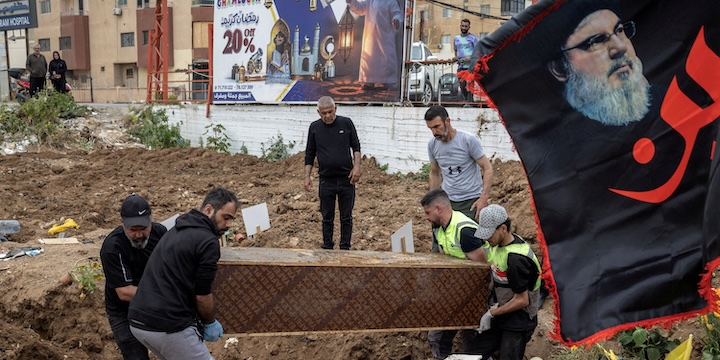
Workers remove a coffin with a body from temporary graves and prepare for transport for a funeral ceremony of four Hezbollah fighters and two civilians, amid a temporary ceasefire between Lebanon and Israel, in Tyre, southern Lebanon, April 26, 2026. Photo: REUTERS/Marko Djurica/File Photo
Hezbollah has paid a heavy price for going to war with Israel on March 2: Israel has occupied a chunk of southern Lebanon, displaced hundreds of thousands of its Shi’ite Muslim constituents and killed as many as several thousand of its fighters, according to previously unreported casualty estimates from within the group.
The move has brought severe political consequences, too. In Beirut, opposition has hardened to its status as an armed group, which domestic rivals see as exposing Lebanon to repeated wars with Israel.
In April, Lebanon’s government held face-to-face talks with Israel for the first time in decades, a decision Hezbollah firmly opposed.
However, more than a dozen Hezbollah officials told Reuters they see a chance to reverse deteriorating fortunes by aligning with Tehran in its war with Israel and the United States. The group, founded by Iran’s Islamic Revolutionary Guard Corps in 1982, opened fire two days into the conflict, which began with U.S. and Israeli strikes on Iran on February 28.
The group’s calculations are based on the assessment that its participation would force Lebanon onto the agenda of U.S.-Iranian negotiations, and that Iranian pressure can secure a more robust ceasefire than one that took effect in November 2024 following a conflict sparked by the war in Gaza, the officials said.
Hezbollah was mauled in the last war, which killed its leader, Hassan Nasrallah, along with some 5,000 fighters, and weakened its long-dominant hold over the Lebanese state.
Rearmed with Iranian help, it has used new tactics and drones, surprising many with its capabilities after a fragile 15-month truce during which Hezbollah held fire, even as Israel continued to kill its members.
Hezbollah lawmaker Ibrahim al-Moussawi denied the group was acting on Iran’s behalf when it resumed hostilities, as alleged by opponents. He told Reuters Hezbollah saw a window to “break this vicious cycle … where the Israelis can target, assassinate, bombard, kill, without any revenge.”
He acknowledged losses and damage in southern Lebanon but said “you don’t go into making calculations of how many are going to be killed” when “pride and sovereignty and independence” are at stake.
Hezbollah’s media office said the figure of several thousand fighters killed in the present war was false.
While a US-mediated ceasefire that took effect on April 16 has led to a significant reduction in hostilities, Israel and Hezbollah have continued to trade blows in the south, where Israel maintains troops in a self-declared “buffer zone.”
Yezid Sayigh, a senior fellow at the Carnegie Middle East Center in Beirut, said Hezbollah had “shown more resilience than many thought possible, but that was not a strategic gain in itself.”
“The only thing that will contain Israel is a comprehensive US-Iran deal,” he said. “Without a deal, there’s going to be a lot of pain for everyone. At best, a hurting stalemate.”
GRAVES FRESHLY DUG, AND QUICKLY FILLED
More than 2,600 people have been killed since March 2, around a fifth of them women, children and medics, Lebanon’s health ministry has reported. Its toll does not distinguish between civilians and combatants.
Three sources, two of them Hezbollah officials, said the ministry’s figures do not include many of the group’s casualties. They said several thousand Hezbollah fighters have been killed, though the group does not have the full picture yet.
In a statement to Reuters, Hezbollah’s media office denied the figures cited by the sources, and that the numbers published by Lebanon’s health ministry included its members killed in Israeli strikes.
One source, a Hezbollah commander, said scores of fighters had gone to the frontline towns of Bint Jbeil and Khiyam intending to fight to the death. Their bodies have yet to be recovered.
In the Hezbollah-controlled southern suburbs of Beirut, more than two dozen freshly dug graves were quickly filled with fighters’ bodies in the days after the ceasefire took hold. Simple marble tombstones identify some as commanders, others as fighters.
In one southern village alone, Yater, the council recorded the deaths of 34 Hezbollah fighters.
Lebanon’s Shi’ite Muslim community has borne the brunt of Israel’s attacks, forced to flee into Christian, Druze and other areas, where many blame Hezbollah for starting the war.
Israel has been entrenching its hold over a security zone stretching as far as 10 km (6 miles) into Lebanon and demolishing villages, saying it aims to shield northern Israel from attacks by Hezbollah militants embedded in civilian areas.
An Israeli government official said Hezbollah had abrogated the November 2024 ceasefire by firing on Israeli citizens on March 2. The threat to northern Israel would be eradicated, the official said, adding thousands of Hezbollah militants had been killed, and Israel was steadily destroying the group’s infrastructure.
The Israeli military says Hezbollah has fired hundreds of rockets and drones at Israel since March 2. Israel has announced 17 soldiers killed in southern Lebanon, along with two civilians in northern Israel.
Citing ongoing Israeli strikes, Hezbollah has called the April ceasefire meaningless and continued to attack.
IRAN ‘WILL NOT SELL’ THEIR FRIENDS
A diplomat who has contact with Hezbollah described its decision to enter the war as a big gamble and a survival strategy, saying it felt it needed to be part of the problem so it could be part of an eventual regional solution.
It has yet to be seen if the gamble will pay off.
Tehran has demanded that Israel’s campaign against Hezbollah be included in any deal on the wider war. But US President Donald Trump said last month that any deal Washington reaches with Tehran “is in no way subject to Lebanon.”
A spokesperson for Pakistan’s Foreign Ministry, Tahir Andrabi, referred Reuters to an April 16 statement in which he said peace in Lebanon was essential to the talks it is mediating between the U.S. and Iran.
A Western official said they saw a possibility the US and Iran might eventually reach a settlement that does not address the war in Lebanon.
Asked about this, the US State Department, Iran’s mission to the United Nations in Geneva and Lebanon’s government did not immediately comment.
Hezbollah’s Moussawi said a ceasefire in Lebanon continues to be a top priority for Iran, adding Tehran shares Lebanon’s objectives, including that Israel halt attacks and withdraw from Lebanon. Hezbollah has “full trust in Iran – that the Iranians will not sell their own friends”, he said.
The State Department referred Reuters to an April 27 interview Secretary of State Marco Rubio did with Fox News, in which he said Israel had a right to defend itself against Hezbollah’s attacks, and that he didn’t think Israel wanted to maintain its buffer zone in Lebanon indefinitely.
The United States has urged Israel “to make sure their responses are proportional and targeted,” he said.
When the April 16 ceasefire was announced, Israeli Prime Minister Benjamin Netanyahu said Hezbollah’s disarmament would be a fundamental demand in peace talks with Lebanon.
Hezbollah has ruled out disarmament, saying the matter of its weapons is a topic for a national dialogue. Any move by Lebanon to disarm the group by force would risk igniting conflict in a country shattered by civil war from 1975 to 1990.
Lebanon’s President Joseph Aoun and Prime Minister Nawaf Salam have sought Hezbollah’s peaceful disarmament since last year. On March 2, the government banned the group’s military activities.
Hezbollah has demanded the government cancel that decision and end its direct talks with Israel.
Lebanese officials have told Reuters they believe direct talks with Israel under the auspices of the US are the best way to secure a lasting ceasefire and the withdrawal of Israeli troops, as only Washington has enough leverage with Israel to achieve those aims.
Uncategorized
US President Trump Tells Israeli Media: ‘I Studied Iran’s New Proposal, It Is Not Acceptable to Me’

US President Donald Trump arrives to award the medal of honor to Master Sgt. Roderick ‘Roddie’ W. Edmonds, Staff Sgt. Michael H. Ollis, and retired Command Sgt. Maj. Terry P. Richardson during a ceremony in the East Room of the White House in Washington, DC, USA, 02 March 2026.
US President Donald Trump said he has reviewed Iran’s latest proposal and described it as “unacceptable” in an interview with Israeli broadcaster Kan News on Sunday. Trump added that ongoing efforts related to the conflict are “progressing very well,” without providing further details. He also renewed his call for clemency for Israeli Prime Minister Benjamin Netanyahu, arguing that Israel needs a leader focused on wartime priorities rather than legal matters.
Uncategorized
Israel Court Extends Detention of Gaza Flotilla Activists
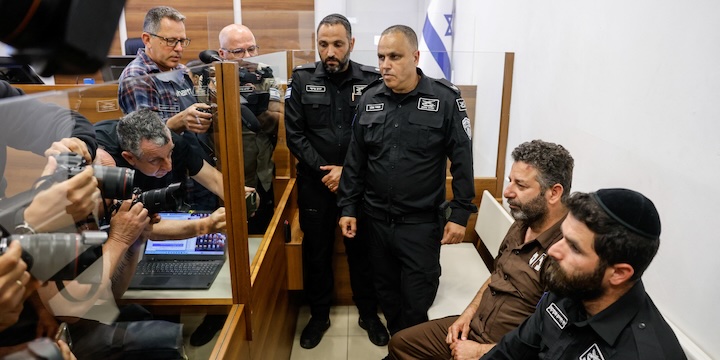
Activist Saif Abu Keshek, a member of the Global Sumud Flotilla detained by Israel, sits at a magistrate’s court for a detention extension hearing in Ashkelon, southern Israel, May 3, 2026. REUTERS/Amir Cohen
An Israeli court has extended by two days the detention of two activists arrested aboard a Gaza-bound flotilla that was intercepted by Israeli forces in international waters near Greece, their lawyer said on Sunday.
Saif Abu Keshek, a Spanish national, and Brazilian Thiago Avila were detained by Israeli authorities late on Wednesday and brought to Israel, while more than 100 other pro-Palestinian activists aboard the boats were taken to the Greek island of Crete.
A court spokesperson confirmed that their remand had been extended until May 5.
The governments of Spain and Brazil issued a joint statement on Friday calling their detention illegal.
The activists were part of a second Global Sumud flotilla, launched in an attempt to break Israel’s blockade of Gaza by delivering humanitarian assistance. The ships had set sail from Barcelona on April 12.
Israeli authorities requested a four-day extension of their arrest on suspicion of offenses that include assisting the enemy during wartime, contact with a foreign agent, membership in and providing services to a terrorist organization, and the transfer of property for a terrorist organization, said rights group Adalah, which is assisting in the activists’ defense.
Hadeel Abu Salih, the men’s attorney, said that the two deny the allegations. Their arrest was unlawful due to a lack of jurisdiction, she told Reuters at the Ashkelon Magistrate’s Court after the hearing, adding that the mission was meant to provide aid to civilians in Gaza, not to any militant group.
Abu Salih said that Abu Keshek and Avila were subjected to violence en route to Israel and kept handcuffed and blindfolded until Thursday morning.
Asked for comment, the Israeli military referred Reuters to the Israeli foreign ministry, which said that staff were compelled to act to stop what it described as violent physical obstruction by Abu Keshek and Avila. All measures taken were lawful, it said.