


Uncategorized
Who is Bruce Blakeman, the ‘Almost Orthodox’ Jew taking on Elise Stefanik in the GOP primary for New York governor?
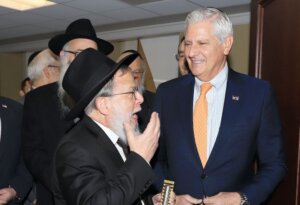
New York Republicans are gearing up for a competitive and generational race between two Trump loyalists vying to win the state’s governorship, both with close ties to the Jewish community.
Bruce Blakeman, the first Jewish executive of Nassau County on Long Island, launched a bid on Tuesday to challenge incumbent Gov. Kathy Hochul in next year’s election. Blakeman, 70, who won reelection last month, said he’d focus on affordability and public safety with an appeal to disaffected Democrats. But first, he will need to win the GOP primary in June, which would mean defeating Elise Stefanik, an upstate congresswoman who has made the fight against antisemitism on college campuses central to her congressional brand.
Stefanik, 41, has leaned heavily on being a protector of the Jewish community amid rising antisemitism and the election of Zohran Mamdani as New York City Mayor. Hochul, who faces a left-wing challenge from her lieutenant governor, Antonio Delgado, had endorsed Mamdani in the general election. Stefanik attacked Blakeman’s record in her immediate reaction to his announcement.
In 2022, former Rep. Lee Zeldin, who is Jewish, came within five percentage points of winning the governor’s race, powered by strong Jewish support. Hochul publicly welcomed the possibility of a contested GOP primary, which could strengthen her chances in the general election. A recent poll found that 46% of Jewish voters support her reelection, while 41% would prefer a generic replacement.
Both Republicans maintain strong ties to President Donald Trump, who said Monday that he regards each of them favorably.
Long Island’s “AOB”
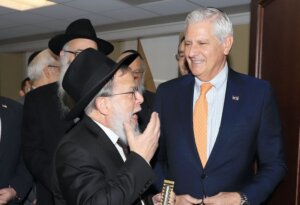
Blakeman, a Long Island native, has spoken publicly about the role Judaism plays in his life. The Jewish community in Nassau County, which borders New York City, makes up about 19% of its 1.4 million residents. Blakeman previously served as councilman of the county’s largest town, Hempstead. His father, Bob Blakeman, was a member of the State Assembly.
Blakeman, who is married to Sigal Magori Blakeman, was previously married to Sir Paul McCartney’s current wife, Nancy Shevell. He is a member of the Jewish Center of Atlantic Beach, an Orthodox congregation, and prays every day. He also keeps a kosher kitchen but does not observe Shabbat halachic rules.
“I have to balance my public life with my spiritual life, which is a challenge every day,” Blakeman said in an interview with the Forward in 2022. He joked that he calls himself “AOB,” similar to Rep. Alexandria Ocasio-Cortez’s “AOC” nickname: “Almost Orthodox Blakeman.”
After he was elected county executive, Blakeman installed a mezuzah at his new office, saying that “Hashem and spirituality are an important part of my life,” using the Hebrew name for God. “I feel that that’s where I derive my strength from.”
Blakeman wore a yarmulke at his inauguration.
Outspoken critic of antisemitism on the left

Like Stefanik, Blakeman has been an outspoken critic of antisemitism on the left. In 2019, Blakeman said he was one of the candidates considered by the Trump administration to head the State Department’s office of Special Envoy to Monitor and Combat Antisemitism.
Blakeman, who ran for Congress in 2014, accused Democratic politicians of not being courageous enough to stand up to “virulent antisemites” in their own party. “It’s unfortunate that AOC, Ilhan Omar and Rashida Tlaib get away with what I consider very antisemitic statements and policies,” he said in the 2022 Forward interview. “If they were in my party, I would do everything in my power to have them thrown out.”
However, in 2024, Blakeman refused to condemn Rep. Marjorie Taylor Greene, who has been accused of trafficking in antisemitism — including her suggestion that a Jewish-funded space laser had sparked wildfires in California in 2018 — suggesting she’s simply uneducated. “She doesn’t reflect the great majority in the Republican Party,” he insisted. “But I’ll take her any day over AOC, Rashida Tlaib and Ilhan Omar.” Greene has since broken with Trump and accused Israel of committing genocide in Gaza.
In 2024, Blakeman clashed with local Democrats over his plan to mobilize provisional deputy sheriffs in dire situations like a superstorm or terror attack. He called on the Democratic leader of the county legislature, Delia DeRiggi-Whitton, to step down after she compared the move to the Brownshirts, the Nazi’s paramilitary army. Blakeman was also the subject of an antisemitic flier by an employee union, which depicted him with horns, an antisemitic slur.
Last year, Blakeman signed a mask ban into law in response to antisemitic incidents, some perpetrated by protesters wearing face masks.
Blakeman was also vocally opposed to Rep. George Santos, who falsely claimed to have Jewish grandparents who fled persecution during World War II. Santos later resigned and served a jail sentence for financial fraud. Blakeman said the lies about the Holocaust were an affront to the many Holocaust survivors and families of Holocaust victims in his Nassau County district.
Recently, Blakeman strongly condemned the New York Young Republicans after it was revealed that its members were praising Hitler in a group chat.
Blakeman’s alliance with Israel
Blakeman is hawkish on issues related to Israel. In 2016, he spearheaded a twin-city agreement between his township and the Samaria Regional Council, a Jewish settlement in the Samarian hills of the occupied West Bank. He told a local publication he doesn’t view the Jewish communities there as settlements.
Hempstead was the first New York municipality to pass anti-Boycott Divestment and Sanctions legislation in 2016. It was later implemented across the state in an executive order signed by former Governor Andrew Cuomo that prohibits state agencies from investing in companies involved in boycotting Israel. Nassau County’s legislature passed a similar bill that year.
The township enforced the law immediately after Ben & Jerry’s announced in July that it would end its relationship with the Israeli licensee that manufactures and distributes its products in the occupied West Bank.
Trump’s umbrella holder
In 2024, Blakeman was mocked on social media for holding Trump’s umbrella while he delivered a statement to the media following a wake for a slain NYPD officer on Long Island.
“It was an honor to be able to hold his umbrella,” Blakeman recalled at the time in a brief phone interview. “But the whole story is that when we left the funeral home, he had an umbrella and asked me to get underneath. He was holding the umbrella for me, and I said to him, ‘This is the first time a president ever held an umbrella for me.’ And then, as we walked to the podium and he was about to speak, I said, ‘Let me hold the umbrella back.’ And he said, ‘Would you mind?’ and I said, ‘Of course not. Of course, I wouldn’t mind.’ So it was an exchange of honors. The greater honor is mine.”
The post Who is Bruce Blakeman, the ‘Almost Orthodox’ Jew taking on Elise Stefanik in the GOP primary for New York governor? appeared first on The Forward.
Uncategorized
Atlanta movie exec who complained of ‘nasty Jews’ is running for Congress
Ryan Millsap, a prominent film and real estate executive in Atlanta who made antisemitic and racist comments in private text messages, is now running for a congressional seat in rural Georgia.
ProPublica and the Atlanta Journal-Constitution reported two years ago that Millsap had sent the offensive texts to a girlfriend.
“Just had a meeting with one of the most nasty Jews I’ve ever encountered,” Millsap wrote in a 2019 text message viewed by the Forward. John Da Grosa Smith, Millsap’s former attorney, filed the text messages in Fulton County Superior Court in Georgia in 2024.
The news outlets also reported that Smith said in court documents that Millsap had allegedly made derogatory comments about Jews while they worked together, including referring to his Jewish colleagues as “the Jew crew” and calling one of them “a greedy Israelite.”
ProPublica and the AJC reported that during arbitration with Smith, Millsap said the comments Smith had described represented “locker room talk.”
Millsap apologized for the offensive text messages in a 2024 statement to the news outlets, saying “comments which I never intended to share publicly have come to light, and people I care about and who put their trust in me have been hurt.”
He also spoke directly at the time to the racist and antisemitic remarks.
“I want to extend my sincere apologies to my dear friends, colleagues and associates in both the black and Jewish communities for any and all pain my words have caused,” his statement continued. “My sincere hope is that the bonds and friendships that we have forged speak far louder than some flippant, careless remarks.”
Millsap is running in the Republican primary for the open seat in Georgia’s 10th Congressional District, which stretches from the far outskirts of Atlanta to the South Carolina border and includes the college town of Athens. The district is outside of the major Jewish population centers in Georgia and had fewer than 7,000 Jewish adults, according to the American Jewish Population Project.
The election is on May 19 and Millsap is running against a popular state lawmaker Houston Gaines in what is expected to be a competitive race.
Gaines called Millsap’s reported text messages “disqualifying.”
“Antisemitism has no place in this country, and as a Christian, I’ll always stand firmly against it,” Gaines said in a statement to the Forward.
Millsap did not respond to a request for comment about the text messages or whether he has conducted any outreach to the local Jewish community as part of his campaign.
In an interview last month with the Washington Reporter, Millsap said that negative interactions with local protesters had pushed him into politics. Millsap’s studio controlled land adjacent to the construction site for Cop City, a planned police training ground near Atlanta, and both sites were targeted by activists.
“They tried to ruin my reputation,” Millsap said in the interview. “Leftist journalists at ProPublica were enlisted to write hit pieces on me, call me a racist, antisemite, anything they could do to hurt my life and put me in a bad political position, because obviously DeKalb County is mostly black Democrats.”
Millsap’s Blackhall Group, whose studio produced movies including “Venom,” “Blockers,” and “Loki,” purchased the property in a county forest near the future Cop City site in 2021. Millsap said activists violently attacked construction workers on his property, burned a pickup truck and left threatening messages in 2022.
He has referred to the demonstrators as “antifa” and made his dispute with them a cornerstone of his campaign.
Antisemitism does not seem to be a major issue in the congressional race, in which Millsap and Gaines have focused on immigration and election security. The seat is considered a safe Republican district and the winner of the GOP primary is expected to win the general election.
According to the text messages filed in court and reviewed by the Forward, Millsap and his then-girlfriend, Christy Hockmeyer, complained about Jews and Black people on several occasions. “F—king Black people,” Millsap wrote in one message reported by ProPublica and AJC after Hockmeyer complained about a Black driver whose car she hit.
Hockmeyer also apologized for her role in the text message conversations with Millsap. “Those comments do not reflect who I am and I disavow racism and antisemitism as a whole,” she wrote in a statement to ProPublica and the AJC.
The ProPublica and AJC article noted that Millsap had built close ties with the Black and Jewish communities in Atlanta after relocating to the city from California and seeking to become active in its robust film industry. He had also been applauded for embracing workplace diversity.
His apology received a mixed response from those he had worked with in Atlanta.
Smith, Millsap’s former attorney, filed the text messages in a lawsuit after the two became embroiled in a heated legal dispute. An arbitrator found that Smith had violated his contract with Millsap when the two were working together and ordered him to pay $3.7 million for breach of contract and breach of fiduciary duty.
Millsap said in his 2024 apology that Smith had “violated the most basic and fundamental principle of attorney client privilege and released private text messages between myself and a former romantic partner.”
The post Atlanta movie exec who complained of ‘nasty Jews’ is running for Congress appeared first on The Forward.
Uncategorized
A new book explores the vibrancy of pre-war Warsaw
The Last Woman of Warsaw
Judy Batalion
Dutton, 336 pages, $30
Don’t be misled by the title of this debut novel by Judy Batalion, nor by her previous book, The Light of Days, about the role of Polish-Jewish women in the anti-Nazi resistance.
Though the specter of the Holocaust looms over The Last Woman of Warsaw, the novel is not really Holocaust fiction. It does not portray a final female survivor of that embattled city. Its subject is instead the odd-couple friendship of two young Jewish women embroiled in the artistic and political ferment of pre-World War II Warsaw.
For Batalion, recreating the atmosphere and quotidian life of this cosmopolitan city, which once elicited comparisons to Paris, was a major aim. “In our contemporary minds, historical Warsaw conjures images of gray and death,” she writes in a lengthy author’s note. But that shouldn’t negate its more vibrant past. “Long before Vegas,” Batalion writes, “Warsaw was the capital of neons, its night skyline dotted with glittering cocktail glasses and chefs carrying platters of roasts. Much of this artistic production was Jewish.”
Even this brief excerpt shows that Batalion isn’t much of a prose stylist. But awkward locutions and diction mistakes aside — including the repeated use of “cache” when she means “cachet” — Batalion generally succeeds in immersing readers in Warsaw’s lively urban bustle and heated street politics. Here, skating on the edge of catastrophe, Polish Jews of varying ideologies and backgrounds face off against antisemitic persecution and violence.
Batalion’s handling of the historical backdrop is defter than her fledgling fictional technique. The narrative of The Last Woman of Warsaw is a plodding and repetitive affair that ultimately turns on an improbable coincidence.
The plot involves the sudden disappearance of a photography professor with communist ties and the halting efforts of the novel’s two protagonists to find and free her. The pair, whose initial antagonism mellows into friendship, are Fanny Zelshinsky, an upper-middle-class Warsaw University student, and Zosia Dror, who hails from a religious shtetl family. Her adopted surname references the Labor Zionist group that now claims her loyalty. Despite their differences, the two women have in common a desire to shake off the past and forge new lives. They also share an attraction to a single man, Abram, who can’t seem to decide between them.
When the story begins, Fanny is engaged to the perfectly nice, highly suitable Simon Brodasz, whom she’s known since her teenage years. Her mother is pushing the match. But Fanny is not in love and dreads the loss of freedom marriage entails. Her true passion is photography – in particular, fashion photography, to which she brings an idiosyncratic, modernist flair.
Zosia’s passion is political activism, and she aspires to a more prominent leadership role in Dror. Like Fanny, she is at odds with her mother, who is urging her to return to the shtetl for the festivities preceding her sister’s wedding.
What brings these women together is the arrest of the famous photographer Wanda Petrovsky, to whom both are connected. Wanda is one of Fanny’s professors, and Fanny needs her help to enter a potentially career-making exhibition. Wanda also happens to be a political activist, a leader of Zosia’s Zionist group, and Zosia hopes she’ll provide her with a visa for Palestine.
As Batalion’s narrative alternates between their perspectives, the antisemitic fervor in Warsaw mounts. Polish right-wing groups have started terrorizing Jews. Police invade clubs where Jewish comedians are mocking antisemitism. At Warsaw University, where Jewish students already have been subject to admissions quotas, the humiliation of being consigned to a “Jew bench” in class comes as a humiliating shock to Fanny.
Zosia, by contrast, has seen far worse. She and her family were victims of one of the murderous pogroms that periodically roiled the Polish countryside. She has been traumatized by the burning of her home, her father’s injuries and the refusal of her neighbors to offer refuge from the catastrophe.
In late 1930s Warsaw, Polish Jews are fighting back – with protests, hunger strikes and more. But what will any of this accomplish? Will Wanda attain her freedom, with or without the help of her protegees? Will Zosia and Fanny successfully defy their families and find meaningful lives? Which woman will Abram ultimately choose? And will any of this matter as both Poland and Polish Jewry hover on the brink of destruction?
Batalion answers these questions in an epilogue describing the fate of both women and of Fanny’s photographs, which eventually take a political turn, and in her author’s note. In the note, she reveals that all four of her own grandparents “spent their young adulthoods in interwar Warsaw.” That heritage helps account for her own passion: “to memorialize Warsaw’s golden age of creativity and the Jewish art and culture that, along with six million lives, was also decimated in the Holocaust.” A worthy endeavor, however clumsily executed.
The post A new book explores the vibrancy of pre-war Warsaw appeared first on The Forward.
Uncategorized
Mahmoud Khalil’s anti-Zionist case to Jews shows the case for skepticism
Mahmoud Khalil wants to reassure the Jewish community. In an extensive new interview with the Forward, the pro-Palestinian protest leader recognized “a Jewish connection” to Israel, and promised that a free Palestine would include safety and security for Jewish residents.
And yet I read the interview and felt a sense of alarm.
Not because Khalil seems insincere. I believe he means much of what he says. But rather because his attempts to instill confidence fall short in ways that illuminate exactly why so many Jews remain afraid and skeptical of the anti-Zionist movement.
Serious causes for serious concerns
Khalil describes himself as a pragmatist. In his activism, however, he envisions a utopia.
He is adamant that a two-state solution preserving a Jewish majority in Israel is a nonstarter. He argues, instead, for a democratic country — or multiple countries — across Israel, the West Bank and Gaza, with equal rights for all and the right of return for Palestinian refugees.
“I know it might sound like a very ideal utopia,” he told the Forward‘s Arno Rosenfeld, “but this is what we should aspire for.”
Khalil is concerned that Jewish fear is an obstacle to Palestinian liberation, and suggests that this fear is misplaced. “People think that we want to drive all Jews to the sea,” he said. “We don’t believe that.”
But history has long shown that Jewish safety without Jewish autonomy often proves conditional. In the ideal that Khalil advances, Israel would lose the self-determination that leads so many Jews to view it as a safe haven. My late grandfather, who was deported to a Siberian gulag by the Soviets from Lithuania — where about 90% of his fellow Jews were murdered by the Nazis — put it simply: Israel was a place where he felt his fate was in his own hands.
Nor is apprehension of anti-Zionism misplaced. Report after report has cataloged persistent harassment of Jews, threats of violence against Zionists, and invocations of antisemitic tropes within anti-Zionist movements. Yes, there are moderates, many of whom are driven by a commitment to a better future for Palestinians. But there are also extremists, and scenes on campuses and city streets around the world have shown that their tactics often prevail.
Adding to Jews’ sense of alarm are decades of violence within Israel — including the Second Intifada and Hamas’ Oct. 7, 2023 attack — and globally, including recent violence against American Jewish institutions. Jews are not scared because we misunderstand the aims of the anti-Zionist movement. We are scared for good reason.
Political abstractions
A genuine effort at reassurance would engage with that truth. Instead, Khalil dances around it, suggesting that the thing we’re worried about doesn’t actually exist. He says, for example, that the pro-Palestinian campus movement did a good job of keeping antisemitism at bay. It did not.
Even when it comes to the well-established facts of Hamas’ Oct. 7 massacre, he demurs: “I wouldn’t rule out that Hamas targeted civilians,” he said, “but I wouldn’t confirm it either.”
When referencing the excesses of pro-Palestinian campus protests, Khalil retreated into vague language. “There were maybe some bad actors,” he said. His denunciations of antisemitism remained safely generic: “some anti-Zionist actions may touch on antisemitism that we absolutely oppose.”
Who, exactly, is “we” here?
Political movements are not abstractions. They consist of real people doing real things. When excesses are common enough, they become characteristic. This is something I’ve long argued about the Israeli right as well. We cannot dismiss settler violence or anti-Palestinian abuses as fringe when they keep escalating and enjoy support from those in power.
It’s easy to say you oppose antisemitism or suffering by Palestinians, or that a utopian future is possible if we all look past our fear. It’s much harder to look within your political coalition and call out the specific negative acts your allies have committed — or acknowledge their very real consequences.
Denial and Oct. 7
Circle back to Khalil’s alarming equivocation about Oct. 7.
He frames the killings as civilians being “caught up” in violence, not targeted by it. Notice the evasive grammar: Khalil says “there were crimes committed” and Hamas has “a responsibility,” rather than “Hamas committed crimes.”
Khalil does explicitly say that he thinks Hamas is “not up to the Palestinian aspiration for liberation” and that he “doesn’t believe in political Islam.” But for someone so attuned to the language of liberation and justice, he is remarkably comfortable with passive voice when it comes to Hamas carrying out horrific murders on Oct. 7.
As I’ve previously written, the evidentiary record is overwhelming. Amnesty International and Human Rights Watch, organizations critical of Israel, independently concluded that Hamas deliberately and systematically targeted civilians. In one intercepted call, a Hamas terrorist bragged to his parents, “Look how many I killed with my own hands! Your son killed Jews!”
Neutrality on established facts is no different than denialism. If you are trying to reassure Jews but can’t acknowledge that Hamas killed Jews as such, any reassurance you have to offer will ring hollow.
A practical peace
Khalil says he is opposed to any violence against civilians but cannot dictate what Palestinians who experience Israeli human rights abuses should do. He says he understands why Palestinians turn to resistance, even violence, in the face of oppression.
But if you say you understand why decades of oppression push Palestinians toward resistance, then you should also understand why decades of terrorism push Israelis toward aggressive security measures, including ones that harm Palestinian civilians. If every act is merely a justified reaction to a prior act, we will end up in a world in which it’s too easy to argue that all violence is legitimate, rather than none of it.
The deep culture of mutual suspicion that this painful history has bred may be the biggest obstacle to Khalil’s utopian vision.
I share Khalil’s aspirations for peace. But Israelis, even most liberals, leftists and the millions who have protested the right-wing government, say they won’t accept a one-state solution. One 2025 poll by The Institute for National Security Studies, an independent think tank affiliated with Tel Aviv University, found that only 4% of all Israelis, and 1% of Israeli Jews, prefer a one-state solution with equal rights. Palestinians, too, are skeptical of a single state with equal rights.
At the same time, many Israelis oppose a two-state solution. So do many Palestinians. The people who live in the region hold complicated and often contradictory ideas of the path forward, and Khalil does not necessarily speak on their behalf.
Any anti-Zionist looking to reassure Jews needs to, at minimum, acknowledge that Hamas killed civilians deliberately, because they were Jews; condemn specific instances of antisemitism rather than just the concept in the abstract; and ask why Jews are scared right now, rather than telling us we shouldn’t be.
Yet Khalil’s reticence to be honest about his own movement’s flaws is a mirror of our own. Supporters of Israel have long been reluctant to name the failures of the Israeli right and to reckon with how settlements and the occupation harm Palestinians.
Khalil recounts being born in the Palestinian refugee camp Khan Eshieh in Syria, and raised on stories of his grandparents’ expulsion from a village near Tiberias. He was shot by an Israeli soldier when he was just 16. His effort to nevertheless engage with Israeli perspectives, like by reading Ari Shavit, is admirable. Jews should similarly listen to Palestinian perspectives and sit with Palestinian stories, including Khalil’s and those of Palestinians living today in the West Bank and Gaza.
The only way for any of us to build a durable political movement is to be exactingly honest about the ways in which we have, so far, failed, and to ask others with open ears: Why are you so scared?
The post Mahmoud Khalil’s anti-Zionist case to Jews shows the case for skepticism appeared first on The Forward.