



Uncategorized
Young Republicans Flock to Anti-Israel Candidate in Florida Governor’s Race

Florida gubernatorial candidate James Fishback. Photo: Screenshot
A radically anti-Israel candidate in Florida’s Republican primary for governor is by far the most popular choice for young voters, despite being accused of antisemitism, a new poll has found.
The University of North Florida poll, released on Tuesday, showed 31-year-old James Fishback, the founder and chief executive of the investment firm Azoria, leading comfortably among Republican voters aged 18–34.
While Fishback remains a long-shot contender overall, the results found he captured 32 percent support among younger Republicans surveyed, compared to just 8 percent for US Rep. Byron Donalds, who continues to lead the broader primary field. Another 46 percent said they were not sure.
Overall, Donalds leads the field with 31 percent support, followed by Fishback far behind at 6 percent. More than half of those polled, 51 percent, said they were not sure who to support.
Fishback has drawn criticism for relentlessly attacking Israel and, according to some critics, veering into antisemitic discourse.
While addressing students at the University of Central Florida earlier this month, Fishback said he “will not visit the country of Israel under any circumstances.” The candidate went on to mock the Western Wall, calling it a “stupid wall.”
“This is how antisemitism rebrands itself in 2026,” Rabbi Steven Burg, the CEO of Aish, a global Jewish educational organization, wrote of Fishback’s comments in a recent op-ed for the Sun Sentinel.
Fishback has also criticized Donalds for arranging a forum at a south Florida synagogue, accusing the congressman of expressing favoritism toward Jewish people. The insurgent candidate also came under fire for praising supporters of antisemitic social media personality Nick Fuentes as “patriots” and “civil.”
“We had a great conversation, and they have a real pulse for what is going on in the country,” Fishback said of Fuentes’s supporters.
In December, the Network Contagion Research Institute (NCRI) released a report analyzing online support for Fuentes, suggesting he has received a major boost from inauthentic amplification by anonymous actors in foreign countries such as India, Pakistan, Nigeria, Malaysia, and Indonesia.
If elected, Fishback has vowed to direct all state government entities to “divest” from bonds issued by the Israeli government on his first day in office. He has also accused Israel of committing “genocide” in Gaza and stated that the supposed “genocide” should be taught in Florida public schools.
Donalds, a stalwart conservative and strident ally of US President Donald Trump, has established himself as a firm supporter of Israel. The lawmaker expressed support for Israel’s right to self-defense in the wake of Hamas’s Oct. 7, 2023, massacre across southern Israel. As skepticism about Israel has surged within the Republican Party in recent months, Donalds has maintained strong vocal support for the Jewish state.
During an interview with Fox Business in December, Donalds lamented rising antisemitism and anti-Israel sentiment within the country and around the world.
“This level of antisemitism, this hatred against Jewish people and against Israel, it’s out of control. It’s insane,” Donalds said.
The latest University of North Florida poll, conducted among likely Republican voters in Florida, included a small sample of 39 respondents in the 18–34 age bracket. Though limited in scope, the findings reflect a broader trend seen in some national surveys, indicating a generational shift among parts of the Republican Party, with younger voters expressing more skepticism toward both Israel and American Jews than their older counterparts.
For example, the Manhattan Institute, a prominent US-based think tank, released a major poll in December examining the evolving makeup of the Republican Party (GOP) and its current attitudes toward Israel and Jewish Americans.
According to the results, newer entrants to the GOP are more likely to be antisemitic
“Anti-Jewish Republicans are typically younger, disproportionately male, more likely to be college-educated, and significantly more likely to be New Entrant Republicans,” the survey found. “They are also more racially diverse. Consistent church attendance is one of the strongest predictors of rejecting these attitudes; infrequent church attendance is, all else equal, one of the strongest predictors of falling into this segment.”
This group is also in general more politically liberal, according to the survey: “Given that many of these voters are younger and former Democrats, more progressive policy tendencies are unsurprising.”
The data also showed that older GOP voters are much more supportive of Israel and less likely to express antisemitic views than their younger cohorts.
According to the data, 25 percent of GOP voters under 50 openly express antisemitic views as opposed to just 4 percent over the age of 50.
Startlingly, a substantial amount, 37 percent, of GOP voters indicate belief in Holocaust denialism. These figures are more pronounced among young men under 50, with a majority, 54 percent, agreeing that the Holocaust “was greatly exaggerated or did not happen as historians describe.” Among men over 50, 41 percent agree with the sentiment.
Uncategorized
Israel, Hezbollah War Persists Despite Truce Extension
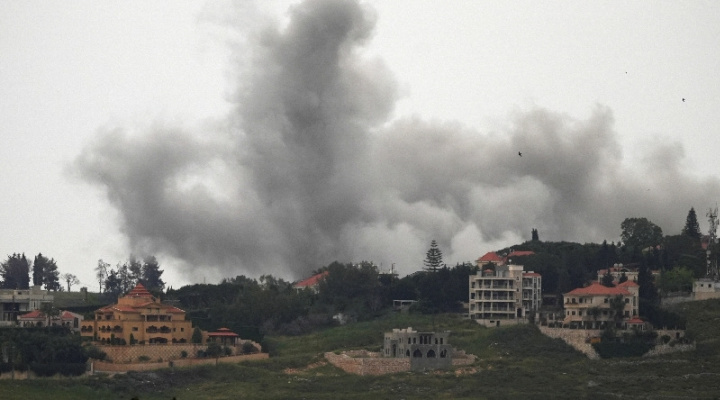
Smoke rises following an Israeli strike in Choukine, Lebanon, May 18, 2026. Photo: REUTERS/Stringer
Israel carried out airstrikes in southern Lebanon on Monday, Lebanese security sources and the state news agency said, while Hezbollah announced new attacks on Israeli forces, continuing the war in Lebanon despite the extension of a US-backed truce.
Since the war began on March 2, more than 3,000 people have been killed in Lebanon, the country’s health ministry reported in its latest casualty toll on Monday. Most of those killed have been Hezbollah terrorists, according to Israeli officials.
Reignited by the US-Israeli conflict with Iran, hostilities between Iran-backed Hezbollah and Israel have rumbled on since US President Donald Trump first announced a ceasefire on April 16, with fighting mostly contained to southern Lebanon.
A 45-day ceasefire extension, announced after a third round of US-hosted talks between Lebanon and Israel on Friday, began at midnight, a Lebanese official said.
The US-led mediation has emerged in parallel to diplomacy aimed at ending the US-Iran conflict. Iran has said ending Israel‘s war in Lebanon is one of its demands for a deal over the wider conflict. Hezbollah, which opened fire at Israel on March 2, objects to Beirut taking part in the talks.
AIRSTRIKES, EXPLOSIVE DRONE
Overnight, an Israeli strike near the eastern Lebanese city of Baalbeck killed a commander of the Palestinian Islamic Jihad terrorist group, a Hezbollah ally, along with his daughter, security sources in Lebanon said.
The Israeli military said it had killed the commander, Wael Mahmoud Abd al-Halim, in a strike, after taking steps to “mitigate the risk of harm to civilians.” It made no mention of Halim’s daughter.
Hezbollah said it launched an explosive drone at an Iron Dome air defense position in the Galilee area of northern Israel and carried out other attacks on Israeli forces in Lebanon.
Israel‘s military said some “launches” aimed at Israeli soldiers in southern Lebanon, as well as an explosive drone, had crossed into Israeli territory.
Lebanon’s National News Agency reported Israeli airstrikes on more than half a dozen locations in south Lebanon.
The Israeli military said it could not comment on the reported airstrikes without the coordinates of each one and didn’t immediately respond to a request for comment on the attack claimed by Hezbollah on the Iron Dome position.
The Israeli military said earlier on Monday it had struck more than 30 Hezbollah sites in southern Lebanon in the previous 24 hours and warned residents of three villages in the south to leave their homes, saying it intended to act against Hezbollah.
DEATH TOLL RISES
Israeli forces have occupied a self-declared security zone in the south, where they have been razing villages, saying they aim to shield northern Israel from attacks by Hezbollah fighters embedded in civilian areas.
Lebanon’s health ministry reported that the death toll in Lebanon had risen to 3,020 people, among them 619 women, children, and health-care workers.
Its toll doesn’t say how many combatants are among the dead. Various reports have put the figure at thousands of Hezbollah fighters.
However, sources familiar with Hezbollah‘s casualty numbers have said many Hezbollah fighters who have been killed in the war are not included in the health ministry death toll.
Reuters reported on May 4 that several thousand Hezbollah fighters had been killed in the war, citing casualty estimates from within the group. The Hezbollah media office said at the time the figure of several thousand fighters killed was false.
Israeli authorities say 18 soldiers have been killed by Hezbollah attacks or while operating in south Lebanon since March 2, in addition to a contractor working for an engineering company on behalf of Israel‘s defense ministry. Hezbollah attacks have killed two civilians in northern Israel.
Uncategorized
Recognizing Shabbat Is Not Establishing a Religion

Shabbat candles. Photo: Olaf.herfurth via Wikimedia Commons.
The backlash to President Trump’s “Shabbat 250” proclamation reveals something deeper than disagreement over a single president or a single ceremonial gesture. It reveals how uneasy a slice of American Jewish leadership has become with the public acknowledgment of a tradition that helped shape America’s moral vocabulary.
The timing matters. Since October 7th, antisemitism has surged on a scale unfamiliar to most American Jews living today – across college campuses, in major cities, on social media, in synagogue parking lots that now require armed guards and entrances fitted with metal detectors. Against that backdrop, a sitting president has used a White House proclamation to honor a core Jewish practice, to invoke George Washington’s 1790 letter to the Hebrew Congregation in Newport, and to name Haym Salomon – the Jewish immigrant financier who helped fund the Revolution – as a model of Jewish American patriotism. One might have expected the organized Jewish community to receive that gesture with something closer to unanimity. Instead, the response has split.
As eJewishPhilanthropy recently reported, the divide ran along predictable lines. Orthodox and politically conservative organizations – Chabad communities, Agudath Israel, the Orthodox Union, the Rabbinical Council of America, Young Jewish Conservatives – embraced the proclamation immediately. Progressive institutions and the Jewish Council for Public Affairs raised church-state concerns. The fault line itself is worth noticing. It tracks, with unsettling precision, which segments of American Jewry still feel confident about Jewish practice in public and which have grown uneasy when Jewish tradition appears outside the synagogue.
The critics’ anxieties are not frivolous. Jewish history is full of governments that used religion coercively and turned on the minorities they once flattered. American Jews were right to be cautious about religious majoritarianism in the past, and a cautious American Jewish political tradition has long taken that lesson seriously. But caution becomes distortion when even symbolic recognition of Jewish practice is treated as a constitutional threat.
The most serious version of the objection comes from Amy Spitalnick, CEO of the Jewish Council for Public Affairs, who warned in the eJP piece that when church-state lines blur, “one day you’re in and the next day you could be out.” The worry deserves a real answer, not dismissal. But Spitalnick herself drew the right distinction in the same interview. A government celebration of Jewish identity and practice, she said, “is very different than trying to utilize the government to advance a specific approach to religion.”
A proclamation honoring rest, gratitude, and the Jewish American contribution to the national story falls squarely on the first side of her line. It establishes no theology. It privileges no denomination. It requires nothing of anyone. It is ceremonial recognition: the same category as presidential Hanukkah candle-lightings, Ramadan iftars, Easter messages, and Thanksgiving statements that have rolled out of the executive branch for generations. The American constitutional order does not require a public square emptied of faith; it requires a public square open to all of them. A president who honors Shabbat one season and hosts an iftar the next is not establishing a religion. He is doing what American presidents have done since Washington: recognizing that the country contains many traditions and that none of them needs to be hidden to be American.
A different objection comes from Rabbi Amichai Lau-Lavie of Lab/Shul, who wrote that we should observe Shabbat “not because a leader commanded it, but because our humanity demands it.” That is a theological worry, not a constitutional one, and it deserves a theological answer. Trump has commanded nothing. All he has done is acknowledge that Shabbat exists, that millions of Americans keep it, that the country is better for the practice.
One can hold separate concerns about this president’s habit of telling Jews how to be Jewish. Those are concerns about a man. They are not an argument against the proclamation. The principle would be right whether the proclamation came from this president or any other, and an American Jewish community that could only accept public recognition from presidents it liked would not be defending the Constitution. It would be practicing politics.
The deeper problem with the church-state framing is that it gets American Jewish history almost exactly backward. American Jews did not flourish because the public square was scrubbed of faith. They flourished because the public square was open to faith – to all faiths -and because the founding promise of religious liberty was extended to a people who had never before been treated as full citizens anywhere in Christendom. Washington’s letter to Touro Synagogue, which the proclamation invokes, did not promise the Newport congregation that religion would be banished from American life. It promised them that the new republic would “give to bigotry no sanction, to persecution no assistance” and that the children of the stock of Abraham would sit safely under their own vine and fig tree. That is not the language of secularism. It is the language of religious confidence extended to Jews as Jews.
The Jews who arrived in America did not ask for invisibility. They asked for equality, and America’s founding promise made that claim possible in a way nearly no other country had. Haym Salomon – born in Poland, jailed by the British, dead in poverty at forty-four after pouring his fortune into the Continental cause – did not finance a revolution so that his descendants could ask the public square to please not mention Jews. The American Jewish bargain has always been the opposite: be visible, be present, be unembarrassed about being Jewish in public, and the country will be the better for it. The First Amendment was designed to prevent a national church. It was never designed to scrub religion from American public life. Covenant, human dignity, moral obligation, liberty under law, the sanctity of conscience; none of it appeared from nowhere. Recognizing that inheritance is not theocracy. It is historical literacy.
It is worth saying plainly what Shabbat is, because much of the anxious commentary proceeds as though the underlying practice were a minor ritual rather than one of the central institutions of Western civilization. Shabbat is the weekly insistence that human beings are not merely productive units. It is the structural refusal to let work, commerce, and noise consume the whole of life. It builds in, by law and by habit, a day for family, for study, for rest, for gratitude and for the things that markets cannot price and bureaucracies cannot manage. The Jewish tradition holds that Shabbat sustained the Jewish people through exile, dispersion, and persecution: more than the Jews kept Shabbat, Shabbat kept the Jews.
That a weekly cessation might be good for an entire country – and not merely for Jews – is not a controversial proposition. It is one of the most quietly radical contributions the Jewish people have made to human civilization. A country drowning in screens, in noise, in the demand to be always available, might reasonably want to pause and acknowledge the institution that taught the West how to stop.
The split inside the American Jewish community over “Shabbat 250” is, in the end, a split about confidence. The progressive instinct to guard the church-state line is the right instinct, applied to the wrong case; the Jews who worry about state-favored religion are reading from the correct historical script, only on the wrong stage. The Orthodox and conservative Jews who embraced the proclamation did so because they still feel ownership over Shabbat; because the practice is theirs, lived, and they are glad to see it honored. Some progressive leaders responded with discomfort because seeing Shabbat publicly honored by political authority now feels unfamiliar, uncomfortable, perhaps even weaponizable. That asymmetry says something painful about where parts of American Jewish life now stand in relation to their own tradition.
Recognizing Shabbat is not the establishment of religion. It is the recognition of a gift; a gift this country received from the Jewish people, and a gift it is finally, in its 250th year, pausing long enough to say thank you for. At a moment when Jews on American campuses are being told they do not belong, and Jews in major cities are being assaulted for being visibly Jewish, the proclamation says something the Jewish community badly needs to hear from the highest office in the land: you are not foreign here. You built this. The country is grateful.
The answer to that gesture is not worry. It is the lighting of candles.
Samuel J. Abrams is a professor of politics at Sarah Lawrence College and a senior fellow at the American Enterprise Institute.
Uncategorized
Stacey Bosworth selected as the Forward’s next Vice President of Development
Forward Publisher and CEO Rachel Fishman Feddersen announced today that Stacey Bosworth has been selected as the Forward’s next Vice President of Development, beginning June 1, 2026.
Bosworth comes to the Forward from documentarian Ken Burns’ Better Angels Society, where she served as Chief Development Officer, leading donor strategy and philanthropic initiatives. Prior to that, she was the Director of Development and Co-Chief Advancement Officer at the Sundance Institute. At both Sundance and Better Angels, she worked with major donors and foundations such as the Emerson Collective, the Ford Foundation, the Doris Duke Foundation and others to secure funding for stories that needed to be told.
Bosworth also served as Vice President of Advancement at MacDowell Artists Residency, where she launched a journalism fellowship fund, was the president of Aaron Consulting, supporting various nonprofit organizations in fundraising strategy, and founding executive director of the Joyful Heart Foundation.
Bosworth began her career at the Workers Circle, then located in the Forward building on 33rd Street in Manhattan. She is also on the board of The Old Stone House in Brooklyn, where she lives.
The post Stacey Bosworth selected as the Forward’s next Vice President of Development appeared first on The Forward.