


Uncategorized
Zohran Mamdani, Muslim Democratic NYC candidate, looms large at Republican Jewish confab
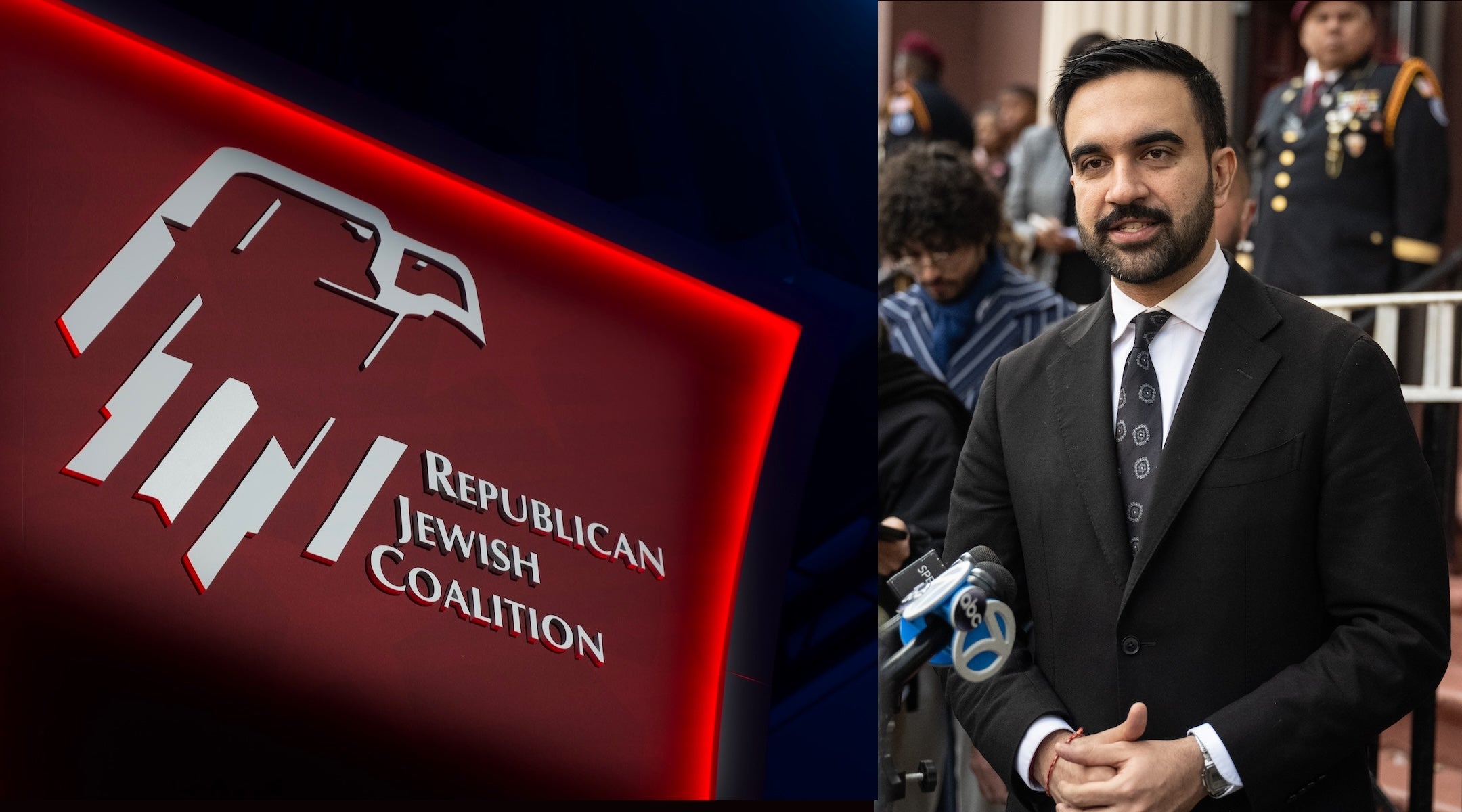
LAS VEGAS — There were a number of villains at the Republican Jewish Coalition’s annual summit here this weekend.
Tucker Carlson, who recently hosted avowed antisemite and white nationalist Nick Fuentes on his show, was lambasted by speakers as not being part of their MAGA movement. The phrase “Imagine if Kamala Harris were president,” said with relief, was uttered more than a few times.
But the name that drew the loudest boos the entire weekend was one that, a year ago, would have been completely unknown to the room.
“Take a look now at Zohran Mamdani, who represents the absolute worst of the worst,” said Norm Coleman, the RJC chairman and former senator.
“The extreme of the party is now the mainstream of the Democratic Party,” he added, a sentiment that was echoed widely, including by the Jewish congressmen Mike Lawler and David Kustoff.
Coleman invoked Mamdani to emphasize the importance of maintaining a Republican majority in Congress, using Mamdani as an example of how the Democratic party will “enact the most progressive, radical, leftist agenda this country has ever seen” if they can take control.
Mamdani, the Democratic nominee and favorite to be elected this week as mayor of New York City, is opposed to Israel’s government and existence as a Jewish state and subscribes to democratic socialist politics that are anathema to the RJC’s values.
Several of the speakers lambasted Mamdani’s 2023 comments, resurfaced this week, accusing the Israeli army of being the cause of problems within the New York Police Department.
The summit came at a moment of growing concern about antisemitism in conservative circles. But by casting Mamdani as the new face and direction of the Democratic Party, RJC speakers were able to acknowledge the existence of antisemitism on the right, while still pointing to the Democrats as having a far bigger, less controlled problem.
“The antisemitism problem exists in both parties,” Ari Fleisher, an RJC board member, told reporters. But, he continued, “Republicans have a cold. Democrats have a fever.”
“The Democrats have a growing socialism problem,” Fleisher continued. “And mark my words, the future is playing out before your very eyes at this meeting: What statement got the biggest reaction from the crowd? It was any reference to Mamdani. He’s not even elected yet.”
Fleisher said he expects Mamdani’s ascension to be “the new animating force that’s going to drive a lot of Republicans” into action.
“They’re adding to their fever, and his election will singularly tip that fever into a red-hot area that’s going to be hard for the Democrats to recover from,” Fleisher said.
The comments comes amid speculation that Republican leaders are in some ways eager for Mamdani’s election in New York, where the current mayor’s tolerance of the Trump administration has fended off some of the targeting that the president has directed toward other large cities this year. A democratic socialist at the helm of the city, long an avatar for conservative anxieties about crime and diversity, gives the Republicans a punching bag for attacks on the Democratic Party and, party strategists hope, boosts Republican odds in upcoming downballot races.
Fleisher was far from the only speaker to call out Mamdani.
Pennsylvania Sen. Dave McCormick said antisemitism is “running wild on the progressive left,” and that “the leaders of the Democratic Party are not confronting it, with their new star, Mamdani.”
Florida Rep. Randy Fine, one of four Jewish Republicans in Congress, called for Mamdani to be deported.
“The only thing I want to see Mamdani running for is his gate at JFK on the deportation flight to Uganda,” Fine said to cheers.
“Lord help us and pray for the people of New York City,” said conservative CNN commentator, Scott Jennings.
Emily Austin, a social media influencer who’s behind the group Hot Girls for Cuomo, said “extremists both abroad and here at home are committed to dismantling” a set of “Western values” that includes ”freedom, individual rights, democracy, capitalism.”
“And nowhere is this clearer than in my home, New York City,” she said.
“He is being elevated as a serious voice, potentially the next mayor of the biggest city in the world,” Austin said. (That title actually belongs to Tokyo; New York is 49th in population.) “Just think about the absurdity of that.”
Rank-and-file Republican Party donors in attendance who’d already been worried about a Mamdani mayoral administration felt their fears confirmed by speakers’ warnings and condemnations.
“I have two sons that work on Wall Street and I’m extremely concerned about their safety,” said Valerie Greenfeld, who moved to Israel from Washington, D.C., in 2021 but remains active with the RJC, in an interview.
“They assure me that they’re fine and all of this, but given everything that I’ve heard today, I know that I’m right,” Greenfeld said. “They’re not fine.”
She added, “Coming to the RJC today has helped me realize what I’ve known for quite some time.”
Speakers’ criticisms of Mamdani ranged from his socialist views (“Maybe he should go down to Cuba and see what it’s like to see a bread line,” said Sen. Rick Scott) to harping on the Queens assemblymember’s Muslim faith. Sid Rosenberg, the Jewish shock jock who quipped about Mamdani cheering for a second 9/11 — which Mamdani’s challenger, former Gov. Andrew Cuomo, played along with on the air — doubled down on that comment.
Rosenberg then explicitly shared his thoughts about Mamdani’s ascendance as a Muslim politician, suggesting that he was emblematic of a wave that he finds threatening.
“I believe there’s, what, 200 elected officials [in the country] that are Muslim, maybe 800 by the end of the year,” Rosenberg said.
“I don’t beat around the bush and I don’t care what you think about me — I don’t want Muslims running this country,” Rosenberg said, drawing applause.
“Now I’m not saying every Muslim’s a bad person,” Rosenberg said. “But when you preface something with something like that, the odds are — a lot of them are, right?”
He added, “When they take over New York City, which they’re about to do in four or five days, the rest of the country gets a heck of a lot easier.”
—
The post Zohran Mamdani, Muslim Democratic NYC candidate, looms large at Republican Jewish confab appeared first on Jewish Telegraphic Agency.
Uncategorized
High-Stakes US Special Forces Mission Rescues Airman From Iran After F-15 Crash

FILE PHOTO: A U.S. Air Force F-15E Strike Eagle aircraft takes off for a mission supporting Operation Epic Fury during the Iran war at an undisclosed location, March 9, 2026. U.S. Air Force/Handout via REUTERS/File Photo
US forces staged the audacious rescue of an airman behind enemy lines after Iran downed his fighter jet, officials said on Sunday, resolving a crisis for President Donald Trump as he weighs escalating the war, now in its sixth week.
The airman rescued by special operations forces, who Trump said was a colonel, was the weapons-systems officer on the downed F-15, a US official told Reuters.
“Over the past several hours, the United States Military pulled off one of the most daring Search and Rescue Operations in US History,” Trump said in a statement, adding that the airman was injured but “he will be just fine.”
The officer was the second of two crew members on the warplane that Iran said on Friday had been brought down by its air defenses. Iran’s Revolutionary Guards said several aircraft were destroyed during the US rescue mission, Tasnim news agency reported.
Reuters reported on Friday that the first crew member had been retrieved, triggering a high-profile search by both Iran and the United States for the remaining airman.
Iranian officials had urged citizens to help find him, hoping to gain leverage against Washington in the war Trump and Israel launched on February 28.
Trump has threatened to escalate the conflict in the coming days with attacks on Iran’s energy infrastructure.
Had Iran captured the airman, the ensuing hostage crisis could have shifted American public perception of a conflict that opinion polls show was already unpopular.
Trump said the airman was rescued “in the treacherous mountains of Iran” in what he said was the first time in military memory that two US pilots had been rescued, separately, deep in enemy territory.
The official told Reuters that as the weapons-systems officer was moved from near a mountain to a transport aircraft parked within Iran, US forces had to destroy at least one of the aircraft because it had malfunctioned.
U.S. AIRCRAFT HIT
The rescue effort, involving dozens of military aircraft, encountered fierce resistance from Iran.
Reuters reported on Friday that two Black Hawk helicopters involved in the search were hit by Iranian fire but escaped from Iranian airspace.
Separately, a pilot ejected from an A-10 Warthog fighter aircraft after it was hit over Kuwait and crashed, the officials said, though the extent of crew injuries was unclear.
Still, Trump was triumphant.
“The fact that we were able to pull off both of these operations, without a SINGLE American killed, or even wounded, just proves once again, that we have achieved overwhelming Air Dominance and Superiority over the Iranian skies,” he said in his statement.
US air crews are trained in what to do if they go down behind enemy lines, measures known as Survival, Evasion, Resistance and Escape, but few are fluent in Persian and face a challenge in staying undetected while seeking rescue.
The conflict has killed 13 US military service members, with more than 300 wounded, US Central Command says. No US troops have been taken prisoner by Iran.
While Trump has repeatedly sought to portray the Iranian military as being in tatters, they have repeatedly been able to hit US aircraft.
Reuters reported on US intelligence showing that Iran retains large amounts of missile and drone capability. Until just over a week ago, the US could only determine with certainty that it had destroyed about one-third of Iran’s missile arsenal.
The status of about another third was less clear, but bombings probably damaged, destroyed or buried those missiles in underground tunnels and bunkers, Reuters sources said.
The US and Israeli war on Iran has spread across the Middle East, killing thousands and hitting the global economy with soaring energy prices that are fueling fears of inflation.
Uncategorized
On Easter, Pope Leo Urges World Leaders to End Wars, Renounce Conquest

Pope Leo XIV waves from the main balcony of St. Peter’s Basilica after delivering his “Urbi et Orbi” (To the city and the world) message, on Easter Sunday at the Vatican, April 5, 2026. Photo: REUTERS/Remo Casilli
Pope Leo urged global leaders in his Easter message on Sunday to end the conflicts raging across the world and abandon any schemes for power, conquest or domination.
The pope, who has emerged as an outspoken critic of the Iran war, lamented in a special message to the thousands gathered in St. Peter’s Square that people “are growing accustomed to violence, resigning ourselves to it, and becoming indifferent.”
“Let those who have weapons lay them down!” the first US pope exhorted. “Let those who have the power to unleash wars choose peace!”
Leo did not mention any specific conflicts in the message, known as the “Urbi et Orbi” (to the city and the world) blessing. It was unusually brief and direct.
The pope said that the story of Easter, when the Bible says Jesus rose from the dead three days after not resisting his execution by crucifixion, shows that Christ was “entirely nonviolent.”
“On this day of celebration, let us abandon every desire for conflict, domination, and power, and implore the Lord to grant his peace to a world ravaged by wars,” Leo urged.
Leo, who is known for choosing his words carefully, has been forcefully decrying the world’s violent conflicts in recent weeks and ramping up his criticism of the Iran war.
In a sermon for the Easter vigil on Saturday night, he urged people not to feel numbed by the scope of the conflicts raging across the world but to work for peace.
The pope made a rare direct appeal to US President Donald Trump on Tuesday, urging him to find an “off-ramp” to end the Iran war.
In his address from the balcony of St. Peter’s Basilica on Sunday to the Square below, decorated with thousands of brightly colored flowers for the holiday, Leo offered brief Easter greetings in ten languages, including Latin, Arabic and Chinese.
The pope also announced he would return to the Basilica on April 11 to host a prayer vigil for peace.
Uncategorized
Temple Mount Set for Limited Reopening to Jews and Muslims

Israeli National Security Minister and head of Jewish Power party Itamar Ben-Gvir gives a statement to members of the press, ahead of a possible ceasefire between Israel and Hamas, in Jerusalem, Jan. 16, 2025. Photo: REUTERS/Oren Ben Hakoon
i24 News – Israeli authorities are preparing to partially reopen the Temple Mount in Jerusalem to both Jewish and Muslim worshipers for the first time since the start of the war with Iran, under a tightly controlled and highly restricted security arrangement, i24NEWS has learned.
According to details obtained by i24NEWS, the Israeli police, backed by National Security Minister Itamar Ben-Gvir, are also expected to permit limited access for Jewish worshipers to the Western Wall as part of the same phased plan.
Under the framework, access to the Temple Mount and surrounding holy sites would be restricted to small groups of up to 150 people at a time. In the event of a missile alert, all visitors would be immediately evacuated in accordance with emergency protocols.
The decision follows a recent Supreme Court ruling allowing demonstrations in a limited format. Police argue that a consistent standard must apply across both civic gatherings and religious sites, with Ben-Gvir insisting that “there cannot be one rule for demonstrations and another for the Temple Mount.”
However, the reopening contradicts recommendations from the Home Front Command, which has advised keeping sensitive sites closed due to the ongoing risk of missile attacks.
Israeli Justice Minister Yariv Levin has proposed transferring authority over such security-related decisions exclusively to defense officials, an initiative that could reshape the balance between the judiciary and security establishment regarding restrictions on public access.