


Uncategorized
7 ways to offer support and Jewish strength to friends or loved ones facing cancer
When Shoshana Polakoff, 40, received an unexpected breast cancer diagnosis three years ago, the mother of three young children needed extra support. Her friends, family and Jewish community in the Washington Heights neighborhood of Manhattan immediately stepped up.
They organized help with after-school childcare, packed school lunches for her kids and sent her little notes of encouragement while Polakoff endured trying cancer treatments.
“I felt pounds lighter and overwhelmed by the chesed that mobilized so quickly,” said Polakoff, using the Hebrew term for kindness. “And the practical help was such an incredible gift.”
Too often, however, friends and loved ones of cancer patients are at a loss for how to respond when someone close to them is diagnosed with cancer.
“Often they feel just as thrown into this new reality as the woman herself and are not sure what to do next,” said Adina Fleischmann, chief services officer for Sharsheret, the national Jewish breast cancer and ovarian cancer organization.
This is especially the case for young people who might never have had a family member or friend diagnosed with cancer before.
Fleischmann — whose organization offers extensive resources for cancer patients, ranging from emotional support, mental health counseling and education to financial subsidies for women and their families facing breast and ovarian cancer — has some guidance for what to say, how to reach out and what kind of help might be appropriate to provide in the face of a friend or family member’s cancer diagnosis.
It’s all about providing chizuk – Hebrew for strength – to the person facing cancer.
1. Establish the “Kvetching Order”
The “Kvetching Order,” based on a concept called the Ring Theory developed by clinical psychologist Susan Silk, dictates that those close to someone struggling with a cancer diagnosis offer only support to the cancer patient, and any kvetching about their own stress outward.
Thus, the person with cancer is at the center of a circle surrounded by a ring of her or his most intimate friends and loved ones. More distant concentric rings include other friends, acquaintances, more distant family and community members.
Colloquially known as “comfort in, dump out,” the Kvetching Order establishes a flow of support directed toward the person facing cancer.
2. Be clear and specific with offers of help
Support can look and feel different to different people facing cancer; each person’s needs and life circumstances are unique. When younger women are diagnosed with cancer — as often is the case with ovarian or breast cancers, where 50% of new diagnoses are in women under age 63 — patients often need extra help managing their responsibilities as parents and/or career professionals.
“Let the woman guide the journey,” Fleischmann says of the cancer patient. “Follow her lead.”
Sharsheret suggests offering concrete, practical assistance, such as offering to take the patient’s child to after-school activities or helping with homework. Maybe offer to come over to help clean the house, do laundry, or pick up groceries and make dinner for the family.
“But give the woman the feeling of control,” Fleischmann said. “Let her be in control of your support.”
Thus, a concrete suggestion like, “Can I bring you pizza for dinner on Wednesday?” is better than a vague offer of “What can I do to help?”
3. Check in often but don’t expect a response
By all means reach out to the person facing cancer. But if they don’t respond to your phone calls, emails or texts, don’t be put off.
“Sometimes the woman may not have the time or energy to respond,” Fleischmann said. That doesn’t mean you shouldn’t continue reaching out. “She will appreciate knowing that you’re thinking of her.”
Polakoff found small gestures particularly meaningful.
“Little things meant a lot,” she said. “Like just a note that said, ‘I’m thinking of you. Have a good Shabbos.’”
4. Leave cancer out of it sometimes and just be with them
Kristen Harvey, who at 23 was faced with an ovarian cancer diagnosis for the second time, said it was important to have friends around her with whom she could talk about the future.
“Just being there was the best thing,” said Harvey, who recently graduated from college and lives in Michigan. “We didn’t need to do anything. I appreciated when people came over and we just hung out and watched a movie.”
Alexis Wilson, a teacher in Jupiter, Florida, said her friendships were essential during her breast cancer treatment. Before starting chemotherapy, her friends threw her a big party to which everyone showed up in different-colored wigs and decorated her yard with signs.
“My friends played a big role,” said Wilson, 39. “I felt like I wasn’t alone.”
5. Continue your support throughout someone’s cancer journey
For some women, “maintenance treatment” can last for many years beyond the active treatments of chemotherapy, radiation or surgery. Women living with metastatic breast cancer, for example, usually continue treatment throughout their lives.
Fleischmann recommends checking in with a woman along every step of her cancer journey: not just the period of active treatment, but also during maintenance treatment, survivorship, and if she is living with metastatic or advanced cancer.
“It’s nice to know my friends and family continued to reach out once I was done with treatment,” Harvey said. “Back to normal doesn’t mean life is ever normal.”
There are often heightened emotional needs around anniversaries of certain cancer diagnoses or treatment dates, Fleischmann said, so marking these dates could be important.
6. Make sure you have your own support system
If you’re particularly close to the person with cancer, you may experience feelings of being overwhelmed yourself. It’s important to take care of your own emotional well-being and not dismiss it in the face of someone else’s more pressing illness.
“As a caregiver, you can be very easily drained without your own coping mechanisms,” Fleischmann said.
Make sure to take care of yourself physically and emotionally so that you have the capacity to attend to your friend or loved one’s needs.
7. Talk to your healthcare provider and safeguard your own health
Even while supporting a loved one or friend with breast or ovarian cancer, it’s important to safeguard your own health.
The BRCA genetic mutation that causes breast cancer and ovarian cancer is much more common among Ashkenazi Jewish women than in the general U.S. population. About 1 in 40 Ashkenazi Jewish women and men carry the mutation, compared to 1 in 400 in the general population. Ashkenazi Jewish men are also at elevated risk for melanoma and prostate and pancreatic cancer.
“Talk to your healthcare provider,” Fleischmann said. “Those whose family members are facing hereditary breast and ovarian cancer should speak with their doctor or genetic counselor to see how this may affect them, too, and learn about appropriate testing and precautions.”
—
The post 7 ways to offer support and Jewish strength to friends or loved ones facing cancer appeared first on Jewish Telegraphic Agency.
Uncategorized
Israel is the one thing both Pennsylvania gubernatorial candidates agree on
(JTA) — Democratic Pennsylvania Gov. Josh Shapiro and GOP opponent Stacy Garrity faced off on Wednesday in a heated gubernatorial debate, clashing over most policy issues — with the notable exception of Israel.
“I want to recognize the anniversary of the Hamas attacks, where 1,200 innocent people were killed, including 49 Americans,” said Garrity, referring to the third anniversary of Hamas’ Oct. 7, 2023, attack on Israel.
“I want to remember the lives that were stolen, the families that were changed forever, and the Americans that didn’t make it home,” she added.
While Garrity, Pennsylvania’s state treasurer, has the endorsement of President Donald Trump, Shapiro has a 25 percentage point lead in a poll released Wednesday. Both candidates won their primaries uncontested in May, and both have been outspoken against antisemitism.
Shapiro, who himself is Jewish, likewise recognized “the third anniversary of the October 7 massacre” at the debate. He recalled how “Hamas, a terrorist organization, broke into Israel and murdered 1,200 innocents, took over 250 hostage, including many Americans.”
“This is a moment where my heart stands with the people of Israel,” he said. “My heart stands with the Jewish community, who I know are grieving as a result of this.”
“This is a moment where we need to stand together against terrorism, against hate and against antisemitism,” the governor added.
Although the candidates shared similar perspectives on Israel during Wednesday’s debate, they clashed on numerous other topics, including the death penalty, voter identification, taxes and tariffs.
Asked by the debate moderator about the plunging support for Israel in the Democratic Party, Shapiro replied that he has “been very, very consistent” in both his “love of Israel” and his disagreements with Prime Minister Benjamin Netanyahu.
Shapiro then noted that Israelis will head to the polls in just a few weeks to choose their next leader. He expressed hope that they would not elect Netanyahu, whom he said “has led Israel down a very dangerous and isolated path.”
“I want America to have a strong relationship with Israel and with the Israeli government,” Shapiro added. “That’s not possible right now with the Netanyahu government in charge.”
Shapiro, one of the most prominent Jewish Democrats nationwide, was among the final candidates considered by Kamala Harris in her vice-presidential search in the 2024 election. He is also seen as a possible 2028 presidential hopeful.
But Shapiro has also faced the challenges posed by increasing antisemitism in America. During Harris’s search, for example, a website and social media feed labeled him “No Genocide Josh” over his support for Israel.
In April 2025, an arsonist set fire to Shapiro’s house just hours after his family had conducted a Passover seder. In 2018, while Shapiro was serving as Pennsylvania’s attorney general, a terrorist killed 11 people and injured six others at the Tree of Life synagogue in Pittsburgh..
Garrity, meanwhile, has more than tripled Pennsylvania’s investment in Israel bonds in her current role. She invested $20 million after the Oct. 7 attack and another $35 million in July 2025.
The post Israel is the one thing both Pennsylvania gubernatorial candidates agree on appeared first on The Forward.
Uncategorized
Protesters overrun Oct. 7 Israeli peace vigil attended by Mamdani
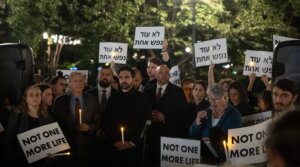
(New York Jewish Week) — Hundreds of pro-Palestinian protesters on Wednesday night overran a vigil marking Oct. 7 attended by New York City Mayor Zohran Mamdani.
The demonstrators swamped the area of Union Square Park that was supposed to host the event held by Israelis for Peace, a left-wing peace group. The organizers moved the vigil to a nearby spot in the park surrounded by police barricades as speakers struggled to be heard above the protesters. Attendees held electrically lit candles and signs reading, “Not one more life.”
Upon learning Mamdani was present, the pro-Palestinian protesters booed and broke into a chant of “Traitor!” and “Zohran, what do you say? How many boots did you lick today?”
The mayor stood solemnly throughout the event and did not speak at the vigil or address the protesters.
One protester yelled at Israelis for Peace organizers: “We don’t want peace with Israelis, bro! We sent your people to hell on October 7.” Other protesters wielded megaphones and drums while chanting anti-Israel slogans, including “Gaza will be liberated!” and “Israel is a terrorist state!”
Earlier in the evening, protesters were seen grabbing the electric candles intended for the vigil and mockingly singing the Jewish folk song “Hava Nagila.”
Another protester in the vigil area shouted out his disapproval of Mamdani: “He’s 100% Muslim but as of now, he stands as an ambassador of Zionism and U.S. imperialism.”

And someone else carried a poster depicting Yahya Sinwar, the Hamas leader who helped mastermind the attacks on southern Israel that killed 1,200 people three years ago Wednesday.
Amid the cacophony, Brad Lander, the Jewish Democratic nominee running to represent parts of Lower Manhattan and Brooklyn in Congress, took the microphone during the vigil to recite the words of the mother of a 20-year-old man who was murdered at the Nova music festival three years ago. He looked visibly shaken as the evening progressed, watching the protesters while speakers shared testimonies of people killed on Oct. 7.
Speakers also shared testimonies of Palestinians killed by the Israel Defense Forces, and the event included the group being led in a Muslim prayer. Many speakers referred to Israel’s campaign in Gaza as a “genocide.”
The vigil ended with the participants raising their candles and reciting the Mourner’s Kaddish, the traditional Jewish prayer honoring the dead. As they filed out of the event, the protesters shouted “Death to the IDF!”
Lander told the Jewish Telegraphic Agency that throughout the ceremony he felt “a deep and profound sadness for the testimony” of those lost, recalling that he’s met family members of some of the victims, both Jewish and Palestinian, whose stories were read.
“That level of heartbreak is a lot more than the level of having some people shouting,” he said. “The flattening of empathy is another sadness. And the fact that this is one of the few places where people even try to say Kaddish together and to mourn both Israeli lives lost on Oct. 7 and 75,000 Palestinian lives lost in Israel’s war since, is also sad. And that’s why it was important to do.”
Amichai Lau-Lavie, who leads New York’s Lab Shul and led the Mourner’s Kaddish, told JTA that “In the heat of these protest battles, there’s no room for nuance. It’s the slurs and the slogans. And what we saw here tonight was hatred that is coming from a good place of justice and freedom, but is not attuned to what we’re doing here.” He described that goal as one that acknowledges that both peoples’ futures are intertwined.
Lau-Lavie also praised the mayor for coming. “I can say I’m glad about the fact that the mayor was here and witnessed this animosity, and stood with us,” he noted. “For all his flaws, and there are many, I hope he got something.”
Despite the war of words, both gatherings disbanded peacefully. No arrests were made.
Amid the rival gatherings, Ross Glick, a New York pro-Israel activist and former executive director of Betar US, a far-right staunchly Zionist group, arrived with a group of counter-protesters holding Israeli flags. They were swiftly confronted by anti-Israel protesters, and the two sides got into a shouting match as they stood separated by a barrier.
The pro-Palestinian protesters had held a rally at City Hall, organized by Pal-Awda and various student groups, before heading to the location of the vigil. They condemned Israel and the United States for the war in Gaza, but also criticized Mamdani for capitulating “to Zionist pressure.” Some carried anti-Mamdani signs, including one that depicted Mamdani rolling out a red carpet for Israeli Prime Minister Benjamin Netanyahu.
The throng of protesters outside City Hall chanted “Free Palestine,” “Globalize the intifada,” “Resistance is justified when people are occupied,” and “Israel is a terrorist state.”
One protester held a sign reading “Operation Epstein Fury,” a play on Operation Epic Fury. Another held a sign that read “Liberation in action Oct. 7.” Nearby, an Israeli flag was held up with the text “Death cult” and an inverted red triangle — a Hamas symbol — atop the Star of David.

Earlier in the day, Jews in the city who marked Oct. 7 expressed fear about the political environment three years on from the attacks.
Toni Rabin, an 83-year-old Upper West Sider who lived in Israel in the 1970s, told JTA that she calls herself a progressive and has attended protests against President Donald Trump. But like many New York Jews, she gets unnerved by Mamdani.
“I’m burying my head in the sand a bit, because it’s a little too much for me to handle,” she admitted. She timed her arrival for her swim at the Marlene Meyerson JCC Manhattan to coincide with the commemoration of the third anniversary of the Oct. 7 attacks by Hamas in southern Israel.
“We should never forget,” she said. “We already have forgotten so much about the Holocaust, and there are very few people left who can speak about it anymore. They’re dying out. … So, we have to remember the horrific event that took place, the shock.”
She spoke over the sound of a cellist who performed for a small crowd in a lobby that was otherwise packed with small children having lunch with grownups. There was art on display by the Israeli artist Zeev Engelmayer from his “Strokes of Hope” exhibition.
Throughout the city on Wednesday, New Yorkers found themselves coping with the intense memories of learning about the 1,200 people, mostly Israelis but also foreign nationals, slain in Hamas-led attacks on southern Israel on Oct. 7, 2023, the majority of them civilians. Meanwhile, Palestinian residents and their supporters mourned the more than 74,000 Palestinians killed in the ensuing Gaza war, according to Gaza’s Ministry of Health. The ministry doesn’t distinguish between civilian and combatant deaths.
Hours before arriving at the vigil, Mamdani posted a statement on X in which he paid tribute both to Israelis killed by Hamas attackers in southern Israel on Oct. 7, 2023, and to Palestinians killed in the Gaza war that followed.
His statement infuriated leaders in the mainstream Jewish community, who read his post as yet another vehicle for accusing the Israeli government of genocide and apartheid.
Wednesday “marks three years since the horrific war crimes of October 7. On that day, Hamas killed more than 1,100 Israelis and abducted 251 others,” the mayor said in his X post. “We grieve alongside our many friends and neighbors who still carry that unthinkable loss.”
He went on, however, to say that the Israeli government led by Prime Minister Benjamin Netanyahu presided over an “ongoing genocide in Gaza,” saying that Israel “has killed more than 74,000 Palestinians — including more than 21,000 children.”
Mamdani continued, “Three years later, we must refuse to accept a world in which occupation and apartheid continue, where war crimes are met with impunity, and our federal government continues its complicity with every arms shipment.”
The city’s Jewish Community Relations Council was scathing in its response, saying that Mamdani “continues to fall short” of bringing New Yorkers together.
“It does not honor the dead to pit them against each other,” it said in its statement. “It is shameful. Today, Jewish New Yorkers across the five boroughs walked through metal detectors to drop off our children at preschool, thanked the police officers posted outside our synagogues for keeping us safe, tucked in our Jewish stars on the subway, and felt the gut punch of grief remembering the 1,200 innocent people who were slaughtered in their homes, in front of their families, and dancing at a music festival just because they were Jewish.”
Lander, favored to win his race for Congress next month, said on X ahead of the vigil that there was room to mourn the dead on all sides. “On this third anniversary of October 7th, a good start is to try to resist the flattening of empathy, to let ourselves weep for all the lives lost, the children killed, the families torn apart, the homes destroyed.”
The post Protesters overrun Oct. 7 Israeli peace vigil attended by Mamdani appeared first on The Forward.
Uncategorized
Newly aired recordings of paramedic Amit Mann’s final hours renew push to let families access Oct. 7 records
(JTA) — Three years after paramedic Amit Mann, 22, was killed by Hamas while treating the wounded in Kibbutz Be’eri on Oct. 7, newly aired recordings of her final calls revealed fresh and harrowing details about her last hours.
The recordings, aired by Channel 12 on Tuesday, prompted her sister, Haviva Mann Izikson, to renew an appeal for a centralized system to ensure other families are not left searching for similar records years later.
The calls capture Amit repeatedly calling emergency services as Hamas terrorists overran Be’eri, seeking assistance while continuing to treat wounded residents.
The previously unknown calls came to light by chance, when, earlier this year, Mann Izikson contacted the Magen David Adom emergency service seeking the precise times of calls Amit had made on Oct. 7 as she updated a presentation she planned to give about her sister. MDA provided information on seven calls. Until then, the family had known of only four.
Mann Izikson said hearing them revealed both that what Amit endured was “even worse than we had thought” and the extent to which Amit continued caring for others even as the situation around her deteriorated.
“It showed me even more both the hell that she went through and, on the other hand, who she was. What she was dealing with, what she went through there, which was even worse than we had thought, and how despite all of that she keeps treating the wounded in every way she can,” Mann Izikson told the Jewish Telegraphic Agency Wednesday as she prepared to return to Be’eri for a memorial event at the dental clinic where Amit was killed.
The recordings trace Amit’s increasingly desperate attempts to summon help as terrorists closed in around the dental clinic. Hours later, she sent her sisters a chilling last message: “They’re here, in the clinic. I don’t think I’ll make it out of here. I love you.”
In one call, Amit is heard struggling to convey the scale of what was happening to a police dispatcher.
“I don’t understand what’s going on,” she told the dispatcher, describing wounded and dead people around her and continued gunfire. She asked whether the army or police had reached the kibbutz. When the dispatcher told her help was coming and urged her to stay inside, Amit began to cry. “Just tell me you’re here.”
Hours later, at 10:41 a.m., after seven calls to Magen David Adom, Israel’s national emergency medical service, Amit made her final recorded call to police. “Listen, terrorists have infiltrated Be’eri! We urgently need an ambulance or police here. Come urgently to the dental clinic.”
Hearing the latest recordings was heartbreaking, Mann Izikson said. She was struck by Amit’s ability to pull herself together after desperate calls for help and return to caring for the wounded, comforting them, asking about their families, bringing them water and improvising with what little there was. Amit placed helmets beneath their heads and covered those who were cold from blood loss.
“She keeps them alive until her final moments, and she stays true to herself until her last breaths,” Mann Izikson said. “It just amazed us.”
Mann Izikson is urging the state to establish a central body that would collect all existing documentation from Oct. 7, including recordings held by emergency services and police as well as security-camera footage and other material, catalogue it by victim, and contact each family. Such a body, she said, should tell relatives: “We have documentation of your loved one. Would you like to receive it?”
“If the family wants it, then all of it should be provided to them proactively,” she added.
She pointed to the family of Gil Buyum, 55, a member of Be’eri’s security squad whom Amit treated after he was shot. In one call, Amit reported him wounded; in a later call, she reported that he had died.
The two recordings allowed Buyum’s widow, Ayelet, to narrow down the time of her husband’s death, Mann Izikson said. Buyum’s 22-year-old son, Inbar “Buri” Buyum, was also killed while trying to defend the kibbutz that morning.
“Only because of Amit’s recordings was she able to identify the 20-minute window in which he died,” Mann Izikson said. “That’s just one example of how someone can get some kind of closure from something like this.”
She said families should be able to decide for themselves whether they want such material. “It belongs to the families. It is the families’ material, and the families should decide what, if anything, to do with it.”
A law passed in July established an Oct. 7 Memory Authority slated to include an archive and centralize documentation of the attack. The law is due to take effect in January, but it is unclear whether the authority will match material to individual victims and notify their families.
JTA was unable to reach the Prime Minister’s Office and the Israel State Archives, the government body responsible for preserving state records, in time for publication.
Merav Israeli-Amarant, CEO and co-founder of the Civil Commission on Oct. 7 Crimes by Hamas, which released a major report in May documenting sexual violence during the attack and its aftermath, said Mann Izikson’s proposal was “profoundly important.”
“Families should not have to discover, years later and by chance, that recordings, footage, or other documentation connected to their loved ones exist,” Israeli-Amarant told JTA. She said there should be a mechanism that “approaches families with sensitivity,” while giving them the choice of whether to “receive it, view it, preserve it, or not engage with it at all.”
But Israeli-Amarant also said there was “unique importance” in preserving such material through civilian institutions, noting that many Oct. 7 families feel abandoned by the state and that some prefer documentation to be handled independently and “outside political considerations.”
Maya Gan-Zvi, manager of the National Library of Israel’s Bearing Witness: October 7 Archive, which has collected hundreds of thousands of files from the attack, cautioned that proactively approaching families, as Mann Izikson proposes, also raised ethical questions because families differ widely in how, and whether, they want to encounter such material.
“Some want to receive everything, and some do not want to know, or not yet,” Gan-Zvi told JTA, adding that even members of the same family may disagree. Contacting a family without first knowing its wishes could “reopen wounds,” she said, particularly in cases involving graphic material or footage filmed by the terrorists themselves.
Gan-Zvi said she favored a system in which bereaved families themselves would take the initiative, registering that they wanted to be contacted, specifying the types of material they wanted and receiving a description of what had been found before deciding whether to obtain it.
According to Israeli-Amarant, any system would face “significant” practical and legal hurdles because Oct. 7 material is scattered among government bodies, emergency services, police, the military, media outlets and private individuals, raising questions of ownership, privacy, consent and the rights of victims’ families.
Some recordings or footage may also be evidence in ongoing investigations or criminal proceedings against Hamas terrorists, she said, making chain of custody, publication restrictions and the integrity of those proceedings additional considerations.
Mann Izikson said providing documentation would help answer fundamental questions that remained unresolved.
“Three years later, we still don’t know the full truth and don’t understand how this happened,” she said. “Every piece of material like this can shed another bit of light and help us understand a little bit more.”
She has listened to the newly aired recordings repeatedly, echoing a pattern she described to JTA on the first anniversary of the attack, when she said she reread Amit’s messages from Oct. 7 every day, in part to piece together what happened during her sister’s final hours and try to come to terms with it.
It took two and a half days for Amit’s body to be identified. Mann Izikson told JTA at the time that when her sister was lowered into the grave, “I felt like they were burying half of my own child. I wanted to go in instead of her.”
Even amid the war, the hostage crisis and the wider grief in Israel on the first anniversary of Oct. 7, Mann Izikson said Amit’s loss eclipsed everything else. “There is all the rest — and the rest is painful and scary,” she said. “And then there is Amit and nothing else at all.”
This article originally appeared on JTA.org.
The post Newly aired recordings of paramedic Amit Mann’s final hours renew push to let families access Oct. 7 records appeared first on The Forward.
