


Features
Campus program gives Winnipeggers a virtual reality experience allowing them to share some of the same emotions Israelis attacked on October 7 felt

By BERNIE BELLAN It was advertised as “Through Their Eyes – October 7th Virtual Reality Journey.”
On September 16, a small number of Winnipeggers were able to participate in a virtual reality experience during which they were able to watch in 3D as different Israelis described what they went through on October 7 last year.
The event was sponsored by Winnipeg Friends of Israel and Bridges for Peace. It was held in the games room of the Rady JCC.
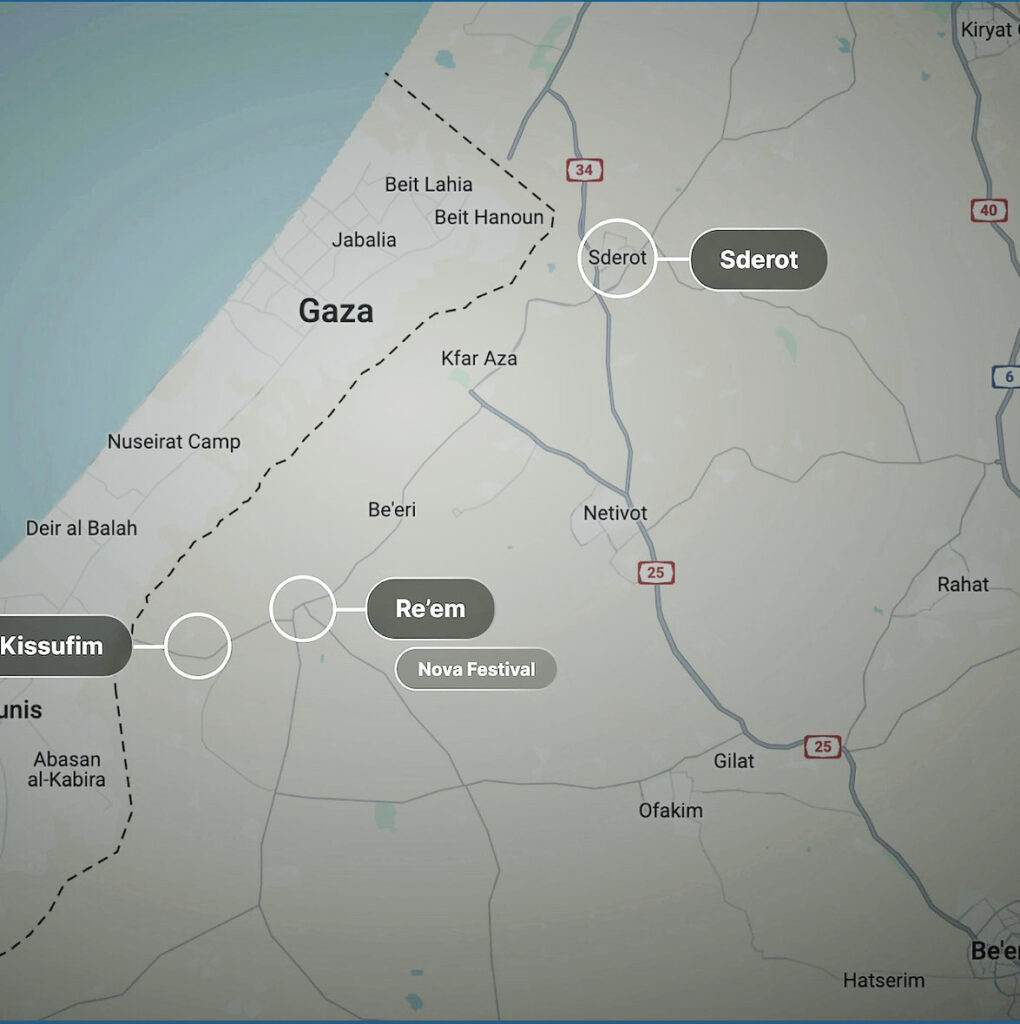
As readers no doubt recall, on October 7, 1200 Israelis (and non-Israelis) living in communities situated close to the Gaza Strip were murdered by what turned out to be over 6,000 Hamas terrorists who had managed to penetrate into Israel fairly easily in the early hours of October 7. As well, 220 individuals (not all of whom were Israeli) were abducted and taken to Gaza.
While almost anyone in the world with access to the internet would have been able to see footage of the atrocities carried out by Hamas – and fully understand the absolute terror that people were experiencing, for Israelis living near the Gaza Strip what was happening was all so terribly confusing. People could hear gunshots all around them – but where were they coming from and who was firing them, almost everyone who was there must have wondered?
And, once the realization that an attack was underway, how were you supposed to respond? Were you better off to try and hide in place or to try to make a run for it?
An Israeli production company that goes by the name of Atlantis-VR embarked upon an ambitious project whereby they wanted to interview some of the individuals who experienced that October 7 attack directly. But, rather than simply interviewing those individuals, Atlantis-VR wanted to show each of them in their own homes – in the exact places they were as the attack was taking place. Through virtual reality technology viewers are now able to see a 360° rendition of an entire room in which the interviewees in the presentation created by Atlantis-VR were situated at the time of the attack. At certain points you are also taken outside interviewees’ homes and see the same vistas that those individuals would have been able to see, including roads and fields with the Gaza Strip in the background.
As groups of six different individuals entered the games room in the Rady JCC on September 16 they were greeted by Daniel Zioni, one of the principals behind Atlantis-VR. There were six different sessions held on September 16, each lasting anywhere from 40 minutes to an hour (depending on how long it took each attendee to watch the presentation. In my case, for instance, I spent over an hour as I had so many questions during the course of watching the presentation that I continued to pepper Daniel with questions about what I had just seen after each segment. Poor Daniel – since each of us had donned the headset at different times and were watching the presentation at our own pace, he was constantly racing from participant to participant, adjusting headsets, turning on the next segment, and answering questions.)
After donning the virtual reality headsets, (which takes some getting used to, especially for older participants who had likely never experienced wearing a VR headset before), the first segment began for viewers. We watched as a woman by the name of Yasmin Margolis describe what had happened to her, her husband Sa’ar, and their two young daughters, when Hamas terrorists entered Kibbutz Kissufim, which is where they lived.
Sa’ar bravely left the family home, armed with his rifle, to take on the terrorists. Unfortunately, while his wife’s and daughters’ lives were spared, Sa’ar died that day fighting to protect his kibbutz.
The next segment is about the Marom family, who were living in Kibbutz Re’em. In their case, their house was set on fire by terrorists while they were inside. Still, they managed to escape through a window and were eventually rescued.
The third segment shows a family living in an apartment block in Sderot. The battle for Sderot actually lasted over two days, as IDF forces entered into protracted gun fights with terrorists who had been hiding throughout the city. During that time the Politi family holed themselves up in their apartment and even provided shelter – and food, for a boyfriend of one of their daughters – and his friend, who had found themselves stranded at a gas station where one of them had been working when the terrorists invaded. There was a moment of comic relief when the Politi husband and wife described what happened when they heard banging on their apartment door. The boyfriend shouted that it was him – and Mr. Politi opened the door. At that point, Mr. Polliti, noted, the boyfriend’s friend said: “I’m hungry – have you got anything to eat?”
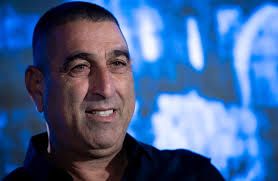
The final segment of the VR presentation – and easily the most mesmerizing of the four segments, consists of an interview with Rami Davidian, who was a 58-year-old member of a moshav by the name of Patish in an area very close to where the Nova Music Festival was taking place. Davidian has become quite a national hero in Israel for what he did on October 7 – and for almost 48 hours non stop thereafter.
As he describes in his interview, he received a phone call from a friend who didn’t quite understand what was happening the morning of October 7, but whohad a daughter who had been attending the Nova Music Festival, which was the site of the murder of 370 young Israelis. The friend knew Rami lived close to where the festival was taking place and asked him whether he could go there to try to find his daughter. Of course, Rami had no idea what he was heading into – and, as he explains during the segment in which he tells his story, even as bullets and rocket propelled grenades began to be fired at his car, he continued on. He managed to find survivors of the massacre and transport them back to his home on the moshav, where his wife took care of them.
But then, he started to receive hundreds of messages from anxious parents who somehow had heard that Rami might be in a position to save their kids. He got back into his car and headed right back to the site of the festival – all the while being fired upon by terrorists. Somehow – and he says he doesn’t know how he survived, he managed to return to the site – over and over again, eventually incredibly helping to rescue 750 young Israelis.
The entire VR presentation is so vivid that I had only wished that more people could have seen it. I asked Daniel Zioni whether there were any plans to convert the four segments of the presentation into one video that, for instance, could be seen on Youtube? Granted, seeing it in VR makes more of an impact, but in terms of reaching a wider audience I wondered whether it might make sense to do what I had suggested. I was especially keen on seeing the segment with Rami Davidian turned into something that could be seen by a much wider audience. While Daniel didn’t give me a definitive answer, he did say that was something under consideration by Atlantis-VR.
In the meantime, if you would like to read more about Rami Davidian and his heroics, there are quite a few articles online that tell his story. Simply Google Rami Davidian.
Here’s a link to the Atlantis-VR website: www.atlantis-vr.com










Features
In memory of Joan Druxman
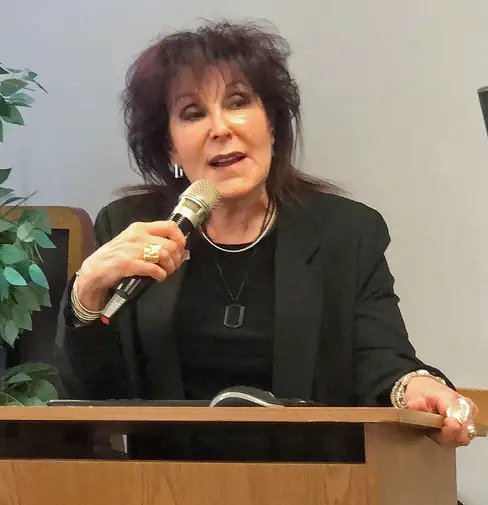
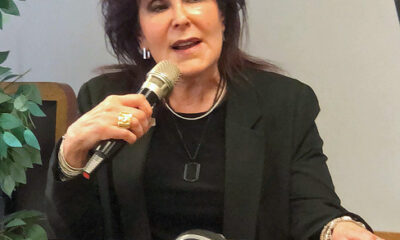
By BERNIE BELLAN In May 2023 I wrote a story about Joan Druxman, whom I had just met in person when she was a guest speaker at the Remis Luncheon series that month.
Sadly, Joan passed away on September 5, after a brief illness. My original story received over 4,000 views, so I thought it worth repeating here, to honour the memory of a vivacious and fascinating woman. Here is that story again:
The February 21, 2001 issue of The Jewish Post & News had an article titled “It’s a Comedy Night!”
That article went on to describe an upcoming event in which State of Israel Bonds would be honouring Rabbi Alan Green. Among the comedians to be appearing at the event was to be “Joan Druxman-Jones.”
Now, 22 years later, State of Israel Bonds doesn’t have an office in Winnipeg, Rabbi Green doesn’t live here any more (although he will be returning this weekend as the Shaarey Zedek’s Rabbi in Residence during Shavuot) and, as for Joan Druxman-Jones, well, she is back in Winnipeg – after having left in 1990 – and after having had a tumultuous series of career changes throughout her life –and, after having dropped the Jones in her name and gone back to Joan Druxman.
Joan Druxman was the guest speaker at this year’s kickoff Remis Forum luncheon on Thursday, May 11, at the Gwen Secter Centre.
I had never met Joan prior to that Thursday, although advertisements for her well-known women’s clothing store, “Joan’s Boutique”, were a regular feature in our paper for years. Once she took the podium at the Gwen Secter Centre it was easy to see how Joan had been a successful model for years. She still maintains a shapely figure and, even at 83, Joan is quite an attractive woman. (Is it okay to say that, I wonder? Who knows what’s permissible nowadays to write about a woman – or a man, for that matter, when it comes to physical appearance?)
But, more than anything, what struck me in listening to Joan tell her life story was her ease in speaking, her quick wit, and her self-effacing sense of humour.
As Simone Cohen Scott noted in an email sent out to Remis Forum attendees (and, by the way, anyone can attend a Remis luncheon. Just let the Gwen Secter Centre know you’re coming by the Tuesday of that week’s luncheon. Call 204-339-1701.), I took “voluminous notes” while Joan spoke.
So, here’s my account of the story Joan told: Born in Winnipeg, Joan (whose maiden name was Zelcovich, she said), grew up in Estevan, Saskatchewan, and moved back with her family to Winnipeg when she was 15.
Joan explained why her father decided to move to Winnipeg. He had owned a successful hotel in Estevan, but many of the patrons of that hotel were rough-hewn oil workers from the area around Estevan. “My father wasn’t about to let those oil workers anywhere near his two teenage daughters,” Joan said. (She had a younger sister at the time they moved here.)
But, the summer before the Zelcoviches moved to Winnipeg, they spent part of that summer at Clear Lake.
There were a lot of Jewish girls at Clear Lake, Joan noted, but they snubbed here because of the way she dressed. “They thought I was a hick,” she said.
That fall though, when Joan began attending Kelvin High School, and she was introduced by the teacher to the other students, the other girls couldn’t wait to be her friend, Joan said. This time she was dressed to the nines, she noted – something that has been very important to her ever since, she also observed.
As she noted toward the end of her talk, “I firmly dress the way you want to be treated.”
But from where did get Joan derive her impeccable fashion sense?
“My mother subscribed to the New York Times Magazine. It was the Vogue of the day,” she said.
Sure enough, when she was only 16, Joan got her first job working at the Mirror Room in the Hudson Bay store while she was attending high school.
After attending Kelvin for a couple of years Joan decided to attend the University of Manitoba. (In those days, she explained, you could take Grade 11 at the university.)
As things turned out, however, and as Joan observed, university was not for her.
“I hated it like you can’t imagine,” she said. “When I got 17 in Biology I knew university was not for me.”
So, Joan decided to enroll in the Angus School of Commerce (which was owned by Janice Filmon’s father at the time) where she obtained her diploma in typing and shorthand. “I was a wiz on the Dictaphone,” she noted.
But, she had to find a job after graduating. “I saw an ad for a company called Gunn Garment, which was owned by Harry Silverberg and Dave Kaufman, and which was managed by Max Duboff.”
“I became Max’s secretary and house model,” Joan said. “That’s how I became a model.”
It was during her time at Gunn Garment that Joan was introduced to the man who was to become her husband, Winnipeg Blue Bomber George Druxman.
“Marilyn Trepel called me up and told me someone had seen me at a wedding. Would I like to meet him? He’s one of the Blue Bombers,” Marilyn said to Joan.
As a Bomber wife, Joan was asked to appear on a local television show along with other Bomber wives where they would each be asked to cook a favourite dish.
“I made blintzes,” Joan noted.
As luck would have it, “two guys from Manitoba Sugar saw me and asked me to do a regular cooking show on TV.”
It was while appearing on her own cooking show that an editor of the Winnipeg Tribune asked Joan whether she would like to become food editor of that paper, and shortly thereafter, the fashion editor as well.
The next step in Joan’s career came when she was asked whether she would like to become the fashion coordinator for the Hudson’s Bay Company in Winnipeg, Saskatoon, and Regina, also the manager of the Fashion Room in the Bay.
But, as Joan recalled, “at the time the Bay fashions were all centrally coordinated. I hated them all. I decided to go out on my own.”
Thus began the longest segment of Joan’s varied career: as owner of Joan’s Boutique.
It was no simple matter, however, for a woman to strike out on her own in a business at that time, which was in 1976
Having been divorced from George Druxman (who died in 1999), Joan was mother of three boys at the time: Trevor, Greg, and Adam. Two of the boys were married by then.)
“I wanted to set up in an old house,” she recalled.
“I went to see a bank manager who said to me: ‘I’ll have you know fashion retailing is the riskiest business there is.”
Not one to be discouraged, however, a former classmate of Joan’s from Kelvin, Brian Aronovitch, told her there was a house at 34 Carlton owned by lawyer Ken Houston – who wanted to rent out part of the house.
At the same time Joan was introduced to another bank manager who was supportive of her dream of opening her own boutique.
“I opened Joan’s in 1977,” she observed. “Business just took off. It was bursting at the seams.”
Ever on the eye for another opportunity, it was while out for a walk in the neighbourhood of the Carlton store that Joan said she saw a rooming house for sale at 22 Edmonton.
“It was a tax sale,” Joan noted. And so, in 1979, Joan Druxman opened Joan’s Boutique at her new location on Edmonton, where she was to remain for the next 13 years.
“I gutted it and had clothing and accessories on the first and second floors,” she said, “with a hairdresser on the third floor.”
Ever restless, however, Joan decided to move to Vancouver in 1990.
“I saw things there that weren’t happening in Winnipeg,” she observed, including a very large Japanese population.
Joan opened her first store in Vancouver at the corner of 12th and Granville, but soon she came across a better opportunity at Berard and Granville. She approached a former friend from Winnipeg, Karen Simkin, who had also moved to Vancouver and who had opened a little gift shop.
“I invited Karen to move to that new location with me,” Joan said.
Karen’s husband, Garry Simkin, was fully supportive, and so the two women opened a store that was a combination clothing and gift ware store.
As mentioned though, Joan had taken note of how many Japanese tourists there were in Vancouver. Accordingly, as she explained, “I went to Simon Fraser University and learned how to read and write Japanese” so that she would better ingratiate herself with Japanese customers.
Things were going along well until their landlord told Joan and Karen that he was going to be raising the rent to $250,000 a year. (And remember, this was the 1990s. One can well imagine how exorbitant that amount would have been back then.)
So – another career switch for Joan was in the offing: “I decided I’d like to be an actress,” she observed. At the same time she started doing stand-up comedy (as noted at the beginning of this article.)
Ever eager for new challenges, however, Joan decided to apply for a green card and move to Los Angeles –where she began studying acting while working for Nordstrom’s.
“I also got my California real estate license,” she added.
But this was all before Obamacare, Joan noted. “Medical insurance was costing me $1500 a month.”
Joan decided to move back to Winnipeg where, once again, she opened “a little store.”
In 2020, however, with the onset of the Covid pandemic, Joan found she “couldn’t get stuff from Europe” and, as a result, she had to close her store.
“So, I walked into the cosmetics department of the Bay (Polo Park store) and said, ‘I want to see the Chanel manager.’ “
As luck would have it, that manager happened to need someone at the Chanel perfume counter and Joan was hired on the spot.
Which brings us full circle to where Joan started when she only 16 – working again at the Bay.
“Here I am at the Bay working five days a week – and loving it,” she said. “Without a bank manager, without a landlord, and without the tax man.”
But, as Joan observed, she still dresses to the nines – even though now she takes the bus to work. (It stops right in front of her apartment and drops her off right at work, so why not?)
As she noted though, you can imagine the looks she gets from other passengers who see an immaculately dressed woman getting on their bus every day.
One time, Joan said, her regular bus driver asked her: “Are you a celebrity?”
Joan told him she wasn’t, but one day that bus driver happened to be shopping at the Bay with his wife when he spotted Joan at the Chanel counter and said to his wife: “I know her. She rides my bus.”
That’s Joan Druxman for you – more twists and turns than a Gerry Posner story. Some day she ought to write a book. Hey, there’s an idea for her next career move!
Post script: We were informed that the day after Joan Druxman spoke at the Gwen Secter Centre she was involved in a terrible accident when she was coming out of work at the Bay.. It seems that Joan was caught in the midst of a situation where some young boys had been fleeing the store after having stolen some jeans. One of them ran into Joan, knocking her to the ground – which broke her hip. At last report she had undergone hip replacement surgery and had been released from the hospital.
Features
What I miss

By DAVID TOPPER When my late wife, Sylvia, and I moved into the house I’m still in, we brought with us not only our furniture and other things from inside the old house, but some outdoor plants and flowers – even a shrub. The shrub, of course, was small: a young mock orange. Sylvia had a thing about mock oranges, so we dug it up and took it with us to the new house. Then there were irises that we inherited from the previous owners of our first house. I can still recall Sylvia doting over those irises when we moved there in 1971. They were very different varieties from those she was familiar with. I liked them, too. I also remember a rose bush. Well, everyone likes roses. Appropriately, it was red. So, the irises, along with the mock orange and the rose bush were transplanted to the new yard. That was in the summer of 1976.
For reasons that I cannot explain, when it came to plants and such, there was a sort of division-of-plant-labor between us. I took care of all the indoor plants and Sylvia did the outdoor ones. This meant that she only worked during the relatively short span from late spring to early fall, since we live in Winnipeg, Canada. Whereas, I looked over the house plants all year long.
Actually, I can explain something. You may have noticed that when speaking of digging up things I use the plural. This was because Sylvia enjoyed physically working in the yard. This digging urge she acquired in the year after High School that she spent working on a Kibbutz in Israel. It was daily hard physical labor in the field: digging, planting, pruning, picking and so forth. Yet she always talked about it lovingly. That was 1960-61 and I saw the blissful look on her face when working in our yard, from 1971 onward.
In time we had a diverse array of plants and flowers. In no particular order, we had lilacs, peonies, hostas, lilies, day-lilies, irises, roses, tulips, lungwort, elephant ears, clematis, rhubarb and the mock orange (which – along with the irises and roses – had grown quite nicely, since the summer of 1976).
All this lasted until the foremost transition in our lives. Early in 2014 Sylvia was diagnosed as being in an early stage of dementia. Over the next six years, as she drifted deeper into her black hole, I gladly obliged taking over the household chores, some of which I had begun already – such as doing most of the cooking. As for the outdoor tasks from spring through summer, that deeply implanted love of gardening was one of the last things to go from her immediate world. Even when she was not too sure who I was, she was glad to work with me in the yard with a shovel in her hands – and a smile on her face.
Sylvia died in the winter of 2020. Come spring, it was just me and the yard.
I don’t remember if it was that first spring or one later, but one day I noticed that the mock orange looked less robust – so I pruned it. That seemed to work for the summer, but the following spring it lost its vigor. More pruning didn’t help. Thus, slowly, over time, it died off and I dug up what was left.
Around the time I was still fiddling with the mock orange, I noticed the rose bush that Sylvia gave lots of love and care was not looking its usual hearty self. I got the fertilizer that she used to try to revive it, and that seemed to work. But the following year, the bush lost its vitality – and nothing I did (extra watering; keeping it dry) worked to impede the track it was on. In time, the rose bush died, too.
“What’s next,” I shouted to our yard.
The following spring the tulips came up as usual, but didn’t look as healthy as they should. These had a special meaning, since we bought the bulbs on a trip to Holland and planted them ourselves. Obviously, I tried everything I could to bring them back – reading all that the Internet had to say about tulips. Needless to say, that was the last summer for the tulips.
“Oh no,” I cried the following spring, when I first saw the irises. They were up, but not looking very well. This was probably the most difficult loss. I don’t know why, but those irises were part of an exceptional bond between us. Sylvia and I and the irises: their singularity symbolized the uniqueness of our relationship.
The irises were the last to go.
As I write this, the rhubarb still comes up, but it’s not as hearty as it used to be. The rest of the plants are doing fine: lilacs, peonies, hostas, lilies, day-lilies, lungwort, elephant ears and clematis. Incidentally, I also have a unique fondness for the clematis, since I bought it and planted it myself many years ago.
I wish to make clear that I’m not putting forth any causal or symbolic or spiritual or mystical meaning to all this, in relation to Sylvia’s demise. Rather, I’m just telling the story of my personal experience with the plants and flowers in our yard. You may read into it whatever you wish.
Now when I walk about my yard, enjoying the remaining plants and flowers amidst the bushes and trees, I not only see and derive pleasure from all that I still have – but I also “see” what is missing: that mock orange, the rose bush, those tulips and the irises.
It also reminds me what I intimately and ultimately miss.
Tags: bonding |caring |coping |loss |sharing |symbolism

David R. Topper writes in Winnipeg, Canada. His work has appeared in Mono, Poetic Sun, Discretionary Love, Poetry Pacific,Academy of theHeart & Mind, Altered Reality Mag. and elsewhere.
Related Posts
Features
A “Tour” of Antisemitism in Eastern Europe
By HENRY SREBRNIK As we enter the fourth year of the “October 7” wars, things in Eastern Europe remain dire. There have been dozens of attacks on Jewish institutions across the region.
True, there are a few bright spots. Albania’s prime minister is a surprising ally of Israel in a mostly Muslim country. Edi Rama openly defends Israel’s right to protect itself, and condemns Hamas in extremely harsh terms, calling them the “Nazis of the 21st century.” He notes that waves of Jewish refugees were welcomed over the centuries.
“On the eve of World War II, only about 200 Jews lived in Albania,” he told the Jewish magazine Mishpacha. “After the Holocaust, there were more Jews here than before — about 3,000. We didn’t hand over a single Jew to the Nazis. Seventy-five Albanians are officially recognized as Righteous Among the Nations, but in truth, the entire population mobilized.”
There is also better news from Croatia. Rabbi Pini and Raizy Zaklas moved to the country in 2004 to establish the first Chabad centre on “the land of a thousand islands.” Coming from their native Israel, it took time for them to come to terms with the fears of the Jewish community.
“We spent the first decade just earning their trust,” Raizy explained. “We had to put our grand ambitions aside and choose an individualized approach, fostering relationships through one-on-one meetings at coffee shops. Sometimes we felt disheartened at the slow pace of growth here, and worried we weren’t making progress. But I see in retrospect that we were putting down roots.”
In 2016, the Zaklas purchased a five-story building in the centre of Zagreb. Since then, it has become the spiritual center of Jewish life in the country. It’s a place where hundreds of weddings, bar and bat mitzvahs, and holiday programs take place annually. It’s a place where more than 3,000 Croatian Jewish men, women, and children find connection with their heritage. And it’s a place where thousands of tourists visit each year.
Less positive is the position of the Czech Jewish community. The Federation of Jewish Communities in the Czech Republic registered a total of 4,694 antisemitic incidents in 2024, compared with 2023, when 4,328 cases were reported. The severity of antisemitic incidents dramatically increased following the events of October 7. 2023. Anti-Jewish hatred, particularly in the form of demonization and delegitimization of Israel, became socially accepted and, according to the Federation, dominated public opinion.
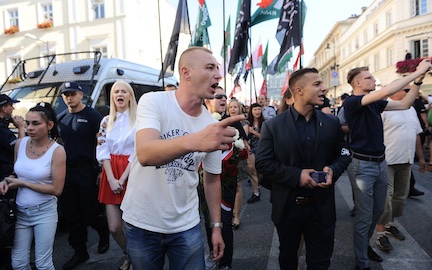
In Greece, a spate of incidents in 2025 included a pro-Palestinian protest that blocked Israelis attempting to disembark from a ship in Syros, an alleged attack against Israeli teens in Rhodes, and an attack on King David Burger, a kosher eatery in Athens. Greek Jewish groups condemned an “anti-Zionist patrol” which took place on the streets of Thessaloniki, 95 years after assault squads targeted Jews in the same city. The left-wing anarchist Rouvikonas group organized the “anti-Zionist patrol” heading toward Mavili Square, which they said “Israeli capital has parasitically infiltrated.” They were joined by members of the groups Permanent Struggle for Class Liberation and the Libertarian Initiative of Thessaloniki.
However, in recent years there has been great improvement in formal Greek-Israeli relations, particularly following the disintegration of Israeli relations with Turkey. In August, Israel and Greece finalized a $3.5 billion deal, called the “Achilles Shield,” providing the Hellenic Republic with a multilayered antimissile system designed to protect the European Union country against aerial attacks from nations such as Iran and Turkey. It is one of the largest defence export deals in the history of the Jewish state.
The two countries “share common strategic interests and face shared regional challenges,” Israeli Defence Minister Israel Katz indicated. “At a time when actors with hegemonic ambitions are seeking to expand their influence and undermine stability in the region, Israel and Greece will continue to deepen their defence and strategic cooperation.”
Hungary too is a bright spot. It has stood virtually alone in defending Israel in the European Union. Budapest has consistently blocked one-sided, anti-Israel statements and stood firm on Israel’s right to defend itself. At the United Nations, where Israel is routinely demonized, Hungary has refused to go along with the mob. And not just on the international stage. At home, Hungary walks the walk.
Hungary is home to the largest Jewish community in Central Europe, with estimates ranging from 80,000 to 100,000 Jews, most of them living in Budapest. The city is one of the only capitals in Europe where Jews can freely wear a yarmulke without being harassed, attend synagogue without metal detectors and celebrate Jewish holidays without police guarding the doors of synagogues. The government has invested millions into preserving Jewish heritage sites, restoring synagogues and funding Holocaust education not just as a formality, but as a national priority.
Poland had the highest Jewish population in Europe prior to the Holocaust and was also the site of the Nazi death camps where most European Jews were murdered. It has therefore always been careful to curb expressions of antisemitism since it became a democratic state in 1989.
But the proportion of Polish citizens who dislike Jews has risen to 40 per cent, according to Poland’s Centre for Public Opinion Research’s 2026 findings. Conducted annually since 1993, the survey asks Poles whether they like or dislike various national and ethnic groups (21 in total). It found that the proportion of people saying they dislike Jews rose eight percentage points, more than for any other group.
Still, thousands of people converge on the historic Jewish quarter of Krakow every summer to attend the annual Krakow Jewish Festival. The festival was initially launched three-and-a-half decades ago for a non-Jewish audience as a new generation of young Poles has discovered a shared past in their mixed history.
“We seek to reintroduce the Jewish contribution to Polish culture to mainstream Polish society after many decades under Communism, where Jewish issues were banned in the country, and people didn’t know that Jewish contributed so much to our heritage,” Krakow Jewish Festival director Robert Gadek explained. “Here you have a Jewish festival that is being held in the open air, and everyone feels safe.”
The war in Gaza sparked a wave of antisemitism in Romania, which has a poor track record of protecting its Jews. Antisemitism in Romania today is visible in far-right demonstrations, extremist political movements, and hostile rhetoric in parts of the media. “It’s getting worse,” according to Alexandru Muraru, a member of Romania’s parliament and vice-president of its National Liberal Party, who is not Jewish. “In Western Europe, they have big Muslim communities, which generates antisemitism. In Romania, there are only one or two mosques, but our antisemitism has historical roots.” Indeed, it does. In the 1930s, Greater Romania was home to some 800,000 Jews, giving it the world’s fourth-largest Jewish population after the United States, Poland and the Soviet Union.
“Back then, Jews made up an important proportion of Romanian society,” indicated Gilbert Șaim, who is the gabbai, or custodian, of Bucharest’s famous Choral Temple. “Despite widespread discrimination, there were villages, towns, and cities with large Jewish majorities — even villages established by ethnic Jews centuries ago, like Podu Iloaiei.”
Only 20 per cent of Romanians know about the Holocaust or its wartime role under pro-Nazi puppet Ion Antonescu. Most are unaware of their country’s role in the mass murder and deportation of hundreds of thousands of Jews during World War II. Antisemitism is expanding on social media, Facebook, TikTok and Telegram, though less visible in traditional mass media. The COVID pandemic amplified conspiracy dating back to the late 19th century. Despite a ban on glorification of Nazi heroes, at the end of November 2024, there was a public ceremony to commemorate a fascist leader.
This past April, the European Parliament lifted the immunity of one of its 33 Romanian members, Diana Sosoaca, the controversial leader of the ultra-nationalist and antisemitic SOS Romania party. Sosoaca, a lawyer, received the honorary Order of the State of for her support of the Palestinian cause.
Although antisemitic incidents are not too common, Serbia, like most other countries in Eastern Europe, also contends with a strong nationalist streak. Around 1,500 Serbs belong to extremist groups, of which perhaps 120 are active. Serbian Action, a small group of neo-Nazis, occasionally holds rallies and spray-paints antisemitic, anti-immigrant and anti-gay graffiti on public buildings.
Israeli and Serbian officials denounced antisemitic comments made by demonstrators during a clash between Serbian students and police at a protest last April. “Death to Vucic and all the Jews around him,” one protester said in a televised interview, referring to Serbian President Aleksandar Vucic. “Long live Serbia.”
Nemanja Starovic, the Serbian minister of European integration and the chair of Serbia’s delegation to the International Holocaust Remembrance Alliance, called on the protest leaders to “unambiguously condemn these antisemitic incidents and to immediately remove all antisemitic messages and slogans from university premises.”
A cause of uncertainty among Jews in Slovakia is the continuing defence by some traditionalist Slovak Catholic clerics and others of the reputation of Father Jozef Tiso, Slovakia’s most senior perpetrator during the Second World War. Tiso was responsible for extreme anti-Jewish laws and widespread Jewish impoverishment followed by expulsion of most of the country’s Jews to Nazi death camps. Yet there has emerged a whole literature of excuses for him.
As Slovenia takes a hard line against Israel, its tiny Jewish community feels increasingly isolated. Slovenia’s Jews have experienced a pattern of hostility for decades. In June 2024, Slovenia’s parliament voted to recognize a Palestinian state, only one week after Spain, Ireland, and Norway had taken that dramatic step. Half a year later, Slovenian public broadcaster RTV, became the first in Europe to demand Israel’s exclusion from the 2025 Eurovision Song Contest. RTV warned it might boycott future editions of Eurovision if Israel isn’t expelled.
Slovenia banned imports from Jewish settlements in the West Bank, only a week after prohibiting all weapons trade with Israel, the first EU member to do so. It also became the first European Union country to impose a travel ban on Israeli Prime Minister Benjamin Netanyahu.
Henry Srebrnik is a professor emeritus of political science at the University of Prince Edward Island.
