


Local News
Former Prime Minister Stephen Harper headlines B’nai Brith Canada’s 150th anniversary celebration
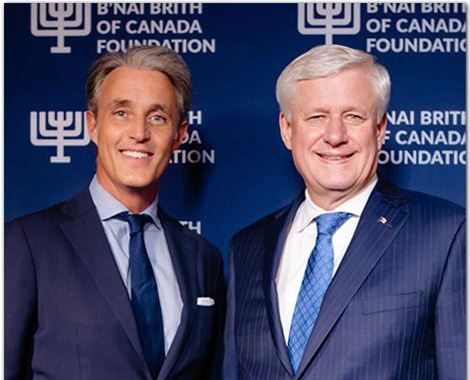
By MYRON LOVE There have been very few – if any – Western leaders who have been more supportive of Israel and the Jewish people than Stephen Harper. On Wednesday, September 10, Canada’s former prime minister (2006-16) was the guest of honour at B’nai Brith Winnipeg’s gala evening in celebration of B’nai Brith’s 150th anniversary.
In a fireside chat with media personality Ben Mulroney, Harper demonstrated that he continues to maintain his moral clarity.
Two hundred B’nai Brith supporters showed up at the Fort Garry Hotel to celebrate the longevity of Canada’s oldest human rights organization. The discussion between Harper and Mulroney was preceded by about 90 minutes of fine dining and shmoozing. The formal program began with Dr. Ruth Ashrafi, B’nai Birth Canada’s Winnipeg Regional Director, reciting a prayer for the release of the remaining hostages held in Gaza.
Ashrafi introduced B’nai Brith Canada COO Judy Foldes and Jay Harris, Chair of B’nai Brith Canada’s Board, – who were both in town for the event – along with Simon Wolle, BBC’s new CEO, who is replacing the late and much appreciated Michael Mostyn.
Just before Harper and Mulroney began their conversation, Mulroney spoke with Jay Harris via video about the organization’s storied history and ongoing wrap-around services. Mulroney highlighted B’nai Brith’s long record of fighting antisemitism and advocating for human rights and its many programs aimed at bringing people together and helping the needy – not only in the Jewish community but in the broader community as well.
Stephen Harper congratulated B’nai Brith on its 150th anniversary and praised the organization for its unflinching efforts in pushing back against antisemitism and fighting for human rights.
“I really grieve for the Jewish people” he continued. “I understand how tough it is out there right now. When I took strong stands in support of Israel as prime minister, I always believed that the great majority of Canadians supported my positions. They were just quiet about it. While the loudest voices get all the attention, I still believe that most Canadians still quietly support Israel and understand that not only is Israel a democratic sates and an ally, but also that the Jewish people in Canada have made such a disproportionate contribution to our business life, charitable life, and public service. So just know that you are widely appreciated across the country.”
Following some discussion on the assassination of young American conservative leader Charlie Kirk a couple of weeks ago, the dangerous state of public discourse in the United States and concomitant worsening situation in that regard in Canada as well, Harper commented that “I just hope that people on both sides of the border will begin to pull back and can engage in vigorous arguments without ostracization, cancellation and assassination,” he said.
In response to a question from Mulroney about what is driving antisemitism in Canada, Harper suggested that “we have allowed certain institutions to make antisemitism – framed a certain way – socially and politically acceptable. After the Second World War,” he noted, “we, as a society, agreed that what we considered far right ideology– the idea that dividing people into categories – with some groups considered superior to others – and the people in inferior groups could be discriminated against, marginalized and, ultimately, killed – was socially and politically unacceptable – beyond the pale.
“But we have permitted in our universities and media the idea to germinate far left ideology, but that is the mirror image of the far right – that people can be divided into oppressors and oppressed – and that the oppressors can be ostracized, marginalized and killed. This is rampant in academic institutions – institutions that we overwhelmingly fund with public money – given on the basis that they represent free and democratic values such as individual, human dignity and small l liberal values. This should not be acceptable”
“This is not just about the Jews,” he added. “It is an entire intellectual framework and people who propagate it should be defunded and removed from their posts. My father taught me that antisemitism, no matter from the left or the right, is the first sign of a political movement and a society going to a dangerous extreme,” Harper said.
Mulroney observed that anti-Israel, antisemitic groups can never be propitiated. (Ed. note: I had to look up the meaning of “propitiated.” Here’s what I found:
Mulroney continued: “We have the most pro-Palestinian government in our history, yet we still see protests popping up in front of government ministers’ homes.”
In response to Mulroney’s questions, Harper pointed out the long-standing and close friendship between Canada and Israel (at least up until this current federal government). “There should be no question that Israel has the right to exist,” he stated, “and every country should be fighting terrorism.”
In response to a question about why Canada should support Israel, Harper noted that it is not about geopolitics or religion, it is a matter of basic common sense. “Israel and Canada are both free and democratic countries,” he pointed out. “The friends of Israel are friends of Canada. The enemies of Israel are enemies of Canada – who are also intent on destroying Canada. If the leaders of a country don’t get that, I don’t know what they understand about international affairs. To me, it is distressing that you have to explain this to so many world leaders.”
Mulroney asked Harper about the worldwide condemnation of Israel for “escalating the conflict by taking out Hamas leaders in Qatar.
“This not escalation,” Harper said. “This is de-escalation. By taking out Hezbollah, Israel has made Lebanon a better place. And the subsequent fall of Assad in Syria has made Syria a better place – although the jury is still out on that. The Israeli and American bombing of Iran has made the world a safer place.
“When I was prime minster, I was in virtually daily battles with the people in Canada’s Foreign Affairs department who wanted to oppose Israel,” he recalled. “It was just so ingrained. I saw it in a lot of other Western foreign affairs departments.”
One of Israel’s challenges, Harper pointed out, is that while there are 50 Muslim states (not all of them hostile to Israel ) in the world and 25 Arab states, there is only one Jewish state. He recalled that, “Too often, diplomats see their responsibility not in representing the interests of their home countries but rather, representing the global community.
“With so many more Muslim and Arab states, he observed, “it is all too easy to go along with the consensus to get along.”
Harper noted that in many of his meetings with foreign leaders, they privately agreed with him – but they didn’t want to fight the media and the academic establishment, so they just went along. “That is not leadership,” he said. “And leaders who don’t support Israel are jeopardizing their own countries’ future.”
Turning to the political situation in Canada, Harper was strongly critical of the Trudeau government which, he said, left Canada in a really bad place. He is hopeful that Mark Carney, our current prime minister, will adopt many of the policies that Conservative Leader Pierre Polievre is proposing, and make the necessary changes. If not, he noted, there will be a change in government.
In closing, Ruth Ashrafi thanked Earl and Cheryl Barish, the honorary gala co-chairs, noting how much their generosity and leadership has enriched both our Jewish and the wider community at large.
Local News
From a ‘pie in the sky’ idea to 2,400 young hockey players

By BERNIE BELLAN I didn’t used to cover sports for The Jewish Post & News except for the odd occasion.
For years we could count on the late, great Harvey Rosen to comb the waterfront, looking for any sports story that might have the least connection to anything Jewish. Harvey would even go into visiting teams’ locker rooms during Winnipeg Jets games and, if a player had a name that sounded Jewish, inquire whether that player might be Jewish.
Then, for a few years, we added well-known sports writer Scott Taylor to the mix. Scott offered quite a different perspective, looking for stories about athletes that went far behind the scenes to uncover details that other reporters might have missed.
With both Harvey and Scott gone from our pages, I’ve occasionally found myself filling the sports void. These days, however, I tend to wait for an interesting story to find me.
And that’s exactly what happened with Wheatland Hockey.
Recently, my neighbours Elliot and Linda Katz mentioned that they knew of a Jewish couple who had started a hockey development program in Winnipeg. The couple, Rich Hechter and Rachel Wolfenson, had apparently started Wheatland Hockey only about 16 months earlier.
I subsequently learned that, in that short time, more than 2,400 young hockey players had gone through Wheatland’s various programs.
That number got my attention.
So, I contacted Rachel and Rich to find out what they had created — and why.
It started with a gap
The idea for Wheatland began, as Rachel described it to me, as “this little pie in the sky idea that we were going to have a spring development program in the spring of 2025.”
They started with about 50 kids spread across three age groups.
Sixteen months later, Wheatland has grown into a broad hockey-development organization offering programs for players from U9 through U15, along with specialized programming, female hockey, spring and summer teams, events and high-performance opportunities.
But the numbers aren’t really the story.
The story is why they thought Wheatland needed to exist in the first place.
Rich and Rachel felt there was a gap between traditional minor hockey and the highly specialized — and often expensive — training programs available to elite players.
There were plenty of opportunities for kids to play hockey. But what about the player who needed to improve one particular part of their game? What about the U9 player whose parents had no idea what skills their child should be working on? What about the player who wasn’t an elite athlete but had the potential to become a much better hockey player with the right instruction?
That was the space they wanted Wheatland to occupy.
As Rachel explained it, some families come to Wheatland knowing exactly what their child needs.
“They might know that the kid’s gap is power skating,” she told me. “They might have a great shot and great stick handling, but they’re not strong skaters.”
Other families arrive with a much less specific question.
“They’re new U9 families,” Rachel said. “Their kids have been spat out of the Timbits world and into the U9 world and they don’t know what to focus on.”
That’s where Rich comes in.
‘Pedagogy on ice’
Rich brings an unusual background to hockey coaching.
He is currently taking a one-year sabbatical from his role as vice-principal of Brock Corydon School, the Winnipeg school often known as the only public school Hebrew bilingual program in North America. For many families in Winnipeg’s Jewish community, Brock Corydon is where they know Rich best.
Before becoming a vice-principal, he worked as a high school teacher and as a university professor in the Faculty of Education. He has also spent more than a decade coaching youth hockey.
This year, rather than stepping away from education, Rich is using his sabbatical as an opportunity to continue learning, writing, and growing as a coach and mentor while devoting more time to developing Wheatland Hockey.
That additional time will also allow Wheatland to extend its reach beyond Winnipeg through a new initiative called “Wheatland on the Road”.
Over the coming year, Rich will travel to rural Manitoba communities including Manitou, St. Laurent, Lundar, Steinbach and Elm Creek to lead coaching and mentoring sessions for local players and coaches.
The initiative reflects Wheatland’s belief that access to quality coaching should not depend on where a young player lives. It also gives Rich an opportunity to work directly with local hockey communities, sharing ideas and helping coaches develop their own approaches to teaching the game.
For Rich, education and hockey aren’t separate worlds.
Rachel described his approach as “pedagogy on ice.”
The idea is simple: coaching isn’t just about showing a young player how to execute a skill. It’s about understanding how that player learns, figuring out what they need, and creating an environment where they can improve.
That educational philosophy is evident in the way Wheatland approaches development.
Its programs focus on areas such as skating, puck control, shooting, passing and receiving, positional play, defensive skills, checking, hockey IQ and tactical understanding.
But the organization also talks openly about developing confidence, resilience and character.
The Wheatland philosophy is summed up on its website as building “skills, character and excellence — on and off the ice.”
And that distinction is important to Rich.
The objective isn’t simply to produce better hockey players.
It’s to help young people become better learners, teammates and competitors.
A Jewish leadership team in an unlikely business
There is also an irony at the heart of Wheatland’s success.
We are not exactly the people known for our sporting prowess, and none of the people leading Wheatland played in the NHL. Yet, the organization is run by Rachel and Rich, with Ryan Paul, Eleni Wener, Avi Walker and Dustin Roitelman in senior leadership roles.
That may be unusual in the hockey world, but it is also part of what makes Wheatland distinctive.
This is not a business built around former professional players leveraging on their own playing careers. It is being led by people who believe deeply in the values Wheatland has developed — and continues to develop.
They believe in teaching young people how to learn, how to work with others, how to persevere and how to contribute to their communities.
In that sense, Wheatland’s leadership team reflects the organization’s broader philosophy: hockey expertise matters, but so do education, mentorship, organization, empathy and a commitment to making the game more accessible.
The fact that this group has helped build a hockey organization serving thousands of young players from across Manitoba is, in its own way, pretty remarkable.
Making hockey and coaching accessible
Perhaps the most important word in Wheatland’s philosophy is accessibility.
“Accessibility is one of our guiding principles,” Rachel said. “We believe that all kids should have the opportunity to get on the ice, regardless of socioeconomic conditions.”
For Rich and Rachel, accessibility means more than making hockey available. They believe that good coaching should be accessible, too.
That commitment is reflected in Wheatland’s “Pay-What-You-Can” program, which helps ensure that financial circumstances do not prevent children and families from participating in quality hockey programming.
For Rachel and Rich, the program is one way of giving back to the broader community. They believe that hockey — and the opportunity to learn from good coaches — should be available to as many young people as possible, not limited only to families who can afford the full cost of specialized training.
That doesn’t mean Wheatland is trying to be everything to everyone.
Rather, the idea is that a family shouldn’t need to have an elite-level hockey player — or an elite-level hockey budget — to access good coaching.
The organization keeps its groups relatively small. A typical session might have four or five players, while a larger session could have as many as 20, with several coaches on the ice.
The result is that a player who shows up to a smaller session can end up receiving something approaching a semi-private lesson without the family having to pay a premium for that experience.
And, Rachel noted, if only a handful of players show up for a session, “they would get the benefit of a semi-private class for a very inexpensive cost.”
Building coaches, too
Wheatland’s emphasis on development doesn’t stop with the players.
The organization has also created a Junior Coach program, through which some of its younger participants have an opportunity to begin learning how to teach the game themselves.
Five of Wheatland’s junior coaches are under the age of 15.
That’s significant because it reflects another part of Rich and Rachel’s philosophy: hockey development isn’t simply about producing better players. It’s about creating people who can contribute to the hockey community.
The organization’s coaching staff also includes experienced coaches with backgrounds in player development, athletic development and hockey education.
The same philosophy is at the heart of Wheatland on the Road. By working with coaches in rural communities, Rich hopes to help build local coaching capacity so that players can continue benefiting from quality instruction long after his visit is over.
Hockey as a bridge between communities
One of Wheatland’s most memorable recent initiatives involved a visiting Israeli hockey club.
The visiting players took part in two on-ice sessions with Rich and Ryan. After changing out of their gear, the young players then visited Rich at Brock Corydon School, where they met with grade 5 and 6 students.
For the players from Israel, the experience offered more than additional hockey instruction. It gave them an opportunity to connect with Winnipeg students through a shared language — the language of hockey — while also learning about one another’s communities.
For Wheatland, the sessions demonstrated how hockey can create meaningful connections that extend well beyond the rink.
Rachel and Rich
While Rich is the face of Wheatland on the ice, Rachel’s role is largely behind the scenes.
A Senior Investment Advisor with TD Private Wealth Management, Rachel brings an entirely different skill set to the organization, overseeing operations and communications and helping ensure that families have a positive experience from the moment they register.
The division of responsibilities seems to work. Rachel brings the organizational perspective needed to turn an idea into an operation. Rich brings the educator’s perspective to player development.
The broader leadership team brings additional experience, energy and commitment to the values that guide Wheatland.
And somewhere along the way, that little “pie in the sky” idea became something considerably larger.
More than 2,400 kids have now gone through Wheatland’s programs in just 16 months.
That’s a lot of hockey players. But when I asked Rachel what she thought accounted for that kind of growth, her answer wasn’t really about hockey.
It was about giving families something they were looking for.
“We teach people first, we teach hockey second,” is the philosophy Rich and Rachel have adopted.
Perhaps that’s why Wheatland has grown so quickly.
Because for all the talk about hockey development, what they are really trying to develop is something bigger: young people who feel supported, challenged and capable of getting better.
And through initiatives such as the Pay-What-You-Can program, Wheatland on the Road and its work with visiting teams, Wheatland is also showing how hockey can be both accessible and a bridge between communities.
If the first 16 months are any indication, there are a lot of Winnipeg families — and perhaps many potential community partners across Manitoba — who were looking for exactly that.
For more information about Wheatland Hockey, visit Wheatland Hockey.
Local News
“Chanukah Guilt: A Jewish Holiday Murder Mystery”
Review –Interview by MARTIN ZEILIG
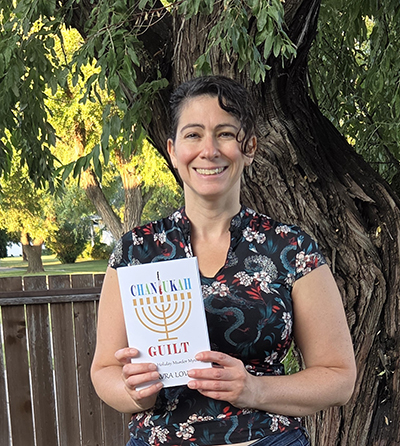
With “Chanukah Guilt: A Jewish Holiday Murder Mystery” (Scribal Scion Publishing 182 pg. $20.00) Winnipeg author Avra Love steps confidently into the world of cozy Jewish crime fiction, delivering a warm, witty, and culturally textured novel that feels instantly familiar to anyone who has spent time in a synagogue social hall.
Published by Scribal Scion in August 2026, the book marks a notable shift from Love’s earlier works — the playful children’s book “Don’t Wake Mommy!” and her flash fiction collection “Into the Junk Drawer” — yet it carries forward her trademark blend of humour, character insight, and affection for the small dramas of everyday life.
Love, who was interviewed by email for this article, grew up surrounded by stories and language, and that early immersion shows. She had long wanted to take on a larger scale project, and this idea — sparked by her own experiences participating in holiday craft sales — lent itself naturally to expansion.
“I was always struck by the diversity and energy you find at these events,” she says. “When I considered it as a background for my story, I chose to make it a Jewish setting.”
The novel unfolds over a single day: the pre Chanukah craft sale at a local synagogue. It’s the kind of event many Jewish readers will recognize immediately — twenty vendors, tables overflowing with handmade goods, the hum of conversation, and the quiet hope that the turnout will justify all the effort.
Into this bustling scene steps Becky, the first time coordinator of the sale, who has taken on the job mostly because no one else would. Becky’s background as a theatre director gives her a keen eye for personalities, staging, and the subtle tensions that animate a room. It also makes her an unexpectedly capable amateur sleuth when a sudden death shatters the cheerful atmosphere.
Love’s decision to set the mystery within a single communal event is inspired. The synagogue social hall becomes a microcosm of Jewish communal life — warm, opinionated, occasionally chaotic, and full of characters who are both endearing and exasperating. The vendors, each with their quirks and motivations, form a lively ensemble cast. Their interactions provide humour, texture, and a steady stream of clues as Becky tries to piece together what happened before the police arrive.
The tone throughout is unmistakably cozy.
Love isn’t interested in grisly details or procedural complexity; her focus is on character, community, and the gentle absurdities that arise when ordinary people are thrust into extraordinary circumstances. The dialogue is sharp and often funny, peppered with Hebrew and Yiddish expressions that feel authentic rather than ornamental. A glossary at the end ensures that readers of all backgrounds can follow along without missing the cultural flavour.
Behind the scenes, Hanukah Guilt was very much a labour of love.
The book began as a “piecework project built over sporadic bouts of creativity,” Love explains, and then underwent multiple revisions.
All told, it took most of three years to complete. When it came time to publish, she didn’t hesitate to bring the manuscript to Scribal Scion.
“I had such a great experience working with James Gershfield on my first children’s book that I went to him first — and I’m glad I did. I’ve been so appreciative of his hard work and expertise in helping me craft the finished product.”
What elevates Hanukah Guilt is Love’s ability to balance levity with sincerity. Beneath the humour lies a genuine appreciation for Jewish communal spaces — their warmth, their imperfections, and their role as gathering points for tradition, creativity, and connection. Becky’s determination to solve the mystery is less about heroism and more about responsibility: to the vendors, to the event, and to the community she cares about.
Love’s writing career continues to expand. In addition to this novel, she has two new Jewish children’s picture books underway with Scribal Scion Kids and continues to write short stories in her spare time. Hanukah Guilt is her third published book — and her most ambitious to date.
In Hanukah Guilt, Avra Love has crafted a charming, accessible, and distinctly Jewish mystery that will resonate with readers across generations. It is a welcome addition to holidaythemed fiction and a delightful new chapter in the career of a Winnipeg writer whose voice continues to grow in range and confidence.
This is a book that belongs on Jewish bookshelves — and one that will make readers smile even as they turn the pages in search of clues.
Avra Love is a Winnipeg educator with a background in English Language studies and Philosophy. She is the author of three books: the flash fiction collection “Into the Junk Drawer,” the children’s book “Don’t Wake Mommy!,” and her new cozy mystery “Hanukah Guilt: A Jewish Holiday Murder Mystery.” She loves to read, write, craft, and practice healthy living.
Local News
Israel’s ambassador to Canada makes first visit to Winnipeg
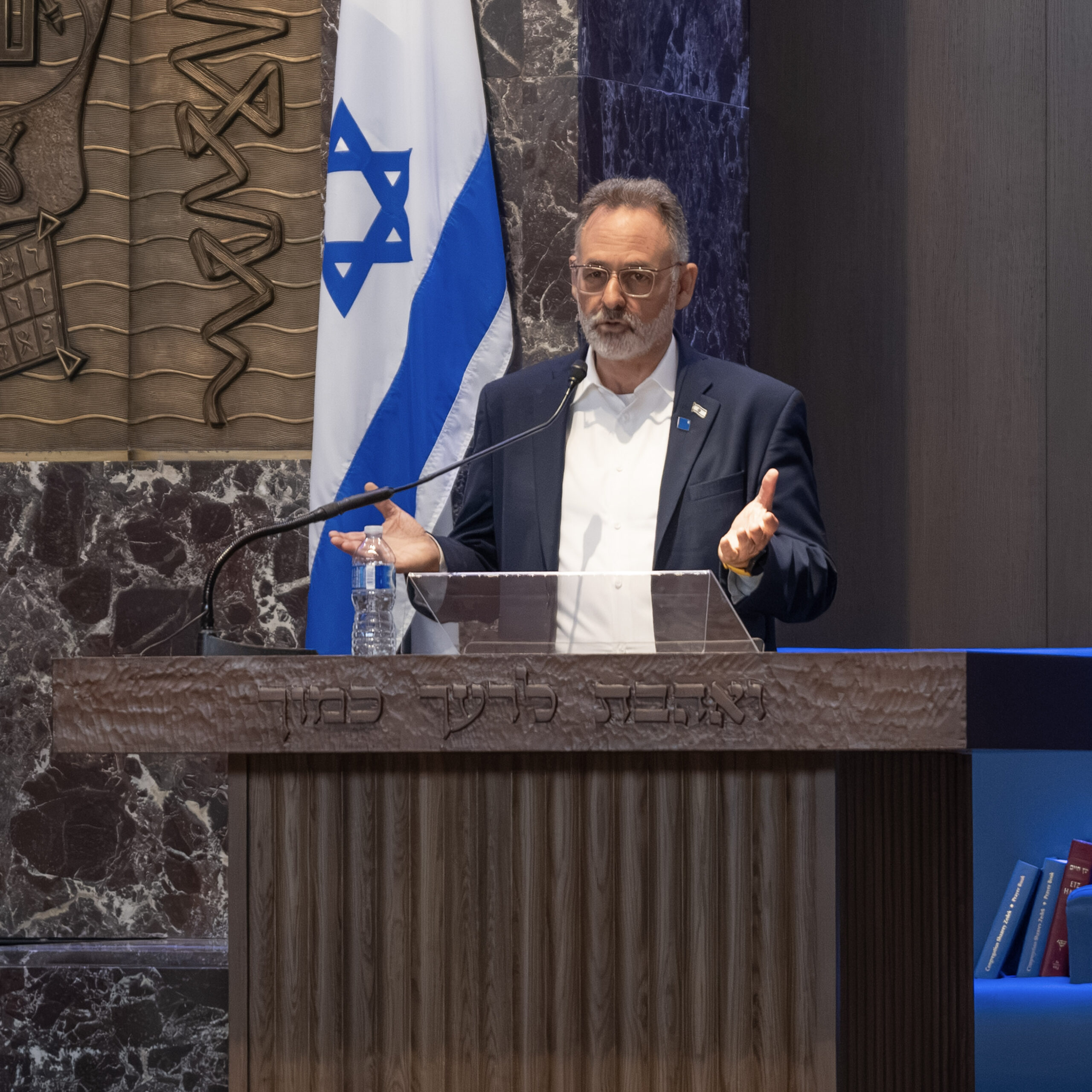
By MYRON LOVE On Thursday, August 6, Iddo Moed, Israel’s ambassador to Canada, made his first visit to Winnipeg and shared an overview of Israel-Canada relations with an engaged audience of about 100 Jewish community members and supporters. This was an important visit for the Winnipeg community. The event was focused on community affairs, with no presence of government or elected officials.
Moed is a 34-year veteran of the Israeli diplomat corps with a resumé that includes postings in China, Singapore, the Netherlands, and the Dominican Republic as well as some African countries. He has been stationed in Ottawa for the past three years.
The evening before the presentation, according to Jeff Lieberman, the Jewish Federation of Winnipeg’s CEO, the ambassador walked through the Asper Campus introducing himself to people he encountered, then took in the show at the Israel Pavilion. Afterward, Moed spoke with several people at the show. On his way out, he looked into the Bedouin tent in front of the cultural display and visited for a few minutes with a family inside.
The evening began with remarks from Gustavo Zentner, Vice President, Prairies, at the Centre for Israel and Jewish Affairs (CIJA), who highlighted the unbreakable bond between our Jewish community and Israel, as well as the deep and enduring connection between the Jewish people and Israel. “At a time of heightened antisemitism and anti-Zionism across Canada,” Zentner said, “the contributions of Jewish Canadians to Manitoba and to Canada are foundational to our shared society.”
He called on the community to celebrate what makes us strong, our innovation, our Jewish “chutzpah”, our resilience, and our commitment to being there for one another. Zentner noted that our determination to strengthen and protect our community must extend beyond our own institutions and include strong, visible advocacy.
“This means,” he observed, “creating more opportunities for open dialogue and meaningful engagement, while firmly denouncing and pushing back against antisemitism, Jew-hatred and anti-Zionism, not only to protect the Jewish community, but also as a means of safeguarding our Canadian way of life and standing up for other minority communities whose voices may not otherwise be heard.”
During his own remarks, Ambassador Moed spoke about the friendliness of Canadians but, nonetheless, he observed, his time here has been difficult.
“I remember a discussion that I had years ago with a friend who predicted that even though incidents of antisemitism back then were minimal, there would undoubtedly be a resurgence.” he observed. “The level of hate I have seen in Canada and around the world has been quite disturbing.”
Moed claimed that 97% of Jewish university students in North America report that they have experienced antisemitism. He added that for Holocaust survivors, the current levels of hate are bringing back traumatic memories.
“Since October 7, life has been much more challenging and difficult for our people,” he noted. “Social media in particular has been a major problem. We need to reach out to our allies in the non-Jewish world. We need to find ways to highlight all the good that Israel does in the world. We also need to emphasize that Jewish values are largely in sync with Canadian values.
“And our Jewish community institutions need to be working together in a pro-active manner,” Moed said.
When it comes to Canada-Israel trade, Moed described the current situation as “stagnant.” “There is a lot of interest in Canada in potential trade deals with Israel,” he reported, “but federal government policies are not helpful.” Moed did add that he sees much potential for trade at the provincial level. “There has been a lot of interest in Quebec and Ontario in particular,” he said. “We are trying to reach out to the other provinces as well.”
The ambassador spoke for a relatively short time so as to leave a lot of time for questions from the audience. One question was about the possibility of a two-state solution. In response, Moed pointed out that over the years, Israel has offered numerous concessions – to no avail.
“We have learned that we can’t trust the Palestinian leadership,” he said.
A question about war crimes gave Moed an opportunity to contrast the Israel Defense Force’s great efforts to reduce casualties among Palestinian civilians with frequent warnings before the air force drop bombs or infantry units move into populated areas with Hamas and Islamic Jihad literally hiding among and behind women and children and hiding in and storing weapons in schools, hospitals, mosques and private homes.
Moed added that every IDF regiment has a legal advisor embedded with it to ascertain that military actions abide by international law.
He noted that on October 6, 2023, Gaza was quiet. On October 8, social media and the legacy media were already condemning Israel for “genocide”.
Moed emphasized the importance of Jewish education in our communities in Canada and the United States – even suggesting that some of the money our communities send to Israel might be better spent investing in Jewish education here at home.
(Despite almost three years of war, Israel still has one of the world’s strongest economies.)
One questioner asked about the prospect of Israel’s high-tech industry- which is second in size only to California – being able to develop a system that can override all the negativity and present a more positive picture online of Israel and the Jewish People.
Moed agreed that “the left are eating our lunch.” “Maybe we can create a platform using AI that can present a more positive view of Israel,” he suggested.
Moed has one more year to serve in Ottawa before he returns to Israel and finds out where he is off to next.
