


Uncategorized
In my small town, ‘that Jewish hut’ has turned Sukkot into a cross-cultural shelter of peace
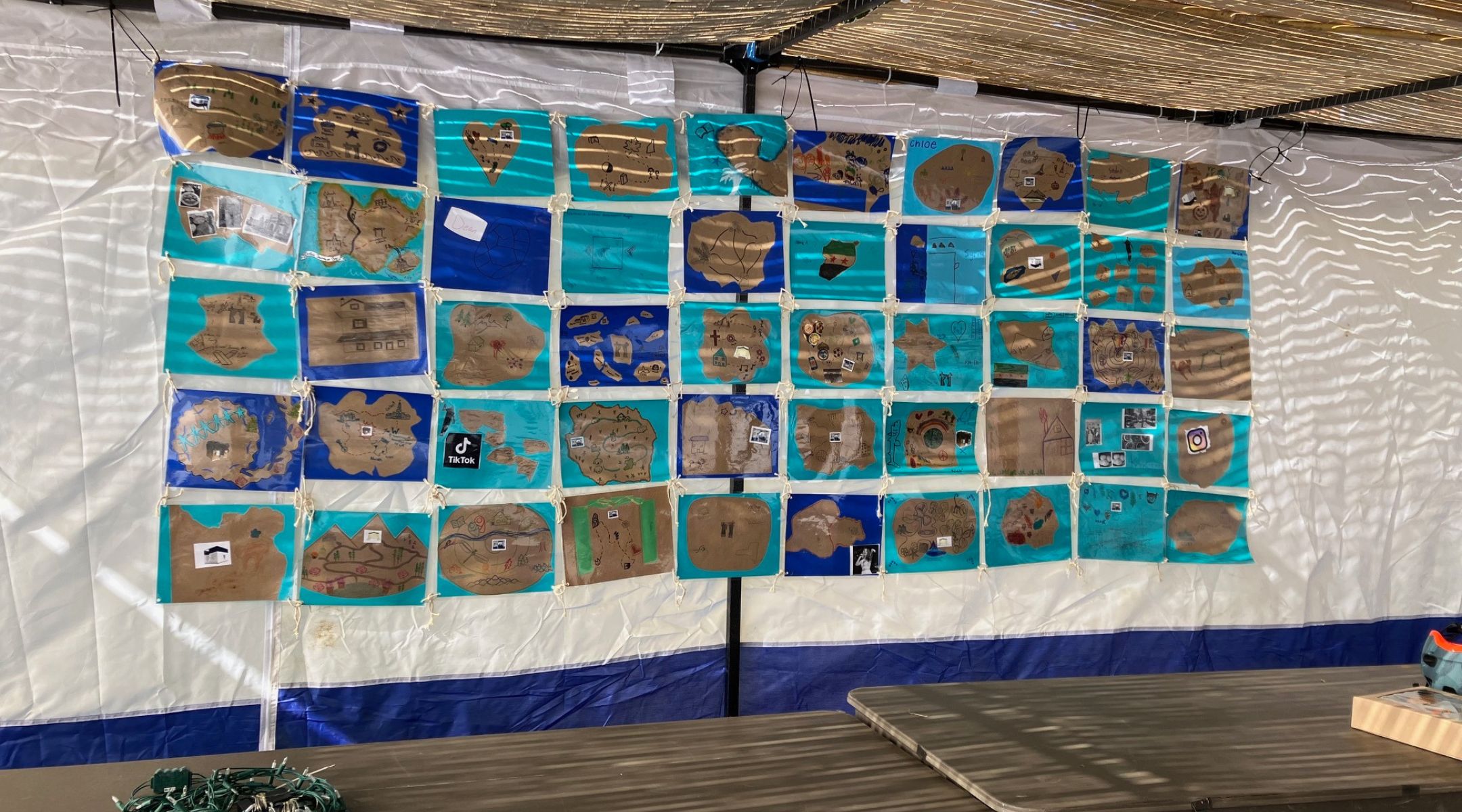
On the weekend between Yom Kippur and Sukkot, Waterville city workers put up the frame for our community sukkah. They were careful to make sure that tree branches did not obscure the view of the stars and the night sky, and that sufficient room was left for a Wabanaki storytelling festival in the town square scheduled during the same week.
This was the second year our municipal workers erected “that Jewish hut.” I never thought Waterville would support the Jewish community in building, hosting, and supporting our sukkah; it came about through an unexpected and somewhat painful discussion. For years, Waterville has hosted “Kringleville,” a community celebration of Santa Claus and Christmas. A non-Jewish member of the Waterville community challenged the practice, and demanded a menorah be placed next to the Christmas tree. Some community members supported this move; others wanted all public observances of religious festivals to end.
Our synagogue leadership was ambivalent about either option. I’ve never liked the idea of Hanukkah competing with Christmas, elevating a minor festival not because of its importance, but rather because of its proximity to a major holiday outside of our tradition. I also believe we should retain community events — religious or otherwise — that reinforce faith, community, and good will. I don’t believe that diminishing Christian festivals strengthens the Jewish community. In light of these values, we suggested a different path forward for the City of Waterville.
In a meeting with the city manager, our synagogue’s executive director, Melanie Weiss, suggested that rather than erect a menorah in the winter, we erect a sukkah in the fall. Why? Sukkot is a major Jewish festival in its own right, the city could provide support for our small synagogue that we actually needed and wanted (putting up a sukkah is hard work!), and we could leverage central Maine’s agricultural and multi-ethnic traditions to bring joy not only to the Jewish community, but to everyone in our region.
Sukkot is a festival about hospitality, joy and creative construction. In the wake of Oct. 7, our synagogue staff and board believed that inviting the greater community into our spaces was a better approach than pulling away behind walls. We wanted our public face to be welcoming, inclusive, beautiful, and proud. As such, in partnership with the Center for Small Town Jewish Life at Colby College, Waterville Creates (our local arts organization), Beth Israel Congregation, and the Waterville Public Schools, we spearheaded a citywide arts project so that everyone in town could contribute some kind of personal decoration to adorn our community sukkah.
In our first year, we organized an art project around “Welcoming our Ancestors,” teaching the greater community about ushpizin and providing a canvas for our neighbors to highlight their journeys from Lebanon, Quebec, Congo, Syria, Iraq, Lithuania and yes, Israel. This year (our second), our community art project charges participants to craft a “Map of Joy” depicting their personal journeys from origin points around the world to places of joyousness. Panels depicting heartfelt and arduous journeys from Homs, Syria, sit next to panels that highlight the vibrancy of Tel Aviv.
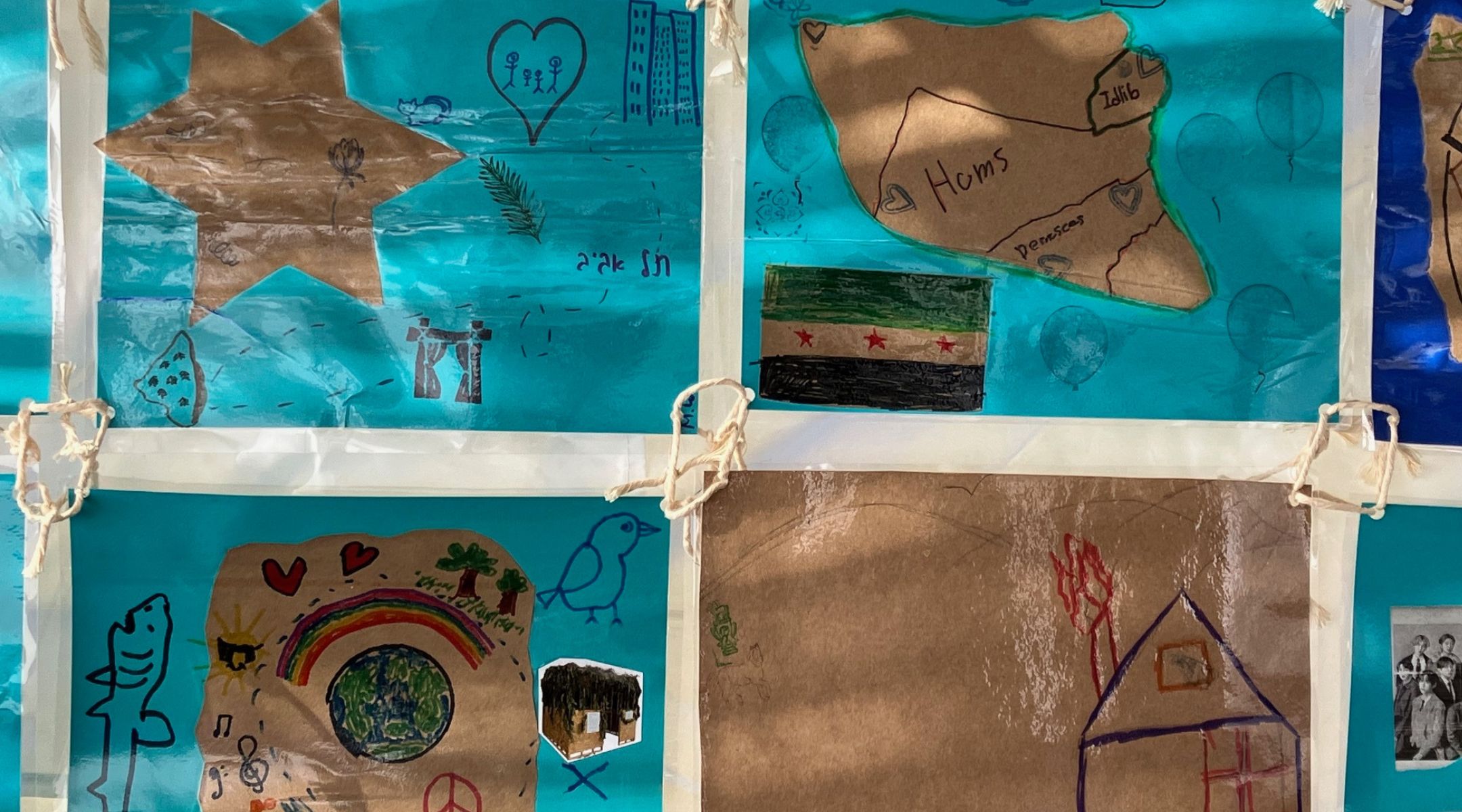
This year’s art project asked participates to create panels depicting personal journeys from places around the world. (Courtesy Center for Small Town Jewish Life)
On Erev Sukkot, we host a vegetarian potluck dinner with dishes from around the world, and we share the blessings of Sukkot with our neighbors. Before candle lighting, we show participants the lulav and etrog, and later we explain the story of Sukkot and its core values. In coordination with Waterville Adult Education and the Capital Area New Mainers Project, we invite translators to make our teaching accessible, and have printed materials in several languages that are spoken in local immigrant communities.
This project isn’t without its detractors. Some resent or oppose Jewish content and representation in public spaces, even if it is in equal measure to Christian, Muslim and Indigenous traditions. Some have asserted that our multifaith work is a way to evade discussions of Israel and Gaza Others fear that the sukkah will be desecrated or attacked. In essence, most of the opposition comes from antisemitic sentiment or the fear of it. And yet we have chosen to put up our sukkah with the support of city partners and with the vigilant protection of the Waterville Police Department. We refuse to acquiesce to the suspicion and hatred of others, or to the fear that it will be expressed.
The Waterville Jewish community and the Center for Small Town Jewish Life have chosen a unique response to this moment of increased Jewish vulnerability and alienation. We have reinforced local partnerships, introduced citizens from all walks of life to the beauty of the Jewish tradition, and invited them to participate, not just as observers, but as co-creators.
Even though there are potential risks, and deficiencies to this approach, it builds on the strengths and spirit of small town Jewish life. We affirm our place in our community through sharing our traditions, and placing them in a greater American and social context, one that emphasizes faith, family, and community. Building friendships and understanding may not protect us from all animus, but it does reduce suspicion and dehumanization. Our festival is made all the more joyous when we see our neighbors celebrating with us, and when we learn about their journeys, families and creative gifts.
Through constructing Sukkot in this way, our local Jewish community gains or develops or cultivates a greater sense of pride, happiness, fulfillment and “at homeness” in Waterville. And through erecting this temporary Jewish structure in shared civic space on Main Street, Waterville is stronger. Our prophets teach that when the world is ultimately redeemed on Sukkot, the Temple will become a house of prayer for all peoples. Although we are miles away from a rebuilt Jerusalem, we are beginning that redemptive process in Waterville, Maine, beam by beam, branch by branch, citizen by citizen.
—
The post In my small town, ‘that Jewish hut’ has turned Sukkot into a cross-cultural shelter of peace appeared first on Jewish Telegraphic Agency.
Uncategorized
The two ways to see Oct. 7 – and how they’ll influence the Israeli election
There are two ways to look at the Oct. 7 attacks, and which way you do will determine, to a large degree, whether you want to see Israeli Prime Minister Benjamin Netanyahu survive the next election.
The first view is that Oct. 7 proved the Israeli-Palestinian conflict cannot be solved. The second is that it proved the conflict cannot be allowed to remain unresolved.
These conclusions point in almost opposite directions, yet both begin with something Israelis learned, or thought they learned, from the same horrific day. One says there is no point trying to mollify the Palestinians, because hatred of Israel runs too deep. The other says that leaving millions of Palestinians indefinitely in their current condition will produce catastrophe again and again. The tragedy is that Oct. 7 supplied powerful evidence for both.
The first view is not without foundation. Even to Israelis (and people across the world) who have long sought a peaceful accommodation, it was shocking to see the sheer joy of the Hamas terrorists as they butchered families while filming their own barbarism, calling parents to brag, then dragging innocents into Gaza where crowds wildly cheered.
But the real shock was the support for this in the West Bank and Gaza – polls showed two-thirds to three-quarters of Palestinians approved – suggesting coexistence is impossible. Rarely have polls been more devastating. As a result, many Israelis lost sympathy for Palestinians and concluded that a cleansing inferno is required. The brutal war that followed certainly reflected that.
The second way to see Oct. 7 is that the Palestinian issue cannot be ignored – that the situation of the Palestinians was so unacceptable that something terrible was bound to happen. Many Israelis have trouble accepting this, because it does not really explain Hamas, which would fight Israel in any case, even if it were led by a far-left government willing to hand over to it every inch of the West Bank and Gaza and divide Jerusalem. But it might explain why so many Palestinians – even ones not in denial about the facts – were prepared to support it.
This view also offers at least one reason why the propaganda war waged by Hamas and its supporters has been so successful. There are others – including antisemitism and an outright denial of Israel’s right to exist . But the fundamentally unacceptable situation of the Palestinians is a big one, to be sure.
The combination of these factors yielded stunning results and contributed to an unfair vilification of the country that continues to frustrate Israeli voters.
By Oct. 9, before Israel had even identified all its dead or invaded Gaza, accusations of “genocide” were already circulating online, then among activists, NGOs, academics and eventually governments. By Oct. 13, protests denouncing “genocide” took place in London. On Oct 17, the Qatar-based Arab Center for Research & Policy Studies held a symposium called “The War on Gaza: Palestinian Defiance and Resistance against Orchestrated Genocide and Expulsion.”
Within weeks, South Africa accused Israel of “genocide” at the International Court of Justice in The Hague, invoking the “crime of crimes,” a term most associated with the Holocaust, the Armenian Genocide and Rwanda. “This libel is powered by a relentless campaign of indictment that engraves a lie into collective memory,” says Adam Fisher, one of Israel’s top venture capitalists, who has researched the propaganda campaign in detail.
When Israel’s military entered Gaza, it faced an enemy that had deliberately embedded weapons caches, command centers and rocket launchers in homes and crowded neighborhoods, including hospitals, schools, mosques and UN sites. Hamas fighters vanished into tunnels beneath civilian areas, turning every dead child, collapsed building and grieving parent into material for a global indictment of Israel on social media. The strategy was clear: maximize civilian suffering, isolate Israel internationally, weaken American Jewish support and ultimately erode U.S. backing.
The implication is that Oct. 7 was a response to Palestinian suffering. The suffering is real, but Hamas was never defending Palestinians. The Iran-backed jihadist group has long sought to destroy Israel rather than establish a Palestinian state, and its campaign of terrorism after the 1993 Oslo Accords helped destroy the peace process by driving Israelis to the right.
Still, none of this makes the pre-Oct. 7 reality acceptable. In the West Bank, three million Palestinians live alongside some 500,000 Jewish settlers without equal rights, largely under military occupation, while extremist settlers have increasingly engaged in violence with the government and military often looking the other way. In Gaza, more than two million Palestinians endured a devastating Israeli-Egyptian blockade because Hamas ruled the Strip. It failed to prevent Hamas from arming itself while making civilian life miserable.
On Al Jazeera recently I was placed opposite a young Gazan named Ahmed Abo Askar, introduced as a humanitarian activist and engineering student. He said he had gone three days without eating, and looked like it. He hoped an aid flotilla might get through and then smuggle out his ailing father.
I tried to put things in perspective, explaining about Hamas and the need to be rid of it. Ahmed answered emotionally: “Israel, not Hamas, they are the ones who killed my sister, killed their children and their entire family on 6 November 2023. Not all of Palestinian people are Hamas. The goods, why it’s not entering? ‘It’s because of Hamas.’ We are not Hamas. We are human in the end.”
Everything I said was true – but he won the argument anyway, because he was a decent person suffering. No history lesson trumps that.
The insane situation has traumatized Palestinians and Israelis in parallel ways. The Palestinians – who are rooted in a conservative society disinclined to compromise – have been made, in large numbers, desperate enough to support a nihilistic movement like Hamas, which is truly genocidal against Jews.
As for Israelis, it has made huge numbers of them stop wanting to think seriously about Palestinians except through the lens of security and punishment. Some openly fantasize about expulsion. Empathy is viewed as naïve. Oct. 7 made Israelis a little crazy too – exactly per the plan of Hamas.
So the Israeli opposition — people deeply hostile to Netanyahu and his extremist coalition — is mostly afraid to touch the Palestinian issue at all in the campaign ahead of the Oct. 27 election, preferring to focus on Netanyahu’s epic domestic failures. Politically, the calculation is correct.
That is where the two interpretations of Oct. 7 attach themselves to the choice Israelis face in this election. Netanyahu has spent much of his career arguing, in practice if not always explicitly, that the Palestinian problem can be managed rather than solved: Contain Gaza, maintain Israeli control of the West Bank, expand settlements, periodically use overwhelming force and resist international pressure for Palestinian statehood.
If the lesson of Oct. 7 is that Palestinian hostility is essentially immutable and territorial compromise merely brings the enemy closer, then Netanyahu’s basic worldview survives despite his catastrophic failure on Oct. 7. The answer is deterrence and permanent Israeli security control — not another attempt at political reconciliation.
Gadi Eisenkot, the main challenger on the center-left, is more complicated. He is hardly offering Israelis a new Oslo: He has explicitly rejected a Palestinian state in the near- or medium-term and says the old two-state formula is unrealistic after Oct. 7. But he has also opposed more West Bank settlements and other measures that would make eventual territorial separation impossible.And he has long warned against Israel sliding into a binational state.
The implication is less a peace plan than a direction: Preserve the possibility of separating Israelis and Palestinians, change the conditions that perpetuate the conflict, and leave open a political horizon even if nobody can presently say exactly when it nears and how it ends. In that sense, the choice is not between Netanyahu and a dove. It is between continuing to manage an apparently permanent conflict and a government that might at least begin trying to move toward a possible peace.
But if Israelis conclude that Palestinians only understand force – which, by the way, Hamas clearly doesn’t – we’re guaranteeing a death spiral. Such a problem left to fester, without any attempt to change the dynamic, will blow up again and again. So after the election, if Netanyahu and his destructive right wing coalition are mercifully gone, this will need to be addressed in new and creative ways.
Both views of Oct. 7 rest on a foundation of facts. The invasion and massacre – and the widespread support for it among Palestinians – simultaneously dismantled both the Israeli left’s confidence in Palestinian intentions, and the Israeli right’s belief that the Palestinian problem could be indefinitely managed.
But it also proved that distrust is not a policy. Israel can build fences, destroy armies, assassinate commanders and punish those who attack it. What it cannot do is make millions of Palestinians disappear. If there is no political answer to that reality, eventually there will be another violent one.
The post The two ways to see Oct. 7 – and how they’ll influence the Israeli election appeared first on The Forward.
Uncategorized
Country star Zach Bryan dons ‘Free Palestine’ shirt at Gillette Stadium
(JTA) — Zach Bryan, one of the world’s most popular country artists, appeared onstage wearing a shirt that read “Free Palestine” on Saturday night at Gillette Stadium outside Boston.
The venue was at the center of the dispute between stadium owner Robert Kraft and rapper Macklemore, who was blocked from performing there after Kraft objected to statements and imagery from an earlier stop on the tour and a “broader history” that Kraft characterized as antisemitic.
Representatives for Bryan and Kraft did not respond to requests for comment.
Bryan, whose biggest hits include “Something in the Orange” and his Kacey Musgraves duet, “I Remember Everything,” broke a stadium attendance record with 73,538 people on hand, the stadium said in an X post.
Kraft, the billionaire owner of the New England Patriots, helped lead an effort by stadium owners to block Macklemore from performing at their venues as Ed Sheeran’s opening act. Sheeran tried to distance himself from the venue owners’ actions, but his backup band and other acts subsequently withdrew from the tour.
This article originally appeared on JTA.org.
The post Country star Zach Bryan dons ‘Free Palestine’ shirt at Gillette Stadium appeared first on The Forward.
Uncategorized
Britain’s Green Party adopts ‘Zionism is racism’ motion
(JTA) — Britain’s Green Party on Sunday adopted a policy equating Zionism with racism, a move that immediately drew condemnation from the Israeli government and sparked concerns among some Jewish party members and the broader Jewish community.
The motion has also caused divisions within the party itself, with leader Zack Polanski, who is Jewish, skipping the vote and the party’s five sitting members of parliament issuing a statement on the policy.
Passing with 1,022 votes to 813 votes at the left-wing party’s annual conference, the motion argues that Zionism as an ideology is racist as it promotes “ethnonationalism,” and “privileges one ethnic group on the basis of the subjugation of others.”
It also declares the Greens to be an “anti-Zionist party” and that Zionism, the movement to develop and protect a Jewish state in Israel, will be “treated as any other form of racism.”
The motion also supports the establishment of a “single democratic Palestinian State in all of historic Palestine with Jerusalem as its capital.”
Israel’s Ministry of Foreign Affairs said in a press statement, “Today, the Green Party in Britain ceased to act as a political party and became a body that gives legitimacy to terrorism. The Greens have adopted not only the green of Hamas, but also its ideology: the elimination of the State of Israel through armed struggle.”
“The shocking resolution adopted today legitimizes armed struggle, calls for a Palestinian state ‘from the river to the sea’ – meaning the destruction of the State of Israel – and labels as ‘racist’ the aspiration of the Jewish people for self-determination,” the ministry statement said, adding that it “goes far beyond the boundaries of legitimate political debate.”
The ministry called on other political parties in Britain, particularly the ruling Labour Party, to reject the resolution.
In a letter to Polanski ahead of the vote, the Board of Deputies of British Jewry, Jewish Leadership Council and Community Security Trust said they had “acute concerns” about the motion and called on the party leaders to oppose it. They wrote that urgent action was needed to address growing antisemitism within the Green Party. Such a motion, they wrote, “fuels hatred of Jews.”
The five representatives of the Greens who sit in Parliament – MPs Ellie Chowns, Adrian Ramsay, Siân Berry, Carla Denyer and Hannah Spencer – issued a joint statement condemning the actions of the current Israeli government led by Prime Minister Benjamin Netanyahu but emphasizing, “We know there is no conflict between supporting the rights of Palestinians and the rights of Jewish people.”
A clause was proposed to protect Jewish Greens by clarifying that the motion should not be used to “pressure, proscribe or discipline” those affiliated with synagogues or other Jewish groups that describe themselves as Zionist. The clause was voted down.
This article originally appeared on JTA.org.
The post Britain’s Green Party adopts ‘Zionism is racism’ motion appeared first on The Forward.
