


Uncategorized
On Friday, the rabbi circles Manhattan — now with tech support to protect an essential Shabbat tool
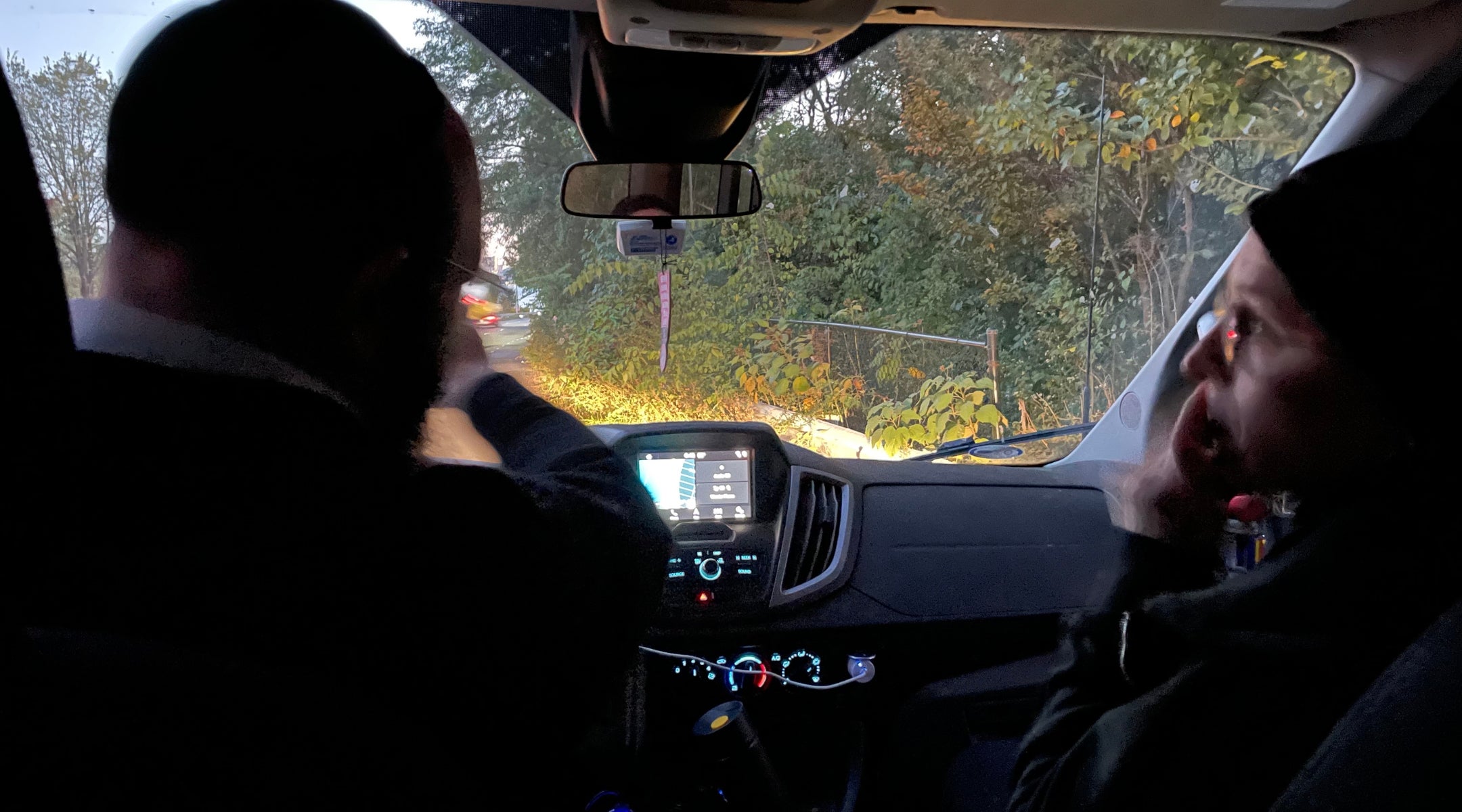
Around 6:15 a.m. on a recent Thursday, Rabbi Moshe Tauber parked his van in the merge lane of the Henry Hudson Parkway at 72nd Street. He turned on his hazard lights and ran out of the vehicle with a flashlight. His wife, Chaya, sitting in the passenger seat, watched anxiously.
Tauber, 51, turned his head upward, shined his flashlight on the nylon fishing wire strung up 30 feet from the ground between two poles, and ran back to the car. All clear — the boundary was unbroken.
For the past 25 years, this process has been the rabbi’s routine on both Thursday and Friday mornings: leaving his home in Monsey, an Orthodox enclave in Rockland County, hours before sunrise in order to circumnavigate the entire island of Manhattan. His mission: to check every part of the borough’s eruv — the symbolic boundary, marked by strings and other man-made and natural elements, inside of which observant Jews may carry objects like food, keys and even babies on Shabbat and certain holidays.
Maintaining the eruv, which must be unbroken to be considered kosher, has been Tauber’s job since 1999. Tauber says it doesn’t make sense for someone else to sub in for him, simply because he knows the eruv so well and can do it so efficiently, after having inspected it for so many years. With Chaya’s approval, he even missed the early-morning birth of his 13th and youngest child, now 7, to check the eruv on a Friday morning. He immediately went to the hospital to visit mother and baby after his inspection was done.
“I don’t know if I can explain what I like in this job,” Tauber said. “I like it.”
Now, for the first time, the eruv inspector is getting some high-tech assistance.
Installed in August, a new sensor system created by technology entrepreneur Jerry Kestenbaum — also the creator of the residential building software company BuildingLink — magnetically snaps onto multiple locations of the eruv. The 142 sensors detect changes in the angle of the wire and send a signal to a receiver held by Spectrum on Broadway, the lighting and electrical company responsible for maintaining the line per Tauber’s instructions. The sensors themselves are battery-operated and meant to last for six to 10 years, sealed in a waterproof case.
“It gives me more comfortability,” Tauber said. But he’s not planning on ceding oversight entirely to the machines, saying, “I know I need to check because the sensors are not 100%.”
The sensors mark the first major innovation to Manhattan’s biggest eruv, installed in 1999 after Adam Mintz, then the rabbi of Lincoln Square Synagogue, requested its installation to surround his Upper West Side neighborhood. (Prior to the borough-wide eruv, different parts of the city each had their own, but travel between them while carrying anything was prohibited on Shabbat.)
According to Jewish law related to Shabbat, no items can be carried outside the home on what is supposed to be a day of rest and prayer. Recognizing this as a potential burden, rabbis in the Talmudic era devised a workaround: The boundary defined by the eruv would extend the “private” zone where carrying is permitted. Despite some community objections — sometimes from Jews and non-Jews who worry that the eruv will change the “character” of their neighborhoods, or civil libertarians who worry about the blurring of church and state — nearly every observant community, from big cities to small towns, is surrounded by an eruv.
The Lincoln Square eruv has expanded multiple times since 1999, now encompassing most of Manhattan, from 145th Street between Riverside Drive and Malcolm X Boulevard at its northernmost point, roughly down FDR Drive all the way to the bottom of Manhattan at the South Street Ferry, and back up the Henry Hudson Parkway.
In the years since he became its inspector, Tauber’s dedication to the eruv has been unflagging. He made sure it was unbroken after 9/11 (it didn’t extend all the way downtown at the time), after the 2003 citywide blackout, after Hurricane Sandy in 2012 and throughout the COVID-19 pandemic. In Tauber’s 25 years of inspections, the eruv has only been down once over a Shabbat, during a snowstorm in 2010.
In addition to checking the eruv twice a week, Tauber helps his wife run a daycare, and he teaches boys at a yeshiva. He hasn’t taken a vacation longer than a few days for a quarter century.
Chaya Tauber said she has a theory about why he likes the eruv job so much. “[It’s] many hours of a busy week — he has more jobs, it’s not the only job — that he can be by himself,” she said.” Quiet time. I think he likes the traveling, also.”
Just two weeks ago, he helped establish an eruv around Columbia University Medical Center in Washington Heights and the surrounding apartments. Eventually, the plan is to connect it to the main Manhattan eruv — and potentially to other smaller eruvs in Upper Manhattan. There, smaller eruvs serve portions of Washington Heights with many observant Jews, including one that is home to the Orthodox flagship Yeshiva University.
Kestenbaum, whose new business, Aware Buildings, provides sensors for home security, said the idea for the electronic eruv technology came about during a conversation with Mintz, now the rabbinic leader of Kehilat Rayim Ahuvim (The Shtiebel) on the Upper West Side at the Marlene Meyerson JCC.
“I was saying to him that the sensors can be applied to many, many things that we’re used to doing manually,” said Kestenbaum, whose wife converted to Judaism under Mintz’s supervision.
“It’s a complicated eruv where the deployed environment changes,” Kestenbaum explained. “It’s not [like] in the suburbs, where the outline of the eruvs remains constant. Things go wrong. You’ve got scaffolding that gets put up. You’ve got other things that happen. The weekly eruv job is not just fixing, sometimes it’s rerouting.”
The complications are what gets Tauber out the door around 3:30 a.m. on inspection days. Not only does he beat rush hour, but once the sun begins to come up, it’s far more difficult to see the wire.
Now, the sensors can help him locate the wires more easily — and safely. “I used to walk [out of the car] because I couldn’t see it without the sensors,” Tauber said, pointing to a section near the Manhattan Bridge. “See the sensors? You don’t have to see the actual line.”
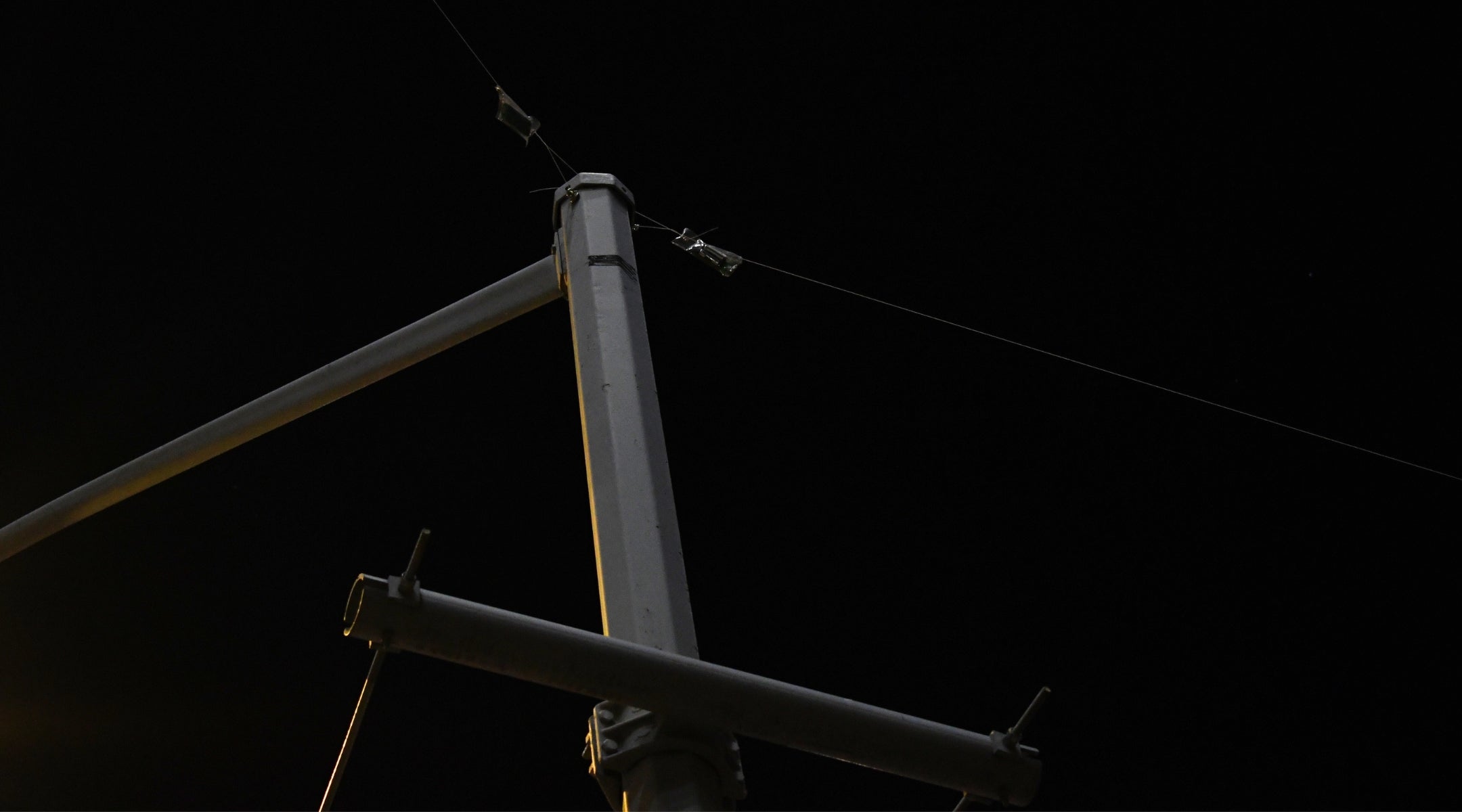
Newly added motion sensors, encased in plastic, are clipped onto a part of the eruv wire by the Manhattan Bridge. (Jackie Hajdenberg)
Tauber has been surprised by the willingness of various city agencies and construction crews to accommodate him in his unusual line of work.
“Even though we are Jewish, and we know we are not the most liked people here, but I never, ever had a problem with any organization or department officials, or even a construction company — they always come across,” he said. “They always look like they admire something which is religious.”
For Chaya Tauber, the early mornings and constrained vacations are worth it because of the way her husband’s work allows Manhattan Jews to observe one major law of Shabbat with ease.
“There is so much less desecration of Shabbos,” Chaya Tauber said, adding that when the eruv is up, “at least they’re not transgressing on this particular halacha. That makes this job such a responsibility.”
—
The post On Friday, the rabbi circles Manhattan — now with tech support to protect an essential Shabbat tool appeared first on Jewish Telegraphic Agency.
Uncategorized
A Chabad Jew was stabbed in NYC. He returned the next day to continue wrapping tefillin.
(JTA) — Less than 24 hours after he was stabbed in midtown Manhattan, Yosef, a Chabad-Lubavitch man from Crown Heights, was back on the same street where he’d been assaulted, popping into Diamond District businesses as usual to help employees wrap tefillin.
Yosef, 26, who did not share his last name to maintain his privacy, told the Jewish Telegraphic Agency that he was back on 47th Street on Thursday afternoon, the day after the stabbing, without missing a beat in his Monday-through-Thursday rounds even as police investigate the incident as a possible hate crime.
A number of the people he visited pieced together that the widely circulated footage of a man being stabbed the previous night was of him.
“They were in shock. They were obviously scared for me,” said Yosef, who has been wrapping tefillin and distributing Shabbat candles to Jewish Diamond District employees for about three years. He started that routine when his father, a Chabad Jew who works in the jewelry business, realized he needed his son’s help to handle the demand for those acts. Yosef told Chabad.org that he was “still shaken” by the attack a day later.
Still, he told JTA, “We can’t allow some hate to stop us.”
Yosef said he felt it was important to communicate that message because “we need more mitzvahs in the world, we need more light in the world.”
Yosef was taken to Bellevue Hospital on Wednesday evening around 6 p.m., where medical staff assessed that he had no internal bleeding and would not need stitches. No arrests have been made, but the assailant has been described as a woman in her 40s.
The attack has renewed concerns about security that have faced Chabad adherents and institutions, which often host public events and maintain a visible street presence. But the threat didn’t diminish their presence in midtown Manhattan on Friday.
Multiple Chabad men stood under a bright yellow tent on the sidewalk wrapping tefillin for a steady stream of workers in the heavily Jewish Diamond District.
“The Rebbe says that the way to defeat darkness is only through the addition of light,” said Shmuel Cohen, who was handing out small photographs of the movement’s late leader, the Lubavitcher Rebbe Menachem Mendel Schneerson.
Cohen told JTA that he had not heard about the attack that took place just down the block two days earlier, though his partner under the sidewalk tent had. Cohen said that the best way to respond is through “the observance of Torah and mitzvot without being ashamed of our Judaism but presenting it to everyone.”
Also on Friday, Chabad officials met with New York Police Department representatives for their annual meeting about security ahead of Chabad’s international conference in Crown Heights, the Brooklyn neighborhood where the movement is headquartered. The conference begins on Nov. 5.
Chabad has been targeted in multiple high-profile attacks in the past year, including the deadly Bondi Beach shooting in Australia in December. The following month, a man rammed a car into the doors of the Chabad-Lubavitch headquarters in Brooklyn, raising further questions over how the movement should balance its commitment to making its events accessible with security.
Meanwhile, Jews have been targeted in more than half of hate crimes committed in New York City in 2026, despite making up about 12% of the city’s population.
“Security is our top priority. Our goal is to provide an environment where every participant feels safe and can fully experience the purpose and spirit of the gathering,” said Rabbi Mendy Kotlarsky, a top organizer of the upcoming conference.
In the wake of the attack, Yosef said he is not concerned about going out in public as a visibly Jewish person and doesn’t plan to change how he approaches the world.
“I was wearing the same clothes on Tuesday and Wednesday and Thursday,” he said. “I didn’t change my routine.”
This article originally appeared on JTA.org.
The post A Chabad Jew was stabbed in NYC. He returned the next day to continue wrapping tefillin. appeared first on The Forward.
Uncategorized
They met on a Birthright trip then married. Now this American Israeli couple’s internet fame has turned to infamy.
Ethan and Hila Klein first met at Yad Vashem — Israel’s Holocaust museum — in 2007, a meet-cute they recounted, giggling, years later for their millions of YouTube followers.
“I think I went up to her and said something like, ‘They had it coming, don’t you think?’” said Ethan, known for his edgy humor and infamous internet trends, including Vape Nation and Papa Bless. “No I didn’t say that. I wonder if you would have laughed though.”
They were on a Birthright trip, Ethan an American and Hila an Israeli soldier on leave to join the group. Soon after the trip ended, Ethan moved to Israel to be with Hila, and the two began making videos under the name H3H3 Productions (the H for Hila and the 3 standing in as an E for Ethan). They married, moved to America, and started a popular podcast.
A Jewish love story, until Thursday, when Hila, now mother to their three children, accused Ethan publicly of having a months-long affair.
“The betrayal I feel is immeasurable,” Hila said in an Instagram post. “My only family on this side of the world. How do I even begin to make sense of this?”
Ethan reposted her statement.
Their podcast is run by a handful of crew members who often chime in and participate in various skits and bits. The crew also shared a statement saying they stand with Hila and refuse to work with Ethan, though they added they don’t know what this will mean for the future of the show.
A couple roiled by Oct. 7
The left-leaning, secular couple’s videos and podcasts focused primarily on pop culture, internet drama and general politics, not Jewish or Israeli issues.
Both Ethan and Hila would make statements sometimes when tensions in Israel flared, and they would occasionally speak out against IDF actions that upset them.
In 2021, Ethan started a podcast with political commenter Hasan Piker, a controversial left-wing influencer, called Leftovers, a nod to their leftist politics.
Then came Oct. 7.
Ethan, an American Israeli dual citizen like Hila, was horrified by the attacks but quick to call the IDF genocidal in the aftermath. In their first episode together after Oct. 7, Ethan and Piker said the show would continue through their disagreements. The episode was tense, and it was their last.
As Piker’s rhetoric on Israel intensified and became at times antisemitic, the two began a nasty internet feud, culminating in a nearly five-hour livestreamed debate.
Piker posted about the news of the affair on X, sharing a video of Ethan and expressing disgust for men who cheat.
“Now this is a high caliber man [with] good morals,” Piker said sarcastically. He also posted “Judge me by my enemies” after sharing Hila’s statement.
Hila, who owns a makeup and clothing company, increasingly came under scrutiny by Piker and others after Oct. 7 for her service in the IDF. Artists refused to work with her. One model she hired publicly disavowed her after finding out she was Israeli.
The couple was harassed, sometimes online, sometimes in-person, as they attempted to take what they viewed as a nuanced stance in the aftermath of Hamas’ attack on Israel and the ensuing war in Gaza. The united front seemed to fortify their relationship, as Ethan, ever outspoken, routinely came to his wife’s defense.
Their show lost thousands of subscribers, but loyal fans stuck with them — fans who now say they are gutted and confused by the news of the affair. Many in disbelief noted that Ethan had Hila’s face tattooed on his arm less than two years ago as a surprise for her.
“The greatest thing a man can do for his children is to love their mother,” says the quote surrounding the tattoo.
The Forward attempted to contact the Kleins through their work emails and did not immediately hear back.
The post They met on a Birthright trip then married. Now this American Israeli couple’s internet fame has turned to infamy. appeared first on The Forward.
Uncategorized
These Jewish college students have some ‘nonnegotiables’ for El-Sayed
At the University of Michigan, first-year student Robert Kashan, 18, and sophomore Jacob Reich, 19, sat behind a large blue sign. “Some things are nonnegotiable,” it declared in all caps.
The sign laid out their requirements for any candidate seeking their support: a commitment to Jewish safety, “including for Zionist Jews,” and supporting Jewish statehood in Israel, among other positions.
“Zionism is a legitimate part of the Democratic coalition, and a lot of us are feeling less represented by the Democratic Party,” Kashan told the Forward.
The students are part of a broader “Nonnegotiable” movement in Michigan, a coalition of Jewish Democrats who are spelling out their dealbreakers for candidates ahead of the Senate election between Democratic nominee Abdul El-Sayed and Republican nominee Mike Rogers.
The movement has attracted national attention, with hundreds of rabbis across 34 states signing on to the “Nonnegotiable” demands. Meanwhile, about 20 students at the University of Michigan have publicly signed, while hundreds more offered support anonymously, according to Reich.
The “Nonnegotiable” supporters aren’t saying whom they’ll vote for if their concerns aren’t addressed — or whether they’ll vote at all. But they are pushing back against the assumption that Jewish voters will, as the saying goes, “vote blue no matter who,” urging El-Sayed to engage with their demands if he hopes to earn their support.
That’s in contrast with two other Jewish political camps, including a group called Michigan Jews for Democracy that endorsed El-Sayed. Their petition, which has garnered almost 1,000 signatures, notes that some signatories hold reservations about El-Sayed but are voting for him nonetheless as a check on President Trump.
“We understand that a vote is not a valentine; it’s a strategic chess move,” the petition reads.
A competing petition, dubbed “Michigan Jews Against Extremism,” has drawn hundreds of signatures from Michigan Jews who plan to vote for Rogers. That petition similarly emphasizes that Rogers voters may still have reservations about the candidate: “Our vote for Mike Rogers does not require that we agree with him on every issue or that we support President Trump,” it reads.
“Nonnegotiable,” meanwhile, rejects the idea that Jewish voters would have to choose between Zionist and Democratic values. Some have criticized the nonnegotiable movement for ignoring the reality of the electoral choice at hand. Others have called it “a veiled attempt to excuse the actions of Jewish Democrats who want to feel validated about voting for Mike Rogers.”
But Kashan and Reich, who met at Hillel and plan to major in political science, said the “Nonnegotiable” movement was the only way they could see themselves engaging in the election, as they felt increasingly pulled between their identities as Democrats and as Jews.
Some Michigan Jews have expressed alarm at El-Sayed’s questioning of whether Israel should exist as a Jewish state and his decision to campaign alongside controversial Twitch streamer Hasan Piker, who has been accused of antisemitic rhetoric. Rogers, who Trump has endorsed, earlier this week called El-Sayed “anti-Jew.”
In a letter to Michigan Jews, El-Sayed has vowed to “stand up against antisemitism and take the threat of violence against our Jewish community incredibly seriously.” He has also hired a Jewish liaison in the final weeks leading up to the election.
This will be the first election when Kashan, who just turned 18, is eligible to vote, and Reich’s first national election after voting in a local primary in his hometown of Palo Alto, California. For both, voting Democratic in their first major election had once seemed like a given.
“I’m a Jewish Democrat, and I want Democrats to take the Senate,” Reich said. “I want to vote for a Democrat in my own state.”
They’re still holding out hope that will happen — and that, with less than two weeks until the Nov. 3 election, El-Sayed will sign on to their petition.
And if he doesn’t? Neither student is ready to say.
The post These Jewish college students have some ‘nonnegotiables’ for El-Sayed appeared first on The Forward.
