


Uncategorized
As 1000+ rabbis sign anti-Mamdani letter, others decry mounting ‘red lines’ in Jewish communities
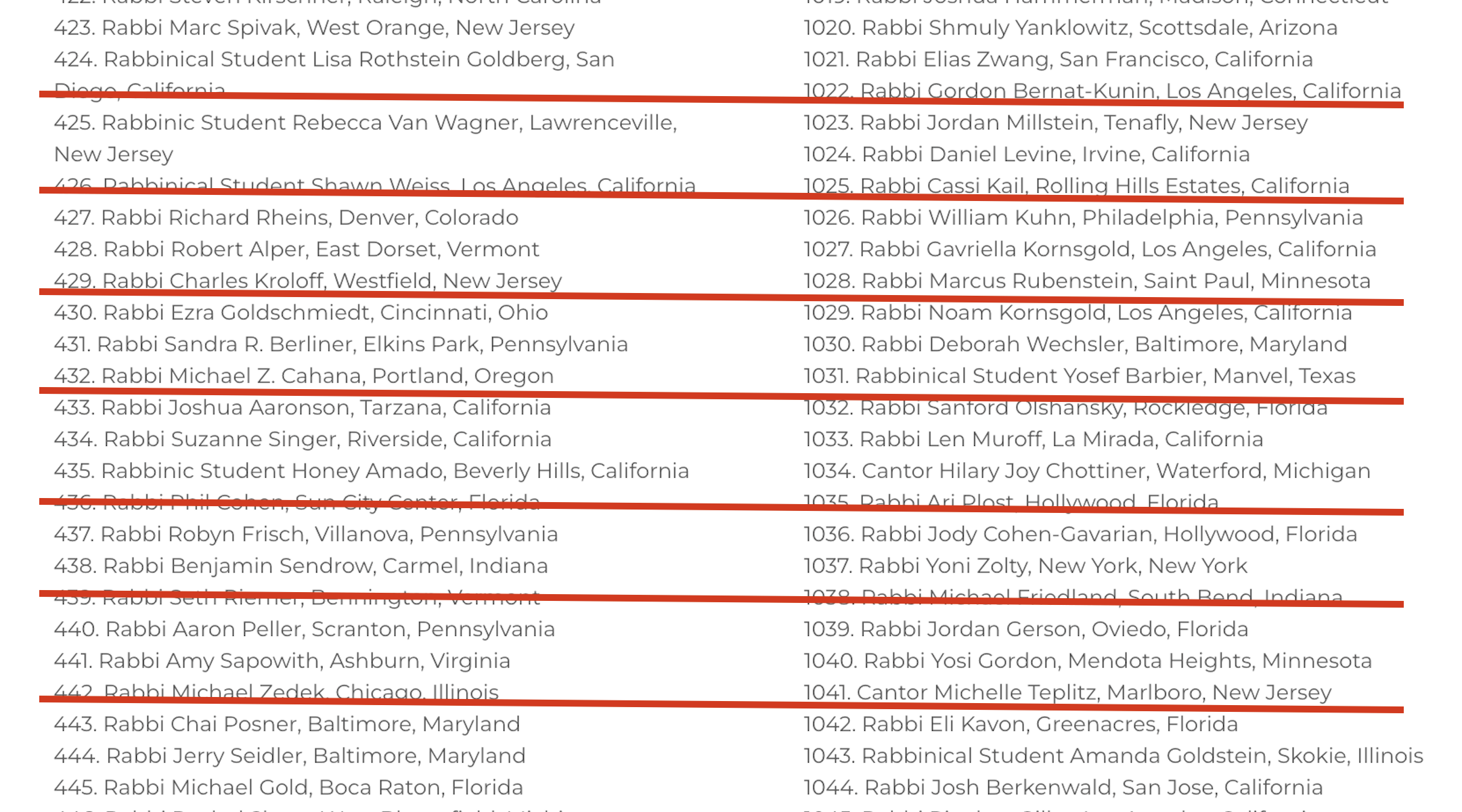
Two days after Rabbi Elliot Cosgrove delivered a sermon urging congregants to vote against Zohran Mamdani, rabbis across the country were asked to sign a letter quoting him.
By the time it was published Wednesday, 650 rabbis and cantors had done so, adding their names calling out the “political normalization” of anti-Zionism among figures like Mamdani, the New York City mayoral frontrunner.
By Friday, the letter had more than 1,000 signatories, making it one of the most-signed rabbinic letters in U.S. history.
But Cosgrove, the senior rabbi of Park Avenue Synagogue on the Upper East Side, was not one of them.
“As a policy, I do not sign group letters,” he said in an interview.
“My fear of such letters is they can flatten subjects and reduce complex issues to ‘Who’s on a letter and who’s not on a letter?’” he added. “There are other platforms that rabbis can give expression to their leadership.”
As the letter has ricocheted across the country and escaped from rabbis’ inboxes to their congregants’ social media feeds, it has ignited a wave of scrutiny, plaudits and recriminations. Some people have voiced relief or disappointment in seeing their rabbi’s name on the list — or on not seeing it.
“Jewish communities are circulating spreadsheets of who signed and who didn’t,” wrote Rabbi Shira Koch Epstein in an essay describing what she said was “a painful public reckoning” taking place both publicly and privately.
“I am not sleeping. These red lines are so dangerous,” responded Rabbi Lauren Grabelle Hermann, of Manhattan’s Society for the Advancement of Judaism, in one of dozens of comments representing a wide range of views. Hermann devoted her Yom Kippur sermon earlier this month to calling on her community to “become an antidote to the polarization and fragmentation in our broader Jewish community and society.”
Now, facing renewed pressure from their congregants over the letter, some New York City rabbis are articulating alternative strategies for responding to a political moment that many Jews are experiencing as fraught and high-stakes.
Rabbi Angela Buchdahl wrote to all members of Central Synagogue, the Manhattan Reform congregation where she is senior rabbi, to explain why they would not find her among the letter’s signatories.
“As a Central clergy team, we have spoken from the pulpit in multiple past sermons and will continue to take a clear, unambiguous position on antisemitism, on anti-Zionist rhetoric, and on sharing our deep support for Israel,” she wrote.
But, citing the importance of “separation of church and state,” Buchdahl wrote that “it is up to each of us to vote our conscience.”
“There are political organizations, including Jewish ones, where electoral politics is the core mission. Get involved,” she wrote. “Central Synagogue, however, is a Jewish spiritual home and we want to keep it that way. It remains our conviction that political endorsements of candidates are not in the best interest of our congregation, community, or country.”
Rabbi Jeremy Kalmanofsky of the Conservative synagogue Congregation Ansche Chesed on the Upper West Side sent out a letter of his own to congregants. He said he would not be voting for Mamdani but did not believe it was his role to tell them how to vote. And he raised concerns about what he said was the “shearing off of liberal from conservative liberal communities,” saying that Jews of all political outlooks should be able to pray and act together.
“The Torah commands lo titgodedu, traditionally interpreted to mean, don’t fragment yourselves into factions,” Kalmanofsky wrote. “I fear this happening to Jews. Frankly, I fear it more than I fear an anti-Zionist mayor.”
Rabbi Adam Mintz, who leads the recently rebranded Modern Orthodox congregation Shtiebel @ JCC, said he’d signed a smaller letter from Manhattan Orthodox rabbis urging the importance of voting. But Mintz felt this letter was outside his role.
“I’m a rabbi. I don’t want to take a political stand,” he said. “I understand that some people feel strongly and they want to take a political stand. I think that’s OK, but that’s not my role.”
Rabbi Michelle Dardashti of Kane Street Synagogue, an egalitarian Conservative synagogue in Brooklyn, did not sign the letter, either. She instead took a different approach to addressing her congregants in the lead-up to the election, hosting about 80 of them Tuesday night for an evening of dialogue.
Members representing a spectrum of views took turns sharing questions and concerns ahead of the election. Dardashti said congregants, despite conflicting views, were “deeply engaged and passionate, and spoke beautifully and respectfully.”
“I understand my rabbinic role to be one that creates space for people to learn from each other’s different experiences, and therefore perspectives,” she said.
Some Jewish leaders and groups outright opposed the letter and its message, rather than considering it an ill-advised strategy. Bend the Arc, a progressive Jewish organization that endorsed Mamdani, released a statement excoriating the letter and its signatories for distracting from what it said was the real issue: Donald Trump.
“These Jewish leaders are doing Trump and the MAGA movement’s work for them: dividing our pro-democracy movement at a time when we need to be united to beat back fascism,” the statement read.
Josh Whinston, a rabbi in Ann Arbor, Michigan, expressed skepticism on social media about the letter’s origin and intentions, and noted that he did not sign it.
“This was not a call for moral clarity; it was a political move aimed at influencing a local race in New York City,” he wrote.
Upon first reading it, Whinston wrote that he “agreed with parts of what it said,” and that he “considered signing.” But, hoping to learn more about the Jewish Majority, the group behind the letter, Whinston wrote, “The site offered no substance. There was no mission, no vision, no leadership, no staff.”
The Jewish Majority’s goal, as stated on its website, is to counterbalance left-wing “fringe groups” like Jewish Voice for Peace and Jews for Racial and Economic Justice, which they say “weaponize the Jewish identity of some of their members to call for policy recommendations that are rejected by the overwhelming majority of the Jewish community.”
The executive director of the Jewish Majority, Jonathan Schulman, is a former longtime AIPAC staffer. In an interview, Schulman said he wrote the letter’s first draft before it underwent rounds of edits from about 40 rabbis of different denominations.
The inspiration came when “Rabbi Cosgrove’s sermon started making the rounds,” he said, adding, “By Sunday morning, rabbis were reaching out to me saying, ‘This is the kind of sentiment we’re feeling all over the country.’”
Unlike Cosgrove’s sermon, which included an endorsement of Andrew Cuomo, the letter does not mention either of Mamdani’s opponents. It does, however, say that political figures like “Zohran Mamdani refuse to condemn violent slogans, deny Israel’s legitimacy, and accuse the Jewish state of genocide,” and calls on Americans to “stand up for candidates who reject antisemitic and anti-Zionist rhetoric, and who affirm Israel’s right to exist in peace and security.”
Schulman recalled being told, “‘There’s the issue of Zohran Mamdani and calls to globalize the intifada and all this, but there’s anti-Zionist candidates running for mayor in Somerville, Massachusetts, in Minneapolis, Seattle — this is becoming normalized, this is becoming mainstream.’”
Rabbi Mark Miller of Temple Beth El in Bloomfield Hills, Michigan, is one of the rabbis who helped edit the letter. He said part of his goal was to help clarify its nature as being national rather than local.
“This was not an attempt for the rest of us to get involved in New York politics,” Miller said. “It’s highlighting it, but the issue is that everywhere we are, this is a concern.”
Signatories on the letter include rabbis from across the United States, and even outside the country.
Rabbi Brigitte Rosenberg, the senior rabbi of a Reform congregation in St. Louis, signed the letter, and said the message about anti-Zionism resonated with her on a national level.
“Mamdani was the big race that was talked about in this, but it’s come up in other races, right?” Rosenberg said, pointing to the comeback bid of “Squad” member Cori Bush to represent St. Louis in Congress.
Rabbi Jeremy Barras from Miami said a number of his congregants have residences in New York, and “they’re just terrified.”
“But I would’ve signed it if it was the same issue in any city in America,” Barras said. “It just happens to be true that we’re a little more sensitive because so many of our families have connections in New York.”
Both Barras and Rosenberg said they couldn’t remember an open letter signed by this many rabbis. There have in fact been examples of open letters being signed by 1,000-plus rabbis, including an appeal to open Palestine to Jews in 1945; a 2017 letter calling on Trump to support refugees and a letter from earlier this year demanding Israel stop “using starvation as a weapon of war.”
Yehuda Kurtzer, co-president of the Shalom Hartman Institute, affirmed that open letters like the one distributed by the Jewish Majority are nothing new, and said there is “definitely a tension that emerges” for those expected to sign. Endorsements from the pulpit, on the other hand, are “new terrain,” he said, noting the Trump administration’s decision to stop enforcement of an IRS rule barring political endorsements from religious institutions.
“We felt pretty strongly that rabbis should not generally do this, and there’s a whole variety of reasons,” Kurtzer said. “It’s a plausible scenario that politicians will start doing quid pro quos with religious leaders around their needs. Once you do it once there’s an expectation that you’ll do it all the time.”
Some of the rabbis who signed say they weren’t making a partisan political statement. Ammiel Hirsch, senior rabbi of Stephen Wise Free Synagogue on the Upper West Side and the leader of a Zionist organization within the Reform movement, acknowledged “worries” about alienating some congregants. But, like others who’ve come out against Mamdani, Hirsch said it was non-partisan to speak out against someone whose rhetoric could compromise Jewish safety.
“There’s always the risk that people will understand you in a partisan way, especially since we’re living in such a hyper-partisan atmosphere now,” Hirsch said. “But it’s a risk that we have to take because the stakes are so high.”
Rabbi Joshua Davidson of Manhattan’s Temple Emanu-El made a similar point. “I’m not going to tell people who they ought to vote for. But I do think it’s important for me to let them know what I think they ought to be thinking about when they vote,” he said, pointing to issues like “the well-being of the State of Israel and the safety of the Jewish community.”
For Cosgrove, whose synagogue is located 20 blocks from Davidson’s, the division that’s arisen since his sermon is something to grieve.
“It deeply saddens me that, in a moment where the Jewish community should be thinking about the external threats that our community faces, that we should be spending an iota of energy on that which exacerbates any fault lines,” Cosgrove said.
—
The post As 1000+ rabbis sign anti-Mamdani letter, others decry mounting ‘red lines’ in Jewish communities appeared first on Jewish Telegraphic Agency.
Uncategorized
Meet the only Jewish president of a Catholic university
Synagogue president and Catholic university president aren’t typically jobs one holds concurrently.
But in 2023, Greg Weiner became president of both Assumption University, a Catholic college in Worcester, Mass., and Congregation Beth Israel, a Conservative synagogue in the area.
Weiner’s inauguration in March of that year made him the first and only Jewish president of a Catholic university — one with the motto “Until Christ be formed in you.”
To him, the combination just made sense.
“I never had any hesitation at all about whether being a Jewish president would work — quite the opposite,” Weiner told the Forward. “The divide in society between people who do and don’t treat religion seriously is much wider than between particular religions.”
Shortly after Weiner’s inauguration, college presidents found themselves in the national spotlight as pro-Palestinian protesters built tent encampments on college campuses across the country in the aftermath of Oct. 7
During that time, Weiner became a figurehead for an unconventional idea: that Jewish students who felt unwelcome at secular universities ought to consider attending Catholic institutions like Assumption instead.
Now, Weiner continues to make the case that Catholic schools have much to offer Jewish students.
“The challenge for Jewish families, Jewish parents, Jewish students, is we have to ask ourselves: Do we value education, or do we simply value the prestige that’s associated with certain universities?” Weiner said. “Because, in a lot of cases, those seem to be inversely correlated.”
How Weiner became president
To state the obvious: Appointing a non-Catholic to head a Catholic university was not a risk-free choice.
How would students, faculty and trustees react? Would the university, founded in 1904 by the Catholic Augustinian order known as the Assumptionists, be accused of turning away from its Catholic history, character and mission?
Historically, Catholic universities were exclusively led by priests from the Catholic order that founded the school. Universities like Notre Dame have continued that tradition; every president since its founding in 1842 has been a priest of the Congregation of Holy Cross.
But as Catholic universities have increasingly sought to attract students of all faiths — and as the number of priests available to lead universities has declined — more laypeople have taken the helm. For instance, Loyola University in Chicago named the first laywoman instead of a priest as president in 2016. The Jesuit Fordham University did the same in 2022, breaking with its 200-year tradition.
“I wouldn’t entirely downplay some tensions here, as much as the motto of our university is ‘Until Christ be formed in you,’” said the Rev. Dennis Gallagher, an Assumptionist priest who serves as Vice President for Mission at Assumption University. “Clearly, he’s not going to give personal credence to that particular expression.”
But Gallagher said he was won over by how Weiner articulated the value of a Catholic liberal education, which emphasizes inquiry and debate — values that also happen to be very Jewish.
An Assumption education asks humanity’s’ “enduring questions,” and attracts the kind of students who “haven’t determined that they know the answers to those things before they arrive,” Gallagher said.
Weiner, who draws parallels between Talmudic debate and Assumption’s inquiry-driven approach to education, was well-positioned to promote those ideals, Gallagher said.
Weiner was also not an outsider at Assumption. After a career in Democratic politics that included working as press secretary for then-Nebraska Sen. Bob Kerrey and getting his PhD in government at Georgetown University, Weiner joined the faculty at Assumption in 2011 as a political science professor. He quickly rose the ranks, becoming provost and vice president for academic affairs in 2019. After former Assumption President Francesco Cesareo announced his retirement in 2022, Weiner became interim leader.
Gallagher said he didn’t think trustees were seriously considering Weiner for the job of president at the time. But when Weiner excelled in the interim role, the choice became clear.
“I remember saying, ‘I think what we’re looking for is right here with us,’” Gallagher said. “Somebody that can both understand and communicate what a Catholic — albeit not being Catholic himself — what a Catholic liberal education is about.”
In the end, Weiner’s appointment drew far more celebration than controversy, with the university actively embracing his Jewish identity. A rabbi bestowed a special blessing upon Weiner at his inauguration.
A Jewish haven?
Weiner, who grew up as a member of the lone Jewish family in the small town of Luling, Texas, is comfortable with being the only Jew in the room.
When a childhood friend expressed concern that Weiner was going to hell, he took it as “a very ham-handed way of expressing genuine caring,” he said. “I was born without the gene that tells you to get offended quickly.”
That same instinct carried into his career. At first, Weiner said, he didn’t publicly lean into his Judaism as part of the presidency. But in the aftermath of the attacks of Oct. 7, he felt “a particular responsibility to speak out.”
In December 2023, Weiner made a splash with a Wall Street Journal op-ed suggesting Jewish students feeling alienated from Ivy League campuses ought to consider Catholic schools like Assumption.
At the time, other Catholic schools were also explicitly courting Jewish students amid turmoil over Israel and antisemitism on college campuses across the country.
Still, it was an unconventional pitch: Assumption has no Hillel or Chabad on campus, and students are required to take Catholic theology courses where they learn about Christian morality, sacraments and other church doctrine.
But whatever Assumption lacked in Jewish religious life, Weiner said it has made up for in campus culture. Assumption had no student encampments protesting Israel after Oct. 7, in part, Weiner said, because Assumption students are more interested in arguing over ideas in a philosophy class than organizing a protest.
Weiner, who has written four books on political theory and previously worked as a political aide for several Democratic politicians, said students on campus hold a range of views about Israel. But Assumption is not a place filled with student activists.
“Too many campuses have encouraged moral certainty, intellectual certainty, when Socrates says, ‘Philosophy begins with a confession of ignorance,’” Weiner said. “Education requires a certain amount of humility.”
Eli Beberman told the Forward he initially chose Assumption in 2018 because it was close to home and had a strong secondary education program. He expected being Jewish at a Catholic school might require some adjustment. He never imagined the university’s president would become Jewish his senior year.
“Seeing upper level leadership at Assumption also be Jewish was a really cool experience for me,” Beberman said.
Assumption was a place where interfaith friendships thrived, Beberman said. Though there was no Hillel on campus, Beberman was able to pray in an interfaith space with a Torah. He also celebrated Jewish holidays with non-Jewish friends, hosting Shabbat dinners and a Hanukkah party in the dorms, where his parents brought over their “famous brisket.”
“I was able to practice my religion how I wanted to, and I felt very comfortable on campus being a non-Catholic student,” Beberman said.
Jewish faculty members, too, said Weiner’s presidency changed how they saw the university.
Samantha Goldman, a Jewish associate professor of special education at Assumption, said she didn’t seek out a job at a Catholic institution. But once she got there, she was surprised at how natural the environment felt.
“Having a Jewish president of a Catholic institution really communicates this sense of welcoming and inclusivity that might not otherwise be apparent,” she said.
Others were drawn specifically to the culture Weiner fostered. In 2024, Mary Jane Rein left her job as executive director of the Strassler Center for Holocaust and Genocide Studies at Clark University. She said Clark had failed to properly support her after students protested a talk she helped organize featuring an Israeli reservist. That inspired her to come to Assumption, where she launched the Center for Civic Friendship, which helps students engage in civil discourse across ideological divides.
“To my surprise as both a scholar and a Jew,” Rein wrote in the Wall Street Journal, “I feel a warmer welcome and more commonality of purpose at a Catholic institution than at Clark, a secular one.”
That same year, Weiner was reappointed for a five-year term through May 2030 in an announcement trustees said reflected “deep confidence in his leadership.”
To Weiner, the success of his presidency is evidence that Judaism and Catholicism are not as far apart as they may seem.
“Obviously, [there are] some foundational theological differences,” Weiner said. “But with respect to the educational commitments, I think they’re quite compatible.”
The post Meet the only Jewish president of a Catholic university appeared first on The Forward.
Uncategorized
The secret Jewish history of the ‘Rocky Horror Picture Show’
“Rocky Horror,” which opened in London cinemas on this day in 1975 is the cultural phenomenon that simply refuses to die. Rather, since its first incarnation as a 1973 London stage musical, “The Rocky Horror Picture Show” has been continuously reborn on the silver screen, in subsequent Broadway stage productions, and, in 2016, as a direct-to-TV film, starring Laverne Cox of “Orange Is the New Black” fame as the transgender Dr. Frank-N-Furter, the mad-scientist role originated by Tim Curry.
In all its incarnations, however, “Rocky Horror” has always been more than just a performance. Its appeal has been widely driven as a participatory event. Film critic Roger Ebert summarized it best writing about the original 1975 film: “‘The Rocky Horror Picture Show’ is not so much a movie as more of a long-running social phenomenon,” because “the fans put on a better show than anything on the screen.” What Ebert refers to is the interactive tradition that has grown up around “Rocky Horror,” whereby fans attend midnight showings primed for a party as much as a screening: reciting the lines out loud along with the characters and interspersing them with “callouts” — responses that have been accepted into the Rocky Horror canon much as the Talmud is commentary on the Mishnah that has in and of itself become part of the sacred text. In the case of “Rocky Horror,” this also includes activities, such as throwing rice or confetti in the air when the married couple in the film leaves the church; squirting water pistols during a rainstorm; and tossing rolls of toilet paper when one character says “Great Scott!”
In one of the most overtly Jewish moments in and outside of the film, a speech by Dr. Frank-N-Furter hailing the creation of the Golem-like creature of the title, Rocky Horror, is met by chaotic noisemaking on the part of the partygoers onscreen and off. In the original film, some of the crowd generates noise with ratchets – a percussion instrument that looks suspiciously like a gragger, as if Dr. Frank had said “Haman.” There are other Purim-like touches in the film, such that temple congregations have made “Rocky Horror” into part of their annual ritual, such as a “Rockin’ Hora Purimshpiel” in which several of the musical numbers are rewritten as Purim songs.
Other Judaized versions of “Rocky Horror” that have appeared over the years include “Hebrew Horror,” which was staged in Los Angeles in 2007, and the “Rocky Hora Chanukah Song” by the Jewish punk-rock parody group, the Shlomones (sort of a redundancy, since several members of the Ramones were in fact Jewish, as was their outlook in numerous ways, including their song, “Bonzo Goes to Bitburg.”
The original London stage version was produced by British-Jewish theatrical impresario Michael White, who was born to Eastern European Jewish-immigrant parents in Glasgow, Scotland. White’s credits had already included the boundary-shattering “Oh! Calcutta!” — the first all-nude revue in commercial theater — and he went on to co-produce the “Rocky Horror” film as well as “Monty Python and the Holy Grail.”
The original musical and film were decades before their time in celebrating the sexual fluidity of the LGBT world – indeed, there wasn’t such a term as LGBT, much less a socio-political acceptance of it, for years to come. The new TV film version is in no small part an effort to seize this cultural moment when LGBT, and particularly transgender issues, are now part of mainstream political and cultural discussion, especially what with the casting of openly trans actress Laverne Cox.
The original did, however, have a political consciousness beyond its seemingly outrageous effort to provoke. Dr. Frank-n-Furter’s lab coat in the movie was inspired by a Nazi concentration camp inmate uniform and was adorned by the pink triangle that the Nazis used to label what we now call LGBT inmates. And in the film at least, there were implications that Frank’s rival, Dr. Scott was a Nazi.
The 2016 version was again produced by music industry legend Lou Adler, who was responsible for turning the stage musical into the original film starring Tim Curry, Susan Sarandon, Barry Bostwick and Meat Loaf. In that version, Eddie was played by American Idol star Adam Lambert, the role played by Meat Loaf in the original Broadway cast and film. Lambert, who starred as Joshua in “The Ten Commandments: The Musical,” has achieved fame as a solo artist and as the replacement for the late frontman Freddie Mercury in the rock band Queen. Lambert’s Jewish mother, Leila, was a dental hygienist.
Seth Rogovoy is a contributing editor to the Forward.
The post The secret Jewish history of the ‘Rocky Horror Picture Show’ appeared first on The Forward.
Uncategorized
Sister of pro-Israel stalwart Lindsey Graham secures GOP Senate nomination
(JTA) — South Carolina Sen. Darline Graham defeated U.S. House Rep. Ralph Norman in a special primary runoff on Tuesday, putting her in a dominant position to win the Senate seat left vacant with the death in July of her older brother, the pro-Israel stalwart Lindsey Graham.
The Associated Press called the race two hours after polls closed at 9:01pm. By the time 99% of votes were tallied, Darline Graham had secured 52.3% of the votes to Norman’s 47.7%.
“Tonight is a great victory, but it’s not the finish line,” Graham told her supporters on Tuesday night. “In fact, it is the starting line for an even bigger fight, which lies ahead.”
If Darline Graham goes on to win November’s general election against Democrat Annie Andrews, she will have big shoes to fill. Her brother served 23 years in the Senate and eight in the U.S. House. He traveled to Israel about a dozen times between Hamas’s Oct. 7, 2023 attack on the Jewish state and his death at age 71.
Heading into the primaries, analysts expressed no doubt that Darline Graham would be pro-Israel. But matching Lindsey Graham’s level of foreign policy activity, they warned, would be a formidable task. Meanwhile, her campaign to date has largely avoided discussion of international affairs. Instead, she has focused on domestic concerns like reducing spending, securing borders and promoting Trump-backed policies.
During a debate aired on C-SPAN last week, Graham struggled to respond to a foreign policy question about Taiwan and the South China Sea, ultimately admitting that she’s “not that informed on national security.”
“I’m not a polished politician up here,” she said. “National security is not my thing, not my area of expertise.”
Later addressing issues of affordability, Graham linked the domestic economic situation to the war in Iran and said she trusts President Donald Trump “to get the Strait of Hormuz open.” She also voiced her preference for financial sanctions over putting troops on the ground.
Asked about the country’s relationship with Israel, Graham described the Jewish state as “one of our strongest allies.” Recognizing her brother’s close relationship with Prime Minister Benjamin Netanyahu, she added that during a recent meeting with the Israeli premier, she vowed to “continue supporting Israel in any way” she can.
“We have to stand with Israel,” Graham said.
At their previous face-off, Graham had secured 33% of the vote, while Norman came in second place, at 25%, against eight fellow Republicans. But South Carolina requires primary winners to earn a majority of votes in order to avoid a two-candidate runoff. In the November general election, Graham will contend with Democrat Annie Andrews, a pediatrician who is unlikely to prevail in the solidly Republican state.
Tuesday’s runoff marked the third time in two months that South Carolina Republicans came to the polls to select a Senate candidate. Lindsey Graham, won the first primary in June but died suddenly the next month from an aortic dissection.
A few days later, South Carolina Gov. Henry McMaster, a Republican, appointed Darline Graham to finish her brother’s term. Though she only had minimal policy experience, including a leadership role at the South Carolina Commission for the Blind, she earned President Donald Trump’s endorsement and declared her candidacy in the full race.
Trump celebrated Graham’s nomination in a Tuesday night Truth Social post, writing that “Darline Graham rides Trump endorsement to win GOP nomination for brother’s South Carolina seat.”
Graham thanked Trump profusely during her Tuesday night acceptance speech, recognizing the president as one of her brother’s “closest friends” and crediting him for helping her secure a victory.
Norman, meanwhile, thanked his supporters on Tuesday night for their “prayer crusade of a campaign,” stressing that he “did not prepare a concession speech.” He accused “outside PACs” of spending $8 million opposing him and blamed the Democrats for this situation, adding that “they got what they wanted.”
He recognized Trump’s role in the race as a supporter of Graham, noting that he “never understood why he got involved” but that it is the president’s prerogative to do so. Nonetheless, Norman pledged that there “won’t be any tears” and that he planned to back Graham.
“I’m not supporting a Democrat, so I will support her, Darline, as best I can,” he added. “We’ll live to fight another day.”
This article originally appeared on JTA.org.
The post Sister of pro-Israel stalwart Lindsey Graham secures GOP Senate nomination appeared first on The Forward.
