


Features
With Einstein and Darwin
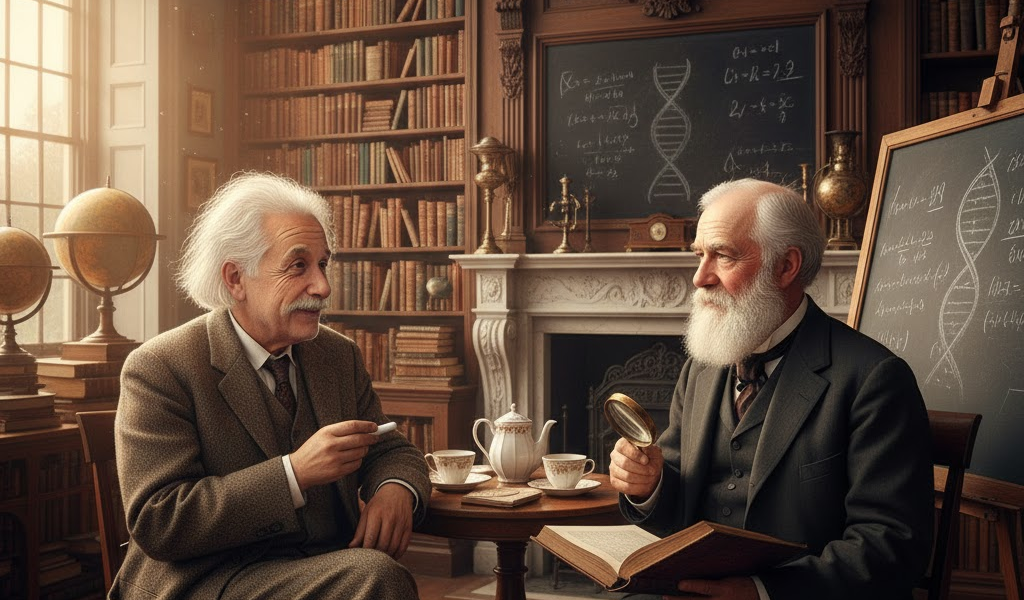
By David R. Topper A significant part of my adult intellectual life has been spent studying and teaching about the life and works of Albert Einstein. This led to my publishing various works about this fascinating, often frustrating man. Just as fervently, but not nearly to the same extreme, I’ve studied and taught about Charles Darwin. But I never published anything on him.
Since Einstein came after Darwin, the question often occurred to me as to whether Einstein ever read, thought, or wrote about Darwin. Indeed, I’ve gone as far as posing the following proposition to myself: Maybe, if Einstein had read and absorbed Darwin’s discovery about the astonishingly dynamical and unpredictable way the natural world works, then he may have been less rigid in his thoughts about the order and structure of the universe. In fact, I could go so far as to conclude that, if he had, then in 1916 he might not have made the erroneous assumption in his model of the cosmos, which he later called the “biggest blunder of my life” (quoted in Topper, p.165).
But I’m getting ahead of my story and I need to start with some basic questions. Did Einstein know about Darwin, and if so, what? In searching through the literature on this possible juxtaposition of these two giants in their fields, as far as I can tell, I’m the first person seriously to pose this issue in some detail – which was a big surprise. It certainly gave me an incentive to pursue this diligently. Thus I did, and here is what I found – plus, at the very end, I add a zany speculation about the nature of the universe, as we know it today.
The names “Einstein” and “Darwin” are seldom juxtaposed, except in a general sense, such as when comparing Einstein’s theory of relativity with Darwin’s on evolution – as overall examples of major ideas in recent centuries. Going through all the indexes of the many dozen books on Einstein that I own, looking for “Darwin” – in the few times I found the name, the reference was always to a general comment about him as a scientist, with nothing about the content of his theory. At most, I found that Albert had read Darwin, which is important to know, but I found little information on what the theory meant to him or what he got out of it.
Hence, I began a journey to see if I could find more, since it seems that I’m the first ever to explore – or even ask – about Einstein and Darwin. My next question was: do we know when Albert was first exposed to Darwin’s theory, and what did he learn? The earliest time I found was during the school year 1895 to 1896, when he was in Aarau, Switzerland, taking remedial high school before enrolling in the Polytechnic in nearby Zurich. We know that the Swiss school he attended was very progressive and it taught Darwin’s theory of evolution. It’s worth quoting something he said much later, when looking back on those years:
“By its liberal spirit and by the austere earnestness of its teachers … this school made an unforgettable impression on me; by comparison with six years of schooling in an authoritarian German Gymnasium [i.e. High School]. … I became acutely aware how much an education directed toward freedom of action and responsibility is superior to an education resting on drill, imposed authority, and ambition (quoted in Ohanian, p.9).”
During his next four years in Zurich at the Polytechnic, we know that among the many physics and math books that Einstein read, he also read Darwin – but we don’t know the details (Pais, p.44). Thus, as we move into the 20th century, at least we can say that he knew something about Darwin’s theory.
My next source to explore was the Collected Papers of Einstein, which are at present up to May 1929, when Albert was age 50. Over all those years, there are only a few places where the name Darwin appears. There is a book review he wrote in 1917, where the author mentions Darwin. Next, is a letter from a colleague in 1918, who talks about Darwin’s theory in passing, while making comments on society and politics. The only place where Einstein himself talks about the content of the theory is in the Third Appendix to his popular book, Relativity: the Special and the General Theory, which he added around 1920. That’s all there is. Albert died in March 1955, so there are still 26 years to go for the Collected Papers, but I’m not optimistic that anything significant will surface therein. Yet, who knows?
Using what I have, let’s explore this topic further, beginning with this appendix. The title is: “The Experimental Confirmation of the General Theory of Relativity.” Einstein begins with a brief foray into epistemology in science: induction and deduction. As science progresses over time, the inductive accumulation of empirical data occasionally needs to be supplemented by deductive ideas logically based upon a few given axioms; and from this there emerges a “system of thought” or a “theory.” The justification for the very existence of the theory is the fact that it correlates with a range of observations (empirical data) and “it is just here that the ‘truth’ of the theory lies (Einstein, p. 124).” He puts the word ‘truth’ in quotes because, as is often the case, there may be several such theories competing for an explanation of the same data. The ultimate goal of this for him is, of course, the issue of his general theory of relativity to explain gravity, in competition with the old theory of Newton. But before he delves into that – which constitutes the rest of the Appendix – he makes this aside comment on biology.
“As an example, a case of general interest is available in the province of biology, in the Darwinian theory of the development of species by selection in the struggle for existence, and in the theory of development which is based on the hypothesis of the hereditary transmission of acquired characteristics (Einstein, p. 124).”
That’s it. As far as I know, that is the only direct statement about Darwin’s ideas that Einstein ever wrote. Let’s look closer at this, for we will need it later. First, I want to point out another way of putting this. Einstein is contrasting the difference between Charles Darwin’s random selection method of evolution, with Jean-Baptiste Lamarck’s developmental process, which had a predetermined direction or goal for the evolutionary process. Thus, Darwin’s “struggle for existence” revealed the dynamical nature of plants and animals as they change over a long time-period. I’m assuming that Einstein realized all this, along with the lack of a specific direction for the evolutionary process according to Darwin. I just wish Einstein had said more; but we go with what is given. Moreover, the stage has now been set for why I have raised the name of Darwin in the first place.
In 1915 Einstein published his landmark paper on the general theory of relativity, which was essentially an explanation of gravity. Whereas Newton had pictured gravity as an invisible attractive force between all the elements of matter throughout the universe (from rocks to planets and stars), Einstein pictured it as a four-dimensional curvature of space (or, more precisely, space-time) around all those elements. Although Einstein’s paper constitutes pages and pages of tensor calculus equations, the conceptual image is quite simple. A rock is not falling to earth by an invisible attractive power; rather, the rock is simply moving into a dimple in space.
After completing this arduous task of many years, Einstein immediately wrote the popular account of the entire theory of relativity for the general reader, with a minimum of mathematics. In his Preface to the first edition, dated December 1916, he ends with this: “May the book bring some one a few happy hours of suggestive thought!” It was the Third Appendix to that work that I quoted above.
Next, he made a prediction. Still in 1916, from his general relativity theory, he wrote another paper, predicting the existence of gravitational waves. Over his lifetime such waves were never found, and in his latter years he doubted that they ever would be – since they are so infinitesimal in nature. But in 2015, almost exactly a century after their prediction, gravitational waves were detected by the clever design of a very big experimental apparatus that was necessary to find these minuscule waves. The three scientists who designed and did the experiment got the Nobel Prize two years later.
Back to 1916, for Einstein was not yet done. The entire enterprise had triggered another thought, and yet another paper. It started with a question. If the space around all elements of matter is bent locally, what does this say about the universe as a whole? Thus, Einstein went back to those equations for locally bending space and – so to speak – he summed them up for the space of the entire universe. In doing so, he found that the resulting universe – unlike the infinite space of Newton and others after him – was finite, since all space curves back into itself. It was as if we were living on the surface of a four-dimensional sphere of finite size. This finite universe was okay with Albert; he saw it as just another discovery that he made.
Yet there was a problem: according to the equations, the whole thing was unstable, due to the gravitational attraction among all the elements of matter. Such a universe would slowly collapse – and that would not do. Surely, the universe was stable; and so, in order to save this theory – after all those years of gruelling work – he stabilized the equation by adding another term; this term symbolized another force, having an equal and opposite repulsive power that balanced the two, and hence stabilized the universe. He called it the cosmological constant. To him, this was another discovery; that is, it was just another constant in nature. All this he published in 1917, and it formed the basis of a new cosmology. Indeed, all modern cosmology goes back to these landmark papers on general relativity by Einstein. Over the next decade, there were a few challenges to his model; particularly around the cosmological constant. Einstein did not see all of them, but the ones he saw, he rejected – thus holding fast to a stable universe.
Also, around this time, Einstein had another bright idea. Since the first decade of the 20th century, when he published his first papers on relativity, he also published major papers on the parallel theory of the atomic constitution of matter; namely, the quantum theory. His other bright idea, which absorbed his scientific attention starting in the 1920s, was to unite the two (relativity and quantum) into a unified theory of everything. He eventually called it the “unified field theory,” and it became his key obsession for the rest of his life.
In the meantime, by the start of the 1930s, he was forced to reconsider his cosmological model. It began in the summer of 1930, when he received an honorary degree from Cambridge University, where he met Arthur Eddington – the astronomer who had led the solar eclipse experiments that proved Einstein’s relativity theory in 1919, by measuring the bending of light from a star around the sun, as predicted by Einstein. Eddington now was familiar with important results coming from American astronomers, such as the work of Edwin Hubble at the Mt. Wilson observatory near the California Institute of Technology (Caltech) – holding the largest telescope in the world at that time. The results, as Eddington interpreted them, meant that the universe was expanding. It was as if that four-dimensional sphere was a balloon being blown up. Since this model contained a force of expansion outward, then no cosmological constant was needed. The universe was, indeed, unstable – and as well, expanding over time.
Serendipitously, at this time, Einstein was on his way to Caltech for three winter sojourns (1930-1933). While at Caltech on his first visit, he therefore had to abandon his commitment to the static model. He was quoted in the American press as saying that his old model was “smashed … like a hammer blow,” and he swung his arm with a fist while declaring this (Topper, p 174). Never again did he bring up the cosmological constant. In the early 1950s, when the topic arose in cosmology again, he was questioned about it: and, as mentioned before, he called the use of that constraint “the biggest blunder of my life.” (I should note here that in recent years it’s been discovered that this expansion of the universe is, in fact, accelerating. Hence, another repulsive force must be added, which today is called ‘dark energy’. Ironically, this may be seen as just another way of bringing back Einstein’s cosmological constant. Perhaps it wasn’t a mistake, after all.)
It’s important here to remember that Einstein’s extraordinary contributions to physics, ranging from his own theory of relativity to a wide range of topics in quantum physics, lasted from around 1905 into the mid-1920s. By then he became obsessed with his unified field theory, and essentially ignored all other important new fields, such as nuclear physics. Although popular culture likes to juxtapose an image of him with his halo of hair next to a mushroom cloud from a nuclear bomb – for example, the cover of Time magazine for July 1, 1946 – in fact, he made nary an iota of input to the actual development of that important branch of 20th century physics. This runs counter to what you may be told in popular accounts of Einstein’s life and work, such as on TV and in the movies. (Yes, I know about that little equation about energy and mass that Einstein is famous for. It was there in those early years of the quantum physics of subatomic particles. Nevertheless, it’s a very long haul from that seemingly innocent equation, through decades of work in nuclear physics, and then designing technological contraptions to making a bomb or any other applications for nuclear energy. All of which was done without Einstein. Incidentally, in that famous Time cover, E = mc2 is embedded in the mushroom cloud.)
More importantly, as quantum physics evolved into quantum mechanics around the mid-1930s, Einstein vehemently rejected the statistical nature of the subject. Although he himself, starting around 1905, had published many important papers using statistics within the quantum world, he interpreted it as a limit imposed by the experimental tools that we have in probing the subatomic world. To him the statistical features were not a part of the world itself, which is – at least, potentially – completely predictable. Yet by the 1930s, especially as expounded by his friend the Danish physicist Niels Bohr and others, the quantum mechanical interpretation of the statistical nature of the equations was that the underlying subatomic world itself was statistical in nature, and had no predetermined or predictable order. Only probabilistic statements can be made about that minuscule world – and that was its fundamental nature, according to quantum mechanics.
Einstein would have none of this. To make an analogy that I believe he would like: consider the use of statistics in actuarial tables by insurance companies, in order to predict the behaviour of groups of people, since individual behaviour can’t be predicted. Using Bohr’s interpretation of statistics in quantum mechanics, there would be no real people – only probable people! However, for Einstein electrons (along with other subatomic particles), like people are real. And so, the fact that quantum mechanics must rely upon statistics to work, means that the theory is incomplete. The problem is with the theory, not the world. Indeed, he believed that one result of achieving his unified field theory someday, would be the deduction of a complete, predictable and real subatomic world. That was another reason to pursue his quest.
In the closest writing to an autobiography, which Einstein penned in 1946, he said this: “Beyond the self, there is this vast world, which exists independently of human beings, and that stands before us like a great, eternal riddle” (Topper, p.10, italics mine). Nonetheless, Bohr’s viewpoint prevailed amongst most physicists. Hence, Einstein fought a losing battle to the end of his life.
What all this shows is that throughout his life, the concepts of stability, predictability, and order were fundamental in Einstein’s picture of the universe – the way he believed his one equation for the unified field theory (if found!) would unite the worlds of relativity and quantum physics. He died in 1955 without finding this equation. Nevertheless, the quest continues, with myriad physicists today searching for, what they now call, a theory of everything.
Now back to cosmology. We now know – and by “now” I mean in only the last few years – that the universe is much more dynamical than it was ever imagined to be, even with all this expanding and accelerating going on. Stars group together as galaxies, and galaxies group together into larger clusters, due to their gravitational attractions. But – and this was realized with the help of the Hubble and now the James Webb telescopes – galaxies merge and interact in a process producing new galaxies. One might call it an internal dynamical change among the galaxies that we never knew about, until now. Closest to home, consider our Milky Way galaxy, where “we” – namely our solar system, with a star (our sun) at the centre – are near the outer edge. Being far from the black hole at the centre of our galaxy, it’s a rather quiet place (astronomically speaking) – and hence life was able to take hold and evolve into what we have today. This will go on until our sun runs its course. Our star is now almost halfway through its 10-billion-year cycle. In about 0.5 – 1.5 billion years, as it starts running out of hydrogen fuel for nuclear fusion, it will expand into a “red giant” that will encompass the orbits of Mercury, Venus, and our Earth – and hence all life as we know it will end. (Unless, of course, humans, with their nuclear weapons, hasten that event.) After that, the sun will collapse into a cold “white dwarf.”
Independently of all this, and on a larger scale, our Milky Way is part of a group of galaxies, the largest being the so-called Andromeda Nebulae, visible as a smudge to the naked eye. Due to gravity, these two galaxies are on a collision course, moving closer at the rate of 110 kilometers per second. They will meet in about 3.5 billion years, long after life has ended here. At the same time, a much smaller galaxy, M33 (also called the Triangulum Galaxy) will also take part, along with the Large Magellanic Cloud (another nearby small galaxy), which may join in on this merger. What happens next is not clear, since we need much more information from the Hubble and the James Webb telescopes. Even so, we will never know if any prediction is true or not, since no humans will be around to see all this happen!
Nonetheless, we do know a lot about such an event. Importantly, I need to clarify what we mean by a collision of galaxies. Or, maybe better said: what we don’t mean. There will be no fireworks, like clashing and exploding stars. To understand this, we must realize this fact: although from a huge distance, any galaxy looks like a compact mass of stars, in reality the individual stars are extremely far apart. As an example, consider our sun and the closest star, Proxima Centauri, which is about 4.2 light-years away. If the sun were a ping-pong ball, Proxima Centauri would be a pea about 1100 kilometres away. And so it goes throughout our galaxy and beyond, with all the other galaxies. In short, the universe is mainly empty space – strange as that may seem. Accordingly, when galaxies merge and form larger ones, there are no fireworks – just a different arrangement of the way stars group together. As for our Milky Way and Andromeda collision – along with the smaller ones – they may just pass through each other, and go on their astronomical ways. Or not. There are several possible groupings that may take place among these merging galaxies in the distant future. All this may be seen by some sentient beings on a planet in orbit around a star, both of optimum size, and in a quiet place similar to us in the Milky Way, such that a life-form evolved to our state of self-consciousness. What would they make of all this?
Now, bringing all this back to the present, and recent past: with Einstein & Darwin. So, here’s my bright idea. Thanks especially to the James Webb space telescope, and thus having this most recent information about how dynamical the universe really is – and, thankfully, not having an obsession with order and stasis – I find myself speculating about the process of galaxies merging and interacting, thus giving rise to new dominant ones and eliminating the old. As such, I picture this as an evolutionary process of survival and extinction – Darwinian in nature. A struggle for existence among the galaxies. A random process producing new galaxies throughout the universe, with no predetermined direction or goal. As such, it’s parallel to Darwin’s notion of natural selection. But now writ large (very large!), to encompass the entire universe and everything in it.
This, at least, is what all this information is telling me. Makes sense, I say.
What would Einstein say? Or Darwin? What do you think?
As a kind of footnote to this essay, I want to point this out: I know where most of Einstein’s commitment to the structured and ordered universe came from. It was his adulation of the Jewish philosopher Baruch Spinoza. I too read Spinoza’s Ethics, and was in awe of the depth of logic entailed in this incredible but difficult work. Unlike all other philosophers that Einstein read – and he read many; remember, he was educated in a 19th century German system – he never critiqued Spinoza. Rather, he absorbed the arguments from the Ethics for his views of the world, as well as for his theology. However, I, with my understanding of history, am able to see how Spinoza’s book was squarely centered in the world-view of the 17th century – not the present world that I live in. Too bad Albert didn’t do the same.
* * *
Bibliography:
Einstein, Albert. Relativity: the Special and the General Theory. A Popular Exposition. Translated by Robert W. Lawson. London: Methuen & Co., 1920. I’m using the paperback reprint of 1977.
Ohanian, Hans C. Einstein’s Mistakes: The Human Failings of Genius. New York: W. W. Norton, 2008.
Pais, Abraham. “Subtle is the Lord”: The Science and the Life of Albert Einstein. New York:Oxford University Press, 1982.
Topper, David. How Einstein Created Relativity out of Physics and Astronomy. New York: Springer, 2013.
#
David R. Topper writes in Winnipeg, Canada. His work has appeared in Mono, Poetic Sun, Discretionary Love, Poetry Pacific, Academy of the Heart & Mind, Altered Reality Mag., and elsewhere. His poem Seascape with Gulls: My Father’s Last Painting won first prize in the annual poetry contest of CommuterLit Mag. May 12, 2025.
Related
Review: Tales of an Unconscious Mind by Dr Nikhil Chandwani
May 23, 2017
In “Books Reviews”
The Dark Side of Albert: Einstein and Marie Winteler, his First Love
August 31, 2025
In “Essay”
A Very Famous Breakfast
April 20, 2020
In “Wellness”
Features
Winnipeg’s Jewish Community and the Question of Online Casino Bonuses: What Manitoba Players Should Know

A reader wrote in last month asking a simple question: is it legal to play online casino games in Manitoba, and if so, what’s actually a fair deal? It’s the kind of practical, money-conscious question this paper’s readers tend to ask before spending anything, the same instinct that shapes how the community shops, budgets for the High Holidays, or decides which shul renovation appeal to support. Manitoba’s online gambling landscape has changed enough in the last few years that the old assumptions no longer hold, and it’s worth walking through what’s actually there now.
Manitoba’s Online Casino Landscape in 2026
Manitoba doesn’t have an open, competitive online casino market the way Ontario does. Since April 2022, Ontario has allowed private operators to apply for licences and compete for players directly. Manitoba still runs a single-operator model: Manitoba Liquor & Lotteries (MLL), the Crown corporation that also runs the province’s Liquor Marts and lottery products, operates the one legal online casino for Manitoba residents, PlayNow.com. That’s the whole regulated market in this province. Outside that single option, Manitobans who search for online casinos will find dozens of sites willing to take their money and their information, a pattern this paper’s own Local/Canadian News coverage has tracked as provinces across the country adjust their approach to regulated gambling. Some are licensed elsewhere, Malta, Curaçao, the UK, and operate in a legal grey zone for Canadian players; enforcement against them has been inconsistent for years. None of them answers to Manitoba’s regulator, and none of them contributes a dollar back to this province.
How Casino Welcome Bonuses Are Structured and Regulated
A welcome bonus is usually presented as free money: deposit $50, get $50 in bonus funds, sometimes with free spins attached. What matters is the fine print attached to it. Wagering requirements determine how many times you must play through the bonus amount before you can withdraw any winnings; a 30x requirement on a $50 bonus means $1,500 in total wagering before that money is really yours. Game weighting matters too: slots typically count 100% toward that requirement, table games often count 10% or less, which punishes anyone who prefers blackjack over slot spins. Time limits, usually 7 to 30 days, and maximum bet sizes while a bonus is active, round out the list of terms most players skip past. On PlayNow.com, these terms are published in plain language and reviewed by a provincial Crown corporation with community accountability baked into its mandate, the same mandate that funds Manitoba’s healthcare and education budgets. That’s a meaningfully different relationship than the one an offshore site has with a Manitoba customer.
The Difference Between Licensed Canadian Operators and Offshore Alternatives
This is where the practical stakes are highest. A licensed Canadian platform is subject to specific consumer protections: verified game fairness, dispute resolution through a regulator you can actually reach, and deposit-limit tools that work. An offshore operator answers to a foreign licensing body, if it answers to anyone at all. Winnipeggers who’ve had a withdrawal disputed by an offshore casino know how limited the recourse actually is; there’s no Manitoba office to call and no local regulator with jurisdiction. Across the country, players comparing regulated options increasingly start by checking a best casino bonus Canada comparison rather than relying on whichever ad appears first. It’s a reasonable way to sort a legitimate Canadian-licensed platform from an offshore look-alike before depositing anything.
Responsible Gambling Resources Available in Manitoba
This part matters more than the bonus terms. MLL runs Informed Gambling, its dedicated responsible-gambling program, which includes deposit and time-limit tools, self-exclusion options, and educational material aimed at helping players recognize when a habit has become a problem before it becomes a crisis. Manitobans concerned about their own gambling, or a family member’s, can call the Manitoba Addictions Helpline, toll-free at 1-855-662-6605, for confidential support. Shared Health, formerly the Addictions Foundation of Manitoba, also provides professional counselling free of charge to anyone who needs it, regardless of ability to pay. For a community that has always taken care of its own, through the Chesed Shel Emes, through synagogue-run support networks, through the kind of quiet checking-in that happens after a funeral or a hard year, these resources are worth knowing before they’re needed, not after. Chasing a Canadian online casino bonus isn’t worth it if the wagering requirements are already causing strain. That’s a conversation worth having, honestly, inside families and inside the community, before it becomes a private one.
Where to Compare Current Casino Bonus Offers Across Licensed Platforms
None of this is an argument against playing. It’s an argument for playing somewhere accountable, with terms you understand, and for a modest amount you’ve already decided you can afford to lose. Manitoba’s single-operator model makes that comparison simpler than Ontario’s crowded market, but it also means doing the homework on wagering requirements and licensing status matters just as much, if not more, when there’s only one legal option and a long list of unregulated ones competing for the same click. Ask the question before depositing, not after; that’s the same advice this community gives about most things worth being careful with.
Features
Embracing your femininity in Tishrei

By ELENA KNIGHT Rosh Chodesh Sameach! This month, Tishrei, is a time of beginnings; we observe Rosh Hashanah, Yom Kippur, Sukkot, Shemini Atzeret, and Simchat Torah, we celebrate humanity’s creation, and we celebrate the seventh month since the Exodus from Egypt with shofar and festivities.
Though all Jewish people celebrate the head of the month, traditionally, women are rewarded for not participating in the sin of the Golden Calf, and many women take the day to honour the Shechinah, the feminine mystical aspect of the divine. Literally meaning “dwelling,” the Shechinah relates to G-d’s close and relational presence amongst people, such as in the Temple. In Kabbalah, since the word is grammatically feminine, the Shechinah is seen as the feminine aspect of G-d, representing a nurturing, compassionate presence, an almost motherly form of the divine. But how can we honour the Shechinah specific to Tishrei?
Rosh Hashanah provides a straightforward answer: New Year’s resolutions. A tradition observed across the globe, by people of all traditions and faiths, we can apply the idea to our New Year, and think of ways to improve in the year 5787. Make a resolution to join a women’s group at your synagogue or JCC, support woman-owned businesses (the SHE-Canada directory can help you find them!), read up on feminist theory or history, or mentor a young girl in your community. And, like traditional resolutions, don’t kick yourself if you slip up!
While we listen to the shofar, recall that its sound awakens the soul, mystically preparing us all for the Shechinah’s manifest presence on Yom Kippur, when it comes to earth to bring realignment and forgiveness.
Yom Kippur, the Day of Atonement, also offers a way to embrace your feminine side. On this day, we are prohibited from all work, and physical pleasures; though it may sound counter-intuitive, this is the perfect day to be aware of your womanhood in its most natural state. No adornments, no makeup, no perfume, no fancy shoes, no gold jewelry. This is a day when we can see who we are without the extras, as G-d made us, and be aware of the beauty in our creation as is. Also, for any women who are pregnant, nursing, or otherwise exempt from the holiday restrictions, isn’t it amazing to know that our Creator values our health over all?
Sukkot offers a time to appreciate the bounty that G-d has provided over the past year, but what I want to call attention to is the Four Kinds. The etrog has both taste and aroma, the lulav’s fruit, the date, has taste but no aroma, the hadas has aroma but no taste, and the aravah has no taste nor aroma; at some point in our life, and likely at some point in the month, we are all like one of the Four Kinds. The Midrash drew a comparison between taste and Torah learning and between aroma and good deeds. Sometimes, we have etrog moments, when we have a perfect balance between learning and doing, we are in harmony. Sometimes, we have lulav moments, when we prioritize learning over worldly involvement. Sometimes, we have hadas moments, when we prioritize action over enlightenment. And sometimes, we have aravah moments, when we have no energy for learning nor doing. All of these are necessary for living, and during the month of Tishrei, we can appreciate each of these moments. As we sit in our Sukkah, we are wrapped in the wings of the Shechinah, and experiencing its divine protection as we celebrate the Festival of Ingathering.
Shemini Atzeret begins our prayers for rain, and here’s where I get a little extra mystical. Rain is connected to femininity through its association with the womb of creation, fertility, and gentle power which renews life. In Genesis, G-d creates the world from a formless void, using language which conveys ideas of a cosmic womb, a life-generating space which G-d filled with his purpose to design our world. As humanity was created in G-d’s image, the womb metaphor is solidified. As rain comes, it revives the earth, making it fertile, restoring the feminine principles of creativity, emotional depth, and spiritual renewal in the very land we walk on. Rain comes most often as a gentle power, one which arrives calmly, sustaining all life.
Simchat Torah is the time when we celebrate finishing the annual cycle of reading the entire Torah and beginning again. Here, we are brought back to Rosh Hashanah and its new beginnings, with an added layer of holiness and celebration. On this day, it is tradition to dance and revel in the joy of our peoplehood, our identity, our Jewishness, and, let’s add, our femininity. G-d has given us a remarkable gift by making us women. While we revel in the holiness of Torah, let us also revel in the holiness of womanhood.
Features
The tragedy of Clara Haber

By DAVID TOPPER This story of the sad and short life of a remarkable woman, Clara Haber, should be better known. I hope this essay is a step in that direction. Her legacy deserves it.
She was born Clara Helene Immerwahr on June 21, 1870 to two Jewish parents. Interestingly, the German surname breaks down into: immer (always, forever, still) and wahr (true, real, right). Take your pick. I like: Still real.
Being smart and hardworking, she was the first woman to obtain a doctorate in Chemistry from the University of Breslau, part of Germany at the time (today it’s in Poland). This was in 1900. Several years before that, she had converted to Christianity. A year later, 1901, she married Fritz Haber, who also had a doctorate in Chemistry. (He was from Breslau too; they met at a dance.) He was two years older than her, and he also had converted to Christianity, in the early 1890s.
This act of conversion – starting in the early 19th century, when, on the heels of the French Revolution, Jews came out of their ghettos – was more common among European Jews than you might think. There were about 2000 conversions per year throughout the century. Some famous ones are: the poet Heine, the mathematician Kronecker, and the composers Mendelssohn and Mahler. In most cases it was the only road to prestigious appointments, otherwise restricted to Christians.
On June 1, 1902 Clara gave birth to what would be their only child, Hermann. The job of raising Hermann was given to her, Fritz being too busy with his important work in his Chemistry Lab – thus ignoring her work in Chemistry. He put in 18-hour workdays, barely leaving time for dinner (if he ate at home) and some sleep. Plus, Hermann was a sickly child, and hence Clara spent all her time raising him – without Fritz. In letters she spoke of her unhappiness in the marriage: especially “Fritz’s oppressive way of putting himself first in our home and marriage, so that a less ruthlessly self-assertive personality was simply destroyed.” These are harsh and powerful words, expressing her extreme disillusionment and frustration with her married life. Yet it was true; her potentially successful career in Chemistry was dead. She never accomplished anything after her degree. The family and household took all her time and energy.
What, therefore, was this important work that kept Fritz busy and out of the home? He was the Director of the Institute for Chemistry in Berlin. His first major discovery was synthesizing ammonia from nitrogen gas and hydrogen gas, which revolutionized the production of fertilizer. The result was higher yields in agriculture throughout Europe and eventually the world. (Even today, it’s been estimated that food produced from this process supports almost half of the world’s population.) For this Haber was seen as a hero, alleviating otherwise mass starvation. In 1918 he got the Nobel Prize in Chemistry for this work.
But there was a flipside to all this: the fertilizer could also be used to make explosives. This too Fritz explored, especially with the start of the First World War in August 1914. Out of this work came poison gases, and thus the creation of chemical warfare.
Fritz was a staunch German patriot and nationalist, supporting the War from the beginning. For example, he signed the “Manifesto of the Ninety-Three,” with other German intellectuals in support of the War. (Incidentally, Albert Einstein, who was living in Berlin at this time – they were good friends – refused to sign the document.)
Fritz not only worked in the lab producing the chemical, he was also involved in supervising their deployment on the war front. Thus, he was in Ypres (near Flanders), Belgium on April 22, 1915. As one historian has drolly put it: “The small Belgium city of Ypres is to chemistry what Hiroshima is to physics.” Indeed, this was the first use of chemical weapons in military history. They released around 170 tons of poison gas across a 4-mile front. There were an estimated 800- 1400 immediate deaths among the French and Algerian troops. Fritz left before the battle was over. During the entire so-called Second Battle of Ypres, from April 22 to May 25 – there were over 67,000 casualties among the French, Canadian, and British troops.
(As an aside: this battle was commemorated by John McCrae, who wrote “In Flanders Fields,” a poem recited every Remembrance Day here in Canada.)
Leaving Belgium, and after a brief stay at home, Haber immediately went to the Eastern Front to oversee gas released against the Russian Army. For all this work, he was given the rank of Captain by the Kaiser.
Meanwhile, Clara, usually alone, was raising Hermann, and taking care of the household, not having time to explore all the chemistry she would like to do. In letters she says that her husband’s work with poison gases is a “perversion of the ideals of science” and “a sign of barbarity, corrupting the very discipline which ought to bring new insights into life.” She also witnessed the accidental death of a former classmate, who was in Fritz’s lab working with these chemicals. To make matters worse, she was hearing rumours of Fritz’s involvement with other women. (Humm, it seems he found time for that!)
When Fritz returned home from Belgium (I don’t know the exact date), and before he left for Russia on May 3rd, there was a celebration at their home on the success of the gas attack. There are reports of arguments between Fritz and Clara, but we don’t know the details. What we do know, as a fact, is this. On the following morning, May 2, 1915, Clara took Fritz’s military pistol and walked into their garden. She shot into the air (presumably to test the gun) and then, pointing it into her chest – she pulled the trigger. Hermann heard the shots, ran into the garden – and his mother died in his arms. The following morning, Fritz left for Russia, to supervise the gas attack on the Eastern Front.
At this point in my story, Clara is gone. But there’s more to tell, and – if she knew the rest – I’m sure she would want the reader to know it too. Especially this.
During the final weeks of the First World War, on the Western Front, the Allies now launched a series of gas attacks in the district of Ypres on the Germans. On the night of October 13-14, 1918, just south of Ypres, in the town of Wervik (or Werwick), the British forces used mustard gas on the 16th Bavarian Reserve Infantry Regiment. One German corporal serving as a messenger in the army was caught in the attack, and was partially blinded. He was able to stagger to safety and eventually was taken to a military hospital in Germany to recover. We know about this because he wrote about it in his 1925 book, Mein Kampf. Adolph Hitler recalled: “I stumbled and tottered back with burning eyes…. [M]y eyes were turned into glowing coals; it had grown dark around me.” He was still in hospital at the end of the War on November 11, 1918, at the signing of the Armistice with Germany’s surrender. While lying blinded, he says he had a vision to enter politics to “save” Germany. How much this is true and how much perhaps psychosomatic, due to the shock of the mustard gas – or just plain hyperbole – we will never know. But it led to his myth of Germany’s “stab in the back” – and all that followed with the rise of the Nazi Party.
In 1933, when the Party took over the country, Fritz was still alive. During the 1920s he had a staff at the Kaiser Wilhelm Institute developing more gases, such as the cyanide gas formulation, Zyklon A, which was used as an insecticide to spray on plants. In the spring of 1933, with the passing of Hitler’s law of removing all Jews in professional jobs throughout the country, Fritz was stunned. But it was worse. Fritz not only lost his job: but all his awarded metals, his many accolades, the staunch patriotism and nationalism, his service to the country, even the conversion to Christianity – it all came to naught, since he was a Jew by birth. Thus: his legacy was completely erased from all records, in all German history – as if he never had even existed.
And so, in August, he left the country. He first went to Paris, then to Spain, England, and finally Switzerland. He even took a brief trip to Palestine, where he bequeathed his private Library to the nascent Weizmann Institute, and was offered a position there. He accepted it, but never fulfilled it. He died of severe coronary sclerosis in Basel, on January 29, 1934 at the age of 65.
A major outcome of the Nazification of Germany, as we know, was World War Two. And with that – the Holocaust. Both Clara and Fritz died before all that; but not members of their families.
Most of Clara’s families were assimilated Jewish professionals and intellectuals, which was no buffer to the Nazi plague. Most of the Immerwahrs died in Auschwitz or Theresienstadt. Only a few had fled to France and then the USA. None was in Germany in post-1945.
As for Fritz’s family, he had a younger half-sister, Frieda. She fled to Jerusalem and survived the war. But her children and grandchildren all died in Auschwitz.
Also, after Clara died, Fritz later married Charlotte Nathan. They had two children: Eva and Ludwig. Just before he died, Fritz sent them to Switzerland; from there all three went to England, surviving the Holocaust.
Then there is Hermann, the only child of Clara and Fritz. After the Nazi party took over Germany, Hermann immigrated to the USA. There he married and had a child, Claire, who became a chemist. Not surprisingly, he had episodes of depression over his adult life, eventually committing suicide in 1946. Sometime later, Claire did the same.
As a final point in this part of my story, I note the following fact. The pesticide gas, Zyklon A from Faber’s lab contained an odorant – to warn users. When the Nazis took over Faber’s lab in the Institute, they removed the odorant, producing Zyklon B, the gas used in the mass murders in the gas chambers during the Holocaust.
As a coda to this story, I wish to compare Clara’s story with Mileva Marić, Einstein’s first wife. The reason for this will be seen below.
In brief, here’s Mileva’s story. Born in 1875 to a Christian Orthodox Serbian family, she had a dislocated hip that resulted in her walking with a limp all her life. Although this isolated her as a child growing up, she had a very loving and doting father who encouraged his very bright daughter in her school work (she was especially good at math) and was proficient at the piano. Moreover, she was the first girl to attend high school physics courses in the entire Austro-Hungarian Empire.
After graduation, she applied to the prestigious Zurich Polytechnic, since (as we saw) Switzerland admitted women to all classes. She passed the entrance exam and majored in Mathematics. With all this potential, it seemed that the future was hers to make, even as a woman. Then, in a small Physics course, she met Einstein. They quickly became a couple. Except for the time they spent together, Mileva still did her school work and passed all her courses over the first three years.
In her fourth year she started on a thesis, hoping to get a PhD. But she failed her final exams. She repeated them, but still didn’t pass. What happened? I find it hard to believe that this sudden change in her performance was due to the tests being too tough for her – after all that she achieved up to this time. The thing that was different – and which I believe was the source of her predicament – is this: she was pregnant with a child fathered by Albert. With the baby in her belly, she just couldn’t concentrate on the tests.
She went home to her parents and the child was born (a girl, they named Lieserl). Being illegitimate, Lieserl was left with her parents (who were very supportive) and Mileva went back to live with Albert. They married in January 1903, in a small civil ceremony. Neither set of parents was there. And so, Mileva became a housewife – and eventually the mother of two boys. Like Clara, all the earlier promises came to naught. Mileva didn’t even get a university degree – let alone her aspiration of a PhD.
By around 1909 Albert was being noticed by the physics community for his publications on relativity (a subject he essentially created) and quantum physics. Mileva wrote to her closest friend that Albert “lives only for his work” and that the family “is unimportant to him.” This strain on the marriage came to a peak in the spring of 1914 when they moved to Berlin, where he had accepted a prestigious position in the Physics section of Kaiser Wilhelm Institute.
For this we need to come back to Fritz and his friendship with Einstein. In many ways their friendship was unexpected, since (except for being born Jewish) they had little in common – opposite on the topics of nationalism, patriotism, war (Albert was a pacifist). Even in dress: Fritz was meticulous in his three-piece suits, and Albert sloppy in dress with his hair all over the place. Yet, when they first met in September 1911 at a scientific society meeting in Karlsruhe, they quickly became close friends. In particular, Fritz was so impressed that he became the chief orchestrator to draw Einstein to the position in physics at the Berlin Institute.
Thus, late in 1913, Einstein was offered a position, and he accepted it. But Mileva was reluctant to leave Switzerland. One main reason: Albert had a divorced cousin in Berlin, Elsa, who Mileva knew Albert was visiting when attending meetings in the city. She even suspected (correctly) that it was an intimate relationship.
Nonetheless, around Christmas 1913, Mileva traveled to Berlin to look for a place to live. She stayed with Fritz and Clara, and – not surprisingly, from all we know about them – the two women quickly and deeply bonded. They certainly had lots to talk about: given their similar situations regarding their stifled careers and abusive husbands. Mileva found an apartment, and in April 1914 she, Albert, and their two boys moved to Berlin.
They were not there for even a month, and the marriage entered a new phase. Albert demanded a series of rules for their relationship. Mileva was to do the laundry, prepare him three meals a day, and keep his office clean – all without any personal relations, no intimacy, and never being seen in public together. It was degrading and cruel; she was reduced to being a maid and a cook.
Mileva tried to accept all this, but quickly found that she couldn’t endure the humiliation. Fritz and Clara knew about all this. Clara consoled Mileva. Fritz acted as a mediator, as the marriage completely broke down. Fritz was a witness, signing the separation agreement. In July 1914 Mileva packed up her things, and she and the two boys went back to Switzerland, where she lived for the rest of her life. The following month was the start of the War – and, ultimately, in May 1915, Clara’s suicide.
There it is: Clara’s sad story, and how it overlapped with Mileva Einstein’s story – with ultimately their short, but profound, friendship.
I hope all this helps bring to light the legacy of this potentially brilliant, surely fascinating, and ultimately tragic woman.
Clara Helene Immerwahr Haber is long gone. Yet, for me, she is: Still real.
- *
Readings:
For Albert’s abusive treatment of Mileva, see: David Topper, “The Dark Side of Albert: Einstein and Mileva Marić, his First Wife,” published in The Academy of the Heart and Mind, February 7, 2025.
For the quotation comparing Ypres and Hiroshima, see: Jörgen Neffe, Einstein: A Biography (2005), p. 252.
