


Uncategorized
What is Elbit Systems, and why did LA synagogue protesters target the Israeli company?
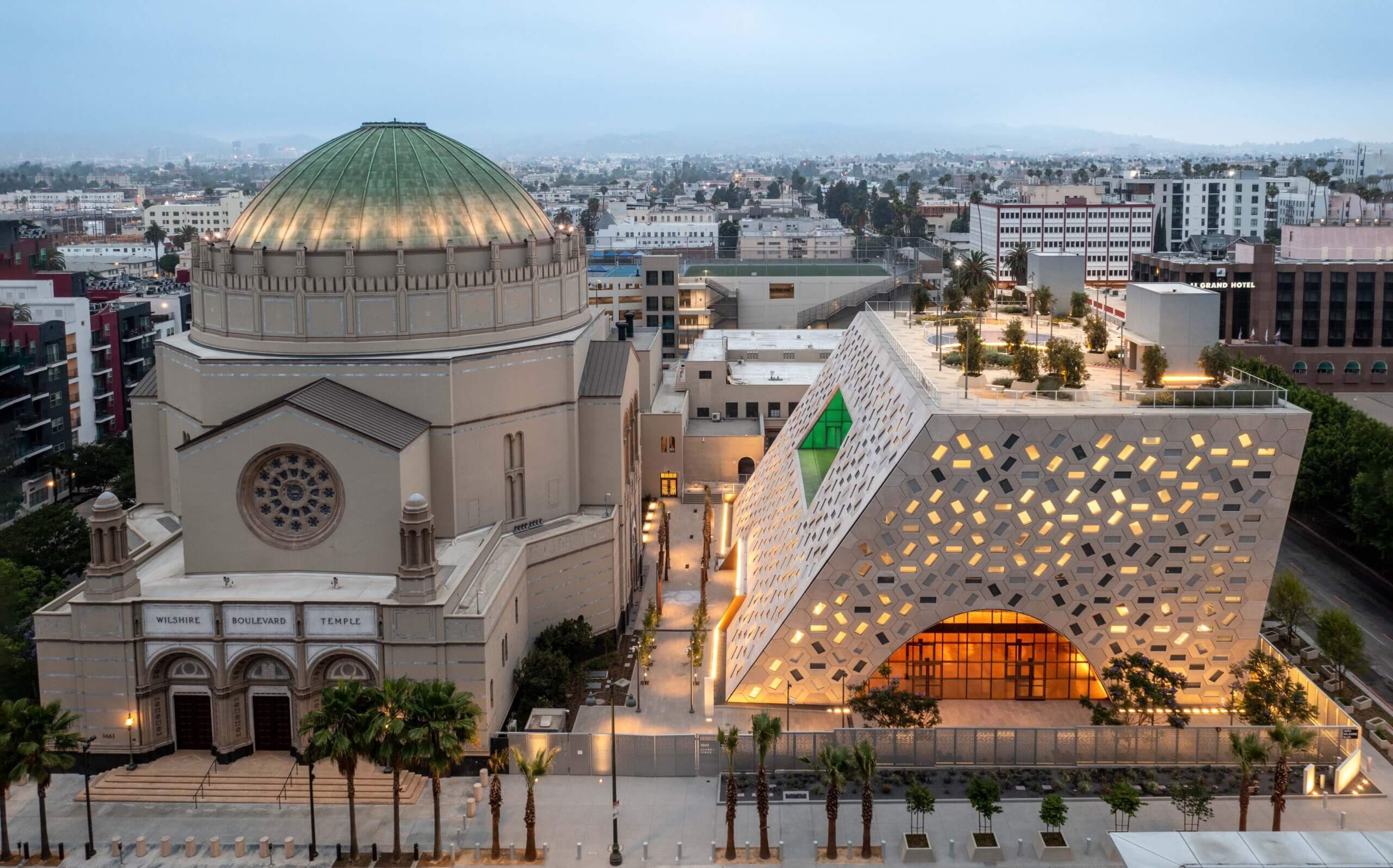
A protest outside Wilshire Boulevard Temple — one of Los Angeles’ oldest synagogues — ended with two arrests Wednesday after demonstrators confronted attendees at an event featuring a speaker from Elbit Systems, the Israeli defense firm whose technology is widely used by Israel’s military and, in some cases, by U.S. law-enforcement and border-security agencies.
Videos posted online showed protesters gathering outside the synagogue’s Audrey Irmas Pavilion, unfurling banners that read “Elbit out of Los Angeles” and “Genociders not welcome.” They handed out flyers accusing the company of supplying “weapons and technology that Israel uses against Palestinian civilians” and that Immigration and Customs Enforcement uses in the U.S.
The reaction was swift. “This behavior is abhorrent and has no place in Los Angeles,” Mayor Karen Bass said. The Jewish Federation of Greater Los Angeles called the demonstration “antisemitism and hate disguised as dissent,” while ADL California said, “Blocking or invading a house of worship is not legitimate protest. It’s intimidation.”
The confrontation underscored the growing attention on Elbit Systems — and the tensions that surround it.
What is Elbit Systems?
Elbit Systems is Israel’s largest privately run defense contractor. Founded in 1966, it has evolved into a multinational firm that manufactures drones, surveillance systems, border-security towers, targeting equipment, and other military electronics used by Israel and a number of foreign governments.
The company has roughly 20,000 employees — most based in Israel — with offices around the globe. Its U.S. subsidiary operates facilities across the country and has long supplied equipment to American defense and homeland-security agencies.
Elbit did not respond to a request for an interview.
Why does Elbit draw protests?
Two main issues animate opposition: Elbit’s role in Israeli military operations and its work for U.S. law enforcement.
Flyers at Wednesday’s demonstration accused the company of producing technology “used against Palestinian civilians.” Protest organizers argue that Elbit’s equipment enables Israeli operations in Gaza and the West Bank.
The Palestinian Youth Movement, one of the groups involved in the synagogue protest in Koreatown, wrote on Instagram: “We KNOW that these technologies are created on the targeting and killing of Palestinians in Gaza and the West Bank, and will do the same to vulnerable communities in Ktown.”
Protest literature also claimed Elbit provides surveillance tools used by ICE and Customs and Border Protection. The company has received contracts to build border-surveillance towers and related systems along parts of the U.S.–Mexico border. It is also on a list of potential contractors for the Pentagon’s Golden Dome missile defense program, a project inspired by Israel’s Iron Dome.
U.S. Elbit facilities are protest sites
Based in Fort Worth, Texas, Elbit Systems of America employs around 3,200 people across 10 states. Several of their U.S. facilities have been the sites of protests.
Merrimack, New Hampshire: An Elbit plant was targeted by pro-Palestinian activists, some of whom climbed onto the roof, deployed smoke devices, spray-painted equipment, smashed windows, and locked building entrances. Among those arrested in the Nov. 2023 incident was a former Disney Channel actress.
Cambridge, Massachusetts: There were repeated protests at this facility beginning in Oct. 2023, five days after the Hamas attack that started the war in Gaza. The office eventually closed down in Aug. 2024.
Ladson, South Carolina: There have been weekly protests at Elbit’s Charleston-area facility since Oct. 2024, with criticism over tax incentives granted to the company. Demonstrators have questioned whether public funds should support a defense-industry site.
Protests are not just in the United States
Since the onset of the Israel-Hamas war, several Elbit facilities in the United Kingdom have been targeted by pro-Palestinian activists — including six who are currently on trial over a 2024 break-in at an Elbit site in Bristol. One is accused of striking a police officer with a sledgehammer. The Bristol facility unexpectedly closed down in September.
In Britain, the government is defending its decision to ban Palestine Action — a group that has repeatedly targeted Elbit facilities — under anti-terror laws. The ban makes membership or public support for the group a criminal offense punishable by up to 14 years in prison.
Last month, activists in six countries — Austria, France, Germany, Spain, Taiwan and the U.K. — simultaneously defaced the offices of Allianz, a global insurer that allegedly undewrites Elbit Systems.
Why did the L.A. protest take place at a synagogue?
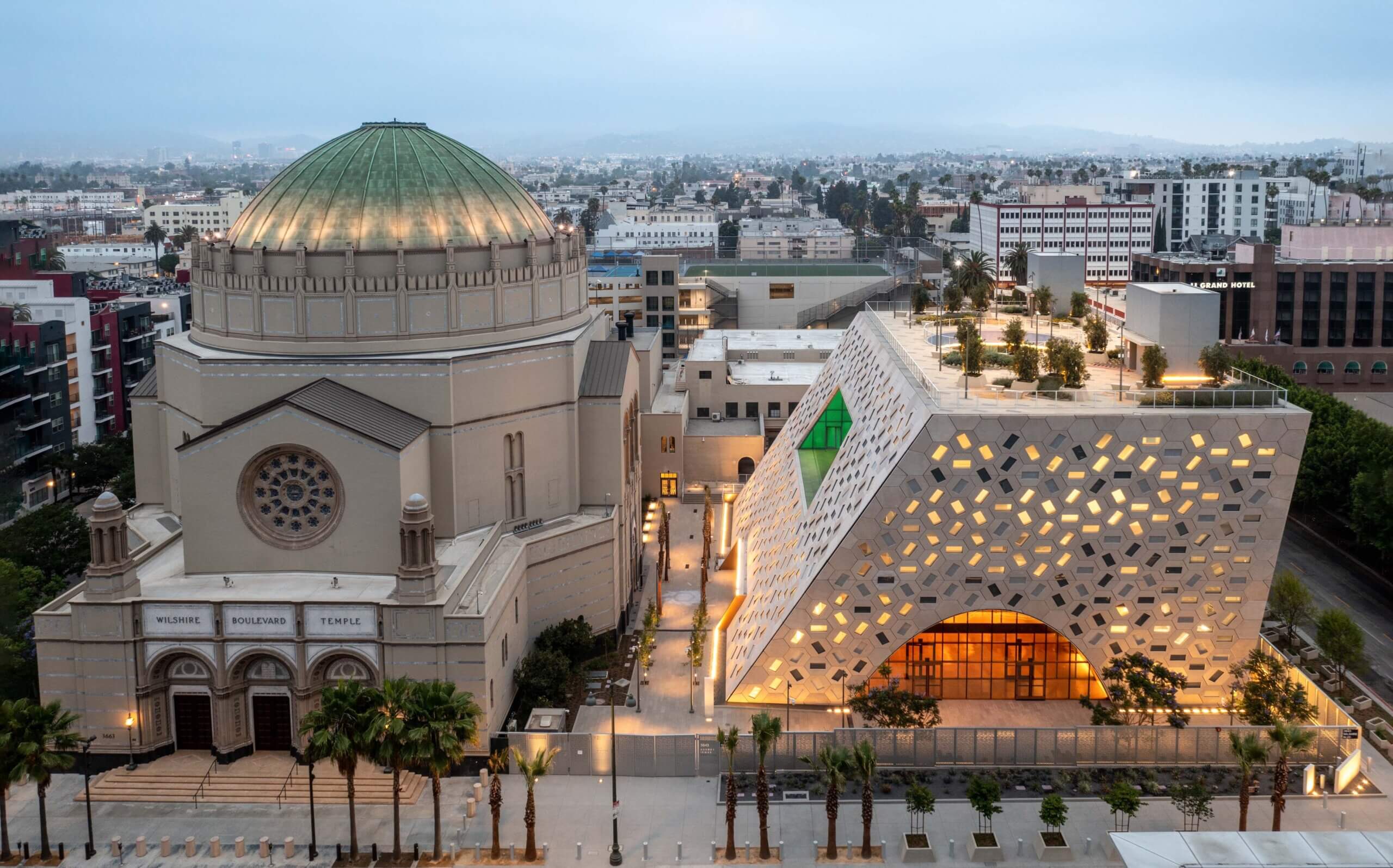
Wednesday’s talk — titled “Innovating Safety, Empowering Communities” — outside Wilshire Boulevard Temple was co-hosted by the Israeli Consulate General of Los Angeles and included speakers from Elbit, the Israeli police, and the local Jewish federation.
Activist groups, including Koreatown for Palestine, the Palestinian Youth Movement, and People’s City Council Los Angeles, urged supporters to contact the synagogue and arrive early to picket the event.
Jewish leaders argued that demonstrating outside a house of worship crossed a line. Protest organizers framed the action around the event itself and Elbit’s participation in it.
What happens next?
Jewish institutions say they face heightened security concerns when Israel-related events take place in their buildings. Last month, protesters demonstrated at Manhattan’s Park East Synagogue, which was hosting a program on immigration to Israel, including West Bank settlements, which are considered illegal under international law.
Mayor-elect Zohran Mamdani faced criticism from parts of the Jewish community after he said, through a spokesperson, that “sacred spaces should not be used to promote activities in violation of international law.” Dozens of Jewish groups plan a solidarity rally Thursday night outside Park East.
On Wednesday, a group of New York lawmakers proposed banning protests within 25 feet of houses of worship — the latest indication of how rapidly the debate over safety, speech, and protest is shifting.
Louis Keene contributed to this article.
The post What is Elbit Systems, and why did LA synagogue protesters target the Israeli company? appeared first on The Forward.
Uncategorized
‘Remember 7.10.23’: In Israel, Hostage Square bears few remnants of a national crisis – but trauma lingers
(JTA) — TEL AVIV – In the days following the Oct. 7, 2023, Hamas attacks, the families of the hostages held in Gaza turned the plaza next to the Tel Aviv Museum of Art into what became known as Hostage Square.
Filled with “Bring Them Home” signs and hostage posters, yellow ribbons and yellow balloons, the square hosted demonstrations and press conferences.
It was here that the families created a replica of a Hamas tunnel and established the Empty Shabbat Table, a haunting art installation to remind visitors – and especially the Israeli government – that their loved ones still languished in Gaza. And it was here, two years later, that the families and thousands of other Israelis gathered to watch the last of the living hostages return to Israel.
Three years after the attack on Simchat Torah, there are few remnants of the hostage families’ encampment: the tunnel replica, a few yellow ribbons and a sign bearing the words “Remember 7.10.23.” During the days leading up to the third anniversary, some paid respects to the few hostage families who set up a sukkah on the square, but the plaza was nearly empty.
By all outward appearances, Israelis have moved on.
Yet beneath the surface, many are still grappling with the trauma of Oct. 7 and the multifront war the attack triggered.
In a Channel 12 TV poll in June, 74% of respondents said they fear that terrorists will carry out another large-scale attack, and 66% said they want the Oct. 7 attack to be investigated by a state commission of inquiry.
Last month, in an Israel Democracy Institute survey, 68% of Jewish Israelis and 32% of Arab Israelis said the Oct. 7 attack is a “central factor” in deciding which party to vote for, behind security and the high cost of living.
In the café at the edge of Hostage Square, Isaac Badra, a 33-year-old realtor, recalled how he and his wife opened their home to their upstairs neighbors because the Badras live on the “safer” ground floor and their Tel Aviv building has no bomb shelter. The trauma persists, he said.
He vividly remembered the air-raid sirens, reserve soldiers rushing to base on Simchat Torah and the frantic phone calls with his wife’s family near the Gaza border as Hamas attacked Sderot, where they live.
“My wife’s mother said she saw terrorists in the street, but I couldn’t grasp what she was saying,” he recalled. When he turned on the TV, he realized the scale of the attack. “I locked all of our doors and our windows and prayed.”
Three years later, Badra said, “When I hear noises outside, I jump. When Arab construction workers shout out to each other, I jump. And now I doubt whether my friends abroad really have our back.”
Roni Shoval, a defense industry worker from northern Israel not far from the Lebanon border, said the trauma of the past three years “is still inside me.” He called the attacks “a modern Holocaust for Israel.”
Even three years later, “I’m not ready to visit Nova,” he said, referring to the memorial at the site of the music festival where Hamas murdered 378 people and abducted dozens more. “Look, I’m getting goosebumps now just talking about it.”
Shoval, 54, is still doing IDF reserve duty, years beyond the maximum age because the IDF needs his expertise. He doesn’t want the same for his children.
“My son will be drafted soon,” he said. “Back in the day, I served in Gaza and Lebanon. I don’t want him sent to Gaza and Lebanon.”
At a nearby table, 24-year-old Yael Meyer sat with classmates from Tel Aviv University. The attack the previous day aboard a flydubai flight bound for Tel Aviv, they said, only reinforced the trauma of Oct. 7 and the war that followed.
“I’m always aware that there could be another terror attack. But I always had the sense that the security services would protect us.” Since Oct. 7, that trust in the government is gone, she said.
Her friend Talia Zecler, also 24, said she felt “helpless” after the attack. “I was angry at my country. Entire families were killed or kidnapped,” she added. “It feels like we’re living in an endless war.”
Her heart races when the sound of a passing motorcycle resembles an air-raid siren. But at the same time, she still marvels at the bravery and solidarity of ordinary Israelis in the months after the attack.
“People became more connected after Oct. 7. They volunteered everywhere, including at Hostage Square,” she said. “There was a sense of unity, that we’re in this together, and we saw it on the flydubai flight.
“This is the Israeli spirit.”
Sitting in the café with her parents, S., a 19-year-old IDF soldier, said the trauma she experienced on Oct. 7 at her home in Jerusalem “is minuscule” compared to the experience of those whose families were directly harmed by the attacks on the Gaza border and, later, attacks by Hezbollah, Iran and the Houthis.
“Sure, when I hear a plane flying in the sky, I think, will there be another war with Iran? I immediately go there,” said S., whose name could not be published due to military protocol.
But as the country prepares to vote for the next government on Oct. 27, she plans to channel her hopes and dreams in the voting booth.
“The most important things for me right now are to have a national investigation of what happened on Oct. 7 and to repair our relations not only with our immediate neighbors but everywhere. We don’t live in a vacuum,” she said.
The post ‘Remember 7.10.23’: In Israel, Hostage Square bears few remnants of a national crisis – but trauma lingers appeared first on The Forward.
Uncategorized
Antisemitic flyers turn up in Ontario neighborhood where a man charged at a synagogue two weeks ago
(JTA) — Police in the Ontario town where a gunman charged the Sons of Jacob synagogue on Yom Kippur are investigating antisemitic flyers distributed around the synagogue’s neighborhood..
In an Oct. 1 press release, Belleville, Ontario, police encouraged those with tips or video evidence to contact police.
“We recognize that incidents such as this can cause concern within our community,” the police said. “Hate has no place in Belleville, and the Belleville Police Service remains in contact with community leaders and are taking proactive steps to support the safety and well-being of residents.”
Police have not identified the distributor of the flyers, and no arrests have been made.
The Canadian Jewish News published photos of the flyers, which included antisemitic conspiracy theories, such as “every single aspect of the Covid agenda is Jewish” and “every single aspect of abortion is Jewish.”
Coming so soon after the attack, the flyers rattled Sons of Jacob congregant Sari Watson, 40. “It’s so incredibly concerning to see this sort of antisemitic rhetoric surface, less than two weeks after the shooting,” said Watson, who skipped attending services the night of the shooting because she was wary of the increase in antisemitic violence in Canada. “This is a sign that this sort of hatred has infiltrated the public consciousness here.”
Belleville police chief Murray Rodd has confirmed the Sept. 20 attack was deliberate.
“This was an exclusive threat to our Jewish community,” he said soon after the attack. “There is no indication there was a threat to any other population or segment of our community, and it was a hate-motivated crime.”
According to police and Ontario’s Special Investigations Unit, the shooter, identified as 29-year-old Sean Ward of nearby Quinte West, Ontario, opened fire on Const. Jeff Smith, who was stationed outside the synagogue as security. Smith, who was seriously wounded, returned fire, and another officer who arrived at the scene also fired at Ward. Ward later died of his injuries. Smith remains hospitalized.
A GoFundMe site dedicated to Smith’s recovery has raised nearly $1 million on behalf of the Canadian Jewish community.
This article originally appeared on JTA.org.
The post Antisemitic flyers turn up in Ontario neighborhood where a man charged at a synagogue two weeks ago appeared first on The Forward.
Uncategorized
From ‘false flag’ to ‘Bibiwood’: flydubai attack spawns conspiracy theories
(JTA) — JERUSALEM – A young girl steps out of the bathroom on a flight and glimpses a bloody scene unfolding in the cockpit: the co-pilot is attacking the pilot with an axe. She screams for help.
A handful of unarmed passengers, still tanned from their vacations in Thailand, rushes by her, successfully grabbing the control wheel as the plane plunges 17,000 feet. They also manage to save the life of the bloodied pilot.
It sounds like the climactic scene from a high-stakes action movie, yet by now most people know that this is what happened last week on a Tel Aviv-bound flydubai jet.
Or did it happen? It is so fantastical that maybe it is just a fabricated story or an event staged by Israel’s Mossad? That is what millions of people on social media seem to be suggesting in online posts.
Even after nonstop media interviews with the hero pilot or with the ordinary passengers who took control of the plane, conspiracy theories about the attempted hijacking are swirling. Some mockingly insist the event never happened. Others say it was a false flag operation. And many of the comments invoke deep-rooted antisemitic tropes.
Some accuse Israeli Prime Minister Benjamin Netanyahu of staging the incident for political survival or to divert attention from the war in Gaza. Others say it was an attempt by Israel to play the victim or garner global sympathy.
“Brought to you by Bibiwood Productions,” wrote one person commenting on a CNN report posted on Facebook.
“Just stop already,” wrote another person beneath CBS’s clip of interviews with the men who fought the rogue co-pilot posted to Instagram. “It’s seriously embarrassing at this point. We didn’t believe it when the news broke; we didn’t believe it the first time you aired this interview. Reposting clips will not convince anyone with half a brain.”
“Bulls–t,” wrote another person.
Monitoring online responses as the attempted hijacking was unfolding last Wednesday, the Combat Antisemitism Movement’s Antisemitism Research Center found that the first conspiracy theories were posted just 67 minutes after the plane sent its first distress signal.
Within five hours, the ARC documented 1,000 hostile posts, and after 12 hours, 2,963 posts. The posts generated at least 30,000 likes and more than 3 million views.
“The fact is that internet companies have promoted a much more open free-speech policy these days, especially on Instagram and X,” said Sacha Roytman, CAM’s Chief Executive Officer, adding that it’s not just the posts that are problematic but also the comments they generate.
“They [the social media platforms] don’t control information anymore; they don’t want to control it,” he said.
Roytman added that another factor is that agitators – likely from Russia or Qatar – have learned how to build an effective bot network to spread misinformation. When the first post appeared after only 67 minutes, he said, “we knew it was not a human posting because no one cares to go online and start posting [that fast].”
“They were activated extremely fast and set up the stage to create an environment that’s toxic enough for other users to be inspired to find the stories they need to build their own claims,” Roytman said.
Amit Cohen, a research fellow at the Institute for National Security Studies and an expert in cyberattacks and digital fraud, said that during such events, “there is often a gap between what the public wants to know and the amount of verified information available at that moment.
“That is exactly the kind of environment in which rumors and conspiracy theories can develop very quickly,” she said. “In this case, claims appeared online within a short period of time suggesting that the event did not happen as reported, that the videos were fake, or that the incident was staged or a false flag.
“Posts like these are not necessarily the original source of the conspiracy theory,” she said, “but they can function as ignition points.”
Cohen said it was important to distinguish between those who “deliberately create disinformation and those who spread it.”
“Someone may share misleading content simply because it fits what they already believe, because it provokes a strong emotional reaction, or even because it seems interesting or ‘worth looking into,’” she said. “They do not need to know where the message originated, and they certainly do not need to be part of any coordinated campaign.”
Gal Yavetz, a senior lecturer of Artificial Intelligence at Bar-Ilan University, said the flydubai story was so incredible, it left many people “looking for answers.”
“Inevitably, some people will accept more natural explanations, and others, who are more extreme, will go and blame the Jews for it,” Yavetz said, pointing out that similar conspiracy theories arose over the summer when thousands of Moroccan nationals flooded Spain’s North African enclave of Ceuta in July.
“Every time there is something that we can’t really understand, that we can’t really explain, we blame the usual suspects — the Jews, the Jews who control the world, the Jews who are the natural scapegoat,” he said, adding that since the Oct. 7, 2023, deadly Hamas raids in Israel, conspiracy theories have become commonplace and all it takes is for a handful of people to start questioning the veracity of the events.
Posts by Egyptian-born, LA-based political satirist Bassem Youssef, known for his controversial comments about Israel and Jews, are a good example. In a series of videos, he mocks the flydubai event and raises suspicions about what really happened.
In one clip posted on X and viewed 130,000 times, Youssef, whose career was supercharged in 2012 when he was boosted by Jewish comedian Jon Stewart, even terms it a “Hollywood production,” drawing on what critics say are familiar antisemitic conspiracy tropes about Jewish control of Hollywood and, by extension, the world.
“I wish it was chatbots, but the truth of the matter is that social media is a breeding ground for this kind of discourse,” said Yavetz, who specializes in social media, political communication and the spread of misinformation and disinformation online.
“They are definitely helping to spread and to reshare most of this misinformation and disinformation, but we know from previous studies that it is really just a negligible number compared to just regular people who are going to the more extreme sides and just taking their own outrageous opinions to social media just because it is now so easy to do so,” he said.
“You don’t really need to do much; you just need to make sure that you can stand behind your claims, and all of a sudden an outrageous post will have 1,000 likes, then 10,000 likes, and these comments are just circulating again and again, going from Facebook to WhatsApp to Messenger and back to Twitter with screenshots and back to Instagram… It’s a flood that you can’t really stop by taking out an umbrella,” Yavetz said.
INSS’s Cohen, who is also a national security expert with the Dvorah Forum, a group that promotes women’s voices in foreign policy, said that “conspiracy theories are not new, but the digital environment has changed their speed, scale, and the ability to obscure where a message originally came from.”
She explained that “in the past, there were more intermediaries between the person producing information and a large audience. Today, a single account can post a claim and reach very large audiences within a very short time.”
And, Cohen added, AI has made the problem worse.
“Mainly because it has dramatically reduced the time, cost, and skill required to create convincing content,” she said.
It has also made it harder for people to believe what appears on their screens.
“The problem is no longer only that AI can create fake content that looks real. It also makes it easier to dismiss real content by claiming that it is fake,” said Cohen. “Once the public knows that convincing images, audio, and video can be artificially generated, the existence of visual evidence no longer necessarily ends the debate.”
This article originally appeared on JTA.org.
The post From ‘false flag’ to ‘Bibiwood’: flydubai attack spawns conspiracy theories appeared first on The Forward.
